Piezo Technology in Healthcare: Ultrasound Imaging and Beyond
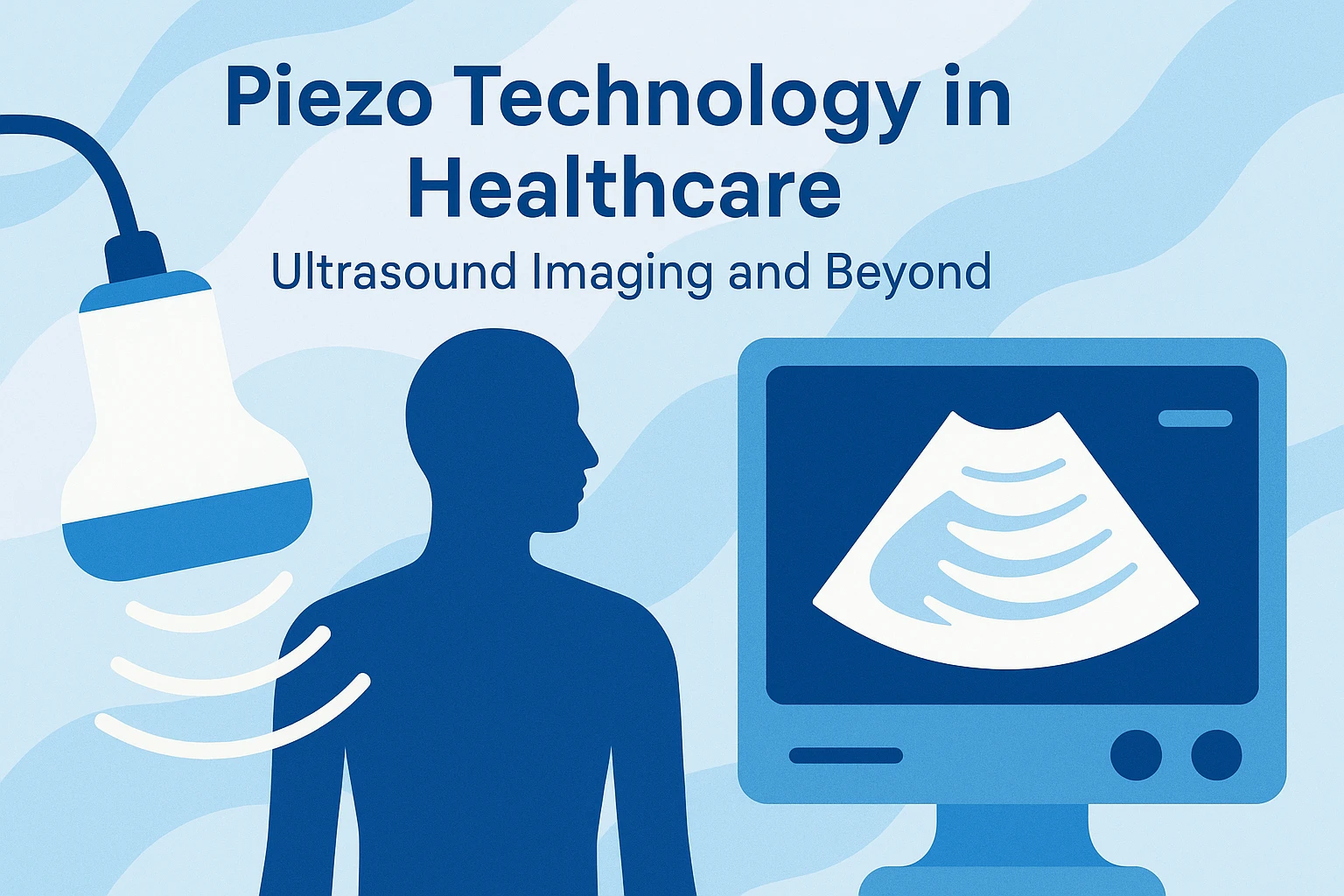
Piezoelectric materials have become indispensable in the modern medical landscape, enabling high-precision diagnostics, targeted treatments, and real-time monitoring. Their ability to convert electrical energy into mechanical vibrations (and vice versa) makes them the core of many biomedical devices. This article explores how piezoelectric medical sensors are transforming healthcare, with a special focus on ultrasound transducer medical technology and emerging applications.
The Role of Piezoelectric Technology in Medical Sensors
Piezoelectric sensors operate based on the piezoelectric effect—a phenomenon where certain materials generate an electric charge under mechanical stress. This makes them ideal for medical sensing and actuation. In clinical settings, these sensors are used to detect pressure changes, generate high-frequency sound waves, and convert physiological signals into electrical outputs.
Key Benefits of Piezoelectric Medical Sensors:
Miniaturization: Ideal for catheters, implants, and wearable diagnostics.. High Sensitivity: Enables detection of subtle physiological changes.. Low Power Consumption: Suitable for portable and battery-powered devices.. Biocompatibility: Piezoelectric ceramics and polymers can be safely integrated into medical tools.
Ultrasound Imaging: The Classic Application
Ultrasound imaging remains the most widespread use of piezoelectric transducers in medicine. These devices emit high-frequency sound waves that penetrate the body and reflect off tissues. The echoes are then converted back into electrical signals to create real-time images.
Types of Ultrasound Transducers in Medical Use:
Linear Transducers Used for vascular imaging and musculoskeletal scans. Provide high-resolution, shallow-depth images.. Used for vascular imaging and musculoskeletal scans.. Provide high-resolution, shallow-depth images.. Curvilinear (Convex) Transducers Common in abdominal and OB/GYN imaging. Offer a wider field of view.. Common in abdominal and OB/GYN imaging.. Offer a wider field of view.. Phased Array Transducers Used in cardiac and transcranial imaging. Suitable for deep penetration and rapid image acquisition.. Used in cardiac and transcranial imaging.. Suitable for deep penetration and rapid image acquisition.. Endocavitary Transducers Designed for rectal and vaginal examinations. Offer closer proximity to internal organs.. Designed for rectal and vaginal examinations.. Offer closer proximity to internal organs.
Used for vascular imaging and musculoskeletal scans.. Provide high-resolution, shallow-depth images.
Common in abdominal and OB/GYN imaging.. Offer a wider field of view.
Used in cardiac and transcranial imaging.. Suitable for deep penetration and rapid image acquisition.
Designed for rectal and vaginal examinations.. Offer closer proximity to internal organs.
How Piezoelectric Elements Power Ultrasound Transducers:
Each transducer contains one or more piezoelectric elements, typically PZT (lead zirconate titanate). When excited by an electric signal, the elements vibrate and emit ultrasound waves. The same elements also receive the echoes, completing the cycle of image generation. For high-precision medical ultrasonic applications, our medical ultrasonic transducers guide provides detailed selection criteria for optimal performance.
Beyond Imaging: Therapeutic and Monitoring Applications
While imaging dominates the discussion, piezoelectric sensors are also pivotal in treatment and monitoring:
1. High-Intensity Focused Ultrasound (HIFU)
Piezoelectric transducers focus ultrasound energy to ablate tumors non-invasively. Used in prostate cancer, liver tumors, and uterine fibroids. Our specialized HJ-2804 beauty transducer demonstrates the precision engineering required for medical-grade applications.
2. Ultrasonic Surgical Tools
Instruments like harmonic scalpels use piezoelectric actuation for precise cutting and coagulation. These tools leverage the same principles found in our ultrasonic welding transducers but are optimized for medical use.
3. Wearable Health Monitors
Flexible piezoelectric films track respiratory patterns, heart rate, and joint motion. The principles of precision ultrasonic sensing are adapted for continuous physiological monitoring.
4. Drug Delivery Systems
Micro-pumps powered by piezo ceramics control the release of medication in implantable systems. These systems require the same level of precision found in our bubble detection sensors for medical fluid monitoring.
Advanced Medical Sensing Applications
Modern healthcare leverages various ultrasonic sensor technologies for enhanced patient care:
Flow Measurement in Medical Devices
Medical flow monitoring systems use ultrasonic flow measurement technology similar to our industrial HJ-2112/1M flow measurement transducer, but with medical-grade biocompatibility and precision requirements. These sensors enable accurate monitoring of blood flow, respiratory volumes, and medication delivery rates.
Bubble Detection for Patient Safety
Critical in intravenous therapy, bubble detection sensors prevent air embolisms by monitoring fluid lines. These piezoelectric medical sensors operate at frequencies optimized for medical tubing materials while maintaining the sensitivity to detect microbubbles that could pose patient risks.
Material Considerations for Medical Applications
Medical piezoelectric devices require specialized materials with enhanced biocompatibility. Our piezoelectric ceramic materials are engineered to meet stringent medical device standards, including:
USP Class VI certification for biocompatibility. Low-lead and lead-free formulations for safety. Stable performance in sterilization environments. Hermetic sealing compatibility for implantable devices
Future Outlook: Next-Gen Piezo in Healthcare
Researchers are now exploring piezoelectric nanomaterials, bioresorbable ceramics, and hybrid composites to create the next generation of medical sensors and actuators. Applications on the horizon include smart stents, bio-integrated ultrasound patches, and autonomous diagnostic tools.
The integration of artificial intelligence with ultrasound transducer medical technology is enabling automated diagnosis and real-time decision support systems. These advances build upon the foundational principles covered in our PZT ultrasonic transducers guide.
Conclusion
Piezoelectric medical sensors, especially ultrasound transducers, have redefined what is possible in diagnostics and therapy. As material science advances, these technologies will continue to expand the frontiers of healthcare, from hospital settings to home-based monitoring systems.
The precision engineering required for medical applications demands the highest quality materials and manufacturing processes. From ultrasonic cavitation transducers used in therapeutic applications to sophisticated imaging systems, piezoelectric technology continues to drive medical innovation.
Interested in custom piezoelectric transducers for medical applications?
Contact Yujie Technology for tailored solutions and downloadable datasheets.