Why Shape Matters: A Deep Dive into the Geometry of Piezoelectric Ceramics
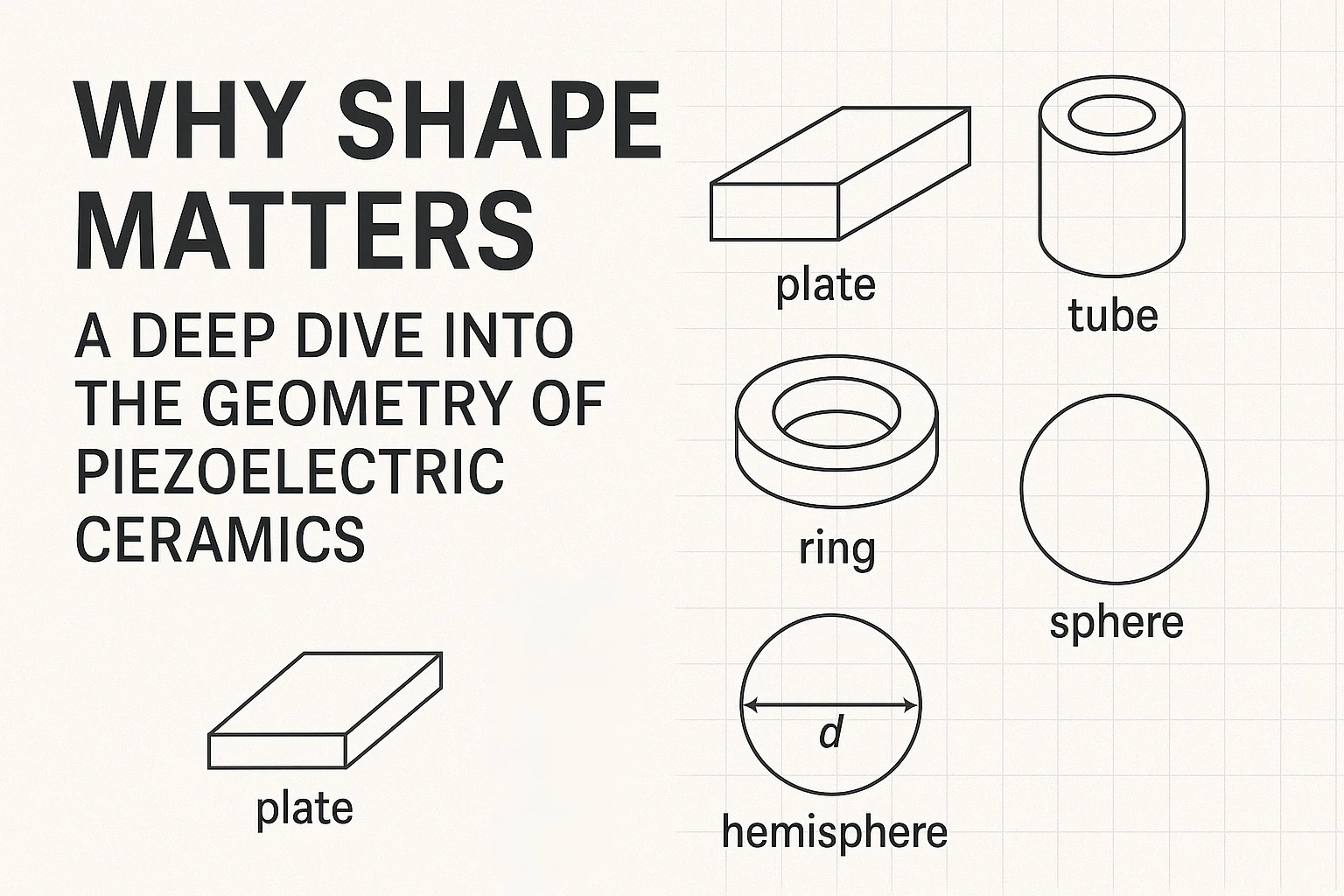
Piezoelectric ceramic materials (primarily Lead Zirconate Titanate, PZT) serve as the core medium for electromechanical conversion. Their performance depends not only on the crystal lattice structure and polarization characteristics but is also strictly constrained by the component's geometry at the macroscopic scale.
The piezoelectric effect is inherently an anisotropic tensor process, meaning the coupling direction between the electric field and mechanical strain is specific. When anisotropic piezoelectric ceramics are processed into specific shapes such as Plates, Tubes, Rings, Discs, Spheres, or Bowls, the constitutive equations must be solved under specific coordinate systems and boundary conditions. This determines the component's unique resonant frequencies, vibration modes, and electromechanical coupling coefficients.
This comprehensive guide analyzes the working principles and vibration modes of piezoelectric components with different geometric shapes, as well as their applications in modern acoustics, precision actuation, and sensing technologies.
Engineering Selection Framework: Matching Shape to Function
Select the piezoelectric geometry based on your primary physical constraint:
High Force & Precision
Geometry: Stack / Block (d33)
For nano-positioning stages, fuel injectors.
Large Displacement
Geometry: Bending Plate / Tube (d31)
For fans, switches, fluid pumps.
Omnidirectional Sound
Geometry: Sphere / Hemisphere
For underwater hydrophones.
Focused High Energy
Geometry: Bowl (Spherical Cap)
For HIFU medical therapy.
Piezoelectric Constitutive Equations and Coordinate Systems
Before discussing specific shapes, we must establish the physical framework describing piezoelectric behavior. Artificially poled piezoelectric ceramics are transversely isotropic. In engineering, the polarization direction is typically defined as the 3-axis (Z-axis).
Tensor Form of Piezoelectric Equations
The linear behavior of piezoelectric ceramics is described by the following equations (strain-charge form):
Where 𝑆 S is the strain tensor, 𝑇 T is the stress tensor, 𝐸 E is the electric field vector, and 𝐷 D is the electric displacement vector. 𝑠 𝐸 s E represents the elastic compliance constants at constant electric field, 𝑑 d represents the piezoelectric strain constants, and 𝜀 𝑇 ε T represents the dielectric constants at constant stress.
Geometric Physical Meaning of Key Constants
For specific shapes, three piezoelectric constants play a dominant role:
d33 (Longitudinal Coefficient): Describes the case where the electric field and strain are parallel to the polarization axis. This is the dominant mode for Stacks and Thickness Mode Plates.. d31 (Transverse Coefficient): Describes the case where the electric field is parallel to the polarization axis, while strain is perpendicular to it. This is the basis for the radial vibration of Tubes, Strips, and Thin Discs. Typically, d31 is negative, meaning a positive field along the polarization direction causes contraction in the perpendicular direction.. d15 (Shear Coefficient): Describes the shear strain produced when the electric field is perpendicular to the polarization axis. This is the basis for Shear Plates and some D-shaped actuators.
Planar and Block Geometries: Plates and Blocks
Rectangular plates and blocks are the most basic piezoelectric forms. Despite their simple geometry, altering the aspect ratio and electrode configuration can excite distinctly different vibration modes.
Longitudinal Mode (d33)
When a piezoelectric component is designed as a bar or column with polarization along the length (usually achieved via multilayer stack processes, as single ceramics are hard to polarize over long distances), it operates primarily in the d33 mode.
Mechanism: The applied electric field is parallel to the polarization, inducing lattice elongation along that direction.. Displacement: For a stack of length L, displacement Δ 𝐿 ≈ 𝑛 × 𝑑 33 × 𝑉 ΔL≈n×d 33 ×V, where n is the number of layers.. Geometry Dependence: The d33 mode offers high stiffness and large force output. Displacement is independent of the cross-sectional area, depending mostly on the number of layers and layer thickness. This makes block geometries ideal for high-load precision positioning stages.
Transverse Mode (d31)
For a single rectangular plate, polarization is usually along the thickness (3-axis) with electrodes on top and bottom surfaces. While the plate elongates in thickness (d33), the more significant application utilizes contraction in length (1-axis) and width (2-axis) via the d31 effect.
Mechanism: Poisson coupling ensures that elongation in thickness is accompanied by transverse contraction.. Bending Actuators (Bimorphs): Utilizing the d31 effect, two piezoelectric plates with opposite polarization are bonded. When one contracts and the other extends, the structure bends significantly. Here, the geometric length-to-thickness ratio (L/t) acts as a mechanical lever, converting minute strains into large tip displacements.
Thickness Shear Mode (d15)
If a plate acts such that polarization is parallel to the surface (e.g., polarized along the length) but electrodes are on the top and bottom, the applied field is perpendicular to polarization.
Mechanism: The electric field torques the electric dipoles, causing lattice shear rather than volume expansion. The rectangular cross-section shears into a parallelogram.. Application Insight: Shear modes have high response speeds and involve isovolumetric deformation (no fluid compression). Therefore, shear plates are often used in viscosity sensors and non-destructive testing (NDT) probes to excite surface waves with minimal acoustic radiation into liquids.
Axisymmetric Planar Geometries: Discs and Rings
Piezoelectric discs are core components for buzzers, ultrasonic cleaning transducers, and atomizers. Their axial symmetry introduces complex coupling between radial and thickness directions.
Radial/Planar Vibration Mode
For thin discs where diameter is much larger than thickness (D >> t), the dominant low-frequency mode is radial extension/contraction, often called the "breathing" mode.
Physical Description: The disc diameter expands and shrinks periodically. Due to Poisson coupling, diameter expansion is accompanied by thickness reduction.. Frequency Constants: Radial resonant frequency fr is inversely proportional to diameter. In engineering, the Radial Frequency Constant Np (Hz·m) is used: fr = Np / D. This frequency is determined by the roots of the first-order Bessel function J1. For PZT, Np is typically around 2000–2200 Hz·m.. Coupling Coefficient kp: The planar coupling coefficient kp measures the efficiency of energy conversion for radial vibration. For discs, kp is typically 0.5–0.7, significantly higher than the simple d31 bar coupling, reflecting the efficient accumulation of strain energy in 2D geometries.
Thickness Extension Mode (kt)
When frequency increases such that the wavelength is comparable to the thickness, the disc behaves like a piston vibrating along the thickness axis.
Mechanism: The disc acts as part of an infinite plate, and radial boundary conditions become less significant.. Frequency Formula: ft = Nt / t, where Nt is the thickness frequency constant.. Geometric Size Effect: Studies show that when the diameter-to-thickness ratio (D/T) is small (e.g., < 5), high-order harmonics of radial modes couple strongly with the thickness mode, causing complex "spurs" or parasitic modes in the impedance spectrum.
Engineering Risk: Mode Coupling
Warning: For pure thickness vibration (e.g., medical ultrasound probes), a D/T ratio > 10 is recommended to isolate the fundamental frequency from radial harmonics. If space is limited, composite materials (1-3 connectivity) must be used to mechanically decouple lateral modes.
Edge Mode
Finite Element Analysis (FEA) reveals localized vibration modes at the edges of discs. These modes concentrate energy at the periphery and do not propagate to the center. However, at certain frequencies, they dissipate significant energy, lowering efficiency. Precision designs often require chamfering the disc edges or applying damping material to suppress this.
Cylindrical Geometries: Tubes and Tubular Actuators
Piezoelectric tubes utilize continuous curved geometries to achieve unique fluid control and multi-dimensional scanning capabilities. Polarization is typically radial (through the wall thickness).
Radial Breathing Mode
When voltage is applied across the inner and outer walls, the tube circumference expands or contracts.
Mechanism: Based on the d31 effect, the electric field through the wall thickness induces strain in the circumferential direction. Due to the closed geometry of the ring, tangential strain translates directly into a change in diameter.. Resonance: The radial resonant frequency depends on the mean diameter Dm and elastic properties. This implies that smaller diameters yield higher resonant frequencies.. Application: Widely used in microfluidic pumps and inkjet printheads. The tube's contraction squeezes internal fluid to eject high-precision droplets.
Axial Mode
Similar to discs, as the tube expands radially, it contracts axially.
Formula: ΔL = d31 × V × (L / twall). Advantages: Compared to solid rods, tubular structures offer higher bending stiffness (Moment of Inertia) and lower mass for the same axial displacement. This makes tubular stacks preferred for high dynamic response applications.
Bending Mode and Segmented Electrodes
This is a distinctive application of tube geometry, particularly in Scanning Probe Microscopes (AFM).
Electrode Segmentation: The outer electrode is divided into four quadrants (+x, -x, +y, -y).. Differential Drive: Applying positive voltage to +x (extension) and negative to -x (contraction) creates a pure bending moment.. S-shaped Bending: By using complex segmentation or reverse driving schemes, the tube can generate an "S" curve, allowing the scanning tip to translate laterally without tilting, which is critical for optical scanning.. Displacement: Displacement is proportional to the square of the length, explaining why scanner tubes are designed to be long and slender.
Spherical and Curved Geometries: Spheres, Hemispheres, and Bowls
Curvature allows piezoelectric components to focus sound waves or radiate omnidirectionally, capabilities indispensable in hydroacoustics and medical therapy.
Piezoelectric Spheres and Breathing Mode
Hollow piezoelectric spheres (often formed by joining two hemispheres) are ideal for underwater hydrophones.
Omnidirectionality: Spherical symmetry ensures consistent acoustic response in all directions, approximating an ideal point source (Monopole).. Hydrostatic Resistance: The spherical geometry converts external deep-sea hydrostatic pressure into uniform membrane stress. Ceramics have excellent compressive strength, allowing spheres to withstand pressures at depths of thousands of meters, unlike plates or discs.. Resonance: The breathing mode frequency is determined by the radius. Due to the stiffness enhancement from double curvature, a sphere's resonant frequency is higher than that of a ring of the same diameter.
Focused Bowls and HIFU
Piezoelectric bowls (spherical caps) aim not for omnidirectionality but for energy focusing.
Geometric Gain: The bowl transducer utilizes geometric focusing to converge all surface-radiated waves in phase at the center of the sphere (the focal point).. Focal Physics: The intensity If at the focus receives massive gain relative to surface intensity I0. The ratio of focal length F to aperture D (F-number) determines focus sharpness. Low F-numbers (deep bowls) produce tighter, higher-intensity spots for tumor ablation; higher F-numbers produce longer focal zones.. Sidelobes: Diffraction at the bowl edge creates sidelobes. Research indicates that apodization (tapering vibration amplitude at edges) or annular array designs can suppress these to prevent damage to non-target tissue.
Complex Asymmetric Geometries: D-Shaped Actuators
While traditional designs seek symmetry, modern piezoelectric motor designs often break symmetry to generate driving forces. The D-shaped actuator is a prime example.
Mode Degeneracy and Splitting
Symmetry Principle: In a perfect disc, two orthogonal radial modes (e.g., sin(nθ) and cos(nθ)) share the exact same eigenfrequency. This is "Mode Degeneracy.". D-Shape Effect: When a segment is cut from a disc to form a D-shape, mass distribution and boundary stiffness become asymmetric. The originally degenerate frequencies split into two distinct modes (f1 and f2) that are close but not identical.
Mechanism of Elliptical Motion
Traveling Wave Generation: By driving the actuator at a frequency between the two split modes, and exploiting the phase difference (one mode acting inductively, the other capacitively), a traveling wave component is generated.. Friction Drive: This traveling wave causes points on the D-shaped edge to trace elliptical trajectories. When pressed against a rotor, this friction drives rotation. Compared to multi-legged piezo motors, D-shaped designs are compact and easily integrated into PCBs for high-precision rotary positioning.
Material Properties and Frequency Constants Summary
Different shapes require specific PZT properties. Below is a summary of shape-dependent frequency constants and material selection logic.
Frequency Constants Table
The frequency constant N is the product of resonant frequency and the controlling dimension.
Conclusion
Through the deep analysis of plates, tubes, discs, spheres, bowls, and D-shaped piezoelectric components, we conclude:
Geometry Defines Mode: The anisotropic piezoelectric tensor is "sculpted" by geometric boundary conditions. Plates utilize d31 or d15; cylinders utilize circumferential continuity for breathing modes; spheres utilize Gaussian curvature for stiffness and omnidirectionality.. Coupling is a Double-Edged Sword: Poisson coupling is inevitable in discs and tubes. It is the basis for some modes (radial vibration radiating sound) but the source of parasitic noise in others. Precision design (e.g., aspect ratio control, chamfering) focuses on managing this coupling.. Symmetry Breaking: Traditional transducers (Spheres, Bowls) maximize symmetry for focusing or omnidirectionality. Modern micro-motors (D-shapes) break symmetry to exploit mode splitting for propulsion.. Scalability: From micron-scale inkjet tubes to meter-scale sonar arrays, geometric design principles remain consistent, though manufacturing techniques vary.
Future developments in additive manufacturing (3D printing) of piezo-ceramics will allow for complex topological structures (e.g., fractal designs), breaking the limits of standard geometries and revolutionizing medical and oceanographic devices.
Related Resources
Piezoelectric Ceramic Elements. Piezoelectric Discs. Piezoelectric Rings. Piezoelectric Tubes. Piezoelectric Hollow Spheres. Rectangular Piezoelectric Plates. What is PZT? Understanding Piezoelectric Ceramics. PZT Material Properties. Contact Our Engineering Team