Piezoelectric vs Electromagnetic Actuators: Which is Best for Precision Motion?
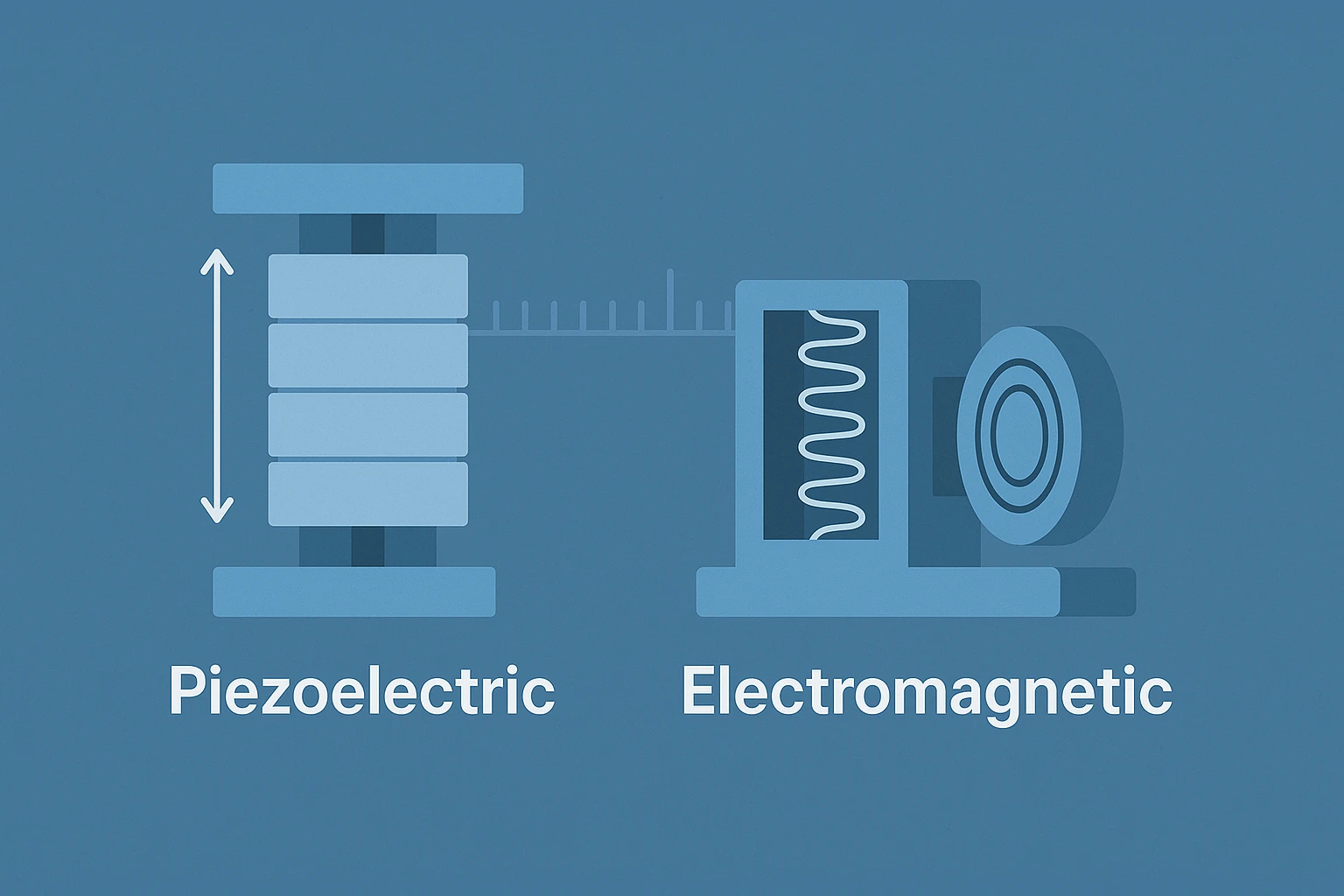
When selecting an actuator for high-precision motion applications, engineers, system designers, and procurement teams frequently encounter a critical choice: piezoelectric vs electromagnetic actuator—which type offers superior performance, reliability, and cost-efficiency? Both actuator types are widely used across industries, from medical imaging to semiconductor manufacturing and precision robotics. However, each technology is built on distinct physical principles and excels under different operating conditions.
This comprehensive guide will walk you through the foundational principles, comparative advantages, limitations, and application-specific recommendations for these two types of actuators. Whether you're selecting components for an advanced industrial automation system or a compact medical device, this article will help you identify the most suitable precision motion actuator for your application.
What Are Piezoelectric Actuators?
Piezoelectric actuators operate based on the inverse piezoelectric effect, a phenomenon where materials such as lead zirconate titanate (PZT) undergo mechanical deformation when subjected to an electric field. These deformations are extremely small but occur with remarkable speed and controllability. Piezo actuators translate voltage inputs into highly precise displacements, enabling ultra-fine positioning.
Key Characteristics:
Ultra-fast response times, typically in the microsecond range. Sub-nanometer or even atomic-level resolution. No rotating or sliding mechanical parts (solid-state design). Highly compact and lightweight, ideal for embedded systems. Minimal hysteresis with closed-loop control
Because of these properties, piezo actuators are often found in devices requiring pinpoint accuracy and stability, such as microscopy stages, laser tuning systems, and advanced medical equipment. Their ability to perform rapid and repeatable movements without mechanical wear makes them a preferred choice in environments where reliability and longevity are critical.
What Are Electromagnetic Actuators?
Electromagnetic actuators—most notably voice coil actuators (VCAs)—use the Lorentz force principle. When a current passes through a coil situated within a magnetic field, it generates a linear or rotational force. Unlike piezo actuators, VCAs offer relatively long travel ranges and smooth force profiles, making them suitable for continuous motion applications.
Key Characteristics:
Long stroke lengths, often ranging from millimeters to several centimeters. Smooth, linear or rotational motion profiles. Capable of handling high forces and speeds. Typically more robust in high-load scenarios. Generally larger and more power-hungry than piezo devices
VCAs are commonly used in audio systems (like loudspeakers), precision metrology instruments, robotics, and haptic feedback devices. Their strength lies in the ability to generate sustained motion over long ranges while offering decent positional accuracy.
Piezo Actuator Advantages
When evaluating voice coil vs piezo actuators for high-performance systems, piezoelectric actuators present several compelling advantages, particularly in high-precision or space-constrained designs:
Higher Resolution: Piezo actuators provide resolution levels that can reach sub-nanometer precision—ideal for tasks such as fiber alignment, interferometry, and nanolithography.. Rapid Response Time: Their direct electromechanical conversion enables response times in the micro- to nanosecond range, far superior to electromagnetic counterparts.. No Magnetic Interference: Because they do not generate or require magnetic fields, piezo actuators can operate in magnetically sensitive environments, such as MRI systems and space electronics.. High Energy Efficiency: Power is consumed only during actuation, making them extremely efficient in hold-position applications where electromagnetic devices would draw continuous current.. Compactness and Integration: Their small form factor and low weight make them easy to integrate into portable or miniaturized systems without sacrificing performance.. Long Operational Lifespan: With no mechanical contact surfaces, piezo actuators suffer minimal wear, ensuring long-term stability and durability.
Electromagnetic Actuator Strengths
Despite their limitations in ultra-precise applications, electromagnetic actuators bring significant benefits in many motion control contexts:
Extended Travel Range: Piezo actuators typically move within a few hundred microns; VCAs can extend movement across several centimeters, making them ideal for applications requiring broader motion scopes.. Constant Force Output: Electromagnetic actuators can sustain a stable force over extended periods, which is essential for applications such as pressing, clamping, or vibration control.. Lower Cost for Macroscale Systems: In applications where extreme precision is not required, electromagnetic actuators tend to be more cost-effective.. Ease of Control for Large Displacements: Piezo actuators often require high-voltage drivers and closed-loop feedback systems, while VCAs can be controlled more simply using conventional current sources and sensors.. Thermal Robustness: Electromagnetic actuators generally tolerate wider temperature ranges and are better suited for rugged industrial environments.. Wide Availability: Electromagnetic actuators are mass-produced for various industries, which often translates to easier sourcing and lower lead times.
Common Application Scenarios
Below is a practical comparison of the most suitable actuator types based on specific application contexts:
Final Thoughts: Piezoelectric vs Electromagnetic Actuator
Choosing between a piezoelectric vs electromagnetic actuator is not about finding a universally superior technology but rather selecting the right tool for the job. Your decision should be based on key performance metrics including:
Required resolution and accuracy. Range of motion. Environmental conditions (e.g., magnetic sensitivity, temperature). Space constraints and integration complexity. Total system cost and lifecycle maintenance needs
If your application demands extreme precision, ultra-fast response, and a compact footprint, a piezo actuator is likely the optimal solution. However, if you prioritize long-range motion, high-force capabilities, and straightforward control, electromagnetic actuators may be more appropriate.
In many advanced systems, hybrid approaches that combine the strengths of both actuator types are emerging. For example, a voice coil might be used for coarse positioning while a piezo actuator handles fine-tuning. This synergy can achieve the best of both worlds.
Still unsure about your selection? Contact Yujie for expert guidance and custom-designed piezo actuator solutions that deliver outstanding performance tailored to your unique requirements.
Whether you need disc-shaped piezoelectric elements, ring-shaped components, or other specialized configurations, our engineering team can help you select the right piezoelectric solution for your precision motion control application.