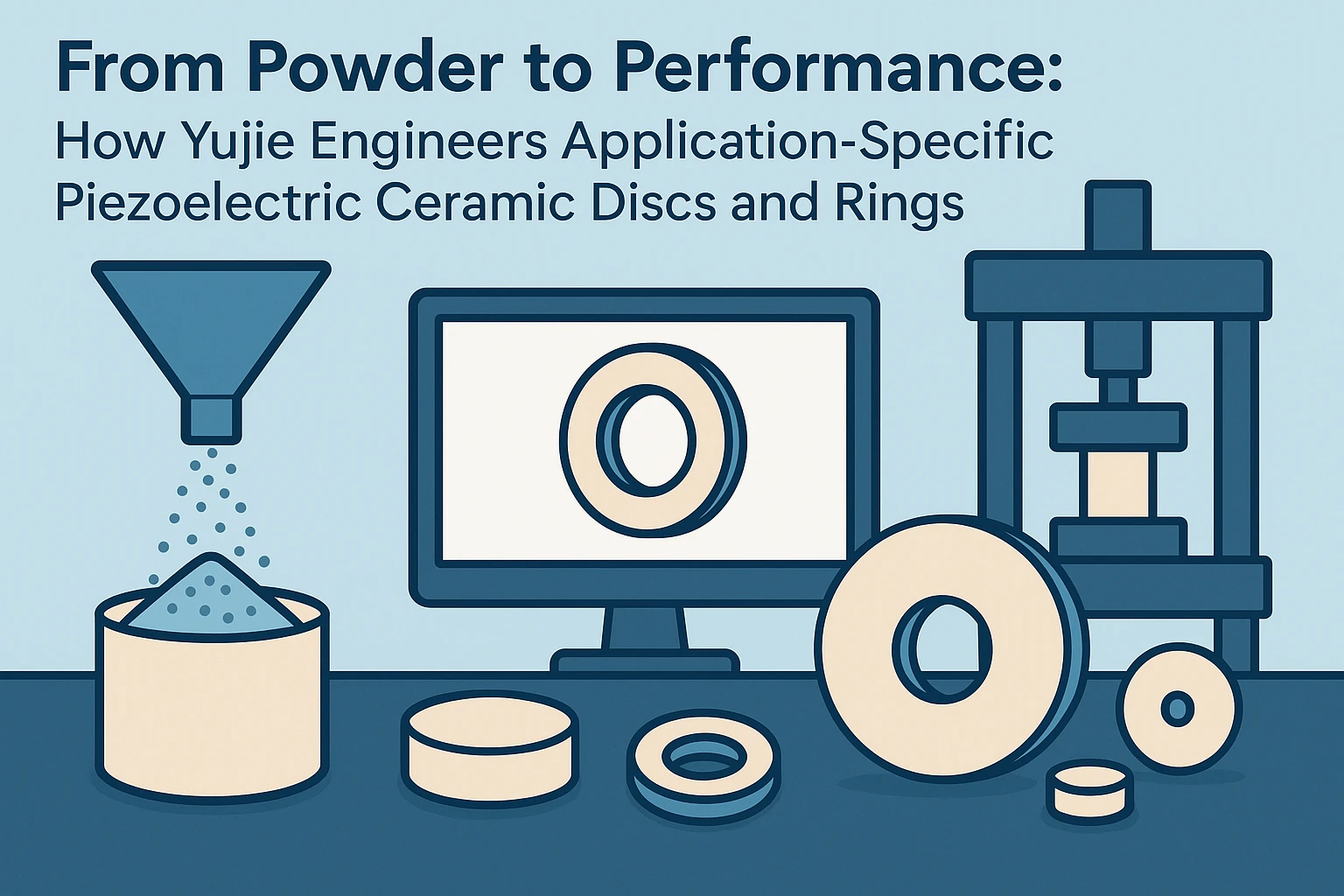
From Powder to Performance: How Yujie Engineers Application-Specific Piezoelectric Ceramic Discs and Rings
I. Introduction: The Critical Decision Beyond the Datasheet
For engineers and procurement managers tasked with sourcing critical components, the selection of piezoelectric ceramics often begins with a datasheet. Specifications for electromechanical coupling, resonant frequency, and capacitance provide a seemingly objective basis for comparison. However, this data represents only a single snapshot in time. It fails to capture the most critical variable determining long-term success: the manufacturing philosophy and process control of the supplier. Choosing a piezoelectric component is not a commodity purchase; it is a strategic partnership decision with profound implications for a final product's performance, reliability, and time-to-market. An inconsistent or poorly manufactured component, even one with an impressive datasheet, can introduce catastrophic failure points, derailing projects and eroding brand reputation.
Since 1996, Yujie has operated not as a simple component supplier but as an essential engineering partner for global innovators. This distinction is fundamental. It is built on the principle that true reliability is not inspected at the end of a production line but is meticulously engineered into every stage of the manufacturing process, from raw powder to final verification. This report moves beyond the datasheet to illuminate the intricate journey of Yujie's piezoelectric ceramic discs and rings. It details how a deep understanding of material physics, a vertically integrated manufacturing blueprint, and a collaborative partnership model converge to mitigate risk and deliver predictable, application-specific performance. For the discerning engineer, this is the story of how a component choice becomes a competitive advantage.
II. The Physics of Performance: Why Material and Geometry Dictate Success
The effectiveness of a piezoelectric component is governed by the immutable laws of physics and material science. The selection of the base PZT (lead zirconate titanate) material and the component's final geometry are the two primary engineering levers that determine its behavior under electrical and mechanical stress. Yujie's expertise is founded on a comprehensive mastery of these principles, ensuring that every component is fundamentally optimized for its intended application from the very beginning.
The PZT Material Matrix - "Soft" vs. "Hard" Ceramics
The terms "soft" and "hard" in the context of PZT ceramics do not refer to their physical hardness but to the mobility of their ferroelectric domains—the microscopic regions of uniform electrical polarization within the crystal structure. This distinction is crucial for matching a material to an application's specific energy conversion requirements.
"Soft" PZT ceramics are characterized by high domain mobility, which makes them easier to polarize. This translates into several key advantages for specific applications: a large piezoelectric charge coefficient (d₃₃), high relative permittivity (K), and high electromechanical coupling factors (k). These properties make them exceptionally sensitive, ideal for devices that convert small mechanical strains into usable electrical signals or vice versa. Consequently, soft ceramics are the material of choice for applications such as:
Sensors: Including flow or level sensors, vibration pickups, and non-destructive testing (NDT) transducers where high charge sensitivity is paramount.. Precision Actuators: Used in micro- and nanopositioning systems where precise, controlled displacement is required in response to a small voltage.. Medical Imaging: High-performance transducers for medical ultrasound rely on the high coupling and clean frequency response of soft PZT materials to generate clear diagnostic images.
"Hard" PZT ceramics, conversely, have lower domain mobility due to the inclusion of specific dopants. This makes them more difficult to polarize and depolarize. While their sensitivity and charge coefficients are lower than soft ceramics, they exhibit superior stability under high mechanical stress and high electric fields. Their key advantages include a high mechanical quality factor (Qₘ), which signifies low mechanical loss, low dielectric loss (tan𝛿), and excellent performance under demanding conditions. This robustness makes them indispensable for high-power applications where the component must reliably convert significant electrical energy into mechanical work, often continuously. Primary applications include:
Power Ultrasonic Transducers: For industrial cleaning, welding, and material processing, where the ceramic must endure high-amplitude vibrations without significant heat generation or degradation.. Sonar and Hydroacoustics: High-power projectors for underwater acoustics require materials that can withstand high drive conditions and mechanical loads.
Yujie's comprehensive material portfolio, which includes high-power P-81 and high-sensitivity P-52 ceramics, demonstrates a deep mastery of this chemistry, allowing for the precise selection of the optimal material for any application, from delicate medical sensors to powerful industrial welders.
The Geometric Imperative - Piezoelectric Ceramic Discs vs. Rings
Beyond material selection, the component's geometry is a critical design choice that directly impacts its integration, performance, and longevity, particularly in high-power systems. The decision between a solid disc and a ring with a central aperture is driven by the mechanical demands of the application.
Piezoelectric ceramic discs are foundational components, ideal for applications that require a uniform vibration across a solid surface. Their simple geometry makes them effective for generating planar or thickness-mode vibrations. They are frequently used in:
High-Frequency Atomization: Yujie's discs operating at frequencies like 1.65 MHz are used in medical nebulizers and humidifiers, where the high-frequency surface vibration efficiently aerosolizes liquids.. Sensors and Buzzers: The uniform displacement of a disc face is perfect for creating audible alarms or acting as a receiver in various sensing applications.. Beauty Devices: Precision devices for skincare often use discs operating around 1.0 MHz to deliver controlled ultrasonic energy to the skin.
Piezoelectric ceramic rings, however, offer a decisive mechanical advantage for high-power transducer assemblies. The central hole is not a trivial feature; it is an essential element for mechanical pre-loading. In applications like ultrasonic welding or cleaning, the ceramic elements are subjected to intense, cyclical mechanical stress. PZT ceramics are exceptionally strong under compression but notoriously weak under tension. During the rarefaction phase of a high-amplitude acoustic wave, the ceramic can experience tensile forces that lead to micro-cracks and eventual failure.
The ring geometry solves this problem by allowing a high-strength bolt or tensioning screw to pass through the center, clamping a stack of rings together. This bolt applies a permanent compressive preload to the ceramic elements. This static compression ensures that even at the peak of the tensile phase of the vibration, the net force on the ceramic remains compressive, dramatically increasing the transducer's power handling capacity, operational lifespan, and reliability. For this reason, rings are the industry standard for assembling powerful, bolt-clamped Langevin-type transducers used in the most demanding industrial applications. Yujie's product strategy reflects this deep engineering insight, with rings specifically designed for high-power ultrasonic cleaning and welding, and discs optimized for high-frequency surface-mode applications.
III. The Yujie Manufacturing Blueprint: Engineering Reliability from Powder to Poling
A superior piezoelectric component is not the result of a single brilliant innovation but the culmination of hundreds of meticulously controlled process steps. Yujie's manufacturing philosophy is built on a vertically integrated blueprint that transforms high-purity raw materials into fully verified, high-performance components. This process is a continuous chain of causality where the quality of each step directly enables the performance of the next, culminating in a product whose reliability is an engineered certainty, not a statistical probability.
Step 1: The Foundation of Purity and Homogeneity
The manufacturing journey begins with the most fundamental element: the PZT powder. The final performance of a ceramic is inextricably linked to the chemical purity and structural uniformity of its foundational material. The process at Yujie starts with the precise weighing and mixing of high-purity metal oxides, including lead, zirconium, and titanium oxides, along with proprietary doping agents that fine-tune the material's properties to be "soft" or "hard".
This mixture is then milled to ensure a uniform particle size before being calcined in a furnace at approximately 1000°C. This critical heating step triggers the solid-state chemical reaction that forms the desired perovskite PZT crystalline structure. The resulting powder is milled again, mixed with an organic binder, and spray-dried to create uniform, free-flowing spherical granules. Yujie's rigorous control over this foundational stage—ensuring chemical homogeneity and optimal particle size distribution—is what enables the industry-leading performance metrics seen in the final products. This meticulous preparation is the reason Yujie's materials can achieve exceptional energy efficiency, with a dielectric loss (tan𝛿) as low as 0.004, and superior sensitivity, with piezoelectric coefficients (d₁₅) reaching up to 950 pC/N.
Step 2: The Art of Precision Forming and Sintering
With a perfectly prepared powder, the next stage is to form the component's shape and solidify its structure. The granulated powder is compacted into a "green" (unfired) disc or ring using powerful hydraulic presses. While simple shapes are pressed directly, more complex geometries may require machining at this stage.
The green parts are then placed in a high-temperature furnace for sintering. This is arguably the most critical and delicate stage of the process. During a carefully controlled heating cycle, the organic binder is burned out, and the ceramic grains grow and fuse together, forming a dense, hard, polycrystalline structure. The temperature profile—including ramp rates, hold times, and atmospheric conditions—is precisely managed, as it directly determines the final density, grain structure, and, consequently, the ceramic's mechanical strength and electrical properties. Sintered PZT is extremely hard and brittle, making it notoriously difficult to machine without introducing micro-cracks that can lead to component failure. Yujie leverages decades of experience and specialized diamond-tipped tools to machine these hard ceramics, achieving tight dimensional tolerances of ±0.02mm, a testament to their mastery over this challenging process.
Step 3: Maximizing Activity and Verifying Performance
After sintering and machining, the ceramic is inert. Two final processes are required to unlock its piezoelectric properties: metallization and poling. First, conductive electrodes, typically of fired-on silver, are applied to the designated surfaces to serve as the electrical interface. Next, the component undergoes poling, where it is heated below its Curie temperature and subjected to a strong DC electric field. This powerful field aligns the randomly oriented ferroelectric domains within the ceramic grains along the field's direction, creating a net permanent polarization and activating the material's piezoelectric effect. The electric field strength, temperature, and duration of the poling process are meticulously managed to ensure maximum piezoelectric activity and consistent performance.
However, the Yujie process does not end here. The final step is what truly separates Yujie from ordinary suppliers: a commitment to Total Verification. While many manufacturers may rely on statistical process control and provide a standard certificate of conformance, Yujie goes further. Every single piezoelectric component undergoes rigorous testing on critical performance parameters. This is not a batch test; it is a 100% verification process that includes frequency response analysis, impedance measurement, and electromechanical coupling verification. Every shipment is accompanied by a full test report detailing these critical parameters, such as the piezoelectric charge coefficient (d₃₃), resonant frequency (Fᵣ), and capacitance (C). This data-driven approach, executed under an ISO 9001:2015 certified manufacturing process, provides clients with an unparalleled level of assurance, guaranteeing that the 100,000th part will perform identically to the first.
IV. Application in Focus: Deploying Yujie Piezoelectric Ceramic Discs and Rings
The true measure of a component's value lies in its real-world performance. Yujie's mastery of material science and manufacturing translates directly into superior reliability and efficiency in some of the most demanding applications across the industrial and medical sectors. The standard product series serves as a proven foundation, while Yujie's core strength lies in engineering custom solutions for unique challenges.
Powering Industry - Rings for Ultrasonic Welding & Cleaning
In the high-stakes world of industrial manufacturing, equipment downtime is not an option. Ultrasonic transducers for welding and cleaning operate under constant, high-power conditions, demanding components that offer both exceptional performance and unwavering durability. This is the domain where Yujie's piezoelectric ceramic rings excel.
The HJ-38/42K through HJ-60/27K series, for example, are specifically designed for high-power welding applications operating between 27-42 kHz. These rings are engineered from hard PZT materials, such as Yujie's P-41 (a PZT-4 type), which is specifically formulated for excellent resistance to high electric fields and robust mechanical endurance. Key performance characteristics include an ultra-low impedance (often ≤15Ω) and a consistently high electromechanical coupling coefficient (Kₚ ≈ 0.42). The low impedance minimizes power loss as heat, allowing the transducer to run more efficiently and at a lower temperature, while the high coupling factor ensures that a maximum amount of electrical energy is converted into powerful mechanical vibrations for effective welding or cavitation-based cleaning. When assembled into a pre-loaded stack, these rings form the reliable, high-performance engine at the heart of modern industrial ultrasonic systems.
Enabling Precision - Discs for Medical & High-Frequency Devices
At the other end of the spectrum are applications that demand precision, high-frequency operation, and exceptional sensitivity. In the medical and consumer wellness fields, Yujie's piezoelectric discs are critical enabling components for a range of advanced devices. These applications leverage the discs' high-frequency efficiency and superior electromechanical coupling factors, which can be significantly higher than those of rings (Kₚ ≥ 0.47–0.58).
For instance, Yujie's discs are integral to:
Medical Nebulizers: Discs operating at 1.65 MHz generate a fine, consistent mist for respiratory therapy, a task that requires stable, high-frequency performance.. Advanced Beauty Devices: Transducers for skincare applications utilize 1.0 MHz discs to deliver precise ultrasonic energy, promoting skin rejuvenation and improving product absorption.. Diagnostic Ultrasound: The high sensitivity and clean signal response of Yujie's soft PZT materials make their components suitable for medical imaging transducers, where clarity and reliability are non-negotiable.
In these applications, the disc's ability to produce uniform, efficient vibration at high frequencies is paramount, and Yujie's low impedance (≤2–4 Ω) ensures maximum energy transfer for optimal device performance.
The Ultimate Capability - Your Custom Engineered Solution
While the standard series provides a robust platform for many applications, Yujie's true value proposition lies in its role as a custom solutions provider. Recognizing that off-the-shelf components often represent a compromise, Yujie has built its business around tailoring solutions to exact client specifications. In fact, most of the company's projects are customized, with over 500 custom projects successfully delivered across a wide range of industries.
This OEM/ODM capability is comprehensive. All specifications—including frequency, impedance, capacitance, and physical dimensions—can be tailored to meet precise application requirements. The engineering partnership extends beyond simple manufacturing. Yujie's team operates as an extension of its clients' engineering departments, providing expert consultation and even assisting with Finite Element Analysis (FEA) simulations to model performance and optimize designs before committing to production. With a rapid prototype turnaround of just 7-14 days and reliable production lead times, Yujie empowers innovators to move from concept to production quickly and with confidence, ensuring the final component is not just a fit, but a perfect, engineered solution.
V. Conclusion: Beyond the Component - A Partnership for Predictable Performance
The selection of a piezoelectric ceramic disc or ring is a decision that echoes through the entire lifecycle of a product. A component chosen solely on the basis of a datasheet can introduce unforeseen risks of performance variability and premature failure. The evidence overwhelmingly suggests that a supplier's manufacturing discipline and engineering philosophy are the true determinants of long-term value and reliability.
Yujie Technology has spent over two decades cultivating a system designed to deliver predictable performance. This system is built on four essential pillars:
Longevity and Experience: With an operational history dating back to 1996 and a client base of over 500 companies worldwide, Yujie has a proven track record of success and stability.. Material Mastery: A deep, fundamental understanding of PZT chemistry allows for the formulation of application-specific materials that are optimized for either high-power robustness or high-sensitivity precision.. Rigorous Process Control: A transparent, vertically integrated manufacturing blueprint—from powder formulation through sintering to 100% final verification—engineers quality into every component, eliminating uncertainty and guaranteeing batch-to-batch consistency.. A Collaborative Spirit: By operating as an engineering partner rather than a mere vendor, Yujie provides invaluable support, from design consultation to rapid prototyping, ensuring clients receive not just a component, but an optimal solution.
Ultimately, partnering with Yujie is an investment in certainty. It is the assurance that every component is backed by decades of expertise, a robust global supply chain, and an unwavering commitment to quality. It is the confidence that comes from knowing your critical components are engineered for performance from the first grain of powder to the final test report.
Your application has unique challenges. Our engineers have decades of experience solving them. Don't just source a component—engineer a solution. Contact our engineering team today to discuss your project requirements and discover how a partnership with Yujie can mitigate risk and accelerate your innovation. With a 24-hour technical response time, your path to a superior solution starts now.