
Beam Angle and Mounting Geometry for Narrow Tanks and Conveyor Detection
Many ultrasonic sensor projects fail even when the range looks correct on paper. The selected model can reach the target, the PLC is wired correctly, and bench testing appears clean, yet the installed system still produces unstable readings or false switching. In most of these cases the real problem is geometry.
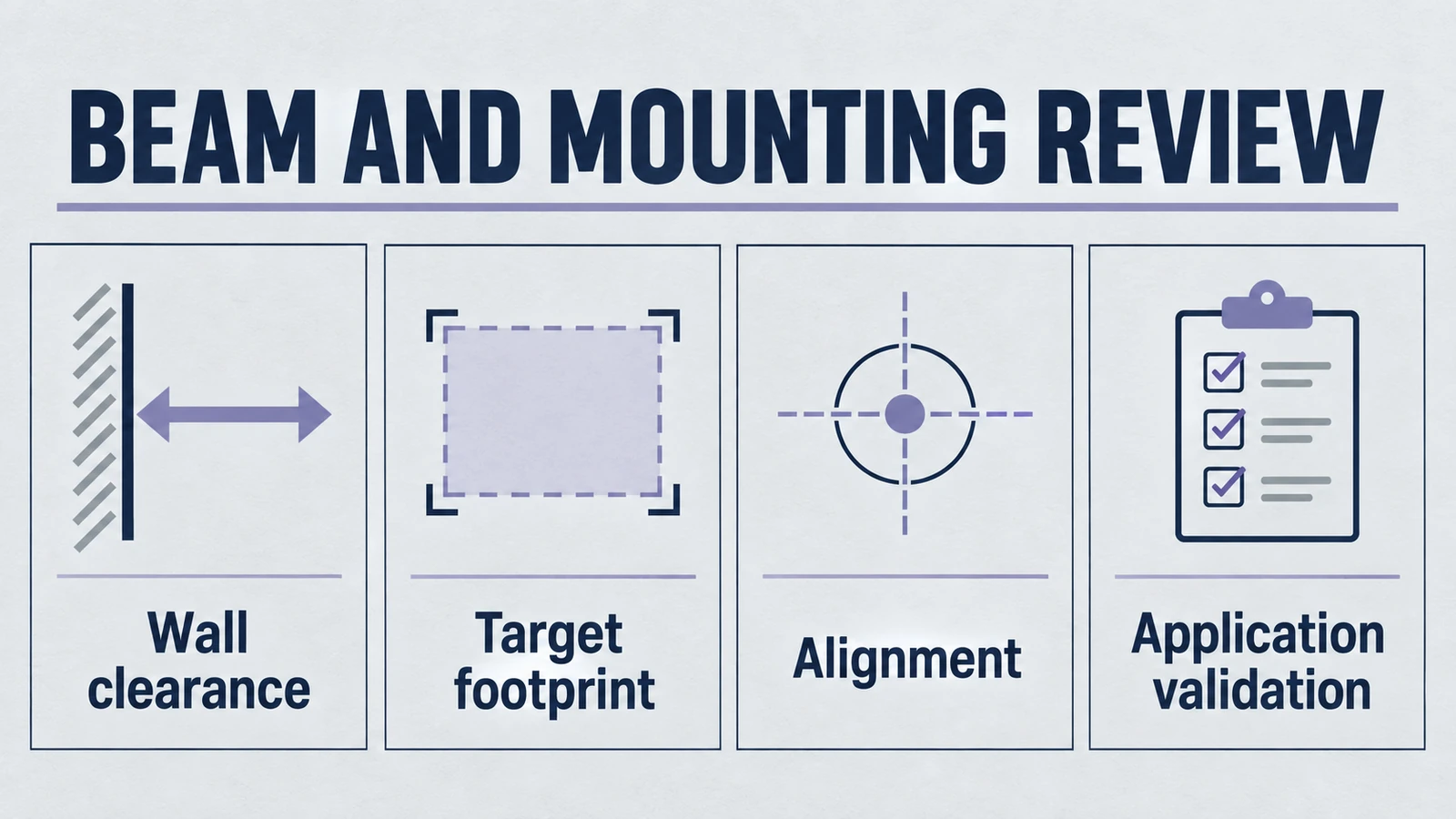
Beam angle, wall clearance, nozzle depth, bracket stiffness, and target width determine whether the acoustic path stays under control after installation. In a narrow tank, the echo can clip the side wall before it returns from the liquid surface. On a conveyor, the same geometric mistake appears when the beam catches a side rail, an adjacent lane, or a vibrating bracket instead of the intended target. Different application, same integration failure.
This article is written as a field geometry playbook for engineering teams evaluating the sensor product hub, the core MU30 sensor, and broader supplier capability through the ultrasonic transducer supplier page. It does not repeat a general M18 versus M30 comparison, and it does not re-run blind-zone theory from first principles. Its job is to show how beam angle and mounting geometry should be screened before sample approval.
Problem Context
Product path for this search intent
Match the article topic to the right YJ Piezo product page
Use this article when sensor performance depends on target distance, beam angle, housing material, liquid behavior, or false echo control. For "Beam Angle and Mounting Geometry for Narrow Tanks and Conveyor Detection", the practical value is in turning the topic into a measurable selection or sourcing decision.
- Ultrasonic Sensors
Distance, level, and detection sensor portfolio
- Flow Measurement Transducers
Bubble and flow-related ultrasonic sensing paths
- Air Acoustic Transducers
Air-coupled transducers for range and presence detection
A "range-matched" installation can still fail because ultrasonic sensing depends on controlling the entire echo path, not only the distance to the intended target. In narrow vessels and confined machine frames, the sensor does not interact with just one surface. It interacts with walls, nozzle lips, lids, standpipes, rails, guards, roller edges, and every rigid object close enough to fall inside the effective beam footprint.
Narrow tanks make this problem especially expensive because the geometry changes with fill level. Near the top of the tank, the nozzle and upper wall can become the strongest reflector. Near the bottom, the blind zone and wall convergence can collapse the usable margin. The result is a measurement that may look acceptable at one operating point and become unreliable only during startup, near-empty operation, or the final filling stage.
Conveyor detection is the clearest analogy: side-wall reflections inside a vessel become side-rail reflections on a lane, and the same geometry logic still applies.
Why Range Alone Creates False Confidence
Teams often buy the first sample that covers the distance window. If the application needs 600 mm to 1800 mm, they pick a model that reaches 2 m or 4 m and assume the problem is solved. That shortcut ignores three decisive questions: how large the effective acoustic footprint becomes at the working distance, how close nearby hard reflectors sit to the main lobe, and whether the sensor must work near its own blind zone or unusable area.
That is why this article stays geometry-first. If you need the conveyor-specific comparison between form factors, use the dedicated M18 versus M30 conveyor guide. If your main concern is minimum detection distance and ring-down behavior, use the blind-zone technical article. Here, the goal is to help you decide whether the installation geometry itself is viable before parameter tuning starts.
Typical Symptoms of Geometry-Led Failure
- Stable but wrong distance: the sensor locks onto a wall, nozzle edge, rail, or fixed bracket instead of the target.
- Intermittent switching: slight mechanical misalignment or vibration moves the beam between the intended target and a nearby hard reflector.
- Failure only near high or low level: the tank geometry becomes acoustically tighter as the level approaches installation boundaries.
- Works with large objects, fails with narrow targets: the effective beam footprint is wider than the target or spills into surrounding structure.
- Unexplained sample disagreement: one installation works and another does not because the mounting geometry, not the electronics, changed between trials.
Engineering Constraints
Before choosing a model, lock the geometry variables that most often break narrow-tank and conveyor applications. This prevents teams from sending incomplete RFQs and then trying to solve a mechanical layout problem with software filtering.
1) Beam Angle Must Be Read Against Tank Diameter, Not in Isolation
A beam angle printed on a datasheet is not meaningful by itself. What matters is how that beam expands over the actual stand-off distance. In a narrow cylindrical tank, even a moderate cone can intersect the wall before the centerline reaches the liquid surface, especially when the sensor is mounted high above the maximum fill level or inside a nozzle. Once the wall enters the effective footprint, the system no longer evaluates one clean echo path.
This is why mid-range tank installations often land naturally around the medium-range tank sensor class represented by MU30. The current product page covers a broad 200 to 6000 mm working range, which gives flexibility for containers and silos, but that flexibility must still be screened against tank diameter and mounting height. The model is not the mistake; the unscreened geometry is.
2) Nozzle and Standpipe Geometry Can Create a Stronger Echo Than the Process Surface
A deep nozzle can behave like an unintended acoustic tunnel. Instead of launching into open headspace, the beam first interacts with the nozzle wall, lip, or internal seam. In practice this can create an apparently stable echo that is easy for the control system to trust and hard for the commissioning team to diagnose. The same problem appears in standpipes if the diameter is too small, the interior is rough, or the sensor axis is not centered.
For procurement and installation review, collect nozzle diameter, nozzle height, sensor recess depth, and whether the pipe interior is smooth or stepped. If those values are missing, the quote is incomplete no matter how detailed the electrical specification looks.
3) Blind Zone and Minimum Measurable Level Must Be Screened Together
A second geometry mistake is treating blind zone as a separate topic from mounting layout. They are the same decision. If the application requires reliable reading near the top of a shallow bin or in a vessel with little headspace, the sensor may approach its unusable area before the measurement window is complete. At that point, the system is not merely less accurate. It is operating in a region where reliable detection is no longer documented.
That is where the compact MU18 option becomes valuable. Its short-range design and smaller blind-zone profile fit close-mounting situations much better than a general-purpose mid-range unit. If the application demands very tight clearance, the correct question is not "Can MU30 be tuned to work?" but "Should the geometry be reassigned to MU18 from the beginning?"
4) Conveyor Lane Width and Side Rails Create the Same Geometry Conflict in Open Air
On a conveyor, geometry errors show up in more visible ways. If the sensor is mounted too high above a narrow lane, the effective footprint can clip the rails, guide plates, or adjacent products. If the target is soft, irregular, or smaller than expected, the rail may return a cleaner echo than the carton, tray, or part you actually want to detect. That is why conveyor applications are a helpful mental model for tank work: both cases are about keeping nearby structure out of the useful beam footprint.
For high-speed or physically tight lanes, the model choice may shift toward MU18 because it is easier to aim in a confined corridor. For longer standoff or larger target areas, MU30 still works well, but only when lane width, rail distance, and target dimensions are screened as part of the mounting review.
5) Bracket Stiffness Matters as Much as Sensor Alignment
A well-aimed sensor can become a poor sensor after vibration starts. Long cantilever brackets, thin L-plates, and unsupported standoffs introduce mechanical movement that changes the echo path every cycle. In a tank, that movement shifts the beam toward the wall or nozzle edge. On a conveyor, it wags the beam into the rail or away from a narrow target window. The resulting false switching is often blamed on signal noise when the root cause is mechanical resonance.
Treat mounting hardware as part of the sensing system. If the bracket is flexible, the beam angle on paper is no longer the beam angle in service. Two-point support, shorter stand-off, and rigid bridge-style mounts usually produce better field stability than tuning filters after installation.
6) Nominal Beam Angle Is Not the Same as Effective Detection Footprint
This distinction is where many qualification projects go wrong. Nominal beam angle is usually defined under controlled conditions and does not describe every real target, every material, or every nearby interference source. The effective detection footprint changes with target size, target reflectivity, surface shape, mounting distance, and environmental noise. In other words, the footprint that matters in your factory or tank farm may be wider than the footprint you imagined from the catalog value.
The engineering rule is therefore conservative screening. If the geometry looks barely acceptable on paper, it is usually not acceptable in the field. Leave margin between the intended target zone and nearby hard reflectors. If margin does not exist, choose a different model, reduce stand-off, or redesign the bracket before sample approval.
Selection Matrix
Use the following matrix to convert geometry constraints into model and mounting decisions before comparing samples.
| Scenario | Main Geometry Risk | Preferred Mounting Rule | Recommended Model | Implementation Note |
|---|---|---|---|---|
| Narrow cylindrical tank with moderate stand-off | Side-wall clipping before the surface echo becomes dominant | Keep sensor centered and leave generous wall margin at maximum empty distance | MU30 | Best when the tank is not extremely shallow and the mounting axis can stay stable |
| Tank with nozzle or standpipe | Nozzle lip or pipe wall creates an early false echo | Minimize recess depth and validate nozzle diameter before quotation | MU30 or SR55 | Move to SR55 when height and side-wall rejection margin exceed the comfort zone of a general-purpose unit |
| Shallow bin with close minimum level | Blind zone overlaps the required measurement window | Reduce stand-off and prioritize short unusable area over maximum range | MU18 | If the sensor must work close to the target, compact geometry matters more than extra range capacity |
| Narrow conveyor with side rails | Rails return a stronger echo than the product | Mount as low and as centered as possible without entering target interference | MU18 | Use MU30 only when lane width and stand-off margin are both clearly adequate |
| Conveyor with mixed target widths and protected mounting space | Variable reflectivity and moving bracket alignment | Use rigid mounting and confirm footprint on the smallest real target | UltraNova2 or MU30 | UltraNova2 is useful where compact protected installation matters more than a cylindrical general-purpose body |
Field Geometry Check Before Sample Approval
- Map nearby hard reflectors: walls, nozzle edges, rails, guards, and brackets must be listed before installation starts.
- Mark the minimum and maximum working distance: do not qualify the sample using only one mid-range point.
- Check the smallest real target: if the footprint is only proven on a large flat plate, the trial is incomplete.
- Inspect mounting rigidity: if the bracket can move visibly, the test result is not stable enough to approve.
- Validate off-center cases: real targets and fill surfaces are not always perfectly centered.
- Record geometry with photos and dimensions: otherwise later failures cannot be compared against the original qualification layout.
Model Mapping
The model decision should follow the geometry bottleneck, not personal preference for one housing size. For this topic, the baseline recommendation is the MU30 sensor because it covers the broadest set of mid-range tank and general installation cases while remaining easier to position than long-range tank hardware.
MU30: Primary Choice for General Geometry-Led Tank Deployment
MU30 should be the first model screened when the application sits between close-range precision and long-range silo measurement. Its current product window of 200 to 6000 mm makes it suitable for many containers, bins, and moderate-height tanks where the installation has real geometry constraints but does not require a dedicated long-range platform. It is also a reasonable reference model when procurement wants one baseline quote before deciding whether to move shorter or longer in range.
MU18: Use When Tight Geometry Beats Broad Range
Move to the compact MU18 option when the governing problem is close mounting, short blind-zone demand, or narrow conveyor geometry. MU18 is not simply the smaller version of MU30. In practical deployment it solves a different geometry class: compact lanes, shallow bins, and installations where the sensor must work close to the target without giving away too much space to unusable area.
SR55: Move Up When Tank Height and Rejection Margin Increase
Move from MU30 to SR55 when the tank is taller, the mounting distance increases, or the side-wall rejection problem becomes more severe than a general-purpose mid-range layout can comfortably handle. The current SR55 page combines IP68 protection with a 280 to 4000 mm range and a 75 kHz class transducer, making it appropriate when the geometry begins to resemble a more dedicated level application. For supporting context, use the SR55 engineering guide.
UltraNova2: Use When Protected Compact Installation Is the Main Constraint
Choose UltraNova2 when the project needs a more compact, protected, or surface-oriented installation rather than a classic cylindrical body. It is especially useful when you still need medium-range capability but want to reduce the mechanical penalty of a protruding threaded sensor body in confined equipment or protected outdoor frames.
RFQ Checklist
If you want suppliers to quote the right geometry, the RFQ must describe geometry directly. Do not send only a target range and an output type. Send the installation envelope.
- Range: minimum, normal, and maximum working distance.
- Environment: dust, moisture, splash, temperature variation, and process atmosphere.
- Output interface: switching, analog, or digital.
- Power: supply window and connector expectation.
- Quantity + lead-time: sample quantity, pilot quantity, and expected delivery timing.
- Tank diameter: internal width at the sensing zone.
- Nozzle diameter / height: include recess depth and pipe condition if a standpipe is used.
- Minimum measurable level: the closest required point, not only the nominal full-scale range.
- Conveyor width: lane width, rail spacing, and sensor height above the belt.
- Target size / spacing: smallest real object, not the ideal laboratory target.
- Mounting orientation: top-down, side-looking, recessed, or bracket-mounted.
For commercial communication, keep the RFQ simple enough to copy and paste but detailed enough to screen geometry risk. Send it through the contact page when you need a direct geometry review.
Copy-paste RFQ starter
Application:
Required range:
Environment:
Output interface:
Power:
Quantity:
Lead-time:
Tank diameter or conveyor width:
Nozzle diameter / height or bracket stand-off:
Minimum measurable level or smallest target size:
Mounting orientation:
Photos / sketches available: Yes / No
A good RFQ does not ask the supplier to guess what matters. It forces the geometry into the first round of discussion, which is exactly where it belongs.
FAQ
Why does an ultrasonic sensor fail in a narrow tank even when the range is correct?
Because the range only describes how far the sensor can detect, not whether the beam remains isolated from the wall, nozzle, or lid across the full measurement window. In narrow tanks the wall often becomes part of the echo path.
When is MU18 better than MU30?
MU18 is better when the core constraint is close mounting, shorter blind-zone demand, or tight conveyor geometry. If the system must work in a compact corridor, the smaller form factor can be more important than extra range headroom.
When should a buyer move from MU30 to SR55?
Move to SR55 when mounting distance, tank height, or required wall-rejection margin pushes the application beyond the comfortable geometry envelope of a general-purpose MU30 layout. This is especially true in medium-range level work with more dedicated tank geometry.
How much wall clearance is needed?
There is no single universal number because clearance depends on stand-off distance, target characteristics, and real installation geometry. The conservative rule is to evaluate clearance at the worst-case working point, not only at mid-range, and leave margin rather than qualifying a layout that is barely acceptable on paper.
Can conveyor side rails cause false detection?
Yes. Rails are hard, repeatable reflectors. If the effective footprint reaches them, they can produce a more stable echo than the intended product, especially when the target is narrow, soft, or inconsistently positioned.
What should be validated during sample testing?
Validate minimum and maximum working distance, smallest real target, off-center conditions, mounting rigidity, and nearby structural reflectors. A sample is not qualified until the real installation envelope has been tested, not just one ideal point.
Can filtering solve a bad geometry layout?
Filtering can reduce symptoms, but it cannot remove a structural echo path mistake. If the wall, rail, or nozzle repeatedly enters the useful footprint, mechanical correction is usually more effective than parameter tuning.
For teams that want a second-pass review before RFQ, the strongest workflow is simple: start from the sensor product hub, compare the geometry around MU30, MU18, SR55, and UltraNova2, then send the geometry package through contact with dimensions, photos, and the actual installation constraints.
Engineering decision notes
Ultrasonic sensing and detection
Use this article when sensor performance depends on target distance, beam angle, housing material, liquid behavior, or false echo control. For "Beam Angle and Mounting Geometry for Narrow Tanks and Conveyor Detection", the practical value is in turning the topic into a measurable selection or sourcing decision.
YJ Piezo treats ultrasonic sensing as an acoustic interface problem: transducer frequency, beam shape, housing, drive electronics, and target environment are reviewed together.
Selection checks
- Define target range, dead zone, beam angle, and mounting geometry before choosing the sensor family.
- Check the medium, target surface, temperature swing, foam, vapor, and side-wall risk.
- Separate detection repeatability from ideal lab accuracy when the sensor will operate in a tank, tube, or moving line.
Failure risks
- A sensor can pass bench distance tests and still fail in tanks with foam, agitation, vapor, or narrow geometry.
- Changing only frequency without reviewing beam angle and mounting can increase false echoes.
- Ignoring housing material or sealing requirements can shorten lifetime in washdown or chemical environments.
RFQ details
- What is the minimum and maximum detection distance?
- Is the target liquid, solid, sheet material, air flow, or a moving object?
- What temperature, humidity, IP rating, and output signal does the system require?
Relevant YJ Piezo pages
- Ultrasonic Sensors
Distance, level, and detection sensor portfolio
- Flow Measurement Transducers
Bubble and flow-related ultrasonic sensing paths
- Air Acoustic Transducers
Air-coupled transducers for range and presence detection
Application FAQ
- What makes an ultrasonic sensor page useful for procurement?
- It should connect range, beam angle, output signal, housing, mounting, and environmental limits to a concrete use case. A model name alone is not enough for reliable supplier comparison.
- Which information speeds up an ultrasonic sensor RFQ?
- Send the target material, distance range, installation geometry, output interface, temperature range, IP rating, and whether the application involves foam, vapor, liquid, or moving objects.