Ultrasonic Transducer Supplier Cleaning, Welding, Flow & Sensing
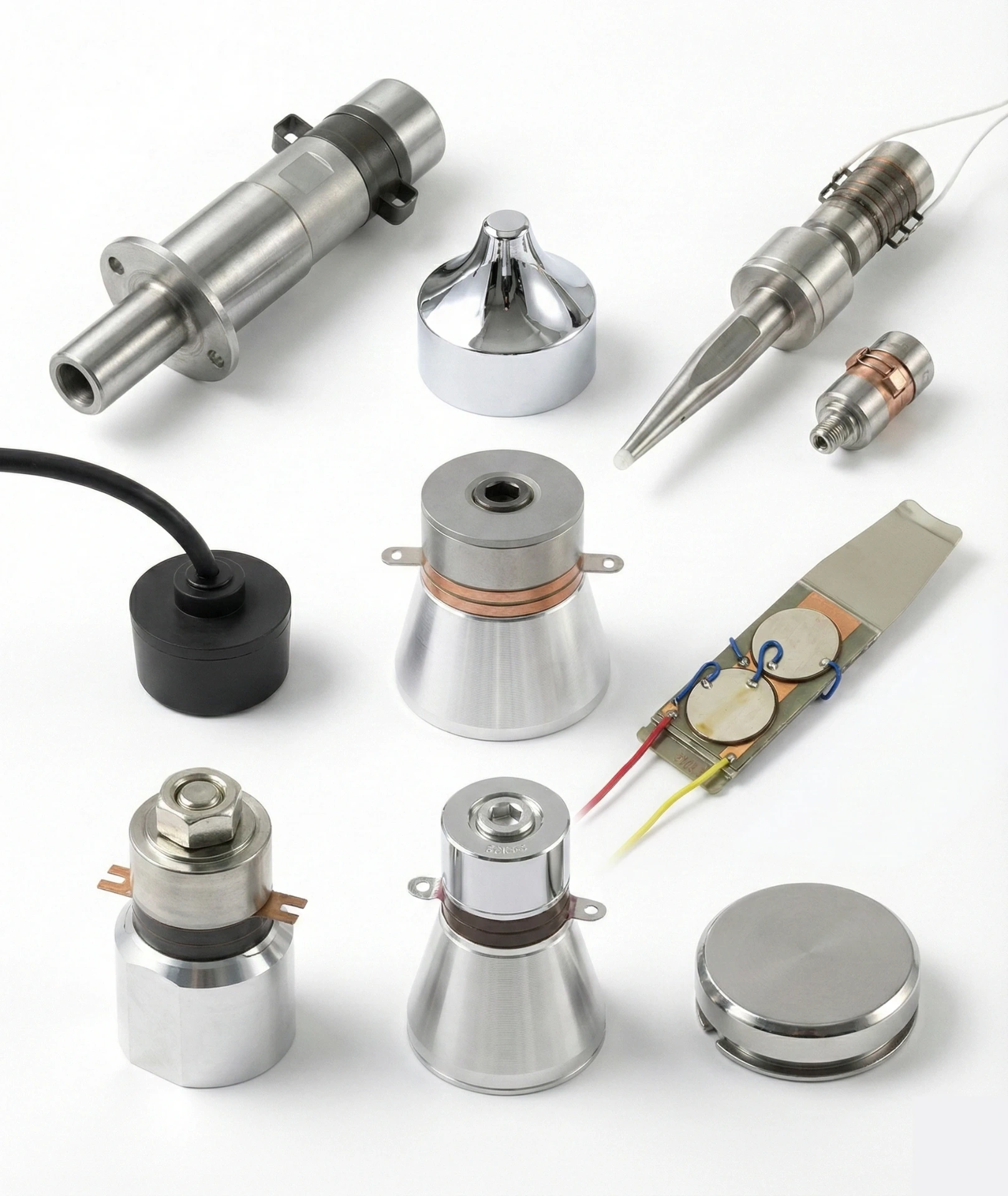
Ultrasonic transducer selection and custom development for cleaning, welding, flow, sensing, beauty-device, and underwater applications. Send frequency, drive conditions, mounting interface and quantity for a model or custom-design review.
Features & Applications
Compare OEM ultrasonic transducers
Open a model to check its specifications. For a quote, include the operating conditions and interface listed for your application.
| Application family | Typical product scope | Key RFQ inputs | Agreed verification focus | Product hub |
|---|---|---|---|---|
| Cleaning HJ-3828 27.8 ± 0.3 kHz Stud-mounted tank cleaning transducer |
Cleaning and liquid-coupled power transducers | Tank dimensions, liquid, target frequency, power, mounting, duty cycle | Resonance and impedance checks, mechanical interface, and agreed operating review | View products |
| Welding HJ-5020B 20.15 / 20.20 kHz Plastic welding transducer with M12 × 1.75 interface |
Welding, drawing, and joining transducers | Material, horn and booster interface, frequency, power, amplitude, duty cycle | Frequency match, impedance response, interface dimensions, and agreed load conditions | View products |
| Flow measurement HJ-2112/1M 1.0 MHz ± 5% Liquid flow measurement transducer |
Liquid and gas flow transducers | Pipe and medium, acoustic path, target frequency, mounting, electrical interface | Electrical response, acoustic-path fit, dimensional checks, and agreed pairing criteria | View products |
| Air acoustic and sensing | Ranging, detection, and air-coupled transducers | Target range, beam angle, housing, environment, driver and receiver interface | Transmit-receive response, frequency, housing interface, and agreed environmental checks | View products |
| Beauty devices | OEM applicator and treatment-head components | Applicator size, target frequency, drive, thermal limits, bonding and duty cycle | Frequency and impedance response, bonding interface, thermal conditions, and agreed functional checks | View products |
| Atomizing discs | 1.7 MHz pressure contact, wired, and glass composite PZT discs | Disc and assembly dimensions, contact method, driver, liquid, water depth and duty cycle | Frequency and impedance checks, mounting drawing, and sample output in the complete assembly | View products |
| Underwater | Sealed transducers for submerged acoustic systems | Depth, medium, beam requirement, housing, cable, sealing and duty cycle | Electrical response, sealing boundary, cable interface, and agreed pressure or immersion checks | View products |
Choose your transducer or sensor family
Open the matching catalog to compare published models. The information below is a starting point for your enquiry; the quotation confirms the supplied part, specification and inspection scope.
- Beauty-device transducersModel or frequency, element or assembly, driver and handpiece interface.
- Distance & level sensorsRange, blind zone, target, output, housing and installation conditions.
- Cleaning transducersFrequency, tank, mounting, generator and duty cycle.
- Welding transducersFrequency, horn or stack interface, generator and operating duty.
- Flow transducersGas or liquid, acoustic path, pressure, temperature and mounting.
- Air acoustic transducersFrequency, beam, target distance, drive and mounting.
- Underwater transducersWorking medium, acoustic target, sealing, cable and mounting.
- Atomizing discsConnection, disc or assembly envelope, driver and liquid conditions.
Choose a ceramic element, housed transducer or assembly
For a bare ceramic element, specify geometry, electrodes and material if known. For a housed transducer, include mounting, cable and working medium. For an assembly, list the required parts and any driver or matching components separately. The quotation confirms what is supplied and what remains with your team.
Define the operating boundary
Frequency, drive or power, working medium, beam or acoustic target, mounting interface, duty cycle, temperature, and sealing requirements are reviewed together.
Agree the evidence before quotation
Dimensions and the applicable electrical or acoustic checks, sampling, records, quantity, and schedule are confirmed for the actual project rather than assumed from a generic supplier promise.
Send what is known
A complete specification is not required for the first review. Separate fixed requirements from open targets and attach a drawing when available.
- Application and function
- Target frequency or operating band
- Drive, power, duty cycle, and medium
- Drawing, mounting, housing, and cable interface
- Prototype quantity and expected production volume
- Required inspection or validation records
Frequency Target
Tolerance confirmed in quotation
Drive & Power
Driver, amplitude, and duty cycle
Mechanical Interface
Mounting, housing, cable, and load
Environment
Medium, temperature, sealing, and duty
Frequency Tuning
Precise frequency adjustment to match your specific application requirements and drive electronics.
- ✓Customer-specified frequencies
- ✓Impedance matching optimization
- ✓Bandwidth control
Power Optimization
Custom power handling and efficiency optimization for your drive circuit configuration.
- ✓Drive circuit matching
- ✓Thermal management design
- ✓Power efficiency maximization
Mechanical Design
Custom mechanical interfaces, mounting solutions, and dimensional requirements.
- ✓Non-standard dimensions
- ✓Special mounting features
- ✓Material selection
Environmental Protection
Protective designs for harsh environments and specific protection requirements.
- ✓IP67/IP68 sealing
- ✓Corrosion resistance
- ✓Temperature protection
Inspection & Validation Planning
Share the acceptance requirements for your component or assembly. The applicable checks, test conditions, sampling, available records, and responsibilities are confirmed for the selected model and order before production.
Inspection Scope to Confirm
- •Required frequency response limits
- •Impedance and electrical limits
- •Performance checks and sampling
- •Dimensions and measurement method
Application Validation Requirements
Specify the tests your application needs. Test feasibility, who performs each test, and acceptance limits require project review. Validate the final assembly in its intended operating conditions.
- •Duty cycle and required endurance duration
- •Temperature range and cycling conditions
- •Vibration and mounting conditions
- •Allowable performance drift over time
Records to Agree
- •Acceptance criteria and drawing revision
- •Measurement conditions and report format
- •Required batch identification and traceability
- •Change notification and nonconformance handling
Requirements Discussion
Initial consultation to understand your application needs and technical specifications
Technical Proposal
Review the feasible supply scope, acceptance criteria, pricing, and proposed schedule
Sample Confirmation
Agree a sample plan and check the selected component or assembly against the project requirements
Volume Production
Confirm the production plan, inspection records, and delivery schedule for the approved requirements
Ongoing Support
Review application feedback and order-specific support or warranty terms
Recommended Guides
Guides for supplier evaluation and OEM collaboration
Use this supplier hub as the starting point, then go deeper with the guide that matches your decision: partner fit, technical manufacturer auditing, or the manufacturing workflow from prototype to production.
- Partner-Fit Guide for OEM ProgramsUse this when your team is choosing a co-development partner for sampling, NPI, engineering communication, and long-term program risk control.
- Technical Audit of ManufacturersUse this benchmark to audit material control, FEA, assembly precision, stabilization, and validation discipline.
- Manufacturing Workflow GuideUse this when the decision is about DFM, prototyping, validation, pilot runs, and scale-up from prototype to production.
- Supplier Vetting StandardUse this when procurement and engineering need a shared framework for auditing supplier traceability, testing, and scale-up risk.
- Application-Specific Engineering GuideUse this when the catalog part looks acceptable on paper but the application needs custom design, matching, or reliability tuning.
- When Custom Design Is NecessaryUse this decision guide when the team is weighing a custom transducer program against an off-the-shelf part.
Professional Ultrasonic Transducer Manufacturing Partner
Extensive product portfolio, custom development capabilities, and rigorous quality control for your ultrasonic applications.
Frequently Asked Questions
- What types of ultrasonic transducers do you manufacture?
- YJ Piezo publishes transducer families for cleaning, welding, flow measurement, sensing, beauty-device, and underwater applications. Current model pages span 14.9 kHz to 5 MHz; targets outside a published model are reviewed as application-specific requirements.
- Do you provide custom transducer development?
- Yes, we offer complete custom development services from concept to production. Our engineering team designs transducers optimized for your specific application requirements and performance criteria.
- What is your production capacity?
- Production planning is reviewed by product family, tooling, process steps, validation requirements, and forecast quantity. Share the pilot and annual demand so engineering and production can confirm an appropriate batch plan.
- Can you provide prototypes and samples?
- Yes. Standard-model samples and custom prototypes are reviewed separately. Availability and timing are confirmed after the target frequency, mechanical interface, driver condition, operating medium, quantity, and required test records are known.
- What quality assurance processes do you follow?
- We follow comprehensive quality assurance including incoming material inspection, in-process testing, final performance validation, and reliability testing. Each transducer is individually tested before shipment.
- Do you offer global shipping and support?
- Yes, we ship worldwide with established distribution networks. We provide technical support, application guidance, and after-sales service globally through our technical team.
- How are warranty and acceptance terms handled?
- Warranty, acceptance criteria, and the response process are confirmed in the quotation or project agreement for the selected model or custom build. The terms depend on the operating conditions, integration boundary, validation plan, and agreed specifications.
- Can you handle high-volume production?
- Yes, we have scalable production capabilities and can handle orders from hundreds to tens of thousands of units. We maintain consistent quality and delivery schedules for high-volume requirements.
Manufacturer + supplier path
One sourcing path from a published transducer family to custom OEM review
YJ Piezo combines published ultrasonic transducer families with project-specific manufacturing and application review. Start from the closest product category, then define the operating boundary and the evidence needed for your own assembly.
- Choose a ceramic element, housed transducer or assembly. For a bare ceramic element, specify geometry, electrodes and material if known. For a housed transducer, include mounting, cable and working medium. For an assembly, list the required parts and any driver or matching components separately. The quotation confirms what is supplied and what remains with your team.
- Define the operating boundary. Frequency, drive or power, working medium, beam or acoustic target, mounting interface, duty cycle, temperature, and sealing requirements are reviewed together.
- Agree the evidence before quotation. Dimensions and the applicable electrical or acoustic checks, sampling, records, quantity, and schedule are confirmed for the actual project rather than assumed from a generic supplier promise.
Send what is known
A complete specification is not required for the first review. Separate fixed requirements from open targets and attach a drawing when available.
- Application and function
- Target frequency or operating band
- Drive, power, duty cycle, and medium
- Drawing, mounting, housing, and cable interface
- Prototype quantity and expected production volume
- Required inspection or validation records