
Beyond the Spec Sheet: How Yujie's Application-Specific Ultrasonic Piezo Transducer Design Solves Core Engineering Challenges
Off-the-shelf ultrasonic piezo transducers can fall short in specialized real-world applications. Discover how Yujie's custom material science and OEM design process (since 1996) helps address critical challenges in medical and industrial applications.
Introduction: The "In-Spec Failure"—When Good Transducers Perform Badly
You've done the work. You sourced an ultrasonic piezo transducer that meets every parameter on your spec sheet: frequency, impedance, and capacitance. Yet, in final testing, the application fails.
In your industrial cleaner, the cavitation is weak, failing to clean precision parts. In your medical device, the imaging resolution is grainy, or worse, the tool causes end user discomfort or introduces unacceptable risk, like membrane perforation. In your high-power system, the transducer's life is unexpectedly short, a victim of wear and friction.
This is the "In-Spec Failure." It's a critical disconnect where a component is technically in-spec but functionally deficient in its real-world environment.
The problem isn't the spec sheet; it's the philosophy. A "one-size-fits-all" component, often sourced from a general-purpose catalog, cannot solve a one-of-a-kind engineering challenge. True performance isn't found in a catalog; it's engineered. As a pioneer in piezoelectric technology established in 1996, Yujie has built its 30+ years of R&D expertise on this single principle: the most critical component is the material science behind the transducer.
The Core of the Problem: Not All PZT Is Created Equal
An ultrasonic piezo transducer is a complex system, but its heart is the PZT (Lead Zirconate Titanate) ceramic. The specific formulation of this ceramic dictates its function. The most significant error in component sourcing is assuming all PZT materials are the same. They are fundamentally engineered for two opposing purposes: high-power transmission or high-sensitivity reception.
"Soft" PZT: The Solution for Precision and Sensitivity
"Soft" PZT formulations, like Yujie's P-51 (PZT-5A) and P-52 (PZT-5H), are engineered for high sensitivity. They exhibit high piezoelectric charge coefficients and superior dielectric constants.
- Yujie's Proof: Our materials are engineered for superior shear strain response, reaching d₁₅ up to 950 pC/N.
- Application: This makes them perfect for receiving minute signals or producing highly precise, controlled displacements. Select by mode, loss, stress, field, duty and readout. Hard PZT is used in high-power surgical and dental tools; soft PZT is not universally required for these applications and does not by itself establish patient comfort.
"Hard" PZT: The Solution for Power and Durability
"Hard" PZT formulations, such as Yujie's PZT-4 and PZT-8, are designed for high-power, high-stress applications. They are characterized by lower losses at high power, high mechanical strength, and excellent stability under extreme electrical and mechanical loads.
- Yujie's Proof: We engineer materials with ultra-low loss (dielectric loss tan δ as low as 0.004) for exceptional energy efficiency and minimal heat generation, which is a common point of failure.
- Application: These materials are ideal for transmitting powerful ultrasonic waves. This includes industrial ultrasonic cleaning, ultrasonic welding, high-power sonar, and high-intensity focused ultrasound (focused ultrasound). This is the direct solution for the "limited functional life" and TCO problem identified in generic transducers.
Application-Specific PZT Selection: Matching Material to Mission
The "In-Spec Failure" is solved by moving from spec-sheet thinking to application-performance thinking. The selection of the core piezoelectric material must be the first step, matching the PZT properties to the mission's core challenge.
| Application Vertical | Core Engineering Challenge | Required Performance | Yujie Material Solution | Yujie Product Example |
|---|---|---|---|---|
| Industrial (Power) | Inefficient cavitation; component failure; heat. | High Power, Low Loss, Durability | Hard PZT (e.g., PZT-4, PZT-8) | HJ-6015 Heavy-Duty Welding Transducer; Industrial Cleaning Transducers |
| Medical (Precision) | end user discomfort; risk; low signal. | High Sensitivity, Miniaturization, Stability | Soft PZT (e.g., P-52 / PZT-5H) | Medical Beauty Transducers (1MHz); Atomizer Transducers (1.65MHz) |
| Sensing & Measurement | Low sensitivity; signal attenuation. | High Piezoelectric Coefficient, Stability | Soft PZT (e.g., P-51 / PZT-5A) | Custom Flow Measurement Sensors; Level Sensors |
| Underwater (Sonar) | Signal integrity; pressure resistance. | High Power, High Sensitivity, Robust | Hard PZT (PZT-8) / Custom | Underwater Acoustic Transducers |
Case Study 1: The Industrial Challenge — Solving for Power and Reliability
The Scenario: An OEM is designing a high-power ultrasonic welding system, a common application for power ultrasound.
The "In-Spec Failure": The OEM sources a standard high-frequency transducer. Under 24/7 production loads, the transducer overheats. The "friction and wear" at the horn interface cause micro-fractures, and the component fails, leading to production downtime and failed QC.
Yujie's Solution (Beyond the Spec Sheet):
A Yujie solution is not just a component; it's a co-engineered system.
- Material: Our engineers (with 30+ years' experience) select our robust PZT-8 hard ceramic, which is specifically formulated to withstand high thermo-mechanical loads and minimize heat generation.
- Design: We custom-engineer the high-power "Langevin" transducer structure, optimizing the head and tail mass to create the precise amplitude and nodal points required for a strong, consistent weld.
- The Result: A robust ultrasonic piezo transducer that delivers consistent, powerful acoustic energy. It solves the TCO and reliability problem, providing a component that lasts.
Case Study 2: The Medical Challenge — Solving for Precision and Safety
The Scenario: A medical device R&D team is developing a next-generation ultrasonic dental scaler or a cosmetic beauty device.
The "In-Spec Failure": Using a generic transducer, the team finds the vibrations are harsh and uncontrolled. In a dental scaler, this leads to high end user discomfort. In a cosmetic device, it fails to deliver energy precisely. This "blunt instrument" approach introduces risk and leads to poor market acceptance.
Yujie's Solution (Beyond the Spec Sheet):
Medical applications are not about raw power; they are about precision.
- Material: Our engineers select a high-sensitivity "soft" PZT-5H formulation. Material selection must follow the actual duty: high-power dental tools may require hard low-loss grades. Precision, stability and comfort depend on the complete assembly and validated use.
- Design: We custom-design the transducer at a high frequency (e.g., 1.0MHz for beauty devices) and in a miniaturized, application-specific shape. This precision can support more selective energy delivery when the complete device design and validation process are aligned with the intended use.
- The Result: A transducer designed for controlled vibration, stable output, and user-experience requirements, with final safety and effectiveness determined at the finished-device level.
The Yujie Partnership: From Concept to Component
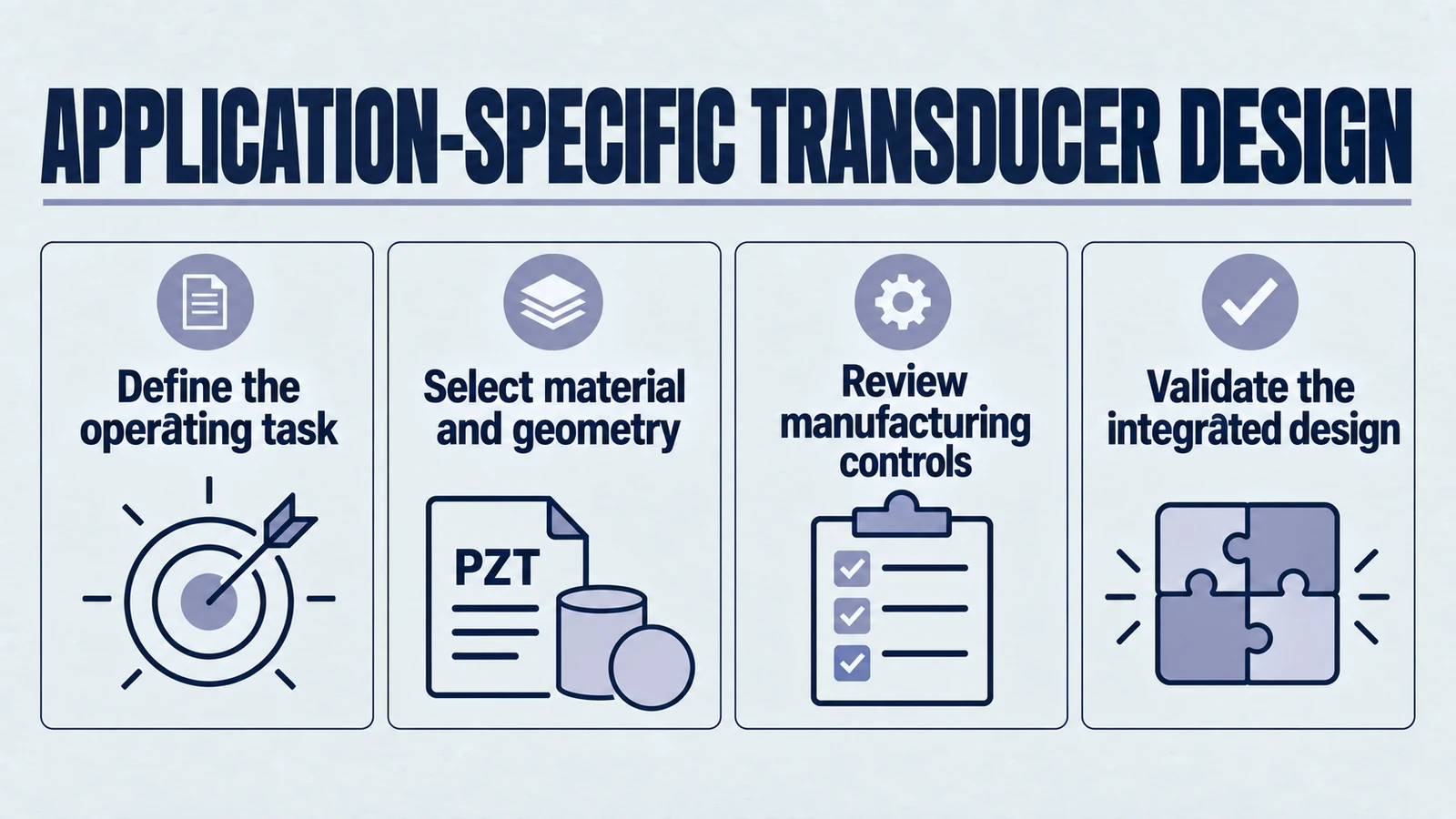
The solution to the "In-Spec Failure" is to change your procurement process. Stop buying components from a catalog and start an engineering partnership. Yujie operates as an OEM/ODM partner, moving from concept to component to ensure your application succeeds.
Step 1: Application Deep Dive
Our experience in piezoelectric and ultrasonic applications dates to 1996. We start by analyzing the application challenge, not just the spec sheet.
Step 2: Custom Material Formulation & Shape Engineering
Based on the analysis, we select and tune the optimal PZT formulation. Whether you need a standard disc, ring, or tube, or a complex, custom-molded shape for a unique housing, we engineer the ceramic for your design.
Step 3: Rigorous Manufacturing & Quality Control
Manufacturing and quality requirements are defined around the selected component. Critical parameters, sampling level, acceptance limits, and available records are confirmed before production rather than presented as an absolute site-wide guarantee.
Step 4: A True Partnership
We are your engineering partner, not a line-item on a purchase order. We provide comprehensive solutions, from raw PZT powder to complete, assembled ultrasonic transducers.
Conclusion: Stop Buying Components. Start Engineering Solutions.
An ultrasonic piezo transducer is not a commodity. It is the heart of your system. Choosing a generic, off-the-shelf part can increase the risk of "In-Spec Failure," leading to poor performance, high TCO, and frustrated end-users.
Choosing Yujie means choosing a partner committed to your application's success. It means leveraging decades of material science and application-specific design to build a product that is more powerful, more precise, and more reliable than the competition.
Don't let a generic component limit your innovation. Your application is unique. Your transducer should be too.
Ready to solve your engineering challenge?
Contact the Yujie engineering team today to discuss your custom piezoelectric solution.
Frequently Asked Questions
What is the difference between soft and hard PZT materials?
Soft PZT materials (like PZT-5H) are optimized for high sensitivity and precision applications such as medical imaging and sensing. Hard PZT materials (like PZT-4 and PZT-8) are designed for high-power applications like ultrasonic welding and industrial cleaning, offering superior durability and low-loss characteristics.
Why do off-the-shelf ultrasonic transducers often fail in specialized applications?
Off-the-shelf transducers are designed for general purposes and may not account for the specific thermal, mechanical, and electrical stresses of your application. Custom-engineered transducers from Yujie are designed around your exact requirements, matching material properties to your high-reliability needs.
How long does it take to develop a custom ultrasonic piezo transducer?
Development timelines vary based on complexity, but typically range from 4-8 weeks for prototype development and validation. Our experienced engineering team works closely with you throughout the process to ensure rapid iteration and optimal results. Contact us for a specific timeline for your project.
What industries benefit most from custom ultrasonic transducers?
Industries that benefit include medical devices (beauty and imaging), industrial manufacturing (welding and cleaning), sensing and measurement (flow meters), and underwater acoustics.
How does Yujie ensure batch-to-batch consistency?
Yujie reviews the PZT material, geometry, process route, electrical targets, and inspection plan together. Batch-to-batch requirements and change-control needs are documented for the selected component and OEM program.
Companion Guides for OEM Custom Programs
Product path for this search intent
Match the article topic to the right YJ Piezo product page
Use this article when the choice is not just a shape, but a material tradeoff between sensitivity, loss, coupling, stability, and operating field. For "Beyond the Spec Sheet: How Yujie's Application-Specific Ultrasonic Piezo Transducer Des...", the practical value is in turning the topic into a measurable selection or sourcing decision.
- PZT Material Hub
Material grades and application tradeoffs
- Piezoelectric Ceramics
Shapes and ceramic manufacturing options
- PZT Material Supplier Hub
Material control, grade selection, and sourcing support
Engineering decision notes
PZT material and ceramic selection
Use this article when the choice is not just a shape, but a material tradeoff between sensitivity, loss, coupling, stability, and operating field. For "Beyond the Spec Sheet: How Yujie's Application-Specific Ultrasonic Piezo Transducer Des...", the practical value is in turning the topic into a measurable selection or sourcing decision.
YJ Piezo coordinates PZT ceramic projects with manufacturing support, so material formulation, sintering, polarization, electrode process, and outgoing inspection can be reviewed against the final application.
Selection checks
- Separate sensing needs from high-power actuation needs before comparing d33 or coupling values.
- Check dielectric loss, Qm, Curie temperature, aging behavior, and operating field against the real duty cycle.
- Confirm whether the application needs standard PZT grades or a custom formulation and geometry.
Failure risks
- Choosing only the highest d33 can create heat, drift, or depolarization risk in power ultrasonics.
- A ceramic that performs well in free measurement can fail once bonded, clamped, or loaded.
- Material substitutions without batch testing can change capacitance, resonance, and system tuning.
RFQ details
- Is the part used for sensing, actuation, atomization, cleaning, welding, or measurement?
- What field strength, temperature, duty cycle, and mechanical load will the ceramic see?
- Which values must be controlled: d33, capacitance, resonance, impedance, Qm, or dimensional tolerance?
Relevant YJ Piezo pages
- PZT Material Hub
Material grades and application tradeoffs
- Piezoelectric Ceramics
Shapes and ceramic manufacturing options
- PZT Material Supplier Hub
Material control, grade selection, and sourcing support
Application FAQ
- Is the highest d33 always the best PZT choice?
- No. High d33 can be useful for sensitivity, but high-power ultrasonic systems often need lower loss, higher Qm, better thermal stability, and safer operation under field and stress.
- What makes PZT material selection different from catalog buying?
- The right PZT choice depends on geometry, load, drive field, duty cycle, temperature, and inspection targets. A catalog value is only useful when it is tied to the final assembly conditions.