
What Is PZT? Full Form, Properties, and PZT-4/5A/8 Selection
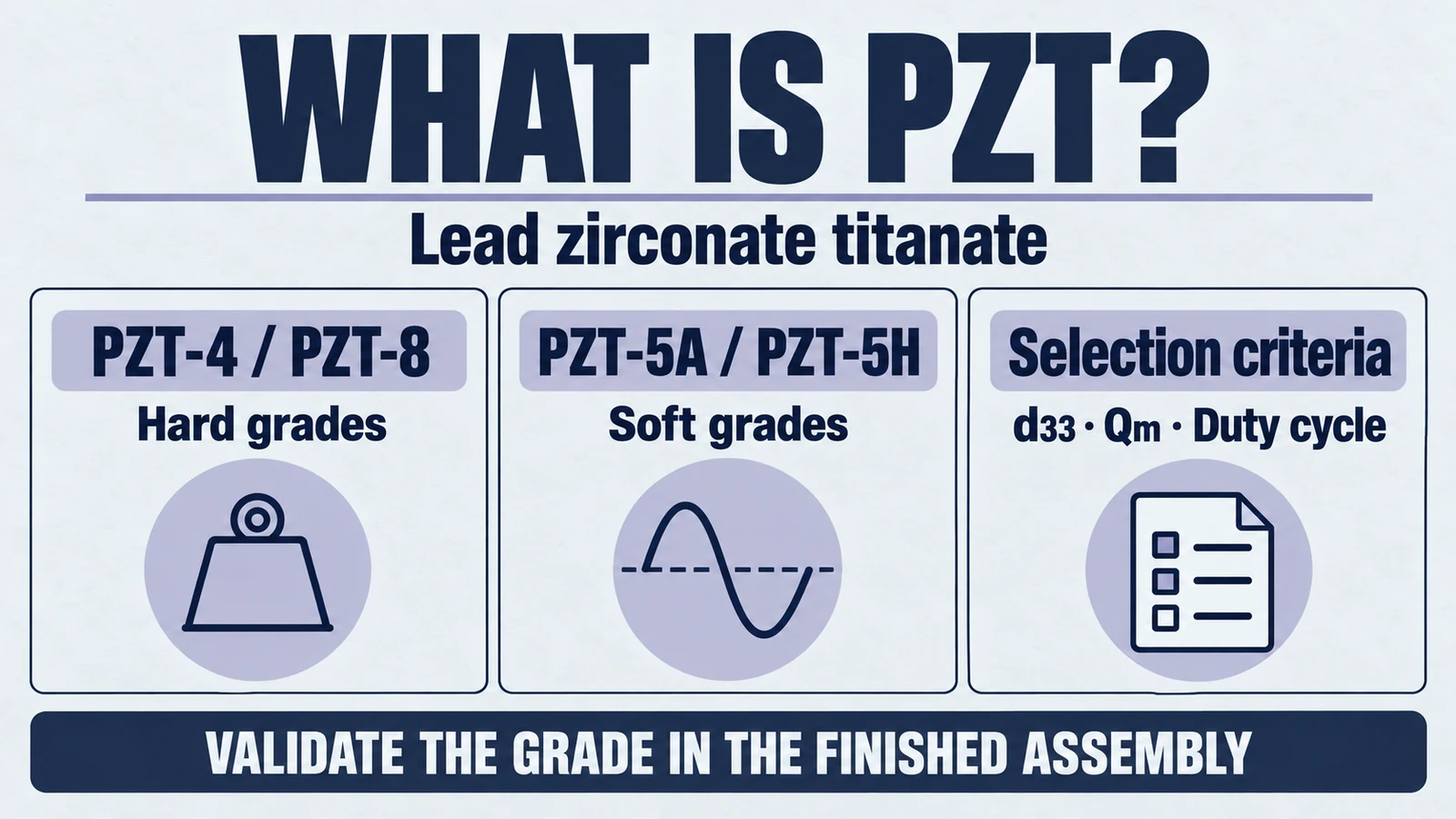
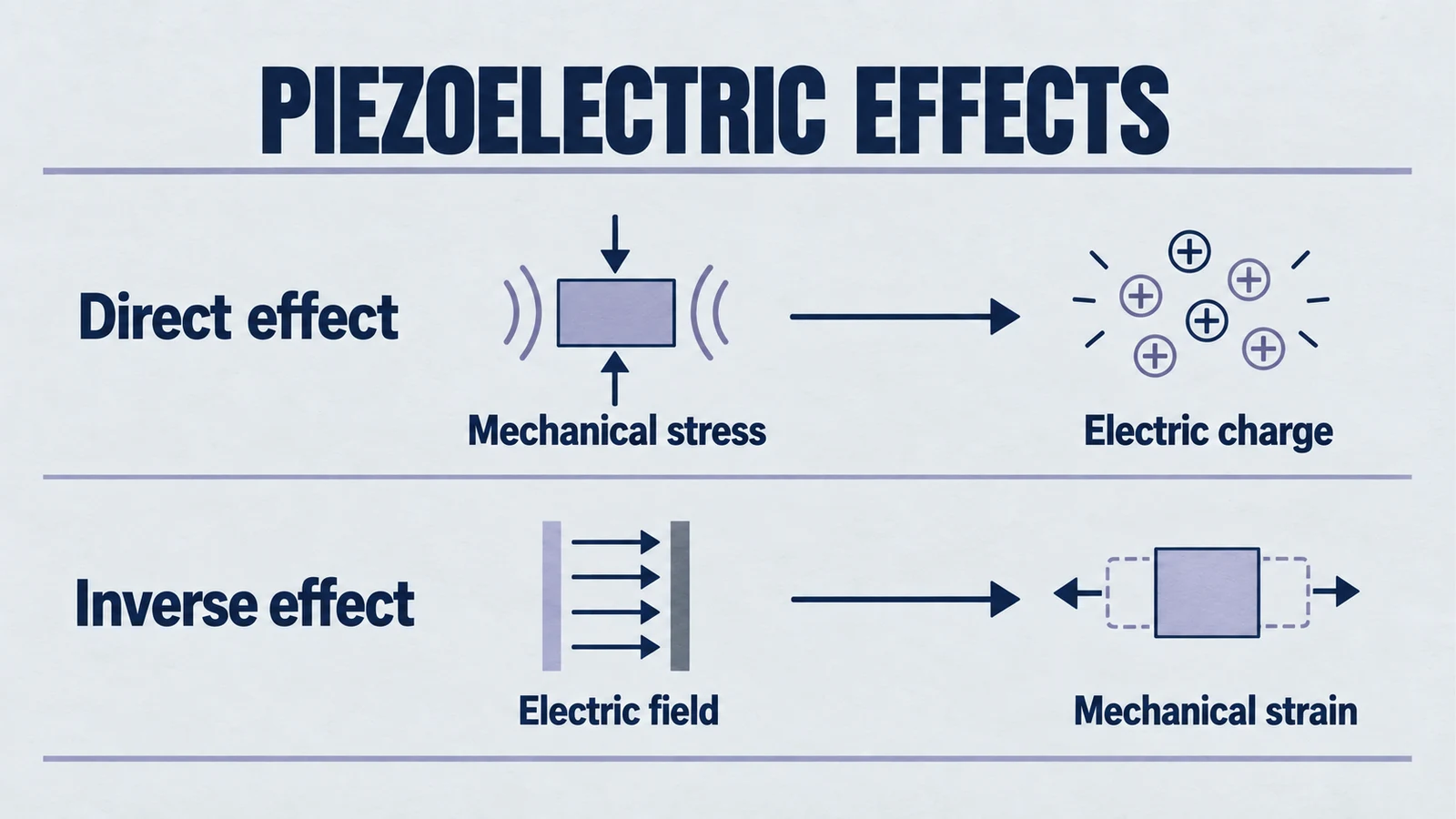
Quick answer: PZT stands for lead zirconate titanate, a piezoelectric ceramic that converts mechanical stress into electrical charge and electrical drive into motion. Engineers choose PZT because it can be tuned for sensitivity, power handling, temperature stability, and resonance behavior in sensors, actuators, and ultrasonic transducers.
- PZT-5A / soft PZT: higher sensitivity for sensors, receivers, and precision actuation.
- PZT-4 / semi-hard PZT: balanced transmit and receive behavior for sonar and medium-power ultrasonics.
- PZT-8 / hard PZT: higher Qm and lower loss for high-power cleaning, welding, and continuous-duty transducers.
For grade comparison, read soft vs hard PZT material selection. For parameter checks, see d33, k, and Qm explained.
When the next step is sourcing, compare the PZT material families, review material supplier capabilities, or start from ceramic shapes and custom elements.
Source PZT Parts for Your Production Requirements
Already have a material grade or an existing part to source? Compare PZT discs, ceramic rings, plates and tubes, or ask about PZT powder supply.
For simple shapes, send dimensions and quantity to start a supply review. Include the material or electrical targets you already use, operating conditions, first-order quantity and expected annual demand if known. Ask for volume pricing on larger orders or repeat requirements; availability, tolerances and delivery are reviewed for your actual part.
Product path for this search intent
Match the article topic to the right YJ Piezo product page
Use this article when the choice is not just a shape, but a material tradeoff between sensitivity, loss, coupling, stability, and operating field. For "What Is PZT? Full Form, Properties, and PZT-4/5A/8 Selection", the practical value is in turning the topic into a measurable selection or sourcing decision.
- PZT Material Hub
Material grades and application tradeoffs
- Piezoelectric Ceramics
Shapes and ceramic manufacturing options
- PZT Material Supplier Hub
Material control, grade selection, and sourcing support
PZT, short for lead zirconate titanate, is one of the most widely used and researched piezoelectric ceramic materials in the world. Recognized for its excellent piezoelectric, dielectric, and electromechanical properties, PZT has earned its place as a core component in numerous high-performance devices. It plays a critical role across a broad spectrum of industries—including medical imaging, consumer electronics, industrial automation, aerospace, defense, and even emerging technologies such as wearable devices and energy harvesting.
Engineering decision focus: Use this guide to decide when soft or hard PZT is the safer choice based on d33, Qm, thermal load, and target operating frequency.
In this article, we will explore what PZT is, delve into its manufacturing process, review its key material properties, and examine why it remains the dominant choice in the field of piezoelectric ceramics. Whether you're a product designer seeking new materials, an R&D engineer working on breakthrough innovations, or a procurement specialist evaluating options for your next project, this in-depth guide will help you understand the science and practical benefits behind PZT ceramics.
Looking to understand the different types of PZT materials and their specific applications? Check out our detailed guide to PZT-4, PZT-5A, PZT-5H, and PZT-8 material selection.
Video: Understanding PZT Piezoelectric Ceramics
1. What is PZT Made Of?
PZT is a solid solution consisting of two major components: lead zirconate (PbZrO₃) and lead titanate (PbTiO₃). Its chemical composition is generally denoted as Pb(ZrₓTi₁₋ₓ)O₃, where the value of x controls the ratio of zirconium to titanium in the crystal lattice. This ratio plays a decisive role in determining the final characteristics of the material.
The versatility of PZT arises from its ability to exhibit both ferroelectric and piezoelectric properties depending on how the crystal structure is aligned and processed. By incorporating small amounts of additional elements known as dopants—such as lanthanum, niobium, or manganese—the properties of PZT can be further enhanced. These dopants are carefully selected to optimize electrical behavior, reduce aging effects, or improve mechanical robustness. For example, lanthanum-doped PZT (PLZT) is often used in optical and display technologies due to its improved transparency and enhanced dielectric stability.
2. PZT Material Properties
PZT possesses a unique combination of electrical, mechanical, and thermal characteristics that make it exceptionally well-suited for piezoelectric applications. Some of its core advantages include:
- High piezoelectric coefficient (d₃₃): Offers excellent sensitivity, making it ideal for transducers and sensors
- Electromechanical coupling (kt, k33): Compare the appropriate mode-specific coupling; efficiency depends on the complete device’s losses and loading
- High dielectric constant: Enables significant charge accumulation under electric fields
- Adjustable Curie temperature: Allows use in environments with elevated operating temperatures
- Reliable frequency response: Maintains stable performance in resonance applications
- Available in soft and hard types: Suitable for either high sensitivity or high power needs
Compared to other piezoelectric materials like quartz or barium titanate, PZT offers much higher performance and tunability, making it the default material in most commercial and industrial piezo devices. For more detailed specifications, visit our material specifications page.
3. PZT Manufacturing Process
The production of PZT ceramics involves multiple precise and controlled steps to ensure material quality and performance consistency. The process includes:
- Powder preparation: High-purity raw materials such as PbO, ZrO₂, and TiO₂ are mixed in exact proportions
- Calcination: The powder mixture is heated to high temperatures (~800–900°C) to initiate solid-state reactions that form the PZT perovskite phase
- Ball milling: Reduces particle size to improve homogeneity and facilitate shaping
- Shaping: The powder is formed into desired geometries using dry pressing, tape casting, injection molding, or extrusion
- Binder burnout and sintering: The shaped bodies are first heated to remove organic binders, then sintered at 1200–1300°C to densify the ceramic and eliminate porosity
- Electrode application: Silver, gold, or nickel electrodes are applied to allow electrical connectivity
- Poling: The ceramic is exposed to a strong DC electric field (~2–3 kV/mm) at an elevated temperature, aligning the electric dipoles and enabling piezoelectricity
At Yujie, we maintain strict process control and perform comprehensive testing to ensure that each PZT batch meets rigorous industrial standards. This commitment to quality is essential for applications where stability and accuracy are non-negotiable. Learn more about our manufacturing excellence.
4. PZT Properties in Detail
Below is a summary of the typical physical and electrical properties of PZT ceramics:
| Property | Typical Value |
|---|---|
| Piezoelectric coefficient (d₃₃) | 200 – 600 pC/N |
| Electromechanical coupling (k₃₃) | 0.5 – 0.75 |
| Dielectric constant (εᵣ) | 1000 – 3500 |
| Curie Temperature | 200 – 360°C |
| Density | ~7.5 – 8.0 g/cm³ |
| Mechanical Q | Soft PZT: ~50 – 100 / hard PZT: ~500 – 1200 |
| Young's Modulus | ~60 – 70 GPa |
| Acoustic Velocity | ~4000 m/s |
In addition to these basic specifications, application-specific variants may be optimized for low aging rates, high mechanical strength, or minimal temperature drift. For instance, some PZT compositions are tailored to have minimal dielectric loss for high-precision sensors, while others are doped to perform under high electric fields without breakdown.
5. Why Is PZT So Popular?
PZT continues to dominate the piezoelectric material landscape due to several key reasons:
- Field-proven reliability: Decades of use in real-world conditions have validated its stability and effectiveness
- High performance-to-cost ratio: Delivers superior functional properties without significantly increasing manufacturing costs
- Wide compositional flexibility: Can be customized for sensing, actuation, or energy conversion
- Versatile shapes and formats: Manufacturable in rings, tubes, discs, plates, rods, hollow spheres, and complex custom geometries
- Scalable production: Readily available in both small and large volumes for diverse customer needs
- Excellent integration: Easily combines with electronics, packaging, and embedded systems
This popularity is further sustained by an active global ecosystem of suppliers, researchers, and equipment manufacturers who continuously advance PZT-based technologies.
6. PZT Ceramic Applications
PZT's outstanding versatility has enabled it to serve as a foundational material in numerous applications:
- Medical Devices: Diagnostic ultrasound probes, validated ultrasound components, piezoelectric scalers, and drug delivery micro-pumps
- Industrial Systems: Precision actuators, ultrasonic cleaners, thickness gauges, NDT probes, and accelerometers
- Consumer Electronics: Smartphone haptics, inkjet printer heads, microphones, piezo buzzers, and vibration sensors
- Aerospace & Defense: Sonar systems, smart structures with embedded health monitoring, gyroscopes, and missile guidance components
- Beauty & Personal Care: Ultrasonic facial tools, atomizers for skincare products, massage heads with precise vibration control
- Energy Harvesting: Self-powered wireless sensors for IoT applications, wearable electronics, and structural vibration scavengers
At Yujie, we support customers across these sectors by providing not just high-quality ceramics, but also engineering expertise, product customization, and logistical efficiency to meet demanding project timelines. Explore our complete product range.
For OEM beauty-device sourcing, see Yujie's facial ultrasonic transducer HJ-2806, the facial cleansing variant HJ-2806C, and the facial massage transducer HJ-2804.
7. Is PZT Right for Your Application?
If you are developing a device that involves motion detection, vibration analysis, frequency generation, or energy transduction, PZT is likely the best material candidate. Choosing the correct formulation and configuration can drastically enhance your product's reliability and performance.
Our team at Yujie helps customers through every step, from design selection to production:
- Material formulation guidance: Matching piezoelectric properties to your technical goals
- Shape and size engineering: Assisting in geometry selection based on mechanical and electrical design needs
- Poling strategy optimization: Ensuring consistent and effective domain alignment for maximum performance
- Environmental testing: Verifying durability in thermal, humidity, and vibration conditions
Whether you're prototyping a new product or scaling up manufacturing, we provide tailored support and quick turnaround solutions.
8. Final Thoughts
PZT remains a core material in modern piezoelectric technology. With broad versatility, tunable properties, and proven reliability, it continues to support innovation across industries. Whether you're developing a new ultrasound probe, sensor array, haptic system, or energy harvester, PZT ceramics provide a robust and cost-effective solution.
Its ongoing popularity is not simply due to historical dominance but to its continual relevance in the face of new technological challenges. With emerging fields such as biomedical wearables, structural health monitoring, and precision robotics pushing the boundaries of performance, PZT's adaptive capabilities are more crucial than ever.
Even as researchers explore next-generation piezoelectric materials, the wealth of knowledge, established infrastructure, and field-tested durability that PZT offers make it a difficult material to replace. Its combination of performance and manufacturability ensures it will remain a go-to option for years to come.
Yujie has built PZT manufacturing experience since 1996. We work closely with our customers to deliver ceramics that meet their exact specifications—from prototyping to mass production. When performance matters, precision counts, and partnership is key, you can rely on us.
Looking for a reliable PZT supplier? Choose Yujie—where expertise meets excellence.
To learn more about our company and capabilities, visit our About page or browse additional articles in our blog.
External References
- PI Ceramic: Piezoceramic materials overview and application notes
- APC International: Piezo theory, material behavior, and constant definitions
- APC International: d33 measurement reference for production screening
Related Engineering Reading
Engineering decision notes
PZT material and ceramic selection
Use this article when the choice is not just a shape, but a material tradeoff between sensitivity, loss, coupling, stability, and operating field. For "What Is PZT? Full Form, Properties, and PZT-4/5A/8 Selection", the practical value is in turning the topic into a measurable selection or sourcing decision.
YJ Piezo coordinates PZT ceramic projects with manufacturing support, so material formulation, sintering, polarization, electrode process, and outgoing inspection can be reviewed against the final application.
Selection checks
- Separate sensing needs from high-power actuation needs before comparing d33 or coupling values.
- Check dielectric loss, Qm, Curie temperature, aging behavior, and operating field against the real duty cycle.
- Confirm whether the application needs standard PZT grades or a custom formulation and geometry.
Failure risks
- Choosing only the highest d33 can create heat, drift, or depolarization risk in power ultrasonics.
- A ceramic that performs well in free measurement can fail once bonded, clamped, or loaded.
- Material substitutions without batch testing can change capacitance, resonance, and system tuning.
RFQ details
- Is the part used for sensing, actuation, atomization, cleaning, welding, or measurement?
- What field strength, temperature, duty cycle, and mechanical load will the ceramic see?
- Which values must be controlled: d33, capacitance, resonance, impedance, Qm, or dimensional tolerance?
Relevant YJ Piezo pages
- PZT Material Hub
Material grades and application tradeoffs
- Piezoelectric Ceramics
Shapes and ceramic manufacturing options
- PZT Material Supplier Hub
Material control, grade selection, and sourcing support
Application FAQ
- Is the highest d33 always the best PZT choice?
- No. High d33 can be useful for sensitivity, but high-power ultrasonic systems often need lower loss, higher Qm, better thermal stability, and safer operation under field and stress.
- What makes PZT material selection different from catalog buying?
- The right PZT choice depends on geometry, load, drive field, duty cycle, temperature, and inspection targets. A catalog value is only useful when it is tied to the final assembly conditions.