
d33, k, Qm in Piezo Ceramics: Engineering Selection Guide
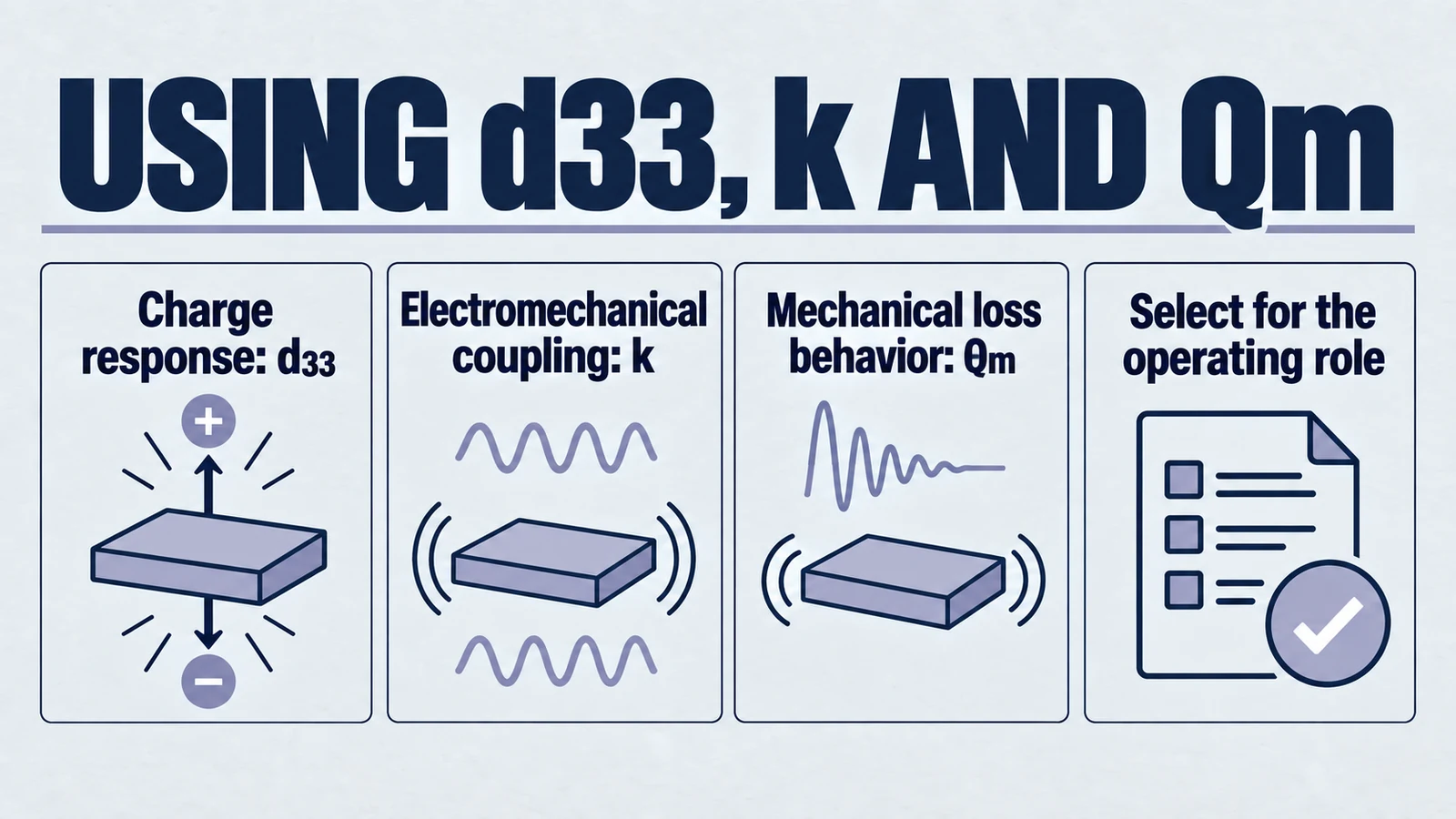
Quick answer: d33 estimates charge output or motion along the poling axis, k shows how efficiently electrical and mechanical energy couple, and Qm shows how sharply and efficiently a ceramic resonates. High d33 is useful for sensing and displacement; high Qm is usually safer for high-power ultrasonic duty.
Use this guide with PZT fundamentals, soft vs hard PZT grades, and piezoelectric material test methods.
Piezoelectric materials are fundamental to a wide range of modern technologies, playing a critical role in sensors, actuators, medical imaging, energy harvesters, and more. These materials possess a unique property: they can convert mechanical energy into electrical energy and vice versa through the piezoelectric effect. This dual capability makes them important in industries that require high precision, efficiency, and miniaturization.
Engineering decision focus: Translate d33, k, and Qm into practical trade-offs between sensitivity, bandwidth, and power durability before selecting a material.
To maximize the performance and reliability of piezoelectric devices, engineers and researchers must understand the quantitative indicators that define their behavior. Among the numerous parameters used to characterize piezoelectric materials, the three most essential constants are d33, k, and Qm. Each of these constants reveals specific performance traits such as sensitivity, efficiency, and durability under repeated mechanical or electrical loading.
Product path for this search intent
Match the article topic to the right YJ Piezo product page
Use this article when the choice is not just a shape, but a material tradeoff between sensitivity, loss, coupling, stability, and operating field. For "d33, k, Qm in Piezo Ceramics: Engineering Selection Guide", the practical value is in turning the topic into a measurable selection or sourcing decision.
- PZT Material Hub
Material grades and application tradeoffs
- Piezoelectric Ceramics
Shapes and ceramic manufacturing options
- PZT Material Supplier Hub
Material control, grade selection, and sourcing support
In this blog, we delve into the technical meaning, physical implications, and practical applications of these constants to support informed material selection, system design, and performance optimization in your piezoelectric projects.
🚀 Advanced Engineering Guide
For a deeper dive into the physics and mathematical modeling of these constants, read our updated 2026 technical guide: The Secret Language of Piezoelectricity: Decoding d33, k, and Qm.
What Are Piezoelectric Constants?
Piezoelectric constants are defined numerical parameters that describe how piezoelectric materials respond to electrical or mechanical stimuli. These constants form the foundation of piezoelectric material science and are critical for simulation, modeling, and device prototyping.
Understanding these constants enables engineers to:
- Predict device output under mechanical or electrical excitation
- Optimize material and geometry for specific application needs
- Compare different piezoelectric materials with similar form factors
The most widely referenced piezoelectric constants include:
- d33 – Piezoelectric Charge Coefficient
- k – Electromechanical Coupling Coefficient
- Qm – Mechanical Quality Factor
Each constant reflects a distinct but interconnected property of the piezoelectric material and informs how the material will behave under different types of loading or operating environments.
d33 – Piezoelectric Charge Coefficient
Definition: d33 relates electric displacement (charge per electrode area) to longitudinal stress at constant electric field, or longitudinal strain to electric field at constant stress, along the poling axis. For a uniformly loaded longitudinal specimen under short-circuit conditions, charge per force gives the same coefficient.
Units: pC/N (picoCoulombs per Newton)
Physical Meaning:
- A high d33 value implies strong mechanical-electrical interaction, making the material ideal for applications where signal strength and sensitivity are paramount.
- The d33 constant is especially important in longitudinal mode operations, such as needle-type ultrasound transducers or force sensors.
Use Cases:
- Medical ultrasound probes (e.g., echocardiography, prenatal imaging)
- Acoustic sensors and hydrophones
- High-resolution actuators in micro-positioning stages
Typical Values:
Yujie's air-acoustic line — the low-frequency KQ-40KH-P, the mid-range KQ-112KH, and the precision distance transducer KQ-200KH-2 — covers the common airborne sensing bands.
- Hard PZT: ~100–300 pC/N (suitable for power applications)
- Soft PZT: ~300–600 pC/N (suitable for sensing and actuation)
k – Electromechanical Coupling Coefficient
Definition: The coupling coefficient k describes electromechanical coupling for a specified mode and boundary conditions; it is not useful-output-energy efficiency of an assembled device. It is a dimensionless number (0 < k < 1) and often represented as a percentage for convenience.
Variants:
- k33: Longitudinal coupling
- k31: Transverse coupling
- kp: Planar coupling
- kt: Thickness mode coupling
Interpretation:
- A higher k indicates stronger coupling for the specified mode. Device efficiency also depends on losses, loading, and drive conditions.
- The value of k affects bandwidth, sensitivity, and mechanical impedance.
Application Examples:
- Energy harvesting systems (to maximize mechanical-to-electrical efficiency)
- Resonant ultrasonic transducers (e.g., for non-destructive testing or welding)
- Piezoelectric motors and gyroscopes
Typical Values:
- Soft PZT: k33 ~0.70–0.75
- Hard PZT: k33 ~0.60–0.68
Engineering Note: The value of k should always be considered alongside d33. For example, a material with a high k but moderate d33 might be efficient but not necessarily produce large signals.
Qm – Mechanical Quality Factor
Definition: The mechanical quality factor Qm measures the sharpness of mechanical resonance by quantifying how little energy is lost as heat or internal friction during cyclic operation. For a specified mechanical resonance, the conventional energy definition is 2π times stored mechanical energy divided by mechanical energy dissipated per cycle.
Interpretation:
- A high Qm value indicates low mechanical losses and a narrow resonance under the specified conditions. It does not independently establish frequency stability with temperature, time, or loading.
- Qm is crucial for power applications that rely on resonance for performance, such as ultrasonic cleaning or sonochemistry.
Applications:
- High-power ultrasonic welding tools
- Resonant sensors and transducers in industrial automation
- Stable-frequency oscillators and filter devices
Typical Values:
- Hard PZT: Qm ~500–1500
- Soft PZT: Qm ~50–200
Bandwidth Consideration:
- Devices that require sharp frequency control (e.g., filters, resonators) prefer higher Qm.
- Applications demanding broader frequency response (e.g., imaging) might benefit from lower Qm.
Choosing the Right Material Based on Constants
Selecting the best piezoelectric material depends on balancing d33, k, and Qm according to the demands of your application. Below is a more detailed overview of how different constant values align with practical device requirements.
| Application Type | Preferred Constant Characteristics |
|---|---|
| High-sensitivity medical sensors | Very high d33, moderate k, lower Qm for broader bandwidth |
| Power ultrasonic transducers | High Qm for resonance, high k for energy conversion, moderate d33 |
| Precision actuators | High d33 for fine movement, moderate k, lower Qm when faster settling or damping is needed |
| Wideband imaging systems | High d33, lower Qm to accommodate wide frequency range |
| Resonant frequency filters | Very high Qm, high k for narrow, stable frequency response |
| Energy harvesters | Balanced k and d33, Qm optimized based on power throughput goals |
The ideal material often involves trade-offs. For example, increasing Qm may enhance resonance but reduce system responsiveness. Working with a supplier that understands these subtleties is essential to fine-tune material specifications to your unique needs.
Conclusion
Piezoelectric constants like d33, k, and Qm are not just academic parameters—they are practical tools that guide the engineering of high-performance devices. Understanding the physical meaning and trade-offs among these constants empowers designers to optimize for signal strength, energy efficiency, mechanical stability, or bandwidth depending on the use case.
Whether you are working on a next-generation medical ultrasound array, developing robust sonar systems, or integrating smart sensors into industrial equipment, your ability to interpret and apply piezoelectric constants will directly influence your product's success.
At Yujie, we specialize in producing customized piezoelectric ceramics that meet exacting performance criteria. Our team is here to help you navigate material selection, optimize your design, and deliver reliable solutions for every application—from concept to mass production.
Reach out to us today to explore how our piezoelectric solutions can elevate your innovation.
External References
- APC International: Piezo theory and core constants overview
- APC International: Resonance, bandwidth, and frequency measurement note
- PI Ceramic: Piezoceramic materials and property trade-offs
Source PZT Parts for Your Production Requirements
Already have a material grade or an existing part to source? Compare PZT discs, ceramic rings, plates and tubes, or ask about PZT powder supply.
For simple shapes, send dimensions and quantity to start a supply review. Include the material or electrical targets you already use, operating conditions, first-order quantity and expected annual demand if known. Ask for volume pricing on larger orders or repeat requirements; availability, tolerances and delivery are reviewed for your actual part.
Related Engineering Reading
Engineering decision notes
PZT material and ceramic selection
Use this article when the choice is not just a shape, but a material tradeoff between sensitivity, loss, coupling, stability, and operating field. For "d33, k, Qm in Piezo Ceramics: Engineering Selection Guide", the practical value is in turning the topic into a measurable selection or sourcing decision.
YJ Piezo coordinates PZT ceramic projects with manufacturing support, so material formulation, sintering, polarization, electrode process, and outgoing inspection can be reviewed against the final application.
Selection checks
- Separate sensing needs from high-power actuation needs before comparing d33 or coupling values.
- Check dielectric loss, Qm, Curie temperature, aging behavior, and operating field against the real duty cycle.
- Confirm whether the application needs standard PZT grades or a custom formulation and geometry.
Failure risks
- Choosing only the highest d33 can create heat, drift, or depolarization risk in power ultrasonics.
- A ceramic that performs well in free measurement can fail once bonded, clamped, or loaded.
- Material substitutions without batch testing can change capacitance, resonance, and system tuning.
RFQ details
- Is the part used for sensing, actuation, atomization, cleaning, welding, or measurement?
- What field strength, temperature, duty cycle, and mechanical load will the ceramic see?
- Which values must be controlled: d33, capacitance, resonance, impedance, Qm, or dimensional tolerance?
Relevant YJ Piezo pages
- PZT Material Hub
Material grades and application tradeoffs
- Piezoelectric Ceramics
Shapes and ceramic manufacturing options
- PZT Material Supplier Hub
Material control, grade selection, and sourcing support
Application FAQ
- Is the highest d33 always the best PZT choice?
- No. High d33 can be useful for sensitivity, but high-power ultrasonic systems often need lower loss, higher Qm, better thermal stability, and safer operation under field and stress.
- What makes PZT material selection different from catalog buying?
- The right PZT choice depends on geometry, load, drive field, duty cycle, temperature, and inspection targets. A catalog value is only useful when it is tied to the final assembly conditions.
Related Products
- Low Frequency Transducer KQ-40KH P
- Mid Range Transducer KQ-112KH
- Precision Distance Transducer KQ-200KH 2