
Top Advantages of Using Piezoelectric Sensors in Medical Devices
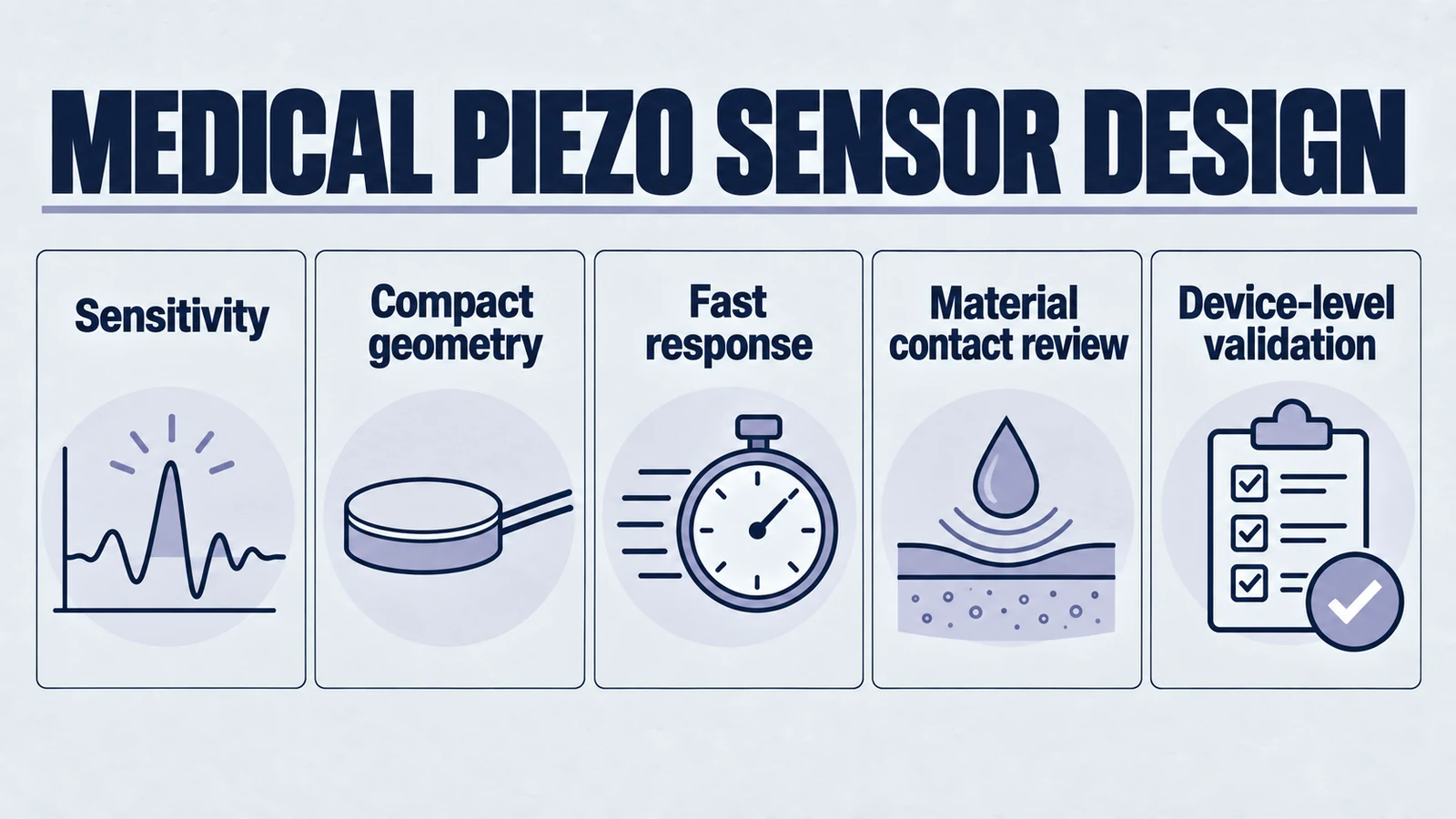
In the rapidly evolving field of healthcare technology, piezoelectric sensors are useful components in many medical device architectures. These sensors convert mechanical stress into electrical signals and can support compact measurement, actuation, and acoustic functions when they are integrated into a validated finished device.
In this article, we explore the top advantages of using piezoelectric sensors in medical devices, and why more manufacturers are adopting piezoelectric sensing technology as a core feature in their innovations.
1. Exceptional Sensitivity and Precision
One of the most valued characteristics of piezoelectric sensors is their high sensitivity to pressure and strain, enabling measurement of dynamic physiological signals within the validated bandwidth, noise, drift and sensitivity limits. This is essential for devices such as:
Product path for this search intent
Match the article topic to the right YJ Piezo product page
Use this article when the choice is not just a shape, but a material tradeoff between sensitivity, loss, coupling, stability, and operating field. For "Top Advantages of Using Piezoelectric Sensors in Medical Devices", the practical value is in turning the topic into a measurable selection or sourcing decision.
- PZT Material Hub
Material grades and application tradeoffs
- Piezoelectric Ceramics
Shapes and ceramic manufacturing options
- PZT Material Supplier Hub
Material control, grade selection, and sourcing support
- Ultrasound imaging systems using piezoelectric transducers
- Cardiac monitoring tools with piezoelectric elements
- Pressure-sensing research: Conventional direct piezo sensing has finite charge-decay/time constants; sustained intraocular/static pressure requires a documented architecture and drift assessment
In these applications, stable component response can support repeatable measurement. The linearity and signal stability of piezoelectric sensing components help device engineers build predictable measurement chains for their own validation programs.
2. Compact Size and Design Flexibility
Piezoelectric sensors can be manufactured in very small sizes, making them ideal for integration into miniaturized medical devices such as:
- Wearable health monitors with embedded piezoelectric sensors
- Implantable medical sensors powered by piezoelectricity
- Endoscopic instruments enhanced with piezoelectric components
This compactness allows for greater design freedom while maintaining functionality, especially in space-constrained instruments. Engineers can integrate piezoelectric sensing technology in tight spaces while balancing sensitivity, packaging, wiring, encapsulation, and sterilization requirements.
3. No External Power Required for Sensing
Unlike many traditional sensors, piezoelectric sensors generate an electric charge on their own in response to mechanical stress. This self-powered feature is particularly advantageous in:
- Long-term monitoring hardware using piezoelectric-based systems
- Remote or wearable medical devices with piezoelectric energy harvesting
- Low-power medical electronics designed with piezoelectric sensors
This can support longer device runtime and lower maintenance burden, key benefits in both healthcare and home-use equipment. Engineers should still evaluate battery strategy, signal conditioning, alarm logic, and failure modes at the finished-device level.
4. High Reliability and Durability
Piezoelectric materials require grade-, package- and finished-device qualification for exposures such as:
- High temperatures in sterilization processes
- Repetitive mechanical stress during use
- Chemical exposure in hospital settings
Establish endurance, reprocessing and chemical compatibility for the actual materials, package, process and use conditions. A piezoelectric element alone does not guarantee superior durability, device conformity or clinical authorization.
5. Fast Response Time
In time-sensitive applications like emergency diagnostics or surgical monitoring, rapid data acquisition is crucial. Complete-system response depends on bandwidth, filtering and latency, providing real-time feedback that can be used to:
- Trigger alerts for abnormal physiological conditions
- Adjust drug delivery rates in infusion pumps using piezoelectric feedback
- Synchronize imaging with physiological cycles using piezoelectric timing cues
This fast response can contribute to closed-loop medical systems that adapt to measured conditions in real time, provided the control logic and system behavior are validated by the device manufacturer.
6. Material Contact and Device-Level Validation
Modern piezoelectric ceramics used near medical devices are usually isolated, encapsulated, or placed outside the direct contact path. Material-contact evaluation should be performed by the finished-device manufacturer, especially for:
- Implantable sensors using piezoelectric transducers
- Catheters and guidewires with piezoelectric-based feedback
- Dental diagnostic equipment incorporating piezoelectric technology
Stable ceramic properties, compatible packaging, and well-documented processing can support consistent performance throughout the device life cycle. Contact path, cleaning, sterilization, and regulatory evidence should be assessed in the complete device design.
7. Versatile Application Across Medical Fields
From cardiology and neurology to oncology and rehabilitation, piezoelectric sensors are highly versatile. Common applications include:
- Respiratory monitoring: Detecting airflow and breathing patterns using piezoelectric elements
- Orthopedic devices: Measuring strain in bone and joint implants with piezoelectric components
- Hearing aids: Capturing sound waves through piezoelectric transducers
Their adaptability allows engineers and designers to tailor solutions for specific device requirements. In combination with data analytics and software, piezoelectric sensor technology can provide inputs for monitoring and decision-support systems.
8. Integration with Digital Health Ecosystems
Piezoelectric sensors support the broader shift toward digital health by enabling real-time data collection and wireless transmission. When integrated with IoT-enabled medical platforms, they facilitate continuous health monitoring and personalized medicine. Examples include:
- Remote monitoring systems with piezoelectric data inputs
- AI-driven diagnostic platforms using real-time piezoelectric sensing
- Smart rehabilitation equipment enhanced by piezoelectric monitoring
Such integration supports proactive care models, may supply monitoring data; reduced readmission or clinical benefit requires a named finished-device study.
Choosing the Right Piezoelectric Components for Medical Applications
When selecting piezoelectric sensors for medical devices, it is important to consider sensitivity, size constraints, operating temperature, contact-path isolation, documentation, and validation requirements. Our comprehensive guide on how to choose the right piezoelectric ceramic provides detailed selection criteria for engineering applications.
For specialized medical sensing applications, consider our various product lines:
- Bubble detection sensors for medical fluid monitoring
- Piezoelectric ceramic elements for acoustic and sensing assemblies
- Rectangular series for flat surface monitoring in medical devices
Final Thoughts
As medical technology continues to push boundaries, the demand for high-performance, reliable, and compact sensing solutions grows. Piezoelectric sensors not only meet these demands but exceed expectations in many critical healthcare applications.
At Yujie Technology, we specialize in advanced piezoelectric ceramic components for device engineering teams. Contact us to discuss PZT material selection, component geometry, electrode layout, and documentation support for your medical device development program.
For more insights on piezoelectric technology in healthcare, explore our related articles:
Engineering decision notes
PZT material and ceramic selection
Use this article when the choice is not just a shape, but a material tradeoff between sensitivity, loss, coupling, stability, and operating field. For "Top Advantages of Using Piezoelectric Sensors in Medical Devices", the practical value is in turning the topic into a measurable selection or sourcing decision.
YJ Piezo coordinates PZT ceramic projects with manufacturing support, so material formulation, sintering, polarization, electrode process, and outgoing inspection can be reviewed against the final application.
Selection checks
- Separate sensing needs from high-power actuation needs before comparing d33 or coupling values.
- Check dielectric loss, Qm, Curie temperature, aging behavior, and operating field against the real duty cycle.
- Confirm whether the application needs standard PZT grades or a custom formulation and geometry.
Failure risks
- Choosing only the highest d33 can create heat, drift, or depolarization risk in power ultrasonics.
- A ceramic that performs well in free measurement can fail once bonded, clamped, or loaded.
- Material substitutions without batch testing can change capacitance, resonance, and system tuning.
RFQ details
- Is the part used for sensing, actuation, atomization, cleaning, welding, or measurement?
- What field strength, temperature, duty cycle, and mechanical load will the ceramic see?
- Which values must be controlled: d33, capacitance, resonance, impedance, Qm, or dimensional tolerance?
Relevant YJ Piezo pages
- PZT Material Hub
Material grades and application tradeoffs
- Piezoelectric Ceramics
Shapes and ceramic manufacturing options
- PZT Material Supplier Hub
Material control, grade selection, and sourcing support
Application FAQ
- Is the highest d33 always the best PZT choice?
- No. High d33 can be useful for sensitivity, but high-power ultrasonic systems often need lower loss, higher Qm, better thermal stability, and safer operation under field and stress.
- What makes PZT material selection different from catalog buying?
- The right PZT choice depends on geometry, load, drive field, duty cycle, temperature, and inspection targets. A catalog value is only useful when it is tied to the final assembly conditions.