YJ Piezo Ultrasonic Sensors
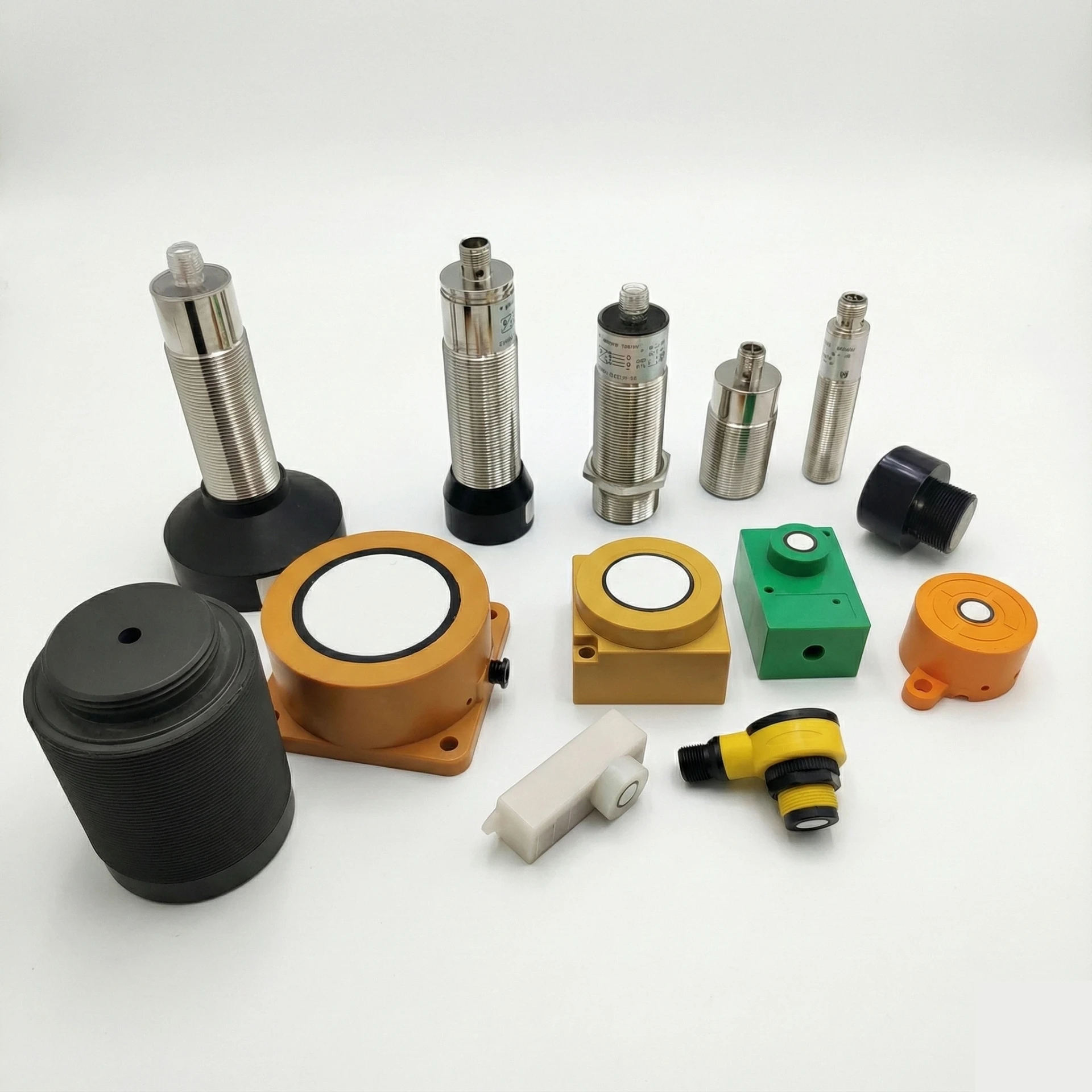
YJ Piezo's professional ultrasonic sensors for non-contact level and distance measurement in industrial environments. Reliable operation in dusty, smoky, rainy or snowy conditions with ranges up to 10 meters.
Features & Applications
Common Features and General Applications
All of these ultrasonic sensors use non-contact level and distance measurement, and they can operate reliably in dusty, smoky, rainy or snowy conditions. They are insensitive to light, colour, surface reflectivity and shape, and can detect metals, plastics, wood and even transparent or granular materials.
With measuring ranges up to 10 m and multiple output options (digital, switching, analog), the sensors are available with PVDF or stainless-steel housings for chemical corrosion resistance and protection grades up to IP68, making them suitable for corrosive environments and outdoor applications.
Non-Contact Measurement
Reliable distance and level detection without physical contact, ideal for fragile or moving targets
All-Weather Operation
Performs reliably in dusty, smoky, rainy, or snowy conditions where optical sensors fail
Material-Independent
Detects metals, plastics, wood, transparent materials, and granular substances regardless of color or reflectivity
Long-Range Detection
Measuring ranges from 60mm up to 10 meters for diverse application requirements
Multiple Outputs
Digital (RS232/485, UART), switching (PNP/NPN), analog (voltage/current), and relay outputs available
Harsh Environment Ready
PVDF and stainless-steel housings with IP67/IP68 protection for corrosive and outdoor applications
Typical Applications
- •Level and Distance Measurement: Tank level monitoring, silo content measurement, material height detection
- •Container and Silo Monitoring: Bulk material level control, hopper management, inventory tracking
- •Goods Management: Warehouse automation, pallet detection, conveyor systems
- •Factory Automation: Production line monitoring, robotic guidance, automated sorting
- •Position Detection: Object positioning, AGV navigation, parking guidance systems
- •Collision Avoidance: Crane anti-collision, mobile equipment safety, overhead protection
Ultrasonic Sensor Integration Constraints
Reliable sensor selection requires balancing physical acoustic constraints against application requirements. Engineering teams must evaluate these three critical integration factors:
1. The Blind Zone vs. Range Trade-off
Physics Constraint: Lower frequency sensors achieve longer detection ranges but require longer piezoelectric ringing times, resulting in larger blind zones.
2. Beam Geometry & Interference
Physics Constraint: Detection reliability depends on matching the acoustic beam width to the tank geometry.
3. Acoustic Impedance Matching
Physics Constraint: Energy transfer efficiency depends on the impedance match between the piezoelectric element and the medium (Air vs. Gas).
Sensor Architecture Classification Matrix
Comparing sensor topological classes rather than individual SKUs matches the right technology to the environment.
Ultrasonic Bubble Detection Sensor
Ultrasonic sensor for bubble detection in fluid lines
Range: Detection distance 60mm
HJ-FS-200-02A Ultrasonic Anemometer Transducer
200 kHz airflow sensing transducer for ultrasonic anemometer and wind measurement systems
Range: Blind zone < 100mm
MU18 Ultrasonic Distance Sensor
Compact M18 sensor with 100-1000mm range
Range: 100-1000mm
MU30 Ultrasonic Distance Sensor
General-purpose sensor with 200-6000mm range
Range: 200-6000mm
Stainless Steel Housing Sensor
Food-grade sensor for corrosive environments
Range: 200-2000mm
MRR-1 Series Sensor
Compact M18×33mm for IoT applications
Range: 100-1000mm
UltraNova-1 Series Sensor
Optional PVDF housing with battery power
Range: 180-3000mm
UltraNova-2 Series Sensor
Surface-mount design with IP68 protection
Range: 200-4000mm
SF-2 Series Sensor
TECH-IN design with battery support
Range: 100-1000mm
SR-55 Series Sensor
Surface-mount with optional AC input
Range: 200-4000mm
SR-80 Series Sensor
Long-distance sensor with 10m maximum range
Range: 400-10000mm
MDC Double-Sheet Detection Sensor
Specialized for double-sheet and label detection
Range: Detection distance 60mm
What are ultrasonic sensors used for?
Ultrasonic sensors are used for non-contact distance measurement, level monitoring, object detection, and collision avoidance in industrial automation, robotics, warehouse management, and IoT applications.
What is the maximum range of YJ Piezo ultrasonic sensors?
YJ Piezo ultrasonic sensors offer measuring ranges from 60mm up to 10 meters. The SR-80 series provides the longest range for applications like crane collision avoidance.
Can ultrasonic sensors work in harsh environments?
Yes, YJ Piezo offers IP67/IP68 rated sensors with PVDF and stainless steel housings designed for corrosive, dusty, and outdoor environments.
How do I choose the right ultrasonic sensor?
Consider your measurement range requirements, environmental conditions, output type needs (analog, digital, switching), and mounting constraints. See our selection guide above or contact YJ Piezo's technical team for assistance.
How does air temperature affect ultrasonic distance accuracy?
The speed of sound in air changes by approximately 0.6 m/s per °C. YJ Piezo ultrasonic sensors include built-in NTC temperature compensation to adjust time-of-flight calculations in real-time, ensuring accuracy across fluctuating thermal environments.
Can these piezoelectric sensors detect sound-absorbing materials like foam?
Sound-absorbing materials with low density (foam, textiles) significantly reduce echo strength. Detection requires sensors with high acoustic pressure output and adjusted sensitivity settings. For these applications, lower frequency models with typically provide better performance than high-frequency precision sensors.
What is the impact of tank overpressure on sensor performance?
Pressurized environments change the acoustic impedance of the gas medium, which can affect the coupling efficiency of the transducer. Additionally, excessive pressure can deform the piezoelectric element casing. Standard sensors are rated for atmospheric pressure key; consult our engineering team for pressurized vessel applications.
Need a Custom YJ Piezo Sensor Solution?
YJ Piezo's engineering team can help you select the right ultrasonic sensor for your application or develop a custom solution tailored to your specific requirements.