
Precision Distance Measurement with Ultrasonic Sensors: Tips for Accuracy
Precision Distance Measurement with Ultrasonic Sensors: Tips for Accuracy
Ultrasonic sensors, widely known as ultrasonic distance sensors or ultrasonic rangefinders, play a crucial role in precision measurement applications across industries such as robotics, automation, automotive, and industrial monitoring. Achieving high accuracy with these sensors is essential for reliable performance. In this comprehensive guide, we'll cover critical factors and best practices for maximizing accuracy with ultrasonic distance sensors.
Understanding How Ultrasonic Distance Sensors Work
Ultrasonic rangefinders operate by emitting high-frequency sound waves and measuring the time it takes for these waves to bounce back from an object. This time is then converted into distance using the speed of sound. Accurate measurements depend on several variables, including temperature, humidity, and object properties.
Product path for this search intent
Match the article topic to the right YJ Piezo product page
Use this article when sensor performance depends on target distance, beam angle, housing material, liquid behavior, or false echo control. For "Precision Distance Measurement with Ultrasonic Sensors: Tips for Accuracy", the practical value is in turning the topic into a measurable selection or sourcing decision.
- Ultrasonic Sensors
Distance, level, and detection sensor portfolio
- Flow Measurement Transducers
Bubble and flow-related ultrasonic sensing paths
- Air Acoustic Transducers
Air-coupled transducers for range and presence detection
The core technology behind these sensors relies on high-quality piezoelectric transducers that generate and receive ultrasonic waves with exceptional precision.
Key Factors Influencing Measurement Accuracy
1. Temperature and Humidity
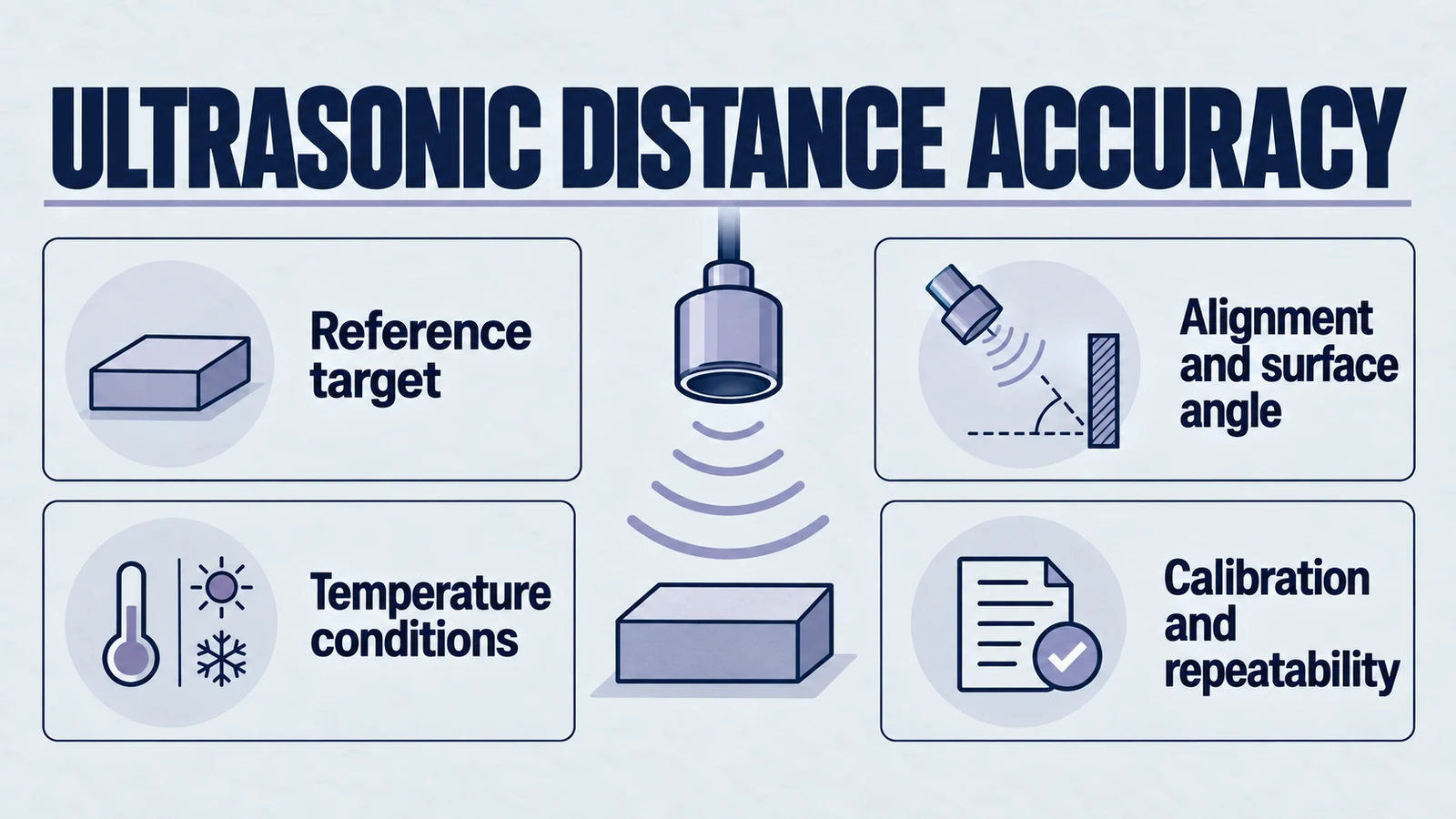
Temperature affects the speed of sound, with warmer air increasing speed, leading to shorter measured distances. Similarly, higher humidity slightly increases the speed of sound. To ensure accuracy, ultrasonic distance sensors often require temperature and humidity compensation.
2. Surface Properties
Reflectivity, texture, and shape of the target surface significantly affect the accuracy of ultrasonic sensors. Hard, flat, and reflective surfaces produce reliable readings, whereas soft, uneven, or absorbent surfaces can cause measurement errors due to weak or dispersed echoes.
3. Sensor Positioning
Alignment and positioning significantly impact the precision of ultrasonic measurements. Proper sensor placement ensures clear, unobstructed sound wave paths and consistent echo returns. Misalignment can lead to inaccuracies due to indirect reflections.
Best Practices for Enhanced Accuracy
1. Optimal Sensor Selection
Choosing the appropriate ultrasonic distance sensor for your application is critical. Consider sensor range, frequency, and beam angle. Higher frequency sensors offer greater resolution but shorter range, whereas lower frequencies can measure longer distances but with less precision.
For industrial applications requiring high accuracy, consider our KQ-112KH acoustic transducer which offers excellent performance in various environments. If the design priority is a tighter 200 kHz short-range window with a narrow beam, our KQ-200KH-2 precision distance transducer is the better fit for focused positioning and compact sensing geometry. For underwater applications, our HJ200KH-P underwater transducer provides reliable distance measurement capabilities.
2. Calibration and Environmental Compensation
Regular calibration ensures accuracy over time, accounting for changes in sensor performance and environmental conditions. Implement temperature and humidity compensation algorithms to maintain stable and accurate readings in varying environmental conditions.
3. Proper Installation and Alignment
Mount ultrasonic sensors securely and accurately aligned towards the measured target. Ensure minimal obstructions and maintain recommended distances between sensors to prevent cross-interference.
4. Signal Processing Techniques
Employ advanced signal processing techniques such as averaging, filtering, and echo detection algorithms. These methods can significantly reduce measurement noise, improve precision, and ensure stable readings even in challenging environments.
Common Pitfalls and How to Avoid Them
1. Acoustic Interference
Ultrasonic sensors can experience interference from other ultrasonic devices or ambient noise. Implement shielding or use sensors with advanced filtering capabilities to mitigate this issue.
2. Dead Zone
Every ultrasonic sensor has a minimum detection range known as the dead zone. Objects too close to the sensor may not be accurately measured. Always adhere to recommended minimum distances to avoid inaccuracies.
3. Echo Loss or Multipath Reflection
Irregular surfaces can scatter sound waves, causing echo loss or multiple echoes. Use flat, reflective targets or implement special algorithms to handle multipath reflections effectively.
Case Studies: Real-World Applications
- Robotics Navigation: High precision ultrasonic distance sensors enable robots to accurately navigate complex environments and avoid obstacles.
- Industrial Automation: Reliable distance measurement ensures efficient and appropriate operations, such as precise material handling or positioning using industrial-grade transducers.
- Automotive Systems: Ultrasonic sensors are integral to parking assist systems, where accuracy directly impacts user safety and vehicle operation.
Final Thoughts
Maximizing accuracy with ultrasonic distance sensors requires careful attention to sensor selection, calibration, environmental factors, and installation practices. By understanding these critical aspects and implementing best practices, engineers and technicians can significantly enhance the reliability and performance of ultrasonic rangefinder measurements, ensuring success in precision-driven applications.
For more insights on ultrasonic technology, explore our guide on ultrasonic level sensors for industrial tanks or learn about PZT ultrasonic transducers and their applications.
Engineering decision notes
Ultrasonic sensing and detection
Use this article when sensor performance depends on target distance, beam angle, housing material, liquid behavior, or false echo control. For "Precision Distance Measurement with Ultrasonic Sensors: Tips for Accuracy", the practical value is in turning the topic into a measurable selection or sourcing decision.
YJ Piezo treats ultrasonic sensing as an acoustic interface problem: transducer frequency, beam shape, housing, drive electronics, and target environment are reviewed together.
Selection checks
- Define target range, dead zone, beam angle, and mounting geometry before choosing the sensor family.
- Check the medium, target surface, temperature swing, foam, vapor, and side-wall risk.
- Separate detection repeatability from ideal lab accuracy when the sensor will operate in a tank, tube, or moving line.
Failure risks
- A sensor can pass bench distance tests and still fail in tanks with foam, agitation, vapor, or narrow geometry.
- Changing only frequency without reviewing beam angle and mounting can increase false echoes.
- Ignoring housing material or sealing requirements can shorten lifetime in washdown or chemical environments.
RFQ details
- What is the minimum and maximum detection distance?
- Is the target liquid, solid, sheet material, air flow, or a moving object?
- What temperature, humidity, IP rating, and output signal does the system require?
Relevant YJ Piezo pages
- Ultrasonic Sensors
Distance, level, and detection sensor portfolio
- Flow Measurement Transducers
Bubble and flow-related ultrasonic sensing paths
- Air Acoustic Transducers
Air-coupled transducers for range and presence detection
Application FAQ
- What makes an ultrasonic sensor page useful for procurement?
- It should connect range, beam angle, output signal, housing, mounting, and environmental limits to a concrete use case. A model name alone is not enough for reliable supplier comparison.
- Which information speeds up an ultrasonic sensor RFQ?
- Send the target material, distance range, installation geometry, output interface, temperature range, IP rating, and whether the application involves foam, vapor, liquid, or moving objects.