
SR80 Ultrasonic Sensor Technical Guide for Industrial IoT
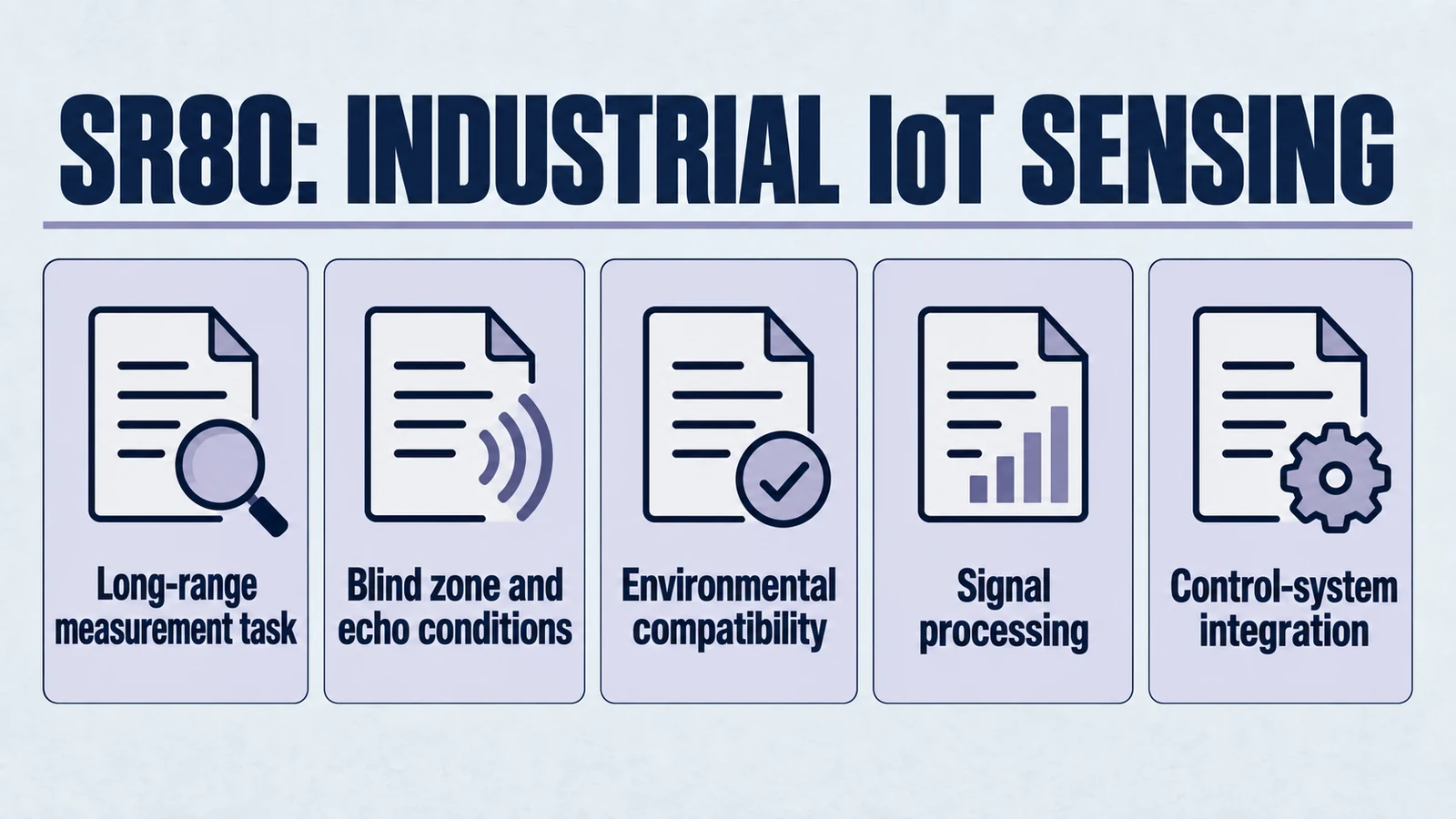
1. Introduction: The Renaissance of Non-Contact Sensing
In the intricate tapestry of modern industrial automation, the demand for precision, durability, and connectivity has precipitated a paradigm shift in sensing technology. As the Fourth Industrial Revolution (Industry 4.0) matures, the reliance on mechanical, contact-based measurement systems is rapidly waning, replaced by sophisticated non-contact methodologies that offer superior longevity and integration capabilities. Within this technological evolution, the SR80 Ultrasonic Sensor, a flagship engineered solution from Yujie Technology (Yujie Piezo), has emerged as a critical component in the architecture of smart monitoring systems.
The SR80 is not merely a transducer; it is a convergence of advanced material science—specifically high-performance piezoelectric ceramics—and sophisticated signal processing algorithms. Designed to operate in the challenging acoustic landscape of industrial environments, the SR80 addresses the quintessential challenges of liquid level monitoring, distance ranging, and object detection with a robustness that optical and mechanical counterparts often fail to achieve.
This technical guide explains how the SR80 Ultrasonic Sensor works, where it fits, and what engineers should verify before integration. It covers piezoelectric materials, acoustic propagation, and practical applications such as fuel tanks, material handling lines, and warehouse automation. The goal is to help engineering managers, system integrators, and procurement specialists evaluate whether the SR80 matches their precision measurement requirements.
Product path for this search intent
Match the article topic to the right YJ Piezo product page
Use this article when sensor performance depends on target distance, beam angle, housing material, liquid behavior, or false echo control. For "SR80 Ultrasonic Sensor Technical Guide for Industrial IoT", the practical value is in turning the topic into a measurable selection or sourcing decision.
- Ultrasonic Sensors
Distance, level, and detection sensor portfolio
- Flow Measurement Transducers
Bubble and flow-related ultrasonic sensing paths
- Air Acoustic Transducers
Air-coupled transducers for range and presence detection
1.1 The Shift from Mechanical to Acoustic
Historically, fluid level measurement relied on float switches and resistive arms—mechanisms prone to mechanical wear, jamming due to particulate matter, and corrosion from aggressive chemicals. The transition to acoustic sensing, championed by devices like the SR80, eliminates these failure points. By utilizing sound waves to interrogate the physical world, the SR80 achieves "measurement without contact," ensuring that the sensor face remains pristine even when monitoring corrosive acids, viscous oils, or abrasive slurries.
Separate analog outputs such as 4–20 mA or voltage from serial electrical interfaces such as RS-485, documented application protocols and external wireless gateways. Select the actual SR80 variant and integration documentation rather than inferring digital communication or a protocol from an output name.
2. The Physics of Precision: Fundamentals of Ultrasonic Technology
To engineer a system utilizing the SR80, one must first possess a deep command of the underlying physics that govern its operation. Ultrasonic sensing is not magic; it is the precise manipulation of mechanical energy waves traveling through a medium. The performance of the SR80 is dictated by the interaction between its piezoelectric core and the laws of thermodynamics and acoustics.
2.1 The Nature of Ultrasound
Ultrasound is defined as acoustic vibrations with frequencies above the upper limit of human hearing, generally accepted as 20 kilohertz (kHz). While human hearing evolved to detect frequencies between 20 Hz and 20 kHz, industrial ultrasonic sensors like the SR80 operate in higher bands, typically ranging from 40 kHz to 80 kHz, and up to several megahertz for medical imaging applications.
The choice of frequency is a critical engineering trade-off, a concept known as the "Range-Resolution Compromise":
- Lower Frequencies (e.g., 20-40 kHz): Lower frequency waves suffer less attenuation (absorption) by the air. They can travel longer distances but have longer wavelengths (λ). Wavelength alone does not set a universal λ/2 range-resolution floor. Resolution, accuracy and usable minimum range depend on bandwidth, estimation, signal quality and complete-device timing.
- Higher Frequencies (e.g., 80 kHz - 200 kHz): Higher frequency waves offer shorter wavelengths, enabling the detection of smaller objects and providing finer distance resolution. However, they are absorbed more rapidly by the atmosphere, limiting their maximum effective range.
The SR80, with its designation often implying an operational frequency in the **65 kHz to 80 kHz** range (depending on specific sub-variant configuration), occupies a "sweet spot" in this spectrum. It provides a balance that is exceptional for mid-range industrial applications—offering significantly better resolution than standard 40 kHz hobbyist sensors while maintaining enough power to punch through 6 meters of air range, making it ideal for tank level monitoring where millimeter-level precision is required.
2.2 The Piezoelectric Effect: Yujie’s Material Mastery
At the heart of the SR80 lies the piezoelectric transducer, the component responsible for converting electrical energy into mechanical sound waves and vice versa. This conversion relies on the Direct and Inverse Piezoelectric Effects.
Yujie Technology’s status as a primary manufacturer of piezoelectric ceramics is a pivotal differentiator for the SR80. Unlike assemblers who purchase generic ceramic discs, Yujie controls the formulation and sintering of the PZT (Lead Zirconate Titanate) material itself.
2.2.1 The Transmission Cycle (Inverse Piezoelectric Effect)
When the SR80’s microcontroller initiates a measurement, it sends a high-voltage, high-frequency electrical burst to the PZT ceramic disc housed within the sensor face. The crystal lattice of the PZT material is non-centrosymmetric. When an electric field is applied, the ions within the lattice shift, causing the macroscopic material to expand or contract. By oscillating this voltage at the resonant frequency (e.g., 80 kHz), the ceramic disc vibrates violently, acting like a microscopic piston that pushes against the air interface to generate a longitudinal sound wave.
2.2.2 The Reception Cycle (Direct Piezoelectric Effect)
After the pulse is emitted, the sensor switches to "listening" mode. When the echo returns from the target fluid or object, the sound pressure wave strikes the sensor face. This mechanical pressure deforms the PZT crystal by a microscopic amount (often nanometers). This deformation forces the internal dipoles of the material out of alignment, generating a measurable electric charge across the electrodes. This weak analog signal is then amplified by the SR80’s onboard operational amplifiers for processing.
2.3 Time-of-Flight (ToF) Mechanics
The fundamental operating principle of the SR80 is **Time-of-Flight (ToF)**. The sensor acts as a precise stopwatch.
The division by two is necessitated by the round-trip nature of the pulse (transmission to target + reflection back to source). While the formula appears simple, the variable c (speed of sound) is dynamic and environmentally dependent, a factor the SR80 must rigorously account for to maintain accuracy.
2.4 Environmental Variables and Compensation
The speed of sound in air is approximately 343 m/s at 20°C. However, it varies significantly with temperature, humidity, and air pressure.
2.4.1 Temperature Dependence
Temperature is the most dominant variable. The speed of sound in air increases by approximately 0.6 meters per second for every degree Celsius increase.
Where T is temperature in °C. In a fuel tank that fluctuates between 5°C at night and 45°C during the day, failing to compensate for this change would result in measurement errors of several centimeters—unacceptable for inventory management. The SR80 incorporates an internal temperature sensor (thermistor) to continuously monitor ambient temperature and adjust the value of c in the distance calculation algorithm, ensuring linearity and accuracy across its operating range of -20°C to +85°C.
2.4.2 Acoustic Impedance Mismatch
One of the greatest challenges in ultrasonic engineering is Acoustic Impedance. Sound travels efficiently through solids (like the PZT crystal) but poorly through air. The boundary between the high-impedance ceramic and the low-impedance air acts like a mirror, reflecting most of the energy back into the sensor rather than transmitting it out.
To overcome this, the SR80 utilizes a sophisticated **Matching Layer** material on the sensor face. This layer has an acoustic impedance that is the geometric mean of the ceramic and the air, acting as a bridge to maximize energy transfer. Yujie’s expertise in material science allows for the precise engineering of this matching layer, optimizing the sensitivity of the SR80.
3. Product Anatomy: The Yujie SR80 Deep Dive
The "SR80" designation represents a class of high-performance industrial sensors designed for versatility and durability. Based on the technical specifications gathered, we can construct a detailed profile of this device.
3.1 Technical Specifications and Performance Metrics
The following table synthesizes the operational parameters of the SR80 series, derived from industrial datasheets for this sensor class:
| Parameter | Specification | Engineering Implication |
|---|---|---|
| Sensing Range | 300 mm – 6,000 mm (Typical) | Covers the depth of most industrial tanks and silos. |
| Blind Zone (Dead Zone) | < 300 mm | Requires standoff mounting for full-capacity measurement. |
| Operating Frequency | 65 kHz - 80 kHz | Tight beam angle and high resolution; less industrial noise. |
| Accuracy | ±0.3% to ±1% of F.S. | Sufficient for custody transfer and precise tracking. |
| Resolution | ~1 mm | Capable of detecting minute changes in liquid levels. |
| Beam Angle | ~7° to 12° | Narrow enough to avoid tank walls and interference. |
| Operating Voltage | 12V – 24V DC | Standard industrial voltage; supports automotive/PLC. |
| Output Signal | 4-20mA, 0-10V, RS485 | Flexible legacy and modern digital integration. |
| Housing Material | Nickel-Plated Brass / PVDF | Options for mechanical ruggedness or chemical inertness. |
| Protection Rating | IP67 / IP68 | Dust-tight; immersion capable for flood/tank apps. |
3.2 The "SR" Nomenclature and Frequency Selection
The "SR" in Yujie’s product line typically denotes "Sensor Ranging" or "Standard Range." The "80" often correlates to the 80 kHz center frequency, although some long-range variants (SR80-AI) may utilize 40 kHz or 65 kHz to achieve greater distances up to 10 meters. This modularity suggests that the SR80 is a platform rather than a singular SKU, allowing engineers to select the specific frequency head that matches their range requirements.
The 80 kHz Advantage:
- Resolution: At 80 kHz and 343 m/s, wavelength is about 4.3 mm, but λ/4 is not a universal range-resolution limit. Use separately specified measured resolution, accuracy and uncertainty for the complete sensor.
- Noise Immunity: Industrial factories are noisy places. Pneumatic drills, air release valves, and motor hums create a cacophony of sound. However, this noise is predominantly in the lower audio spectrum (<20 kHz). By operating at 80 kHz, the SR80 functions in a "quiet" spectrum, immune to the acoustic interference that might plague lower-frequency sensors.
3.3 The Blind Zone (Dead Zone) Phenomenon
A critical specification for any integrator to understand is the SR80's Blind Zone, typically listed as 0 to 300 mm. This is not a design flaw but a physical limitation of single-transducer piezoelectric systems.
When the piezoelectric crystal is struck with the 1,000V excitation pulse to transmit sound, it rings like a bell. It takes a finite amount of time for this mechanical vibration to dampen down to zero. During this "ring-down" period, the sensor is deaf—it cannot distinguish between the lingering vibration of the transmission and a returning weak echo. Any object located within this distance (e.g., 20 cm) will return an echo while the sensor is still ringing, making it undetectable.
Mitigation Strategy: For applications requiring measurement up to the very top of a tank, the SR80 must be mounted on a "standpipe" or nozzle that elevates the sensor face 300 mm above the maximum liquid level.
3.4 Housing and Chemical Compatibility
Yujie offers the SR80 in various housing materials to suit the chemical environment:
- Nickel-Plated Brass: Extremely robust mechanically. Ideal for non-corrosive environments like water tanks, grain silos, or distance measurement on machinery. It resists impact and threading damage.
- PVDF (Polyvinylidene Fluoride) / PTFE: For aggressive chemical applications. If the SR80 is monitoring a tank of sulfuric acid or diesel fuel, the vapors can corrode metal. PVDF is a high-purity fluoropolymer that is chemically inert to most acids, solvents, and hydrocarbons. This ensures the sensor face does not degrade over years of exposure to fuel vapors.
4. Signal Processing: The Brain of the SR80
While the piezoelectric ceramic is the heart, the onboard microcontroller is the brain. The SR80 distinguishes itself from basic hobbyist sensors through advanced signal processing capabilities designed to handle the complexities of real-world echoes.
4.1 False Echo Suppression
In a perfect world, a tank is an empty cylinder. In reality, tanks contain ladders, agitator blades, heating coils, and weld seams. Each of these internal structures reflects sound, potentially creating "false echoes." If a ladder rung is at 1 meter and the fuel is at 3 meters, a dumb sensor might report the fuel level as 1 meter.
The SR80 incorporates Intelligent Echo Processing. This involves a "Teach-In" function where the sensor maps the empty tank. It records the static echoes from the ladder and agitator and stores them in memory as a "mask." During operation, the sensor ignores these masked signals and only reports the dynamic echo from the moving liquid surface.
4.2 Time-Varying Gain and Automatic Gain Control
Sound follows the Inverse Square Law: acoustic intensity diminishes rapidly with distance. An echo from 6 meters away is orders of magnitude weaker than an echo from 30 cm away.
Time-varying gain is scheduled with elapsed time; automatic gain control responds to received signal amplitude. They are distinct techniques. Establish the SR80’s actual gain functions from its controlled documentation.
- Near Field: Immediately after transmission, the amplifier gain is set low to prevent saturation from strong, close echoes.
- Far Field: As time elapses (and the listening window extends to further distances), a time-varying-gain schedule may increase gain for later echoes. The schedule need not be exponential; use the documented device behavior.
This ensures the SR80 maintains stable detection across its entire 300 mm to 6,000 mm range without user intervention.
4.3 Evaluation Limits and Hysteresis
To prevent output "chatter" (rapid switching between values due to surface ripples), the SR80 employs adjustable hysteresis and averaging windows. The user can often program the sensor to average the last 10 or 20 readings, smoothing out the data from a sloshing fuel tank on a moving truck. Furthermore, "Evaluation Limits" (A1 and A2) can be set to define the valid working window, flagging any readings outside this range as errors rather than valid data.
5. Applications: Where the SR80 Drives Value
The versatility of the SR80 allows it to serve a multitude of industries. However, specific verticals leverage its unique properties for maximum ROI.
5.1 Logistics and Fleet Management: Fuel Level Monitoring
One of the most commercially significant applications for the SR80 is **Fuel Telematics**.
- The Problem: Fleet operators face massive losses due to fuel theft and inefficiency. Standard float sensors in vehicle tanks are notoriously inaccurate (often ±10%) and have moving parts that wear out due to vehicle vibration.
- The SR80 Solution:
- Non-Contact: The SR80 mounts to the top of the fuel tank. It never touches the diesel, meaning no wear and no risk of the sensor getting stuck.
- Theft Detection: By interfacing with a GPS tracker, the SR80 provides real-time level data. If the fuel level drops rapidly while the ignition is off (a signature of siphoning), the system triggers an immediate alarm.
- Accuracy: With ±1mm resolution, the SR80 can detect even small pilferage events that float sensors would miss.
5.2 Industrial Automation: Process Control
In the factory environment, the SR80 acts as the eyes of the control system.
- Roll Diameter Monitoring: In paper, textile, and plastic film manufacturing, materials are unwound from large master rolls. To maintain constant tension, the motor speed must adjust as the roll diameter shrinks. The SR80 continuously measures the radius of the roll, providing the feedback loop for the Variable Frequency Drive (VFD).
- Hopper Levels: Injection molding machines feed on plastic pellets. If the hopper runs dry, production stops. An SR80 mounted on the hopper lid monitors the pellet level, signaling the central vacuum system to refill before the machine starves. The sensor's ability to detect granular solids (like pellets) despite their scattering nature is key here.
5.3 Smart Cities and Environmental Monitoring
The Internet of Things (IoT) demands robust sensors for outdoor infrastructure.
- Smart Waste Management: Municipalities are deploying SR80 sensors inside public trash compactors and dumpsters. The sensor measures the "air gap" in the bin. When the bin is 80% full, it alerts the sanitation department. This optimizes routing, reducing fuel consumption and carbon emissions by ensuring trucks only collect full bins.
- Flood Warning Systems: Climate change has necessitated better hydrological monitoring. SR80 sensors are mounted under bridges to monitor river levels. Unlike pressure sensors which must be submerged (and can be swept away by debris), the SR80 monitors safely from above. Its IP67 rating ensures it survives heavy storms.
5.4 Agriculture: Silo and Tank Monitoring
- Feed Silos: Poultry and swine farms rely on automated feed delivery. Running out of feed can be disastrous for animal health. The SR80 monitors grain silos, cutting through the heavy dust clouds that would blind laser sensors. The mechanical vibration of the sensor face provides a self-cleaning action, preventing dust buildup from blocking the signal.
- Liquid Fertilizer: Storage tanks for nitrogen and other fertilizers are corrosive. The PVDF-faced version of the SR80 is immune to these chemicals, providing reliable inventory data to the farmer's smartphone via LoRaWAN integration.
6. Integration Guide: Best Practices for Engineers
Successfully deploying the SR80 requires attention to mechanical and electrical details. This section outlines the best practices for system integrators.
6.1 Mechanical Installation Guidelines
- Perpendicularity is Paramount: The ultrasonic beam behaves like a flashlight. If the sensor is tilted, the sound "light" will bounce away from the sensor rather than returning to it. The SR80 must be mounted perpendicular to the target surface within a tolerance of ±2 degrees.
- Clearance: The beam spreads in a cone (typically 7-12 degrees). Ensure no objects (pipes, ladders, internal struts) intrude into this cone. Calculation: At a distance of 3 meters, a 10-degree beam has a diameter of approx. 0.52 meters. The installation location must have this much clearance.
- Standpipes: When using a standpipe to bypass the blind zone, the pipe diameter must be sufficient. A general rule is to use a pipe with a diameter at least half the size of the transducer face, but ideally larger (e.g., 3-inch or 4-inch pipe). The pipe interior must be smooth (seamless) to avoid internal reflections.
6.2 Electrical Integration
- Cable Routing: Ultrasonic signals involve high-voltage internal pulses and sensitive micro-volt echoes. To prevent electromagnetic interference (EMI), sensor cables should never be run in the same conduit as high-voltage motor power cables or VFD output lines. Use shielded twisted-pair cables and ground the shield at the PLC end only.
- Power Supply: The SR80 typically requires 12-24V DC. Ensure the power supply is low-noise. Switch-mode power supplies with high ripple can inject noise into the sensor's analog front end, causing erratic readings.
- Loop Isolation: If using the 4-20mA output, consider using a signal isolator if the sensor is mounted on a tank with a different ground potential than the control room, to prevent ground loops.
6.3 Configuration and Calibration
Many SR80 variants offer a **"Teach" wire** or button.
- Setting Limits: To set the 4mA point (Empty) and 20mA point (Full), the user typically positions a target at the desired distance and grounds the Teach wire for a specific duration.
- Output Inversion: The sensor can be configured for "Rising Ramp" (4mA = Far, 20mA = Near) or "Falling Ramp" (4mA = Near, 20mA = Far) depending on whether the logic requires "Distance to Surface" or "Level of Fluid."
7. Comparative Analysis: Why Choose the SR80?
In the crowded market of sensors, why is the Yujie SR80 the optimal choice? We compare it against alternative technologies.
7.1 SR80 vs. Radar (FMCW)
- Radar: Uses electromagnetic waves (GHz range). Unaffected by temperature or wind. Can see through foam.
Pros: Best for extreme conditions (high temp, high pressure, foam).
Cons: Significantly more expensive (often 5x-10x cost of ultrasonic). Complex setup. Power hungry. - SR80 Verdict: The SR80 offers the **Best Price-to-Performance Ratio**. For 90% of industrial applications (water, fuel, simple solids), radar is overkill. The SR80 provides the necessary accuracy at a fraction of the cost, making it scalable for large fleets or tank farms.
7.2 SR80 vs. LiDAR (Laser)
- LiDAR: Uses light. Extremely narrow beam.
Pros: Pinpoint accuracy. fast response.
Cons: Fails in dust (silos) and fog. Cannot detect transparent liquids (water) or clear oils reliably. Lenses require frequent cleaning. - SR80 Verdict: The SR80 is **Environmentally Superior**. It ignores optical transparency. It works in the dark. It is self-cleaning via vibration. For liquid level and dusty silos, the SR80 is far more reliable than optical sensors.
7.3 SR80 vs. Capacitive/Resistive Floats
- Floats: Contact-based.
Pros: Simple, passive.
Cons: Moving parts wear out. Floats get stuck. Intrusive installation. - SR80 Verdict: The SR80 is **Maintenance-Free**. Being non-contact, it experiences no mechanical wear. It extends the service life of the monitoring system from months to years.
8. The Future Roadmap: SR80 and Industry 5.0
As we look to the future, the SR80 is evolving from a data point generator to an intelligent edge node.
8.1 Edge Analytics
Future iterations of the SR80 will likely include enhanced on-chip processing to perform "Edge Analytics." Instead of just reporting "Distance = 1.5m," the sensor could report "Status = Filling," "Status = Rippling," or "Alert = Foam Detected." By analyzing the acoustic signature (echo width and amplitude), the sensor can infer the condition of the process, not just the level.
8.2 Wireless Mesh Networking
The integration of the SR80 with low-power wide-area networks (LPWAN) like LoRaWAN and NB-IoT is accelerating. Yujie’s efficient piezoelectric ceramics consume very little power, making the SR80 ideal for battery-operated wireless nodes that can be deployed in remote agricultural fields or oil pipelines, reporting data for 5+ years without a battery change.
9. Conclusion: The Yujie Advantage
The SR80 Ultrasonic Sensor is an industrial acoustic sensing component for inventory management, process automation, and monitoring workflows where non-contact measurement is useful.
By leveraging **Yujie Technology’s** vertical integration—from the synthesis of raw piezoelectric powder to the assembly of the IP67 housing—the SR80 delivers a level of consistency and quality that generic integrators cannot match. It offers the ruggedness to survive the oil field, the precision to satisfy the lab manager, and the cost-effectiveness to scale across the enterprise.
In an era where data is the new oil, the SR80 provides the reliable, accurate, and robust data stream that empowers industries to operate smarter, safer, and more efficiently. Whether you are monitoring a fleet of 500 trucks or a single critical chemical reactor, the SR80 is the sensor that ensures you always know exactly where you stand.
For engineers seeking to upgrade their sensing infrastructure, the SR80 is not just an option; it is the industry standard for reliable ultrasonic measurement. Or, check out other advanced ultrasonic sensors from Yujie Technology.
Related Technical Resources
Use these internal references to compare geometry, material selection, reliability testing, and sourcing decisions.
- Key Design Parameters for Curved Piezo Elements
- Focused Piezo Ceramics in Medical Ultrasound: Engineering Constraints
- Mode Coupling Risk in Piezo Ceramic Geometry
- Selecting Piezo Ceramics for Continuous Duty Applications
- Common Mistakes Integrating Ultrasonic Transducers into OEM Systems
- Piezoelectric Ceramics Geometry and Shape Guide
- Understanding Ultrasonic Transducers: Types and Uses
- How to Test and Measure Piezoelectric Materials
Engineering decision notes
Ultrasonic sensing and detection
Use this article when sensor performance depends on target distance, beam angle, housing material, liquid behavior, or false echo control. For "SR80 Ultrasonic Sensor Technical Guide for Industrial IoT", the practical value is in turning the topic into a measurable selection or sourcing decision.
YJ Piezo treats ultrasonic sensing as an acoustic interface problem: transducer frequency, beam shape, housing, drive electronics, and target environment are reviewed together.
Selection checks
- Define target range, dead zone, beam angle, and mounting geometry before choosing the sensor family.
- Check the medium, target surface, temperature swing, foam, vapor, and side-wall risk.
- Separate detection repeatability from ideal lab accuracy when the sensor will operate in a tank, tube, or moving line.
Failure risks
- A sensor can pass bench distance tests and still fail in tanks with foam, agitation, vapor, or narrow geometry.
- Changing only frequency without reviewing beam angle and mounting can increase false echoes.
- Ignoring housing material or sealing requirements can shorten lifetime in washdown or chemical environments.
RFQ details
- What is the minimum and maximum detection distance?
- Is the target liquid, solid, sheet material, air flow, or a moving object?
- What temperature, humidity, IP rating, and output signal does the system require?
Relevant YJ Piezo pages
- Ultrasonic Sensors
Distance, level, and detection sensor portfolio
- Flow Measurement Transducers
Bubble and flow-related ultrasonic sensing paths
- Air Acoustic Transducers
Air-coupled transducers for range and presence detection
Application FAQ
- What makes an ultrasonic sensor page useful for procurement?
- It should connect range, beam angle, output signal, housing, mounting, and environmental limits to a concrete use case. A model name alone is not enough for reliable supplier comparison.
- Which information speeds up an ultrasonic sensor RFQ?
- Send the target material, distance range, installation geometry, output interface, temperature range, IP rating, and whether the application involves foam, vapor, liquid, or moving objects.