
Piezoelectric Energy Harvesting for IoT: Feasibility Guide
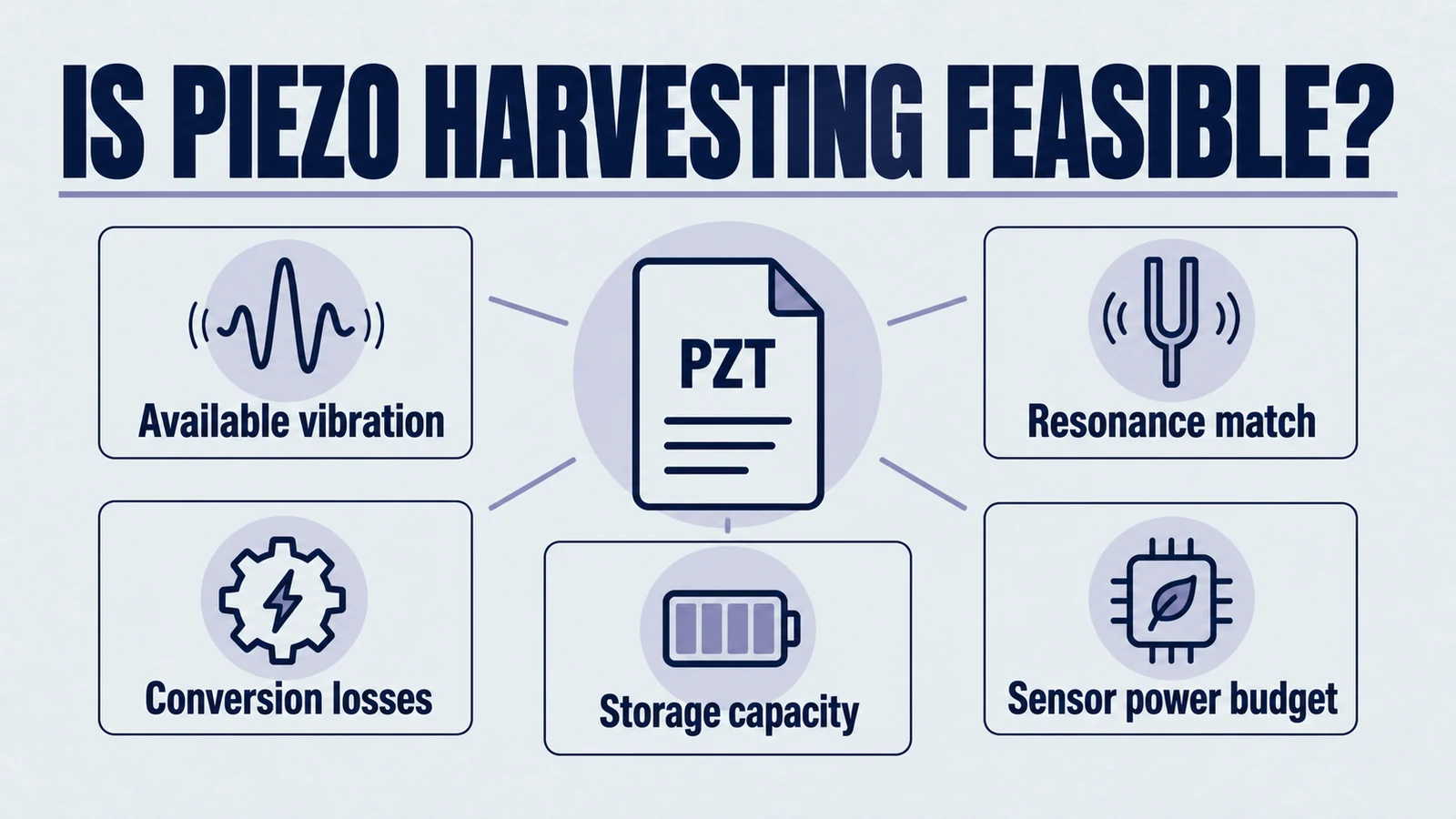
The Internet of Things (IoT) has changed how devices interact with homes, factories, and infrastructure by enabling automation, real-time monitoring, and data-driven decisions. However, a significant challenge facing IoT implementation is ensuring continuous, reliable power. Traditional batteries have limitations, including limited lifespan, replacement costs, and environmental concerns. Energy harvesting, particularly using piezoelectric devices, offers a way to convert ambient vibrations into usable electrical energy for suitable low-power IoT sensors and wireless devices.
Engineering decision focus: Confirm power budget and vibration spectrum match before committing to piezo harvesting architecture, storage size, and duty-cycle strategy.
Understanding Piezoelectric Energy Harvesting
Piezoelectric energy harvesting leverages the unique property of certain materials—primarily piezoelectric ceramics like lead zirconate titanate (PZT)—which generate electricity when mechanically stressed. This phenomenon, known as the piezoelectric effect, allows the conversion of mechanical vibrations from the environment into electrical energy.
Product path for this search intent
Match the article topic to the right YJ Piezo product page
Use this article when sensor performance depends on target distance, beam angle, housing material, liquid behavior, or false echo control. For "Piezoelectric Energy Harvesting for IoT: Feasibility Guide", the practical value is in turning the topic into a measurable selection or sourcing decision.
- Ultrasonic Sensors
Distance, level, and detection sensor portfolio
- Flow Measurement Transducers
Bubble and flow-related ultrasonic sensing paths
- Air Acoustic Transducers
Air-coupled transducers for range and presence detection
The typical setup includes:
- Piezoelectric Transducers: Devices that convert mechanical vibrations into electrical signals. Our KQ-230KH high frequency transducer demonstrates the efficiency of piezoelectric conversion technology.
- Rectifier Circuitry: Converts alternating current (AC) from the transducer into direct current (DC), suitable for powering IoT devices.
- Energy Storage: Capacitors or rechargeable batteries that store harvested energy.
Advantages of Piezoelectric Energy Harvesting
1. Sustainability and Low Maintenance
Piezoelectric harvesters are self-sustaining, requiring minimal maintenance since they rely on ambient mechanical vibrations. This drastically reduces the environmental impact and the cost associated with battery disposal and replacement.
2. Small Form Factor
Piezoelectric transducers are compact, enabling integration into small-scale IoT devices where traditional power sources are impractical. Our range of acoustic transducers like the KQ-112KH mid-range transducer offers various form factors for different application requirements.
3. High Reliability and Durability
Due to the solid-state nature of piezoelectric devices, they exhibit high reliability and resilience to harsh environmental conditions, making them suitable for industrial and outdoor applications. Learn more about our high-quality piezoelectric materials on our materials page.
Applications in IoT Sensors
Structural Health Monitoring
Piezoelectric energy harvesters effectively power sensors embedded in structures such as bridges, buildings, and industrial machinery. They use the vibrations produced by these structures to generate power for sensors that continuously monitor structural integrity, detect faults early, and provide predictive maintenance data. Our ultrasonic bubble detection sensor showcases how piezoelectric technology enables reliable monitoring in industrial applications.
Wearable IoT Devices
Piezoelectric elements integrated into wearable technologies harvest energy from body movements. Devices like fitness trackers, medical monitors, and smart clothing benefit greatly, enhancing battery life and reducing dependency on conventional charging methods. Our HJ-2804 facial massage transducer demonstrates how piezoelectric technology integrates into personal care devices.
Industrial IoT (IIoT)
In industrial environments, vibration energy harvesters power wireless sensors for machinery monitoring, predictive maintenance, and process optimization. They eliminate wiring complexities, reduce maintenance downtime, and provide real-time operational data. Explore our comprehensive range of ultrasonic cleaning transducers for industrial automation applications.
Flow Measurement and Energy Harvesting
One of the most promising applications for piezoelectric energy harvesting is in flow measurement systems. Our HJ-2112/1M ultrasonic flowmeter transducer demonstrates how ultrasonic technology can be powered by ambient vibrations for accurate flow measurement without external power sources.
Gas Flow Monitoring
Gas flow applications particularly benefit from vibration energy harvesting due to the natural vibrations in pipeline systems. Our HJ-GF200KH gas flow transducer shows how this technology improves HVAC and energy monitoring systems while reducing power consumption.
Designing Effective Piezoelectric Energy Harvesters
To achieve optimal performance, several design factors must be considered:
- Frequency Matching: Piezoelectric harvesters must match the dominant vibration frequencies of their environment for maximum efficiency. Understanding transducer design principles is crucial for proper frequency selection.
- Mechanical Design: Proper design of mounting, housing, and damping systems ensures efficient energy transfer to the transducer. Our HJ-6015 ultrasonic welder transducer demonstrates optimal mechanical coupling design.
- Electrical Circuit Optimization: Maximizing energy capture with advanced rectification and energy storage systems enhances overall efficiency.
Material Selection
The choice of piezoelectric material significantly impacts energy harvesting efficiency. Our comprehensive piezoelectric materials page explains how different PZT types affect energy conversion performance.
Underwater and Marine Applications
Marine environments offer unique opportunities for vibration energy harvesting from wave motion and underwater currents. Our HJ-200KH-P submersible transducer demonstrates how piezoelectric technology adapts to challenging marine conditions.
Advanced Applications and Specialized Uses
Ultrasonic Cleaning and Energy Recovery
Industrial cleaning systems can benefit from energy harvesting technology. Our HJ-3840 high-power cleaning transducer shows how cleaning processes can potentially recover energy from their own vibrations.
Medical Device Applications
Medical devices require reliable, long-lasting power solutions. Piezoelectric energy harvesting enables continuous operation of implantable sensors and monitoring devices. Our medical ultrasonic sensors demonstrate the reliability needed for healthcare applications.
Challenges and Future Directions
While piezoelectric energy harvesting presents numerous advantages, it also faces challenges such as limited power generation capabilities and sensitivity to vibration frequency mismatches. Current research is focused on developing multi-frequency piezoelectric harvesters, advanced materials with higher efficiency, and integrated circuit designs that further enhance energy extraction.
Quality Considerations
Maintaining high-quality piezoelectric components is essential for long-term energy harvesting success. Learn about material quality and specifications on our materials page.
Beauty and Consumer Applications
Beyond industrial uses, ultrasonic technology finds applications in consumer devices. Our HJ-4012/1M skincare transducer demonstrates how ultrasonic technology enhances beauty and wellness applications through efficient energy use.
Welding and Manufacturing Applications
Manufacturing processes generate significant vibrations that can be harvested for powering monitoring sensors. Our HJ-5020B plastic welder transducer shows how manufacturing equipment vibrations can be converted to useful energy.
Precision and Accuracy in Energy Harvesting Systems
For applications requiring high accuracy, understanding measurement principles is crucial. Energy harvesting systems must maintain accuracy while operating on harvested power, making efficient design essential for reliable operation.
Conclusion
Piezoelectric energy harvesting represents a significant advancement for IoT technology, enabling long-lasting, sustainable power solutions. By addressing current limitations through continued innovation, piezoelectric devices will increasingly power a broader range of IoT applications, from structural health monitoring to wearable tech, transforming industries and everyday life.
The integration of piezoelectric energy harvesting with IoT sensors creates self-sustaining monitoring systems that reduce maintenance costs and environmental impact. As vibration energy harvester technology continues to evolve, we can expect to see more sophisticated energy recovery systems that make IoT deployments more sustainable and cost-effective.
Related Engineering Reading
- Review PZT fundamentals before energy harvesting selection
- Validate harvested output with proper test methods
- Explore sensor-side integration options
- Contact engineering for feasibility evaluation
Ready to implement piezoelectric energy harvesting in your IoT project?
Contact our experts for custom piezoelectric solutions and energy harvesting system design.
Get Technical ConsultationEngineering decision notes
Ultrasonic sensing and detection
Use this article when sensor performance depends on target distance, beam angle, housing material, liquid behavior, or false echo control. For "Piezoelectric Energy Harvesting for IoT: Feasibility Guide", the practical value is in turning the topic into a measurable selection or sourcing decision.
YJ Piezo treats ultrasonic sensing as an acoustic interface problem: transducer frequency, beam shape, housing, drive electronics, and target environment are reviewed together.
Selection checks
- Define target range, dead zone, beam angle, and mounting geometry before choosing the sensor family.
- Check the medium, target surface, temperature swing, foam, vapor, and side-wall risk.
- Separate detection repeatability from ideal lab accuracy when the sensor will operate in a tank, tube, or moving line.
Failure risks
- A sensor can pass bench distance tests and still fail in tanks with foam, agitation, vapor, or narrow geometry.
- Changing only frequency without reviewing beam angle and mounting can increase false echoes.
- Ignoring housing material or sealing requirements can shorten lifetime in washdown or chemical environments.
RFQ details
- What is the minimum and maximum detection distance?
- Is the target liquid, solid, sheet material, air flow, or a moving object?
- What temperature, humidity, IP rating, and output signal does the system require?
Relevant YJ Piezo pages
- Ultrasonic Sensors
Distance, level, and detection sensor portfolio
- Flow Measurement Transducers
Bubble and flow-related ultrasonic sensing paths
- Air Acoustic Transducers
Air-coupled transducers for range and presence detection
Application FAQ
- What makes an ultrasonic sensor page useful for procurement?
- It should connect range, beam angle, output signal, housing, mounting, and environmental limits to a concrete use case. A model name alone is not enough for reliable supplier comparison.
- Which information speeds up an ultrasonic sensor RFQ?
- Send the target material, distance range, installation geometry, output interface, temperature range, IP rating, and whether the application involves foam, vapor, liquid, or moving objects.