
SR55 Ultrasonic Sensor Technical Guide for Industrial Automation
Executive Summary
In the intricate fabric of modern industrial automation, the demand for non-contact sensing technology has transitioned from a luxury to a fundamental operational requirement. As industries ranging from wastewater management to automated logistics strive for higher efficiency and lower maintenance overheads, the limitations of mechanical float switches and the cost-prohibitive nature of radar systems have created a distinct void. This void is effectively filled by high-performance ultrasonic sensors.
This technical guide explores the SR55 Ultrasonic Sensor (Model: UM4000-SR55-AU), a solution from Yujie Piezo Technology. It explains the sensor's engineering, acoustic physics, materials, and signal processing choices that define its performance. By examining its 75 kHz operating frequency, PBT housing construction, and 4-meter detection range, the guide helps engineers, system integrators, and procurement specialists evaluate whether the SR55 fits their application.
We will explore the underlying piezoelectric phenomena that power the device, the thermodynamic principles governing its temperature compensation, and the real-world application dynamics that dictate its installation. This is not merely a product overview; it is a deep dive into the science of sensing.
Product path for this search intent
Match the article topic to the right YJ Piezo product page
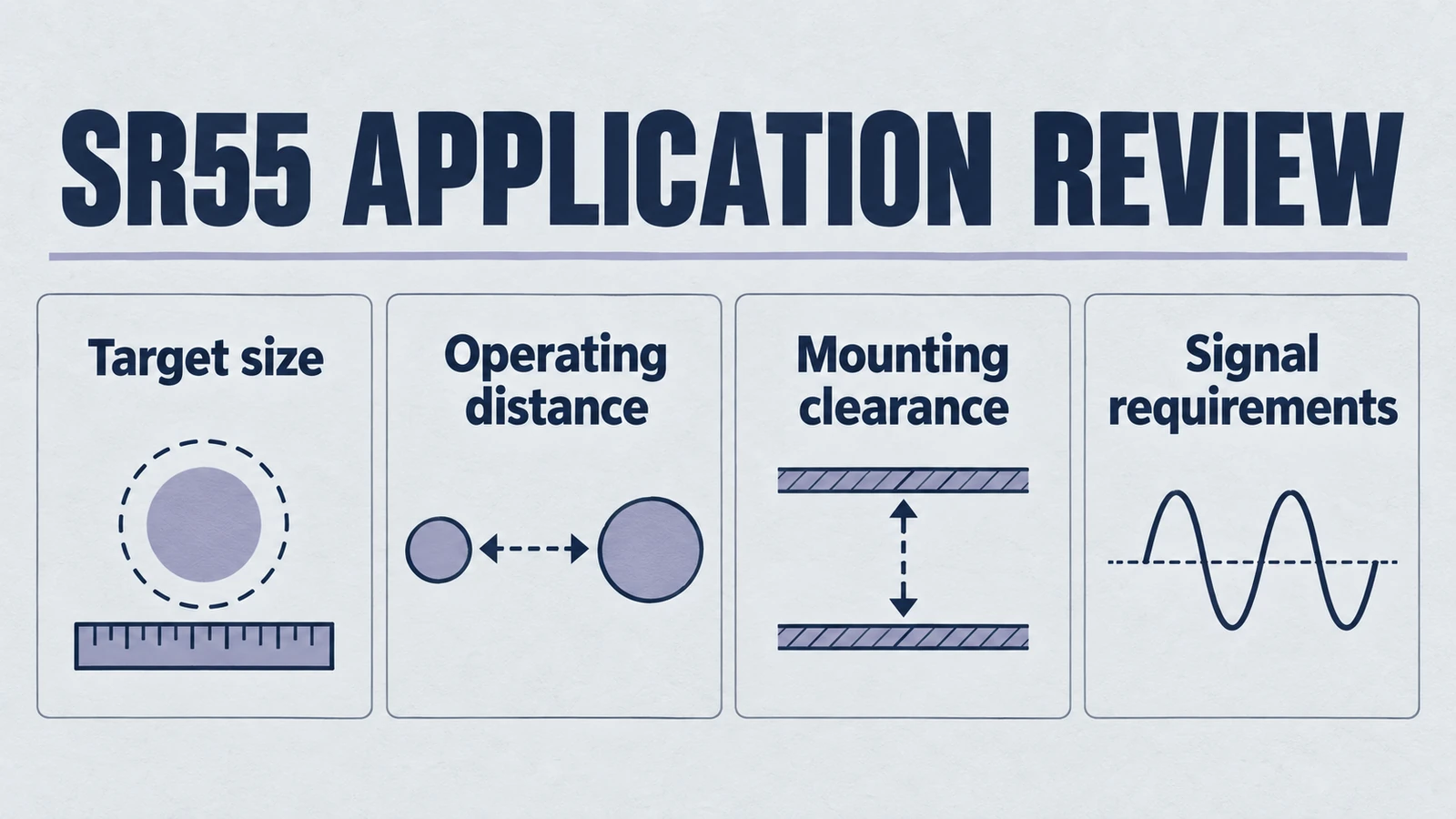
Use this article when sensor performance depends on target distance, beam angle, housing material, liquid behavior, or false echo control. For "SR55 Ultrasonic Sensor Technical Guide for Industrial Automation", the practical value is in turning the topic into a measurable selection or sourcing decision.
- Ultrasonic Sensors
Distance, level, and detection sensor portfolio
- Flow Measurement Transducers
Bubble and flow-related ultrasonic sensing paths
- Air Acoustic Transducers
Air-coupled transducers for range and presence detection
1. The Physics of Ultrasonic Sensing: A Foundational Analysis
To truly appreciate the engineering behind the SR55, one must first understand the fundamental physical principles it exploits. Ultrasonic sensing is not magic; it is the precise manipulation of mechanical energy waves.
1.1 The Nature of Sound and the Ultrasonic Spectrum
Sound is a mechanical wave that propagates through a medium (solid, liquid, or gas) by causing local displacement of particles. Unlike electromagnetic waves (light, radio), which can travel through a vacuum, sound requires matter.
- Infrasound (< 20 Hz): Below human hearing. Used for seismic monitoring.
- Audible Sound (20 Hz - 20 kHz): The range of human hearing.
- Ultrasound (> 20 kHz): Above human hearing. This is the domain of the SR55.
The SR55 operates at 75 kHz. This frequency is not arbitrary; it is a carefully calculated engineering compromise.
- The Frequency-Attenuation Trade-off: Lower frequencies (e.g., 20 kHz) travel further because they are less susceptible to atmospheric absorption. However, they have long wavelengths, which reduces resolution and requires larger transducers to focus the beam.
- The Resolution Factor: Higher frequencies (e.g., 200 kHz) have short wavelengths, offering excellent resolution and the ability to detect small objects. However, they are rapidly absorbed by air, limiting their range to a few meters or less.
- The SR55 "Sweet Spot": At 75 kHz, the SR55 strikes a balance. It is high enough to be well above industrial noise floors (which are often typically low-frequency rumbles from motors and gears) and to offer good directionality. Yet, it is low enough to propagate effectively out to 4000 mm (4 meters) without suffering debilitating signal loss. This specific frequency selection positions the SR55 as a versatile "mid-range" sensor, capable of bridging the gap between short-range proximity detection and precision level measurement systems like the UltraNova 2.
1.2 The Piezoelectric Effect: Converting Energy
The heart of the SR55 is a piezoelectric ceramic transducer. The operation relies on the reversible piezoelectric effect.
1.2.1 The Inverse Piezoelectric Effect (Transmission)
When the SR55 initiates a measurement, its internal microcontroller triggers a driver circuit. This circuit sends a burst of high-voltage electrical pulses to the PZT ceramic disc at exactly 75 kHz.
- Mechanism: PZT is a ferroelectric material. When an electric field is applied across its crystal lattice, the ions within the lattice shift, causing the macroscopic material to deform (expand or contract).
- Resonance: By alternating the voltage polarity at the ceramic's natural resonant frequency, the ceramic vibrates vigorously. This mechanical vibration is transferred to the sensor's face (the acoustic window), which in turn pushes against air molecules, creating a longitudinal pressure wave—the ultrasonic pulse.
1.2.2 The Direct Piezoelectric Effect (Reception)
Once the pulse is emitted, the sensor switches to "listening" mode. The sound wave travels through the air, hits a target (e.g., liquid surface), and bounces back.
- Mechanism: When the echo returns, it strikes the sensor face. The pressure of the sound wave compresses the PZT ceramic slightly.
- Voltage Generation: This mechanical stress deforms the crystal lattice, displacing the internal charge centers. This charge separation generates a small but measurable voltage across the ceramic's electrodes. The SR55's sensitive amplifier detects this minute voltage spike, marking the arrival of the echo.
2. Technical Architecture of the SR55 Sensor
The SR55 (Model: UM4000-SR55-AU) is a sophisticated integration of acoustic, mechanical, and electronic engineering. We will now analyze its specifications in detail, exploring the implications of each parameter for industrial usage.
2.1 Mechanical Construction and Housing
2.1.1 Material Selection: PBT and FRP
The housing of the SR55 is constructed from Polybutylene Terephthalate (PBT) or optionally Fiber Reinforced Plastic (FRP).
- Why PBT? PBT is a semi-crystalline engineering thermoplastic. It is chosen specifically for its chemical resistance. In industrial environments, sensors are often exposed to hydrocarbon vapors, cutting fluids, or mild acids. Standard plastics like ABS would degrade, crack, or swell under these conditions. PBT remains dimensionally stable and chemically inert, ensuring the sensor's longevity. For more profound insights into material choices, see our technical guide to selecting sensors for harsh environments.
- Thermal Stability: PBT has a high melting point and excellent thermal stability. This allows the SR55 to operate reliably in an ambient temperature range of -25°C to +70°C. Whether installed in a freezing outdoor grain silo in winter or a hot engine room, the housing maintains its structural integrity and does not warp, which could otherwise de-tune the acoustic resonance of the transducer.
2.1.2 Ingress Protection: IP68
The SR55 carries an IP68 rating. This is a critical specification for industrial deployment.
- First Digit (6): Dust Tight. The sensor is completely sealed against the ingress of dust. In applications like flour mills, cement plants, or grain handling facilities, fine particulate matter is ubiquitous. If dust were to enter the sensor housing, it could coat the electronics, causing short circuits or overheating.
- Second Digit (8): Immersion. The "8" indicates protection against the effects of continuous immersion in water. While the SR55 is an air-coupled sensor (meant to measure through air), this rating ensures it survives accidental flooding of a sump pit or high-pressure washdowns in food processing plants. This is typically achieved by potting the internal electronics in a high-grade epoxy resin, which also serves to dampen internal mechanical resonances.
2.2 Sensing Parameters and Performance
2.2.1 Detection Range: 280 mm to 4000 mm
The SR55 specifies a usable range of 0.28 to 4.0 meters.
- The Upper Limit (4000 mm): This range covers the vast majority of "intermediate" industrial applications. It is perfect for standard 3-meter chemical storage tanks, wastewater flumes, and conveyor belt monitoring.
- The Blind Zone (0 - 280 mm): The "unusable area" of 0...280 mm is a physical characteristic of all piezoelectric sensors, often called the "dead band" or "ringing time."
- The Physics of Ringing: After the PZT ceramic is excited by the drive voltage, it does not stop vibrating instantly. It continues to "ring" like a bell for a brief period. During this phase, the sensor cannot distinguish between its own residual vibration and a returning echo.
- Installation Implication: Users must mount the sensor at least 280 mm above the highest possible liquid level. If the liquid rises into this zone, the measurement will become unpredictable.
2.2.2 Resolution and Accuracy
The SR55 boasts a repeat accuracy of ±0.1% of full-scale value and a linearity deviation of ±1%.
- Repeatability: This refers to the sensor's ability to report the same value for the same distance over multiple measurements. For a 4-meter range, 0.1% equates to 4 mm. This high precision allows the SR55 to be used in process control loops where stability is paramount.
- Linearity: The ±1% linearity ensures that the 0-5V output maps accurately to the physical distance across the entire range.
2.2.3 Beam Angle
The SR55 typically features a beam angle of approximately 8° to 10° (based on similar 75kHz specifications).
- Benefits of Narrow Beam: A tighter beam minimizes "side lobe" detection. In a narrow tank, a wide beam might hit the tank walls or internal ladders, creating false echoes. The SR55’s focused energy ensures it detects the liquid surface, not the infrastructure.
2.3 Electrical Interface and Connectivity
2.3.1 Power Supply
The unit operates on 10…30 VDC.
- Versatility: This wide range allows compatibility with 12V mobile equipment (AGVs, trucks) and standard 24V industrial automation power grids.
2.3.2 Analog Output: 0-5V
The SR55 provides a 0-5V analog voltage output.
- Interfacing: Connect a 0–5 V output to a compatible input, or use suitable scaling, protection and grounding. A 3.3 V-only microcontroller input is not automatically compatible.
- Mapping: Typically, 0V represents the minimum sensing distance and 5V represents the maximum, or vice versa depending on configuration.
2.3.3 Response Time
The listed response time is approximately 125 ms. Obtain the separate output update-rate and filtering specification before setting line speed or control-loop bandwidth; reciprocating response latency does not establish an 8 Hz update rate.
- Smoothing vs. Speed: Ask for documented filtering and worst-case response timing. A response-time value alone does not identify internal averaging or its behavior during changing targets.
3. Advanced Operational Principles
3.1 Time-of-Flight (ToF) Calculation
The fundamental algorithm is the Time-of-Flight measurement. The sensor measures the time () from pulse emission to echo reception. Since the sound travels to the target and back, the distance () is calculated as:
3.2 Thermodynamic Temperature Compensation
The speed of sound in air is strictly dependent on temperature:
Where T is the temperature in degrees Celsius.
- The SR55 Solution: The SR55 includes an integrated temperature compensation feature. It continuously monitors the ambient air temperature. The internal processor uses this data to adjust the calculation of the speed of sound, ensuring the sensor maintains its accuracy across the -25°C to +70°C operating range and minimizing sensor drift due to temperature changes.
3.3 The TEACH-IN Functionality
The SR55 features a TEACH-IN input.
- Customization: This feature allows the user to define the measurement window boundaries (limits) by applying the supply voltage (-UB or +UB) to the teach-in pin. This simplifies the setup process without requiring complex programming software.
4. In-Depth Applications: Where the SR55 Excels
The SR55’s combination of chemically resistant PBT, 4-meter range, and IP68 sealing makes it a "workhorse" sensor for diverse industries.
4.1 Chemical Processing and Storage
Challenge: Monitoring levels of corrosive fluids like Hydrochloric Acid or Diesel Exhaust Fluid (DEF).
SR55 Solution:
- Non-Contact: The sensor never touches the acid, eliminating corrosion concerns.
- Material Compatibility: The PBT housing is resistant to chemical vapors that would attack standard ABS sensors.
- Safety: The analog output can be integrated into safety interlocks to prevent tank overfilling.
4.2 Water and Wastewater Management
Challenge: Monitoring pump station sump levels in humid, wet environments.
SR55 Solution:
- IP68 Rating: The sensor survives high humidity and potential submersion.
- Pump Control: The SR55 enables reliable "Level Control" logic—turning pumps on when the pit is full and off when empty.
4.3 Solid Level Monitoring (Silos and Hoppers)
Challenge: Measuring the level of plastic pellets, grains, or animal feed.
SR55 Solution:
- 75 kHz Penetration: The sound wave has a wavelength long enough to push through moderate dust clouds often found in grain silos.
- Reflection: The high sensitivity allows the SR55 to detect diffuse reflections from the uneven surface of pellets.
4.4 Automated Logistics and AGVs
Challenge: Collision avoidance for Automated Guided Vehicles (AGVs).
SR55 Solution:
- Material Independence: Ultrasound reflects off black rubber tires or transparent pallets just as well as white walls.
- Range: The 4-meter range gives a fast-moving AGV enough time to detect an obstacle and brake smoothly.
5. Common Installation Pitfalls: Why Sensors Fail
In our analysis of RMA (Return Merchandise Authorization) data, 90% of "sensor failures" are actually application mismatches or installation errors. Here is a checklist to prevent the most common site issues.
5.1 The Foam Factor
The Physics: Ultrasonic waves reflect off density changes. Solid liquid reflects 99.9% of the sound. Light, airy foam, however, acts as an acoustic sponge. It absorbs the energy or scatters it in random directions.
- Symptom: Sensor reports "Target Loss" or erratic jumping values when the tank is agitated.
- Solution: Install a "Stilling Well" (a PVC pipe with breather holes) that extends into the liquid. This protects the effective measurement area from foam and turbulence.
5.2 The Mounting Torque Mistake
The Physics: The SR55 is a tuned acoustic instrument. Its housing vibration is part of the sensing mechanism.
- The Error: Technicians often crank down the mounting nuts with a wrench to "ensure it never moves."
- The Consequence: Compressing the sensor neck distorts the PBT housing, physically squeezing the piezoelectric assembly. This shifts the resonant frequency and dampens the sensitivity.
- Best Practice: Hand-tighten the nuts, then turn 1/4 turn with a wrench. The sensor should be secure but not strangled.
5.3 Chemical Vapor Gradients
The Physics: The speed of sound depends on the gas composition. In a solvent tank (e.g., Acetone or IPO), the vapor density is heavier near the liquid surface than at the top.
- Symptom: The sensor measures "Long" (distance appears greater than reality) because sound travels slower in heavy hydrocarbon vapors than in air.
- Solution: For high-precision chemical metering, use a reference reflector or switch to a guided wave radar solution if vapor concentrations fluctuate wildly.
6. Conclusion: The Engineering Choice
The SR55 Ultrasonic Sensor (UM4000-SR55-AU) represents a triumph of pragmatic engineering. It does not seek to replace every sensor type; rather, it perfectly occupies the critical "mid-range" niche where industrial automation lives.
Its 75 kHz frequency provides the optimal compromise between range and resolution. Its PBT housing and IP68 rating ensure it survives the chemical and physical assaults of the factory floor. Its Temperature Compensation and 0-5V output provide the accuracy and connectivity required by modern control systems.
SR55 Technical Specifications Summary
| Feature | Specification | Engineering Benefit |
|---|---|---|
| Model | UM4000-SR55-AU | Official Yujie Piezo Identifier |
| Transducer Frequency | 75 kHz | Optimizes range (4m) vs. resolution. |
| Sensing Range | 280 mm – 4000 mm | Ideal for mid-sized tanks and collision avoidance. |
| Blind Zone | 0 – 280 mm | Defines required mounting standoff height. |
| Housing Material | PBT / FRP | Superior chemical resistance compared to ABS. |
| Protection Grade | IP68 | Fully submersible and dust-tight. |
| Analog Output | 0 - 5 V | Universal compatibility with industrial PLCs. |
| Supply Voltage | 10 – 30 V DC | Flexible power options (12V/24V systems). |
| Operating Temperature | -25°C to +70°C | Reliable in outdoor and industrial heat. |
| Accuracy | Repeat: ±0.1% | High precision for process control stability. |
| Response Time | ~125 ms | Fast update rate for level monitoring. |
| Connection | 4-Pin PVC Cable | Standard industrial connectivity. |
For more information on the SR55 or to discuss your specific application needs, please contact Yujie Piezo Technology.
Engineering decision notes
Ultrasonic sensing and detection
Use this article when sensor performance depends on target distance, beam angle, housing material, liquid behavior, or false echo control. For "SR55 Ultrasonic Sensor Technical Guide for Industrial Automation", the practical value is in turning the topic into a measurable selection or sourcing decision.
YJ Piezo treats ultrasonic sensing as an acoustic interface problem: transducer frequency, beam shape, housing, drive electronics, and target environment are reviewed together.
Selection checks
- Define target range, dead zone, beam angle, and mounting geometry before choosing the sensor family.
- Check the medium, target surface, temperature swing, foam, vapor, and side-wall risk.
- Separate detection repeatability from ideal lab accuracy when the sensor will operate in a tank, tube, or moving line.
Failure risks
- A sensor can pass bench distance tests and still fail in tanks with foam, agitation, vapor, or narrow geometry.
- Changing only frequency without reviewing beam angle and mounting can increase false echoes.
- Ignoring housing material or sealing requirements can shorten lifetime in washdown or chemical environments.
RFQ details
- What is the minimum and maximum detection distance?
- Is the target liquid, solid, sheet material, air flow, or a moving object?
- What temperature, humidity, IP rating, and output signal does the system require?
Relevant YJ Piezo pages
- Ultrasonic Sensors
Distance, level, and detection sensor portfolio
- Flow Measurement Transducers
Bubble and flow-related ultrasonic sensing paths
- Air Acoustic Transducers
Air-coupled transducers for range and presence detection
Application FAQ
- What makes an ultrasonic sensor page useful for procurement?
- It should connect range, beam angle, output signal, housing, mounting, and environmental limits to a concrete use case. A model name alone is not enough for reliable supplier comparison.
- Which information speeds up an ultrasonic sensor RFQ?
- Send the target material, distance range, installation geometry, output interface, temperature range, IP rating, and whether the application involves foam, vapor, liquid, or moving objects.