
Ultrasonic Sensor RFQ Template: 14 Specs Buyers Must Provide Before Quotation
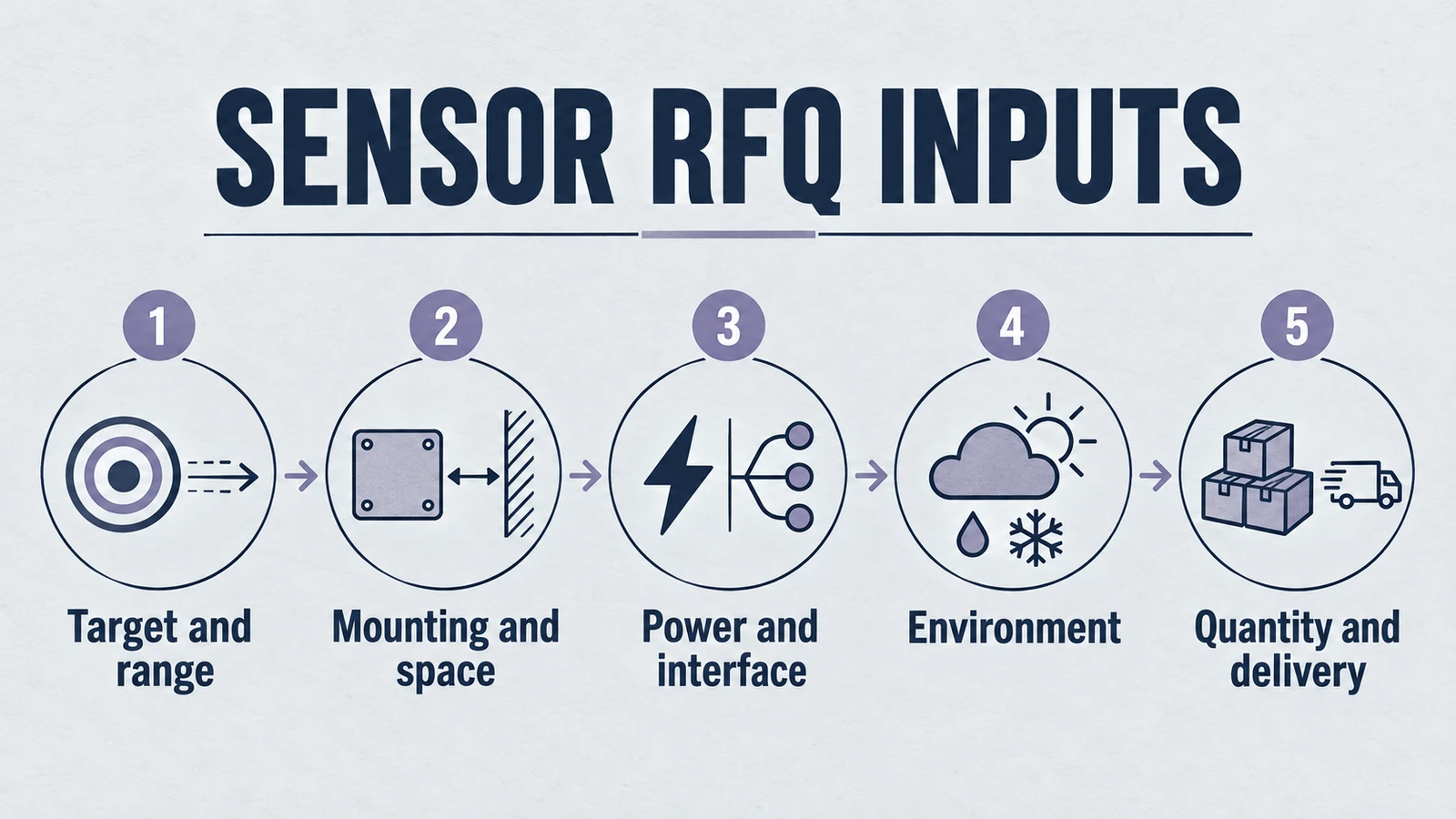
Many industrial RFQs for ultrasonic sensors still start with one sentence: "Please quote a sensor for tank level" or "Need a distance sensor for automation." Procurement teams want a fast response and a clean unit price, while engineering teams still need missing boundary conditions before any model can be selected responsibly.
That gap creates a repeated failure loop: incomplete RFQ, broad supplier quote, sample mismatch, redesign, and delayed launch. The technical problem is not usually that sensors are unavailable. The problem is that requirements are submitted in a form that is not decision-grade.
This article provides a practical RFQ framework that procurement and engineering can share from day one. The objective is simple: reduce quotation cycles, improve model-fit accuracy, and avoid late-stage integration surprises.
If you are evaluating sourcing options now, start from the ultrasonic sensor product hub, then align supplier scope through the ultrasonic transducer supplier page, the piezoelectric supplier page, and the PZT material supplier page.
Product path for this search intent
Match the article topic to the right YJ Piezo product page
Use this article when sensor performance depends on target distance, beam angle, housing material, liquid behavior, or false echo control. For "Ultrasonic Sensor RFQ Template: 14 Specs Buyers Must Provide Before Quotation", the practical value is in turning the topic into a measurable selection or sourcing decision.
- Ultrasonic Sensors
Distance, level, and detection sensor portfolio
- Flow Measurement Transducers
Bubble and flow-related ultrasonic sensing paths
- Air Acoustic Transducers
Air-coupled transducers for range and presence detection
Problem Context
In ultrasonic projects, quotation quality is determined less by procurement speed and more by requirement completeness. If the RFQ omits critical operating constraints, every supplier can technically respond, but none of the responses will be directly comparable or reliably deployable.
Why Incomplete RFQs Look Fast but Execute Slowly
A short RFQ may feel efficient in week one, but it creates multiple hidden loops in weeks two to eight. Engineering requests clarifications, suppliers revise assumptions, samples arrive without a stable test protocol, and final pricing shifts once the real environmental and interface constraints become explicit.
For teams measured on delivery and uptime, these loops are expensive. They consume procurement bandwidth, delay controls integration, and compress commissioning windows at exactly the wrong stage of the project.
Three Common Failure Patterns
Pattern A: Blind-zone mismatch in short-range applications. The RFQ states only "0-500 mm range" but does not define minimum usable distance and mounting geometry. A sample is selected for nominal range, then fails at near-field operation. Background: blind-zone limits in short-range ultrasonic sensing.
Pattern B: False-echo instability in process vessels. The RFQ omits foam, vapor, turbulence, and internal obstructions. Supplier quote assumes clean surface conditions. Field behavior becomes unstable due to multi-path reflections and weak target echoes.
Pattern C: Electrical integration delay. Procurement asks for "sensor with output" without specifying PLC input expectations, cable policy, or protocol constraints. Sample works in bench test but requires rework at panel level.
What a Good RFQ Must Achieve
A high-quality RFQ should do three jobs at once:
- Define a technically valid operating envelope.
- Enable apples-to-apples supplier comparison.
- Create a direct bridge from quotation to acceptance testing.
If one of these jobs is missing, the quote is not wrong, but it is incomplete for project control.
Engineering Constraints
Before quotation, engineering and procurement should lock constraints in six domains: measurement, medium, mechanics, electronics, environment, and lifecycle. These constraints define feasibility boundaries and remove guesswork from supplier responses.
1) Measurement Envelope and Blind-Zone Boundary
Range must be specified as minimum, normal, and maximum values, not a single nominal number. The minimum distance is often the first technical gate in short-range deployments because ring-down and echo separation set a hard near-field limit.
If your process regularly approaches that limit, include the maximum acceptable blind zone as an explicit RFQ field. This prevents suppliers from quoting models that pass nominal range but fail practical installation.
2) Target and Echo Behavior Under Real Process Conditions
Ultrasonic performance depends on target reflectivity and surface behavior. A still liquid surface, a turbulent liquid surface, and an angled solid face do not return echoes the same way. The RFQ should state target type, surface dynamics, and expected contamination conditions.
For level sensing in process tanks, include notes on agitation, filling dynamics, foam layer expectations, and any internal structures in beam path. If you are seeing seasonal drift or unstable readings already, add baseline data from your current installation.
3) Process Atmosphere and Compensation Limits
Temperature, humidity, and vapor composition influence acoustic propagation and measurement stability. Teams frequently specify ambient temperature but omit headspace vapor behavior, which is often more relevant for level monitoring in chemical or sanitary processes.
If compensation is required, ask suppliers to describe algorithm assumptions and expected error envelope under your operating profile. For practical compensation and calibration context, review ultrasonic sensor accuracy and temperature compensation and sensor drift troubleshooting in industrial monitoring.
4) Mounting Geometry and Mechanical Integration
Mechanical details should be RFQ inputs, not post-quote clarifications. Specify thread standard, available nozzle diameter, standpipe constraints, sensor orientation, and any nearby obstructions. Include whether the sensor must fit existing tank nozzles or machine fixtures without structural modification.
In narrow spaces, beam behavior and mounting offset can drive more risk than electronics. If installation flexibility is low, ask for recommended mounting geometry in supplier response.
5) Electrical Architecture and Interface Discipline
Output selection should map to control architecture at RFQ stage. Define whether the application needs switching output, analog loop, voltage output, or digital communication. Also define supply constraints, cable policy, and connector expectations.
When teams defer interface decisions until sample stage, quotation remains broad but integration risk increases. RFQ completeness here is one of the fastest ways to cut rework.
6) Environmental Survivability and Lifecycle Planning
Ingress rating is necessary but not sufficient. In aggressive environments, housing material compatibility, connector sealing reliability, and washdown survivability often determine long-term success. Include cleaning chemistry, duty cycle, and maintenance policy in the RFQ.
If dual-sourcing or second-source readiness is required, state it explicitly. Suppliers should know whether your quote is single-project, platform-level, or multi-site standardization scope.
Selection Matrix
Use the matrix below to convert initial demand into quote-ready inputs. This structure is designed for cross-functional review before supplier outreach.
| Requirement Block | Minimum RFQ Data | If Missing | Validation Method |
|---|---|---|---|
| Measurement envelope | Min/normal/max distance, blind-zone limit | Near-field failure during commissioning | Static target sweep at min and max points |
| Target characteristics | Material, surface state, angle, turbulence profile | False echo or unstable return | Controlled target reflectivity test |
| Process atmosphere | Temperature band, humidity, vapor notes | Compensation error not visible in bench test | Thermal ramp and repeatability check |
| Mounting geometry | Thread/nozzle size, tilt, obstacle map | Wall reflections and installation conflict | Fixture mockup with obstruction simulation |
| Interface and power | Output type, voltage, cable/connector policy | PLC integration delay and rewiring | I/O bench validation with target controller |
| Environmental durability | IP target, chemistry exposure, washdown cycle | Premature field degradation | Ingress and chemical compatibility verification |
| Commercial planning | Sample/pilot/annual quantity and lead-time target | Quote not aligned to launch schedule | Milestone-based delivery confirmation |
| Qualification scope | Acceptance criteria and report requirements | Subjective sample approval | Predefined FAT checklist and record format |
Supplier Response Scorecard (Suggested)
To avoid price-only selection bias, score each quote against the same weighted criteria:
- Technical fit: 35%
- Validation evidence quality: 20%
- Integration readiness (interface + mechanics): 15%
- Lead time and delivery confidence: 15%
- Commercial terms and lifecycle support: 15%
This approach keeps procurement objective while preserving engineering risk visibility.
Model Mapping
The RFQ should request a primary model and a backup model candidate. This prevents single-model lock and makes qualification more resilient when installation constraints change late.
| Application Scenario | Primary Model | Backup Model | RFQ Notes |
|---|---|---|---|
| Compact short-range machine positioning | MU18 | MU30 | State minimum distance and blind-zone limit clearly |
| General conveyor and material handling distance control | MU30 | SR55 | Provide object speed, spacing, and cycle timing |
| Industrial tank level with moderate vapor or turbulence | SR55 | SR80 | Include tank internals, agitation, and expected foam layer behavior |
| Longer-range level monitoring with stronger echo management demand | SR80 | UltraNova2 | Request false-echo handling strategy in quote response |
| Harsh washdown or chemically aggressive environment | Stainless steel housing sensor | UltraNova1 | Define cleaning chemistry and washdown frequency |
| Clear or transparent object detection in packaging lines | MRR1 | MU18 | Provide line speed and target spacing tolerance |
For decision framing between technologies, use a total-cost view rather than component-only price. A useful reference is ultrasonic vs pressure level sensing for tank monitoring. For sanitary process architecture choices, review open vs closed ultrasonic sensors in CIP environments.
RFQ Checklist (14 Required Specs)
Copy this list into your RFQ template. If one field is currently unknown, mark it as TBD with an owner and target date. Unknown is acceptable. Unstated is not.
- Application objective: level, distance, presence, counting, or safety interlock.
- Target and medium details: liquid/solid type, surface behavior, contamination expectations.
- Range definition: minimum, nominal, and maximum distance in real installation geometry.
- Blind-zone requirement: maximum allowed near-field non-measurable region.
- Accuracy and repeatability target: include tolerance and test condition reference.
- Response-time requirement: update rate, filter tolerance, and control-loop constraints.
- Mounting details: thread standard, nozzle, stand-off distance, tilt, and obstacle map.
- Output interface: PNP/NPN, 4-20mA, voltage, RS485, or required protocol behavior.
- Power constraints: supply range, current limits, protection expectations.
- Housing and ingress target: material preference, IP requirement, cable or connector type.
- Environmental envelope: operating and storage temperature, humidity, washdown exposure.
- Validation method: acceptance test sequence, pass/fail limits, and report format needed.
- Commercial quantities: sample, pilot, annual volume, and ramp schedule assumptions.
- Lead-time and sourcing policy: required delivery window, quote validity, second-source expectation.
Six Fields That Must Never Be Omitted
range + environment + output interface + power + quantity + lead-time. If these six are missing, both quote speed and quote quality degrade significantly.
Copy-Paste RFQ Starter
Project Name: [project]
Application: [level/distance/presence]
Target and Process Medium: [details]
Range (min/normal/max): [values]
Blind-Zone Limit: [value]
Environment: [temperature/humidity/vapor/foam/dust/washdown]
Output + Power: [interface], [supply range]
Mounting: [thread/nozzle/stand-off/tilt/obstruction]
Quantities + Lead Time: [sample/pilot/annual], [required delivery date]
Preferred Models for Evaluation: [primary], [backup]
Acceptance Criteria: [test standard and pass/fail]
What the Supplier Should Return in the Quote
- Recommended primary and backup models with trade-off explanation.
- Declared assumptions used for compensation and echo handling.
- Electrical and mechanical integration notes specific to your application.
- Validation plan proposal for sample and pilot stages.
- Lead-time breakdown by sample, pilot, and production quantities.
- Risk notes and mitigation recommendations before commercial lock.
FAQ
Why is "range only" not enough for a reliable quote?
Because feasibility depends on boundary conditions, not nominal distance. Blind zone, target behavior, mounting geometry, and process atmosphere determine whether a quoted model can be validated in your actual environment.
How many model options should procurement request?
Request one primary and one backup model with explicit trade-offs. This gives you resilience during qualification and avoids schedule shock if installation constraints shift.
Should we finalize price before sample validation?
Use provisional pricing for planning, but do not lock final commercial decisions until sample validation passes against predefined acceptance criteria in realistic conditions.
What is the minimum acceptance test scope for industrial ultrasonic sensing?
At minimum: range-end checks, near-field blind-zone check, repeatability under thermal variation, interface stability in target control system, and basic false-echo resilience under representative process conditions.
How do we compare suppliers beyond unit price?
Use a weighted scorecard that includes technical fit, validation evidence, integration readiness, lead-time confidence, and lifecycle support. This approach reduces hidden total-cost risk.
When should we consider switching sensing technology?
If your process consistently violates ultrasonic constraints such as severe vapor instability, persistent heavy foam, or extreme geometry limitations, run a structured comparison against alternatives before forcing model-level optimization.
Can one RFQ template work across multiple plants?
Yes, if you keep a fixed core checklist and allow site-specific appendices for environment, interface standards, and maintenance policy. Standardized RFQ structure improves scaling and dual-sourcing strategy.
Request Engineering Support
If you want faster, cleaner quotation cycles, send the 14-point checklist together with your current installation constraints. We can help map requirements to primary and backup models and propose a qualification path before commercial lock.
- Email Engineering for RFQ
- Submit Requirements via Contact Page
- Review Sensor Product Families
- Check Supplier Capability Overview
Related Technical Reading
- Ensuring ultrasonic sensor accuracy with temperature compensation and calibration
- Troubleshooting sensor drift in industrial ultrasonic monitoring
- Ultrasonic vs infrared sensor selection in practical deployments
- Ultrasonic vs pressure level sensing for tank monitoring
- Selecting ultrasonic sensors for harsh, sanitary, and high-speed environments
- Open vs closed ultrasonic sensors in CIP environments
Engineering decision notes
Ultrasonic sensing and detection
Use this article when sensor performance depends on target distance, beam angle, housing material, liquid behavior, or false echo control. For "Ultrasonic Sensor RFQ Template: 14 Specs Buyers Must Provide Before Quotation", the practical value is in turning the topic into a measurable selection or sourcing decision.
YJ Piezo treats ultrasonic sensing as an acoustic interface problem: transducer frequency, beam shape, housing, drive electronics, and target environment are reviewed together.
Selection checks
- Define target range, dead zone, beam angle, and mounting geometry before choosing the sensor family.
- Check the medium, target surface, temperature swing, foam, vapor, and side-wall risk.
- Separate detection repeatability from ideal lab accuracy when the sensor will operate in a tank, tube, or moving line.
Failure risks
- A sensor can pass bench distance tests and still fail in tanks with foam, agitation, vapor, or narrow geometry.
- Changing only frequency without reviewing beam angle and mounting can increase false echoes.
- Ignoring housing material or sealing requirements can shorten lifetime in washdown or chemical environments.
RFQ details
- What is the minimum and maximum detection distance?
- Is the target liquid, solid, sheet material, air flow, or a moving object?
- What temperature, humidity, IP rating, and output signal does the system require?
Relevant YJ Piezo pages
- Ultrasonic Sensors
Distance, level, and detection sensor portfolio
- Flow Measurement Transducers
Bubble and flow-related ultrasonic sensing paths
- Air Acoustic Transducers
Air-coupled transducers for range and presence detection
Application FAQ
- What makes an ultrasonic sensor page useful for procurement?
- It should connect range, beam angle, output signal, housing, mounting, and environmental limits to a concrete use case. A model name alone is not enough for reliable supplier comparison.
- Which information speeds up an ultrasonic sensor RFQ?
- Send the target material, distance range, installation geometry, output interface, temperature range, IP rating, and whether the application involves foam, vapor, liquid, or moving objects.