
How to Test and Measure Piezoelectric Materials
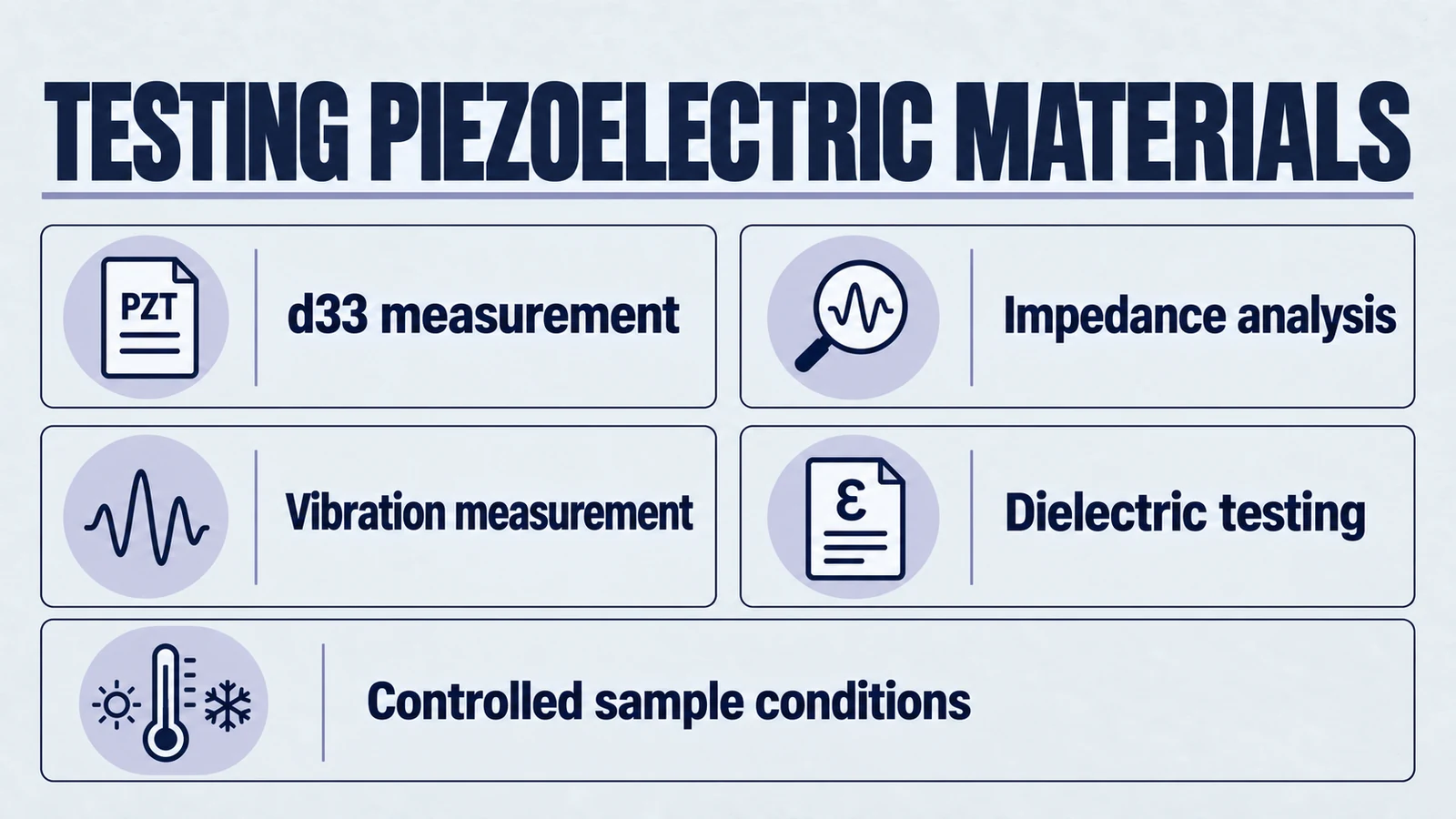
Piezoelectric materials play a foundational role in a wide array of modern technologies, from ultrasonic medical imaging to high-precision industrial actuators and sensors used in aerospace, robotics, and energy harvesting. Their unique ability to convert mechanical stress into electrical energy—and vice versa—makes them important in systems where control, precision, and responsiveness are crucial. However, realizing the full potential of these materials requires accurate, repeatable, and standardized testing piezoelectric materials. This guide delves deep into the methods, tools, and best practices for testing piezoelectric materials and interpreting the results for real-world applications.
Why Testing Piezoelectric Materials Matters
The performance characteristics of piezoelectric ceramics and composites influence critical factors such as signal accuracy, power efficiency, mechanical endurance, and overall device lifespan. Conducting rigorous testing piezoelectric materials enables manufacturers and engineers to:
- Validate batch-to-batch material consistency and detect manufacturing defects
- Optimize design parameters for improved electromechanical performance
- Identify early failure indicators in components used in harsh environments
- Select the most appropriate material formulation for a specific use-case
- Support compliance with regulatory and industry-specific quality standards
Product path for this search intent
Match the article topic to the right YJ Piezo product page
Use this article when the choice is not just a shape, but a material tradeoff between sensitivity, loss, coupling, stability, and operating field. For "How to Test and Measure Piezoelectric Materials", the practical value is in turning the topic into a measurable selection or sourcing decision.
- PZT Material Hub
Material grades and application tradeoffs
- Piezoelectric Ceramics
Shapes and ceramic manufacturing options
- PZT Material Supplier Hub
Material control, grade selection, and sourcing support
In high-stakes sectors like aerospace or medical diagnostics, even minor deviations in piezoelectric behavior can lead to costly performance issues or safety concerns, making testing piezoelectric materials not just beneficial, but essential. Understanding why quality matters in piezoelectric components is crucial for maintaining reliable performance.
Key Properties to Measure in Piezoelectric Materials
When testing piezoelectric materials, several electrical, mechanical, and electromechanical properties must be quantified to assess suitability and ensure performance predictability:
- Piezoelectric charge constant (d33, d31, d15): Relates electric displacement (charge per area) to stress at constant electric field, or strain to electric field at constant stress. For uniform longitudinal loading with short-circuit charge collection, d33 can be measured as charge per force.
- Electromechanical coupling coefficient (k33, kp, kt): Describes coupling for a specified mode and boundary conditions. It is not assembled-device power-conversion efficiency.
- Dielectric constant (εr): Determines the material's capacity to store electrical energy within its structure—important for capacitive performance and impedance matching.
- Mechanical Q factor (Qm): Reflects the sharpness of resonance, impacting frequency stability, sensitivity, and energy dissipation.
- Resonant and anti-resonant frequencies (fr, fa): Reveal insights into the material's dynamic mechanical behavior and its suitability for resonant applications like ultrasonic transducers.
- Dielectric loss tangent (tanδ): Indicates energy lost as heat; a low tanδ is generally desirable in sensing and actuation systems.
These parameters are fundamental to understanding how different PZT material types perform in various applications.
Common Testing Methods for Piezoelectric Materials
In this YJ Piezo video, follow three complementary checks: capacitance, quasi-static d33, and impedance resonance. See how sample preparation and test conditions affect the readings, and what each measurement can and cannot establish.
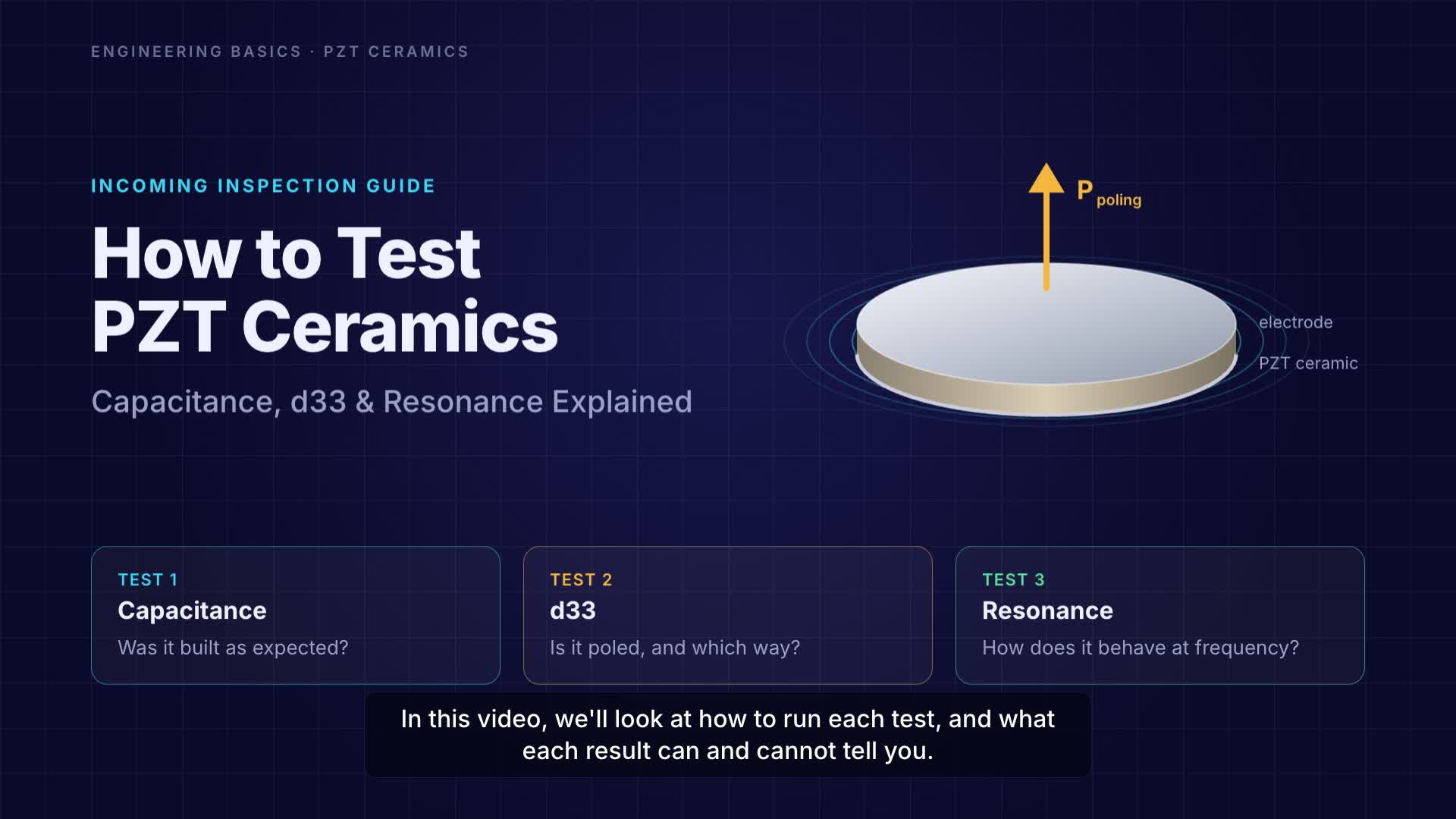
Watch the PZT testing guide on YouTube.
1. d33 Meter (Direct Quasi-Static Method)
This is a widely used tool for quickly assessing the d33 coefficient by applying a low-frequency mechanical force along the poling axis and measuring the induced charge. Advantages include speed and simplicity, making it ideal for quality control in manufacturing. This method is particularly useful when evaluating materials for piezo sensor applications.
2. Impedance Analysis (Resonance-Antiresonance Method)
Using an impedance analyzer, one can measure frequency response characteristics of the piezoelectric element. From the impedance spectrum, various constants such as k, Qm, and compliance can be derived. This method provides highly accurate dynamic property data and is considered a gold standard for research and development. Understanding factors affecting piezoelectric sensor sensitivity helps optimize these measurements.
3. Berlincourt Piezo Meter (Quasi-Static d33 Measurement)
The Berlincourt method is the low-frequency quasi-static d33 method described above, using a small alternating force and measuring charge response. Record force, frequency, preload, contact geometry, and temperature. A quasi-static reading does not establish resonant or high-drive performance in sonar devices or ultrasonic welders.
Marine integrators can start from the deep-water transducer CS-220KH and the submersible transducer HJ-200KH-P product pages.
4. Laser Doppler Vibrometry (LDV)
A non-contact optical technique that uses laser beams to measure the velocity and displacement of vibrating surfaces with extreme precision. LDV is especially advantageous for testing fragile micro-components or thin films where physical probes would interfere with motion. This technique is valuable for characterizing materials used in high-performance piezo actuators.
5. Dielectric Spectroscopy
In this frequency-domain method, dielectric constant and loss tangent are measured over a wide spectrum. This helps in understanding how the material behaves under different AC field conditions and is essential for selecting materials in capacitive sensing and filtering applications.
6. Quasi-Static Charge Measurement Systems
Advanced systems can simultaneously capture charge output, force input, and displacement to provide a full mechanical-to-electrical transfer function for custom geometries or multi-axial stress conditions. These systems are crucial for developing custom piezo actuator solutions.
Preparing Samples for Accurate Testing
Reliable testing piezoelectric materials outcomes are contingent on meticulous sample preparation. Poor preparation can result in skewed data or misinterpretation. Here's what to keep in mind:
- Electrode Coating: Ensure uniform and low-resistance electrode coverage. Common materials include sputtered silver, gold, or conductive inks, chosen based on frequency and operating temperature requirements.
- Poling Verification: For ferroelectric ceramics requiring poling, record the history, direction and measured response. Other piezoelectric materials, including quartz, do not require ferroelectric poling. A thermal-depolarization mapping procedure must identify the actual method and any alteration or destruction of polarization; it is not an unspecified routine nondestructive completeness check. A single d33 reading does not prove saturated domain alignment.
- Standardized Geometry: Whenever possible, cut samples to standard shapes (discs, plates, rods) with known dimensions to allow for comparative measurements and accurate calibration.
- Environmental Conditions: Perform tests in controlled temperature and humidity environments to prevent dielectric drift or mechanical softening.
Understanding how to choose the right piezoelectric ceramic is essential before beginning the testing process.
Interpreting Test Results: What the Numbers Really Mean
Test results must be interpreted within the context of application requirements. Raw numbers like a d33 of 600 pC/N or a Qm of 1200 are only useful when compared against real-world needs. For example:
- High d33 and low Qm: Ideal for actuators needing large displacements but not sharp frequency control.
- High Qm and narrow resonance: Perfect for filters or ultrasonic applications where frequency selectivity is key.
- Low tanδ and stable εr: Preferred in energy-efficient sensing devices, especially in medical applications.
Beware of over-optimizing a single parameter—real-world applications often demand a balance between electrical responsiveness, mechanical robustness, and environmental reliability. This is particularly important when comparing piezoelectric vs traditional sensors.
Industry Standards and Testing Protocols
Standardization ensures uniform quality control and cross-vendor compatibility. Adhering to well-established guidelines is crucial for both development and commercialization:
- IEEE Standard 176-1987: A historical reference on piezoelectricity. IEEE lists it as inactive-withdrawn, with withdrawal dated March 6, 2000; identify the agreed test method and edition when reporting results.
- MIL-STD-1376: Historical guidelines for piezoelectric ceramic materials and measurements for Naval sonar transducers. DLA lists the standard as canceled on July 13, 1999; it is not a general aerospace certification.
For acoustic component and regulated programs, agree the applicable component test methods, editions, sample geometry, conditions, and traceability requirements with the device manufacturer. When choosing a reliable supplier, distinguish historical material references from current contractual or regulatory requirements.
Testing for Specific Applications
Different applications require specialized testing approaches:
Medical Device Testing
For medical device applications, material-contact evaluation testing and long-term stability under physiological conditions are crucial. Temperature cycling and fatigue testing simulate real-world operating conditions.
Industrial Applications
Industrial piezoelectric components require testing under extreme conditions including high temperatures, vibration, and chemical exposure. Cross-industry applications each have unique testing requirements.
Energy Harvesting Systems
For energy harvesting applications, efficiency measurements and power output optimization are primary concerns.
Advanced Testing Techniques
Emerging testing methodologies continue to advance the field:
- Scanning Probe Microscopy: For nanoscale property mapping
- Acoustic Emission Testing: For real-time failure detection
- Digital Image Correlation: For full-field strain measurement
- High-Speed Testing: For transient response characterization
These advanced techniques align with emerging trends in piezoelectric technology.
Common Testing Challenges and Solutions
Several challenges commonly arise during testing piezoelectric materials:
- Temperature drift: Use temperature-compensated measurement systems and controlled environments
- Contact resistance: Implement proper electrode design and connection techniques
- Mechanical coupling: Ensure consistent mounting and loading conditions
- Electromagnetic interference: Use shielded chambers and proper grounding
Understanding these challenges helps avoid common pitfalls in piezoelectric transducer design.
Quality Control in Manufacturing
Implementing robust quality control processes is essential for consistent material performance:
- Statistical process control for key parameters
- Automated testing systems for high-volume production
- Traceability systems for batch tracking
- Regular calibration of testing equipment
Working with experienced OEM manufacturers ensures proper quality control implementation.
Future Developments in Testing Technology
The future of testing piezoelectric materials includes:
- AI-powered analysis and prediction systems
- Non-destructive testing advances
- Real-time in-situ monitoring capabilities
- Miniaturized testing equipment for field use
These developments will continue to improve our understanding of piezoelectric ceramic behavior and performance optimization.
Conclusion
Testing piezoelectric materials is far more than a technical checkbox—it is a foundational practice that ensures devices function as intended, even in the most demanding environments. By applying the right testing techniques and understanding how to interpret key metrics like d33, k, Qm, and εr, engineers can design with confidence and manufacturers can assure quality.
Whether you are prototyping new ultrasonic sensors or mass-producing ceramic discs for industrial actuators, robust testing piezoelectric materials empowers smarter decisions and better results.
PZT Components: Quotes & Volume Pricing
Catalog models are examples. We also make common ceramic shapes in the dimensions you need. For simple shapes, send dimensions and quantity; no drawing is needed to start an enquiry.
Ask for volume pricing on larger orders or annual requirements. Samples, custom designs and development enquiries are welcome too.
Request a Quote · View Piezoelectric Ceramics
Compare PZT discs, ceramic rings, rectangular plates and tubes for your component requirements.
External References
Engineering decision notes
PZT material and ceramic selection
Use this article when the choice is not just a shape, but a material tradeoff between sensitivity, loss, coupling, stability, and operating field. For "How to Test and Measure Piezoelectric Materials", the practical value is in turning the topic into a measurable selection or sourcing decision.
YJ Piezo coordinates PZT ceramic projects with manufacturing support, so material formulation, sintering, polarization, electrode process, and outgoing inspection can be reviewed against the final application.
Selection checks
- Separate sensing needs from high-power actuation needs before comparing d33 or coupling values.
- Check dielectric loss, Qm, Curie temperature, aging behavior, and operating field against the real duty cycle.
- Confirm whether the application needs standard PZT grades or a custom formulation and geometry.
Failure risks
- Choosing only the highest d33 can create heat, drift, or depolarization risk in power ultrasonics.
- A ceramic that performs well in free measurement can fail once bonded, clamped, or loaded.
- Material substitutions without batch testing can change capacitance, resonance, and system tuning.
RFQ details
- Is the part used for sensing, actuation, atomization, cleaning, welding, or measurement?
- What field strength, temperature, duty cycle, and mechanical load will the ceramic see?
- Which values must be controlled: d33, capacitance, resonance, impedance, Qm, or dimensional tolerance?
Relevant YJ Piezo pages
- PZT Material Hub
Material grades and application tradeoffs
- Piezoelectric Ceramics
Shapes and ceramic manufacturing options
- PZT Material Supplier Hub
Material control, grade selection, and sourcing support
Application FAQ
- Is the highest d33 always the best PZT choice?
- No. High d33 can be useful for sensitivity, but high-power ultrasonic systems often need lower loss, higher Qm, better thermal stability, and safer operation under field and stress.
- What makes PZT material selection different from catalog buying?
- The right PZT choice depends on geometry, load, drive field, duty cycle, temperature, and inspection targets. A catalog value is only useful when it is tied to the final assembly conditions.