
Piezoelectric Ceramics: Types, Properties, and Selection Guide
What Are Piezoelectric Ceramics?
Piezoelectric ceramics are a class of advanced functional materials that generate an electrical charge when mechanically stressed, and conversely, deform when an electric field is applied. This dual ability—known as the piezoelectric effect—makes them extremely useful in a wide range of applications, from medical devices to industrial sensors.
Engineering decision focus: Select the material family by balancing coupling behavior, mechanical Q, thermal stability, and manufacturability against your target operating conditions.
Product path for this search intent
Match the article topic to the right YJ Piezo product page
Use this article when the choice is not just a shape, but a material tradeoff between sensitivity, loss, coupling, stability, and operating field. For "Piezoelectric Ceramics: Types, Properties, and Selection Guide", the practical value is in turning the topic into a measurable selection or sourcing decision.
- PZT Material Hub
Material grades and application tradeoffs
- Piezoelectric Ceramics
Shapes and ceramic manufacturing options
- PZT Material Supplier Hub
Material control, grade selection, and sourcing support
These ceramics are typically made by doping lead zirconate titanate (PZT), barium titanate, or other ferroelectric compounds to enhance their piezoelectric properties. Among them, PZT-based materials are the most widely used due to their high piezoelectric coefficients and mechanical strength.
How Do Piezoelectric Ceramics Work?
The piezoelectric effect occurs in materials with non-centrosymmetric crystal structures. When mechanical pressure is applied, it displaces the internal dipoles, generating a voltage across the material. This is known as the direct piezoelectric effect.
In reverse, when an external voltage is applied to the ceramic, the dipoles align and the material undergoes mechanical deformation—called the converse piezoelectric effect. This property enables applications like actuators, buzzers, and ultrasonic transducers.
Key Applications of Piezoelectric Ceramics
Medical Devices
Piezoelectric ceramics are vital in ultrasonic imaging, nebulizers, dental scalers, and high-precision surgical tools. Their sensitivity and rapid response make them ideal for real-time diagnostics and non-invasive procedures.
Consumer Electronics
They are used in piezo buzzers, ignition systems, microphones, and vibration sensors in smartphones and home appliances. Their compact size and reliability make them suitable for mass-market electronics.
Industrial Equipment
In manufacturing and automation, piezo ceramics power ultrasonic welding machines, NDT (non-destructive testing) systems, and flow meters. Their durability and high power output suit demanding industrial conditions.
Beauty Devices
In the beauty industry, piezo ceramics are used in ultrasonic skin scrubbers and facial massagers. Their ability to generate high-frequency vibration helps promote better skin absorption and gentle exfoliation.
Energy Harvesting
Piezoelectric ceramics can convert mechanical vibrations into electrical energy, making them ideal for powering small sensors or devices in remote locations.
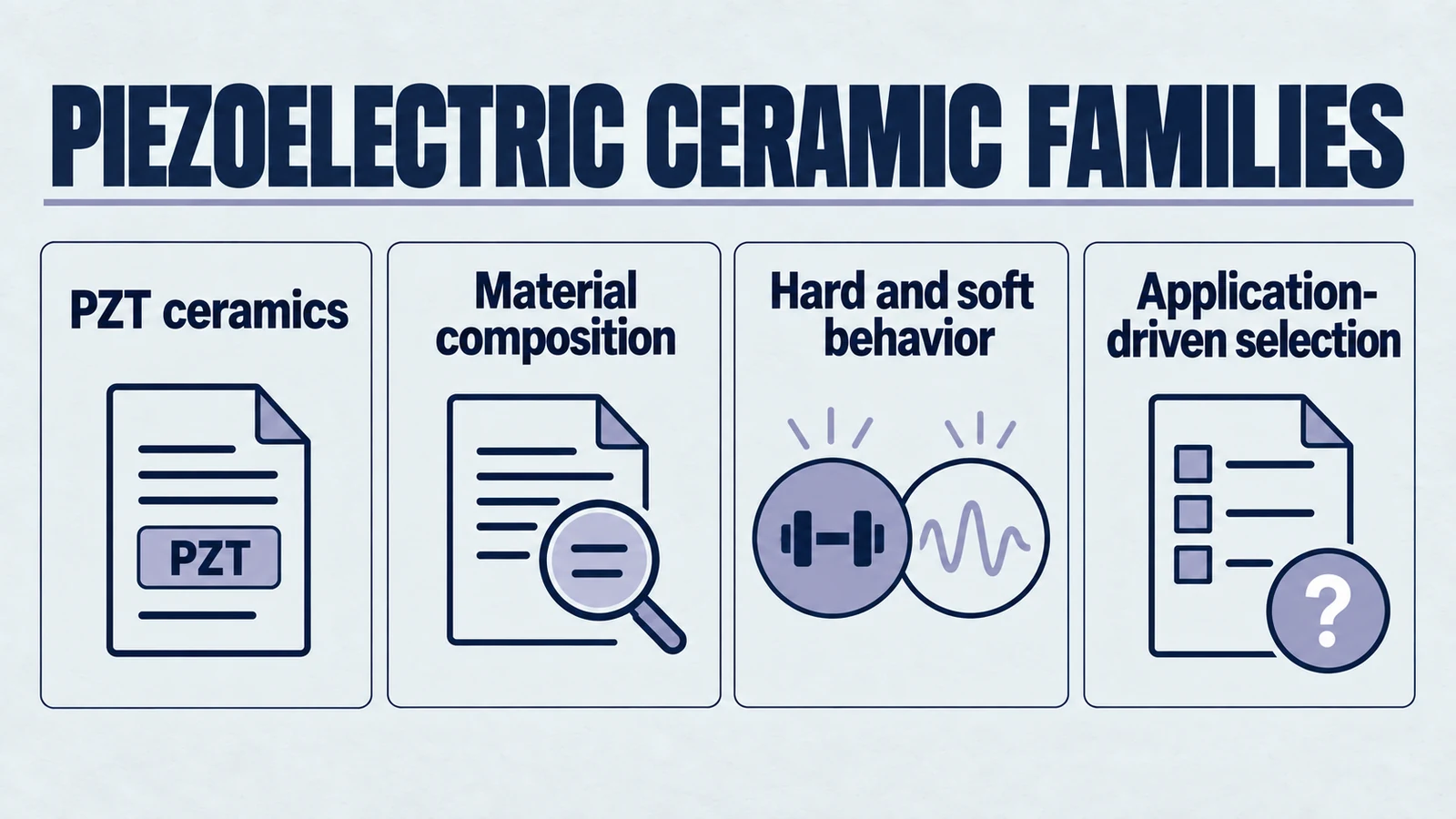
Types of Piezoelectric Ceramics
Different formulations suit different needs. Below are some common types:
- PZT-4: Offers high power output, low dielectric loss, and is ideal for ultrasonic cleaning and welding.
- PZT-5: Known for high dielectric constant and sensitivity, used in sensors and medical diagnostics.
- PZT-8: Features high mechanical quality factor and thermal stability, perfect for high-power applications.
Hard vs. Soft Piezo Ceramics
- Hard ceramics (e.g., PZT-8) are less sensitive but handle high power well.
- Soft ceramics (e.g., PZT-5H) commonly offer higher charge coefficients. Hard PZT often shows faster typical post-poling aging; quantify the relevant property, grade, time, temperature and field history separately from fatigue or thermal stability.
How to Choose the Right Piezoelectric Ceramic for Your Application
Choosing the right material involves balancing performance factors. Consider:
- Operating Frequency: Select material, dimensions and mode together; frequency is not determined by stiffness alone and does not universally require a stiffer grade.
- Mode of Operation: Select longitudinal, transverse, shear or other modes from the poling, electrode and load directions. Both d31 and d33 participate in direct sensing and converse actuation.
- Mechanical Load: Materials must withstand expected pressure or tension.
- Electrical Requirements: Voltage levels, capacitance, and response time.
- Environment: Temperature, humidity, or chemical exposure.
If you're unsure, consulting with a manufacturer can help narrow down your options.
Why Work with a Reliable Manufacturer?
Finding the right material is only half the battle—partnering with an experienced supplier ensures quality, consistency, and technical support. At Yujie, our piezoelectric ceramics development and manufacturing experience has been built since 1996 for global clients.
We offer:
- Tailored material solutions
- Fast prototyping and samples
- Stable long-term supply
- Technical guidance at every step
Contact us today to discover how we can support your next project.
FAQs about Piezoelectric Ceramics
Are piezoelectric ceramics appropriate for medical use?
Yes, when properly designed and encapsulated, they are widely used in finished-device regulated devices.
Can piezoelectric ceramics generate electricity?
Yes, they can convert mechanical stress into electrical energy, useful for sensing and energy harvesting.
What's the difference between piezoelectric ceramics and quartz?
Quartz is a natural crystal with weak piezoelectricity, while ceramics are engineered for stronger, tunable performance.
Related Engineering Reading
- PZT fundamentals for early material screening
- Compare soft vs hard PZT for your duty profile
- Review piezoelectric ceramics options for procurement
- Contact engineering for selection support
Conclusion
Piezoelectric ceramics play a crucial role in modern technology by offering a unique electromechanical interface. With diverse types and a wide range of applications, selecting the right material is essential to achieving optimal performance. To get started, partner with a trusted manufacturer who understands both materials and your end-use needs.
Explore our product range or learn more about our material specifications to find the ideal piezoelectric solution for your application.
Engineering decision notes
PZT material and ceramic selection
Use this article when the choice is not just a shape, but a material tradeoff between sensitivity, loss, coupling, stability, and operating field. For "Piezoelectric Ceramics: Types, Properties, and Selection Guide", the practical value is in turning the topic into a measurable selection or sourcing decision.
YJ Piezo coordinates PZT ceramic projects with manufacturing support, so material formulation, sintering, polarization, electrode process, and outgoing inspection can be reviewed against the final application.
Selection checks
- Separate sensing needs from high-power actuation needs before comparing d33 or coupling values.
- Check dielectric loss, Qm, Curie temperature, aging behavior, and operating field against the real duty cycle.
- Confirm whether the application needs standard PZT grades or a custom formulation and geometry.
Failure risks
- Choosing only the highest d33 can create heat, drift, or depolarization risk in power ultrasonics.
- A ceramic that performs well in free measurement can fail once bonded, clamped, or loaded.
- Material substitutions without batch testing can change capacitance, resonance, and system tuning.
RFQ details
- Is the part used for sensing, actuation, atomization, cleaning, welding, or measurement?
- What field strength, temperature, duty cycle, and mechanical load will the ceramic see?
- Which values must be controlled: d33, capacitance, resonance, impedance, Qm, or dimensional tolerance?
Relevant YJ Piezo pages
- PZT Material Hub
Material grades and application tradeoffs
- Piezoelectric Ceramics
Shapes and ceramic manufacturing options
- PZT Material Supplier Hub
Material control, grade selection, and sourcing support
Application FAQ
- Is the highest d33 always the best PZT choice?
- No. High d33 can be useful for sensitivity, but high-power ultrasonic systems often need lower loss, higher Qm, better thermal stability, and safer operation under field and stress.
- What makes PZT material selection different from catalog buying?
- The right PZT choice depends on geometry, load, drive field, duty cycle, temperature, and inspection targets. A catalog value is only useful when it is tied to the final assembly conditions.