
Soft vs Hard PZT: d33, Qm, and Engineering Selection
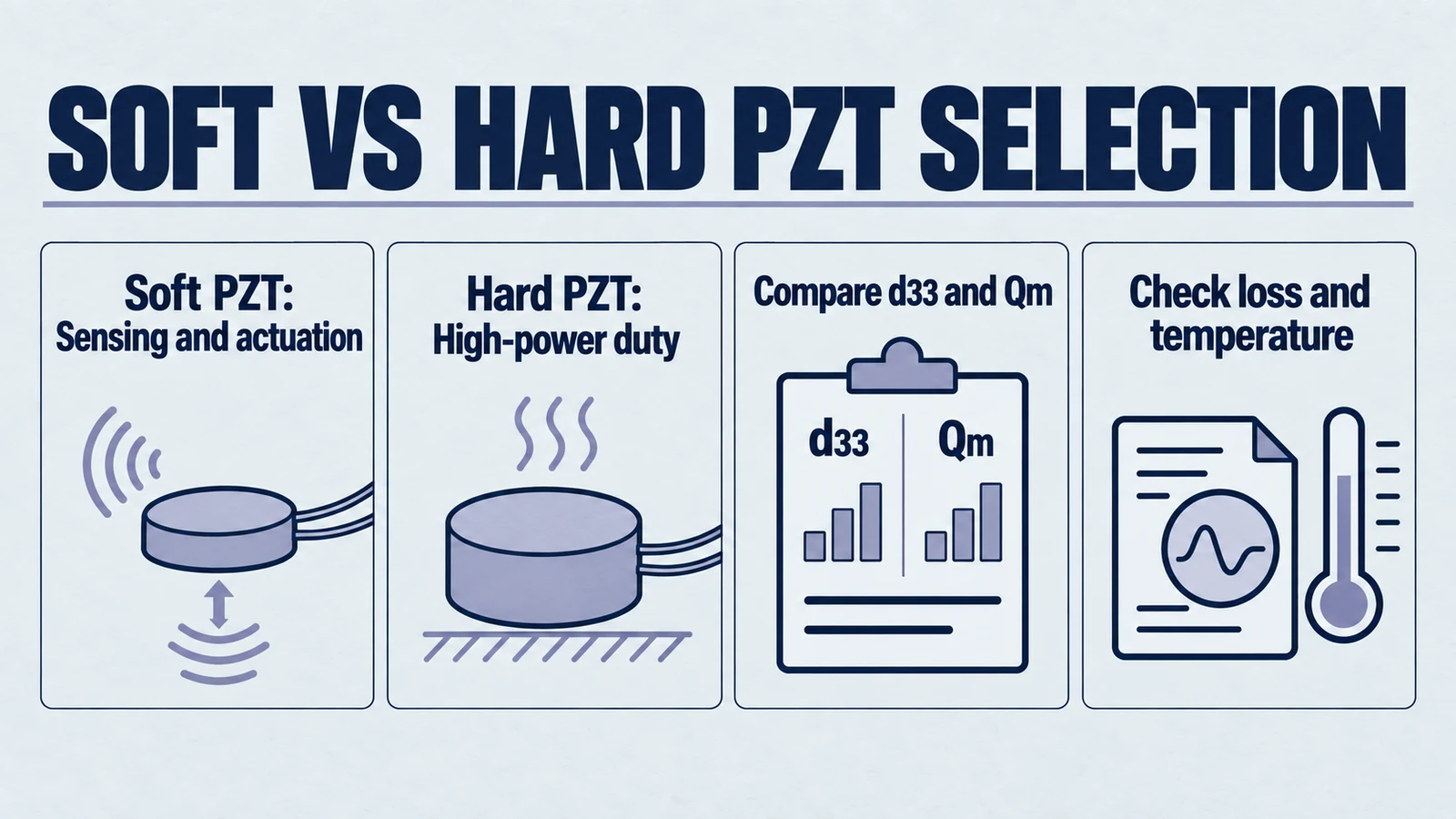
Quick answer: Soft PZT grades such as PZT-5A and PZT-5H favor sensitivity and displacement. Hard PZT grades such as PZT-4 and PZT-8 favor lower loss, higher Qm, and better high-power stability. Choose soft PZT for receiving, sensing, and actuation with force capability checked for the selected geometry and drive; choose hard PZT for ultrasonic cleaning, welding, sonar transmit, and continuous-duty power devices.
Start with what PZT means, validate parameters with d33, k, and Qm, then confirm geometry through piezoelectric ceramic options.
In the world of electro-ceramics, selecting the wrong piezoelectric material is the most expensive mistake an engineer can make. We see it often at Yujie Piezo: a client designs a high-power ultrasonic welding transducer using a material with high d₃₃ (sensitivity), only to find the system overheats and drifts in frequency after 10 minutes of operation.
Engineering decision focus: Match PZT-5, PZT-4, and PZT-8 to duty cycle, thermal margin, and drive level before locking your transducer architecture.
While generic datasheets define PZT (Lead Zirconate Titanate) by Navy Types, the real-world application requires a deeper understanding of the "Soft" vs. "Hard" PZT dichotomy.
Product path for this search intent
Match the article topic to the right YJ Piezo product page
Use this article when the choice is not just a shape, but a material tradeoff between sensitivity, loss, coupling, stability, and operating field. For "Soft vs Hard PZT: d33, Qm, and Engineering Selection", the practical value is in turning the topic into a measurable selection or sourcing decision.
- PZT Material Hub
Material grades and application tradeoffs
- Piezoelectric Ceramics
Shapes and ceramic manufacturing options
- PZT Material Supplier Hub
Material control, grade selection, and sourcing support
This guide moves beyond textbook definitions to explain exactly when to use Soft PZT (PZT-5 series) and when to switch to Hard PZT (PZT-4/PZT-8), based on thermal dynamics, loss factors, and our manufacturing experience. For foundational knowledge, see our complete guide: What is PZT? or our updated analysis on selecting the right piezoelectric material.
Visual Guide: PZT Material Types Explained
Watch our video explanation for a visual overview of different PZT material types and their applications:
The Core Distinction: Doping and Domain Wall Motion
To choose the right material, you must understand what happens inside the crystal lattice. The terms "Soft" and "Hard" refer to the mobility of the ferroelectric domains (dipoles) within the ceramic, not mechanical hardness.
Soft PZT (Donor Doped)
Soft PZT materials (including Yujie P-51 and P-52) are created by doping the lattice with "Donor" ions (like Nb⁵⁺). This creates vacancies that essentially facilitate domain wall motion.
- Result: The domains move easily.
- Advantage: You get massive displacement and high sensitivity (high d₃₃ and εᵣ).
- Disadvantage: Soft formulations commonly have greater dielectric and mechanical losses than suitable hard power grades. Heating depends on actual drive, stress, frequency, duty cycle and cooling; overheating or depoling is not inevitable for every soft-PZT device.
Hard PZT (Acceptor Doped)
Hard PZT materials (like Yujie P-81 and P-41) are doped with "Acceptor" ions (like Fe³⁺). This creates oxygen vacancies that "pin" the domain walls in place.
- Result: The domains resist movement.
- Advantage: Suitable hard formulations commonly offer low losses and better high-drive tolerance. Their drive, stress and temperature limits still require validation in the actual assembly; hard PZT can also overheat or depole.
- Disadvantage: Lower displacement per volt compared to Soft PZT.
Detailed Material Analysis: When to Use What?
1. Hard PZT: The Powerhouse (PZT-8 & PZT-4)
If your device generates high-power ultrasonic energy (Welding, Cleaning, Atomizing, Surgical Tools), you are in the realm of Hard PZT.
Yujie P-81 (Equivalent to Navy Type III / PZT-8)
- The "Cold" Runner: PZT-8 is the industry standard for continuous high-power applications.
- Key Stat: High Mechanical Quality Factor (Qₘ ≈ 1000+) and extremely low Dielectric Loss (tan δ < 0.3%).
- Why Engineers Choose It: In ultrasonic welding or continuous cleaning lines, heat is the enemy. PZT-8 generates minimal heat during operation due to its low dielectric loss under high drive conditions. It maintains its properties even under high pre-stress and high drive voltage.
- Best For: Ultrasonic Welders, focused ultrasound systems, High-Power Cleaning Transducers.
Yujie P-41 (Equivalent to Navy Type I / PZT-4)
- The "Dual-Role" Hybrid: PZT-4 is "Hard," but not as hard as PZT-8. It offers a middle ground.
- Key Stat: Moderate Qₘ (~500) but higher d₃₃ (~300 pC/N) than PZT-8.
- Why Engineers Choose It: PZT-4 is excellent when you need to transmit power but also need to receive a signal (sensitivity), or for medium-power applications where a bit more amplitude is required.
- Best For: Sonar (Transmit/Receive), Underwater Acoustics, Medium-Power Cleaning. (See our engineering report on cleaning transducers).
Engineering Debate: PZT-4 vs. PZT-8 for Welding
A common question we get: "PZT-4 has higher amplitude (d₃₃), why not use it for welding?"
The Verdict: Both PZT-4-class and PZT-8-class ceramics can be candidates for industrial welding. Compare exact-grade high-drive losses, amplitude, preload, temperature rise and resonance under the intended load. Voltage alone is not electric field: field depends on voltage and ceramic thickness. Neither a 2000 V threshold nor a family label proves that PZT-4 will fail or P-81 will remain cool.
2. Soft PZT: The Sensor Specialist (PZT-5A & PZT-5H)
If your device is listening (sensors), measuring, or moving precisely with force and displacement checked for the selected actuator, you need Soft PZT.
Yujie P-52 (Comparable to PZT-5H)
- The Sensitivity King: This material offers the highest permittivity and piezoelectric charge constant.
- Key Stat: d₃₃ ≈ 650+ pC/N.
- Trade-off: It has a lower Curie temperature than PZT-5A. It is temperature sensitive and less stable in hot environments.
- Best For: Medical Ultrasound Imaging Probes, Precision Actuators, Low-Power Hydrophones.
Yujie P-51 (Comparable to PZT-5A)
- The Stable Sensor: Less sensitive than P-52, but more stable over time and temperature.
- Key Stat: Curie temperature specified at ≥260°C for Yujie P-51.
- Why Engineers Choose It: If your sensor prioritizes calibration stability over maximum sensitivity, P-51 is the balanced PZT-5A-class choice; verify thermal margin against its ≥260°C Curie temperature for hot environments.
- Best For: NDT (Non-Destructive Testing) Sensors, Accelerometers, Flow Meters, Impact Sensors.
Technical Comparison Table
Here is how Yujie Piezo materials stack up against standard Navy designations.
| Yujie Grade | Navy Type | Classification | d₃₃ (pC/N) | Qₘ (Mech. Quality) | Dielectric Loss (tan δ) | Primary Application |
|---|---|---|---|---|---|---|
| P-81 | Type III | Hard | ~225 | 1000+ | < 0.2% | Ultrasonic Welding, Cleaning |
| P-41 | Type I | Hard | ~300 | 500 | ~0.4% | Sonar, Cleaning (Med Power) |
| P-51 | Type II | Soft | ~400 | 75 | ~1.5% | NDT, Flow Sensors, Accelerometers |
| P-52 | Type VI | Soft | 650+ | 65 | ~2.0% | Medical Imaging, Precision Actuators |
(Note: Data represents typical values for guidance. Please consult specific batch datasheets for precise calculations.)
For industrial tank builds, Yujie's advanced cleaner transducer HJ-4528, high-power cleaner transducer HJ-3840, and industrial cleaning transducer HJ-5028 are common OEM options.
3 Common Failure Modes We See in Production
Understanding materials helps you troubleshoot failures in your transducer assembly line.
1. "My Welding Transducer is losing power when hot."
- Diagnosis: You might be using PZT-4 or a low-quality PZT-8 with high impurities. As the ceramic heats up, tan δ rises, creating a thermal runaway loop.
- Solution: Switch to Yujie P-81 for superior thermal stability.
2. "The Ceramics cracked during assembly."
- Diagnosis: Both hard and soft PZT are brittle ceramics; the labels describe ferroelectric domain behavior, not an ability to conform to uneven contact faces. Uneven surfaces, edge loading, bending, or improper preload can cause cracking.
- Solution: Use flat, parallel contact faces and uniform preload appropriate to the assembly. Avoid point, edge, and bending loads; establish acceptable preload with the transducer designer.
3. "The sensor output dropped after soldering."
- Diagnosis: You likely used PZT-5H-class material (Yujie P-52) and overheated it. Because high-sensitivity soft PZT has lower thermal margin, soldering heat can partially depole the material.
- Solution: Use Yujie P-51 (PZT-5A-class material) where thermal stability matters more than maximum sensitivity, or switch to conductive epoxy instead of soldering directly to the electrode.
Conclusion: Engineering Your Success
Choosing between PZT-4, PZT-8, and PZT-5 is not just about checking a box on a spec sheet; it's about matching the thermal and mechanical behavior of the ceramic to your specific load conditions.
Catalog models are examples. We also make common ceramic shapes in the dimensions you need. For simple shapes, send dimensions and quantity; no drawing is needed to start an enquiry.
Source PZT Parts for Your Production Requirements
Already have a material grade or an existing part to source? Compare PZT discs, ceramic rings, plates and tubes, or ask about PZT powder supply.
For simple shapes, send dimensions and quantity to start a supply review. Include the material or electrical targets you already use, operating conditions, first-order quantity and expected annual demand if known. Ask for volume pricing on larger orders or repeat requirements; availability, tolerances and delivery are reviewed for your actual part.
Related Engineering Reading
Engineering decision notes
PZT material and ceramic selection
Use this article when the choice is not just a shape, but a material tradeoff between sensitivity, loss, coupling, stability, and operating field. For "Soft vs Hard PZT: d33, Qm, and Engineering Selection", the practical value is in turning the topic into a measurable selection or sourcing decision.
YJ Piezo coordinates PZT ceramic projects with manufacturing support, so material formulation, sintering, polarization, electrode process, and outgoing inspection can be reviewed against the final application.
Selection checks
- Separate sensing needs from high-power actuation needs before comparing d33 or coupling values.
- Check dielectric loss, Qm, Curie temperature, aging behavior, and operating field against the real duty cycle.
- Confirm whether the application needs standard PZT grades or a custom formulation and geometry.
Failure risks
- Choosing only the highest d33 can create heat, drift, or depolarization risk in power ultrasonics.
- A ceramic that performs well in free measurement can fail once bonded, clamped, or loaded.
- Material substitutions without batch testing can change capacitance, resonance, and system tuning.
RFQ details
- Is the part used for sensing, actuation, atomization, cleaning, welding, or measurement?
- What field strength, temperature, duty cycle, and mechanical load will the ceramic see?
- Which values must be controlled: d33, capacitance, resonance, impedance, Qm, or dimensional tolerance?
Relevant YJ Piezo pages
- PZT Material Hub
Material grades and application tradeoffs
- Piezoelectric Ceramics
Shapes and ceramic manufacturing options
- PZT Material Supplier Hub
Material control, grade selection, and sourcing support
Application FAQ
- Is the highest d33 always the best PZT choice?
- No. High d33 can be useful for sensitivity, but high-power ultrasonic systems often need lower loss, higher Qm, better thermal stability, and safer operation under field and stress.
- What makes PZT material selection different from catalog buying?
- The right PZT choice depends on geometry, load, drive field, duty cycle, temperature, and inspection targets. A catalog value is only useful when it is tied to the final assembly conditions.
Related Products
- Skincare Transducer HJ-4012 3M
- Advanced Cleaner Transducer HJ-4528
- High Power Cleaner Transducer HJ-3840