
Guide to Piezoelectric Ceramic Materials (PZT Types) and How to Select Them
Piezoelectric ceramics are the cornerstone of modern precision sensing, actuation, and energy harvesting technologies. Among these, PZT (lead zirconate titanate) ceramics dominate due to their high piezoelectric coefficients, mechanical strength, and adaptability across various frequency ranges. This guide will help engineers, designers, and sourcing professionals understand the different types of PZT materials and how to select the right piezoelectric ceramic for your application.
What Are Piezoelectric Ceramics?
Piezoelectric ceramics are engineered materials that generate electrical charge under mechanical stress (direct piezoelectric effect) and deform under an electric field (inverse piezoelectric effect). They are widely used in sensors, actuators, ultrasonic transducers, and energy harvesters.
PZT ceramics are the most commonly used piezoelectric ceramics due to:
Product path for this search intent
Match the article topic to the right YJ Piezo product page
Use this article when the choice is not just a shape, but a material tradeoff between sensitivity, loss, coupling, stability, and operating field. For "Guide to Piezoelectric Ceramic Materials (PZT Types) and How to Select Them", the practical value is in turning the topic into a measurable selection or sourcing decision.
- PZT Material Hub
Material grades and application tradeoffs
- Piezoelectric Ceramics
Shapes and ceramic manufacturing options
- PZT Material Supplier Hub
Material control, grade selection, and sourcing support
- High piezoelectric constants
- Wide operational temperature range
- Tunable dielectric and mechanical properties
- Cost-effective mass production
Understanding PZT Types
PZT materials can be categorized based on their composition and properties to suit specific applications. Common PZT types include:
1. Soft PZT (High Sensitivity):
- High piezoelectric coefficients and dielectric constants
- Suitable for sensors and low-power actuators
- Higher dielectric losses and lower mechanical quality factors
2. Hard PZT (High Power):
- Lower piezoelectric coefficients but high mechanical quality factors
- Low dielectric losses
- Suitable for high-power ultrasonics, actuators, and transducers that require stability under high drive conditions
3. Customized PZT Formulations:
Adjustments in doping and composition allow tailoring properties for specific frequency, temperature, and mechanical requirements.
Common PZT material designations like PZT-4, PZT-5, PZT-8, and manufacturer-specific codes reflect their varying properties. For example:
- PZT-5 (Soft PZT): Higher sensitivity, commonly used in sensing applications.
- PZT-8 (Hard PZT): Lower sensitivity but high stability, ideal for ultrasonic cleaning and welding transducers.
Key Properties to Consider for PZT Material Selection
When performing PZT material selection for your application, consider:
- Piezoelectric Charge Constant (d33): Indicates the material's ability to convert mechanical energy into electrical energy.
- Coupling Factor (k): Describes mode-specific electromechanical coupling under defined boundary conditions, rather than finished-device power efficiency.
- Mechanical Quality Factor (Qm): Higher Qm is critical for high-power applications to minimize energy loss.
- Curie Temperature (Tc): Marks the ferroelectric phase transition for the specified composition; use the qualified operating-temperature rating and field/load conditions separately.
- Dielectric Constant: Influences the capacitance and impedance matching of the device.
Understanding these parameters helps you balance sensitivity, operational stability, and energy handling based on your specific application. Learn more about piezoelectric constants and their significance.
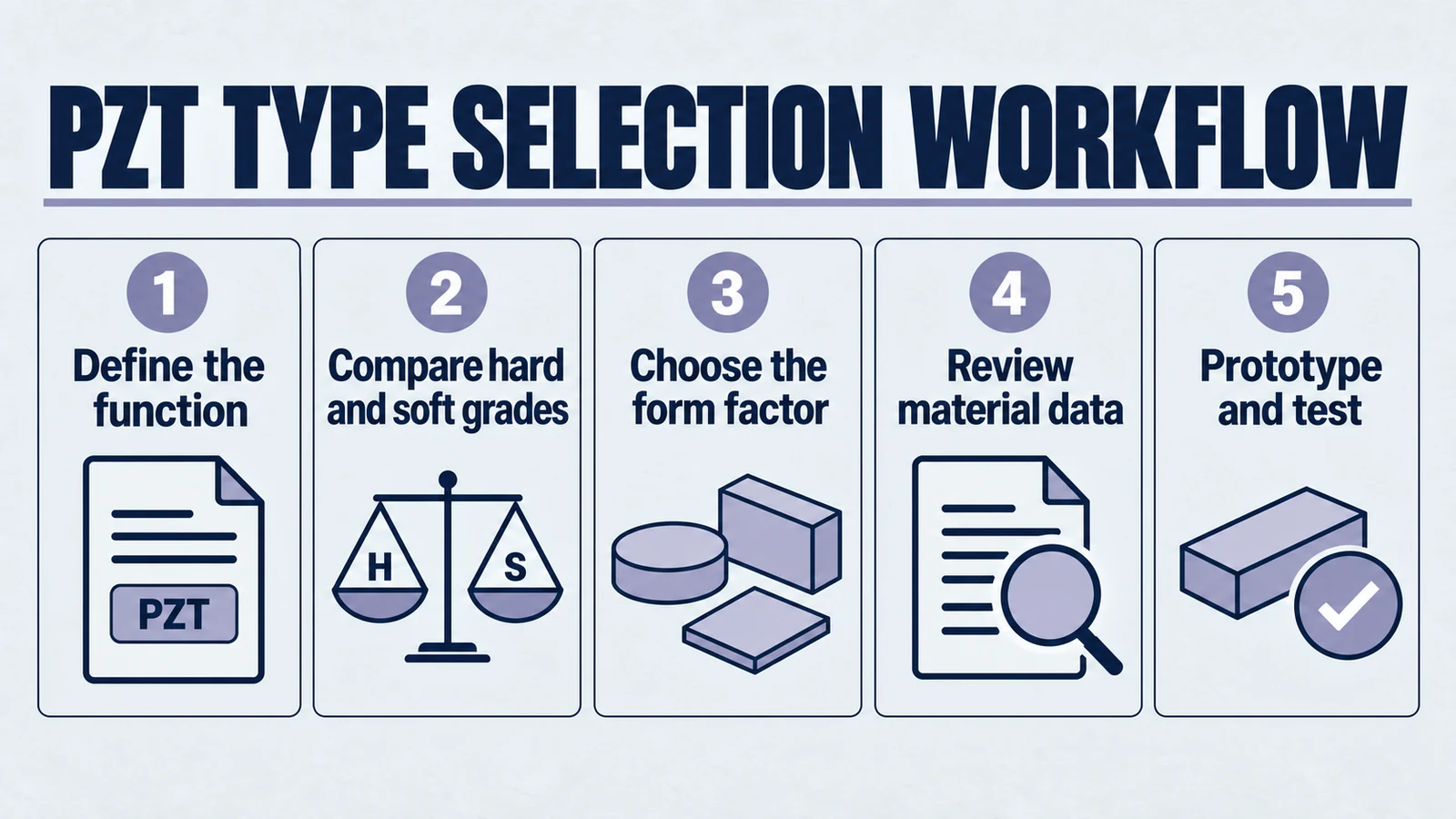
How to Select the Right Piezoelectric Ceramic for Your Application
1. Define Your Application Requirements:
- Is it a sensor, actuator, or transducer?
- Operating frequency range?
- Required displacement or sensitivity?
- Working environment (temperature, humidity, mechanical stresses)?
2. Match PZT Type to Your Needs:
- Soft PZT: For high sensitivity in medical sensors and low-power actuators.
- Hard PZT: For high-power ultrasonic applications, energy harvesting, or actuators requiring stability under high drive conditions.
3. Consider Form Factor:
Yujie provides PZT materials in various forms:
- Discs and rings for ultrasonic transducers
- Tubes for endoscopy and flow sensors
- Plates and custom geometries for specific actuator designs
4. Consult Technical Data Sheets:
Request technical data sheets and performance curves to match PZT properties precisely to your system requirements.
5. Prototype and Test:
Even with theoretical selection, prototyping is essential for tuning your system's performance. Yujie can provide sample PZT components for your evaluation.
Application-Specific PZT Selection Examples
Beauty and Personal Care Devices
For ultrasonic beauty devices, soft PZT materials are preferred for gentle skin procedures and enhanced product absorption. Our 1MHz skincare transducers use specially formulated PZT for optimal performance.
Industrial Cleaning Applications
Hard PZT ceramics excel in industrial cleaning systems where high power output and durability are essential. The high-power cleaning transducers demonstrate the effectiveness of properly selected hard PZT materials.
Acoustic and Underwater Applications
Marine and underwater applications require PZT materials with excellent stability under pressure. Our acoustic transducers are designed with specialized PZT formulations for harsh environments.
Why Choose Yujie for Your Piezoelectric Ceramic Needs?
With PZT manufacturing experience built since 1996, Yujie offers:
- A wide range of piezoelectric ceramic materials for different application needs
- Customized material formulations for specific frequency and mechanical requirements
- Consistent quality control to ensure reliability in your systems
- Technical support to assist your PZT material selection and prototyping
If you are developing a sensor, actuator, or ultrasonic device and need reliable PZT ceramics, contact us to discuss your requirements and request a quote.
Quality Assurance and Testing
Understanding how to test and measure piezoelectric materials is crucial for ensuring optimal performance. Our comprehensive testing protocols document consistent material properties and long-term reliability in your applications.
Conclusion
Selecting the right piezoelectric ceramic material is critical for the success of your product. By understanding the types of PZT materials and their properties, you can optimize your device for performance, stability, and cost-effectiveness.
Explore Yujie's PZT materials today and take your projects to the next level with precision piezoelectric technology. For specific guidance on material selection, consult our supplier selection guide to ensure you're making the best choice for your application.
Engineering decision notes
PZT material and ceramic selection
Use this article when the choice is not just a shape, but a material tradeoff between sensitivity, loss, coupling, stability, and operating field. For "Guide to Piezoelectric Ceramic Materials (PZT Types) and How to Select Them", the practical value is in turning the topic into a measurable selection or sourcing decision.
YJ Piezo coordinates PZT ceramic projects with manufacturing support, so material formulation, sintering, polarization, electrode process, and outgoing inspection can be reviewed against the final application.
Selection checks
- Separate sensing needs from high-power actuation needs before comparing d33 or coupling values.
- Check dielectric loss, Qm, Curie temperature, aging behavior, and operating field against the real duty cycle.
- Confirm whether the application needs standard PZT grades or a custom formulation and geometry.
Failure risks
- Choosing only the highest d33 can create heat, drift, or depolarization risk in power ultrasonics.
- A ceramic that performs well in free measurement can fail once bonded, clamped, or loaded.
- Material substitutions without batch testing can change capacitance, resonance, and system tuning.
RFQ details
- Is the part used for sensing, actuation, atomization, cleaning, welding, or measurement?
- What field strength, temperature, duty cycle, and mechanical load will the ceramic see?
- Which values must be controlled: d33, capacitance, resonance, impedance, Qm, or dimensional tolerance?
Relevant YJ Piezo pages
- PZT Material Hub
Material grades and application tradeoffs
- Piezoelectric Ceramics
Shapes and ceramic manufacturing options
- PZT Material Supplier Hub
Material control, grade selection, and sourcing support
Application FAQ
- Is the highest d33 always the best PZT choice?
- No. High d33 can be useful for sensitivity, but high-power ultrasonic systems often need lower loss, higher Qm, better thermal stability, and safer operation under field and stress.
- What makes PZT material selection different from catalog buying?
- The right PZT choice depends on geometry, load, drive field, duty cycle, temperature, and inspection targets. A catalog value is only useful when it is tied to the final assembly conditions.