
Piezo Actuators: Mechanisms and Advanced Applications
Piezo Actuators: Mechanisms and Advanced Applications
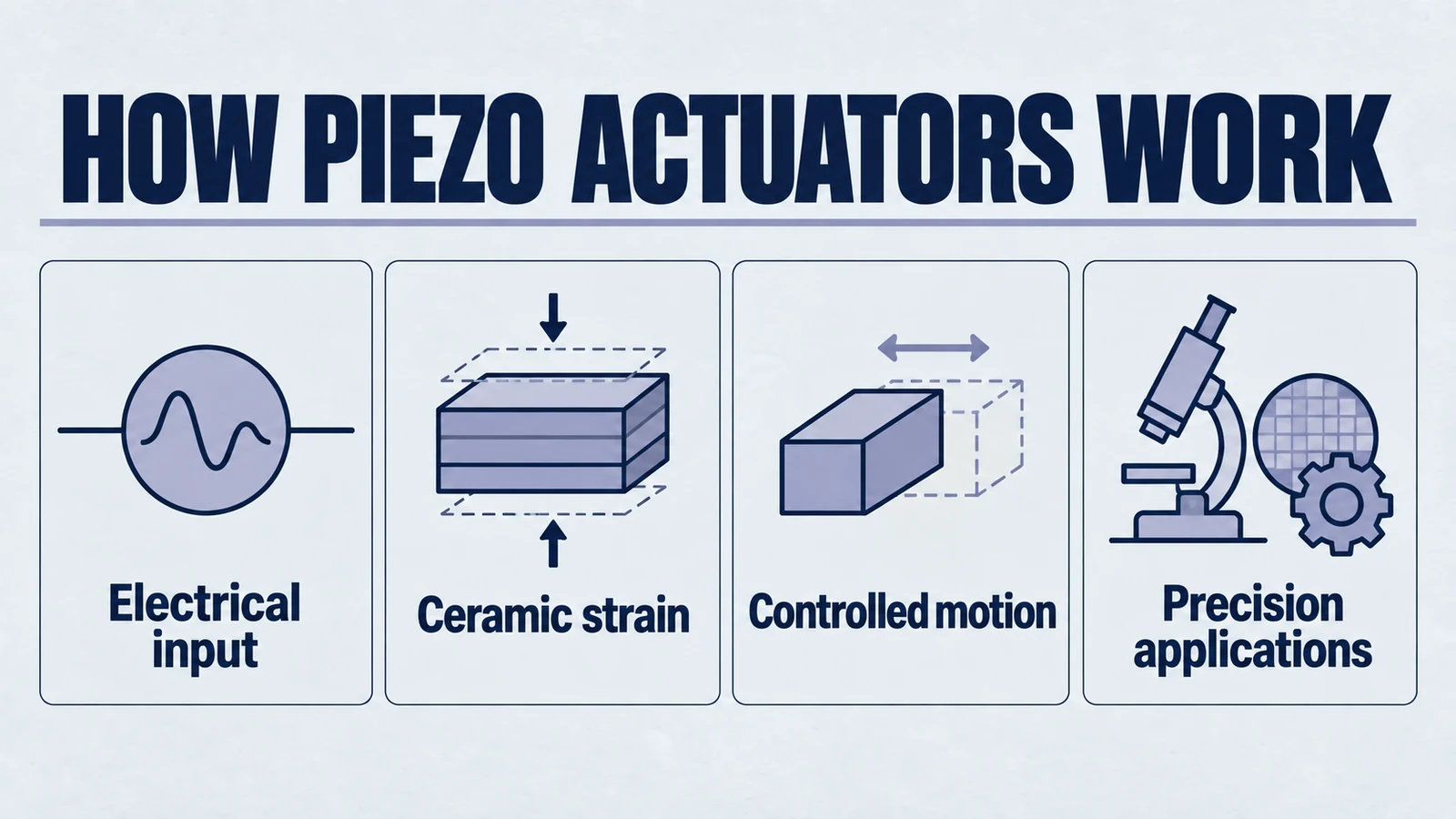
Piezo actuators are precision-engineered devices that transduce electrical energy into mechanical displacement through the inverse (converse) piezoelectric effect. This phenomenon—wherein crystalline materials exhibit dimensional changes under applied electric fields—enables piezo actuators to achieve high-resolution motion on the micro- to nanometer scale. Piezo actuators' combination of rapid response times, sub-nanometer precision, and substantial force output has positioned them as important components in cutting-edge sectors such as aerospace engineering, biomedical instrumentation, and nanotechnology research.
Sourcing a Ceramic Element for an Actuator
For a PZT element with specific geometry, material, or electrode requirements, use the custom piezoelectric component review. Include dimensions or a drawing, drive voltage, load or preload, temperature, target motion, sample quantity, and expected production quantity. Identify whether you need the ceramic element or a complete actuator with housing, feedback, and drive electronics so the supply scope can be reviewed. Final displacement, force, and lifetime depend on the assembled system and need validation under its operating conditions.
Product path for this search intent
Match the article topic to the right YJ Piezo product page
Use this article when the choice is not just a shape, but a material tradeoff between sensitivity, loss, coupling, stability, and operating field. For "Piezo Actuators: Mechanisms and Advanced Applications", the practical value is in turning the topic into a measurable selection or sourcing decision.
- PZT Material Hub
Material grades and application tradeoffs
- Piezoelectric Ceramics
Shapes and ceramic manufacturing options
- PZT Material Supplier Hub
Material control, grade selection, and sourcing support
Operational Principles of Piezo Actuators
The core mechanism of piezo actuators centers on the intrinsic properties of piezoelectric ceramics, typically based on lead zirconate titanate (PZT) compositions. When subjected to an electric field, these ceramics undergo anisotropic deformation, manifesting as axial elongation or contraction. Piezo actuators are commonly configured in stacked multilayer architectures to amplify displacement while maintaining compact form factors. Their electromechanical behavior is governed by parameters such as the piezoelectric charge constant (d₃₃), dielectric permittivity, and mechanical stiffness, which collectively dictate performance characteristics.
Essential structural elements include:
- Piezoelectric Stack: A laminar assembly of active ceramic layers interleaved with electrodes.
- Electrodes: Typically sputtered or screen-printed metallic layers enabling uniform field distribution.
- Preload Mechanisms and Housing: Mechanical constraints to prevent tensile failure and ensure robustness under dynamic cycling.
Advanced designs of piezo actuators incorporate integrated strain gauges or capacitive sensors, facilitating closed-loop feedback control to mitigate hysteresis and creep, which are intrinsic to piezoelectric materials. Learn more about the fundamental properties in our guide to piezoelectric ceramics.
High-Precision Application Domains
1. Aerospace and Adaptive Optics
Piezo actuators are critical for real-time wavefront correction in telescopes and satellite systems, mitigating atmospheric distortion and enhancing imaging fidelity. Piezo actuator arrays also serve in active vibration isolation and fine-tuning of spaceborne instrumentation. These applications demonstrate the future potential of piezoelectric technology in advanced industries.
2. Biomedical Engineering
Their integration into microfluidic systems enables picoliter-scale dispensing and flow regulation, pivotal for lab-on-chip devices. Additionally, piezo actuators enhance resolution in high-frequency ultrasonic transducers and precision surgical tools. Our flow measurement solutions utilize similar technology for precise control in medical applications.
3. Semiconductor Fabrication
Wafer steppers, e-beam lithography, and advanced metrology instruments leverage piezo actuators for nanoscale alignment and stage positioning, directly impacting yield and device performance. The precision requirements in this field mirror those needed in our ultrasonic sensor technology.
4. Nanopositioning and Scanning Probe Microscopy
Atomic force microscopes and scanning tunneling microscopes employ piezo actuators for atomic-resolution raster scanning and feedback stabilization, ensuring reliable nanoscale measurements. The capabilities of piezoelectric components in precision applications are further explored in our article on ultrasonic transducer science.
5. Industrial Automation and Robotics
Used in high-precision assembly lines and robotic manipulators, piezo actuators deliver consistent, repeatable micro-motions essential for manufacturing sectors demanding micron-level tolerances. This precision is similar to what we achieve with our ultrasonic welding transducers.
6. Energy Harvesting and Emerging Technologies
Current research explores bidirectional functionalities, utilizing piezo actuators in vibrational energy scavenging and as elements in hybrid electromechanical systems. The future of this technology is discussed in our exploration of ultrasonic transducer applications.
Engineering Advantages and Design Considerations
Piezo actuators provide non-magnetic, frictionless, and low-thermal-load operation, making piezo actuator systems ideal for vacuum environments, cryogenic setups, and electromagnetically sensitive systems. Their high stiffness ensures resonant frequencies that accommodate rapid dynamic actuation, although limitations such as charge leakage, hysteresis, and long-term material fatigue necessitate careful design and system-level compensation. Piezo actuators' longevity and precise motion capabilities continue to make them the preferred solution in high-tech applications.
YJ Piezo reviews custom PZT ceramic element requirements for actuator projects. Geometry, material direction, electrode layout, and inspection requirements are assessed against the application. Send your requirements through the custom component page or contact us directly to confirm the feasible supply scope and sample plan.
Whether you're looking for disc-shaped piezoelectric elements, ring-shaped components, or other specialized geometries like rectangular piezo elements, our engineering team can help design the optimal solution for your application. Learn more about selecting the right piezoelectric ceramic for your specific needs.
Engineering decision notes
PZT material and ceramic selection
Use this article when the choice is not just a shape, but a material tradeoff between sensitivity, loss, coupling, stability, and operating field. For "Piezo Actuators: Mechanisms and Advanced Applications", the practical value is in turning the topic into a measurable selection or sourcing decision.
YJ Piezo coordinates PZT ceramic projects with manufacturing support, so material formulation, sintering, polarization, electrode process, and outgoing inspection can be reviewed against the final application.
Selection checks
- Separate sensing needs from high-power actuation needs before comparing d33 or coupling values.
- Check dielectric loss, Qm, Curie temperature, aging behavior, and operating field against the real duty cycle.
- Confirm whether the application needs standard PZT grades or a custom formulation and geometry.
Failure risks
- Choosing only the highest d33 can create heat, drift, or depolarization risk in power ultrasonics.
- A ceramic that performs well in free measurement can fail once bonded, clamped, or loaded.
- Material substitutions without batch testing can change capacitance, resonance, and system tuning.
RFQ details
- Is the part used for sensing, actuation, atomization, cleaning, welding, or measurement?
- What field strength, temperature, duty cycle, and mechanical load will the ceramic see?
- Which values must be controlled: d33, capacitance, resonance, impedance, Qm, or dimensional tolerance?
Relevant YJ Piezo pages
- PZT Material Hub
Material grades and application tradeoffs
- Piezoelectric Ceramics
Shapes and ceramic manufacturing options
- PZT Material Supplier Hub
Material control, grade selection, and sourcing support
Application FAQ
- Is the highest d33 always the best PZT choice?
- No. High d33 can be useful for sensitivity, but high-power ultrasonic systems often need lower loss, higher Qm, better thermal stability, and safer operation under field and stress.
- What makes PZT material selection different from catalog buying?
- The right PZT choice depends on geometry, load, drive field, duty cycle, temperature, and inspection targets. A catalog value is only useful when it is tied to the final assembly conditions.