
Piezoelectric Energy Harvesting: Powering the IoT Revolution
Introduction
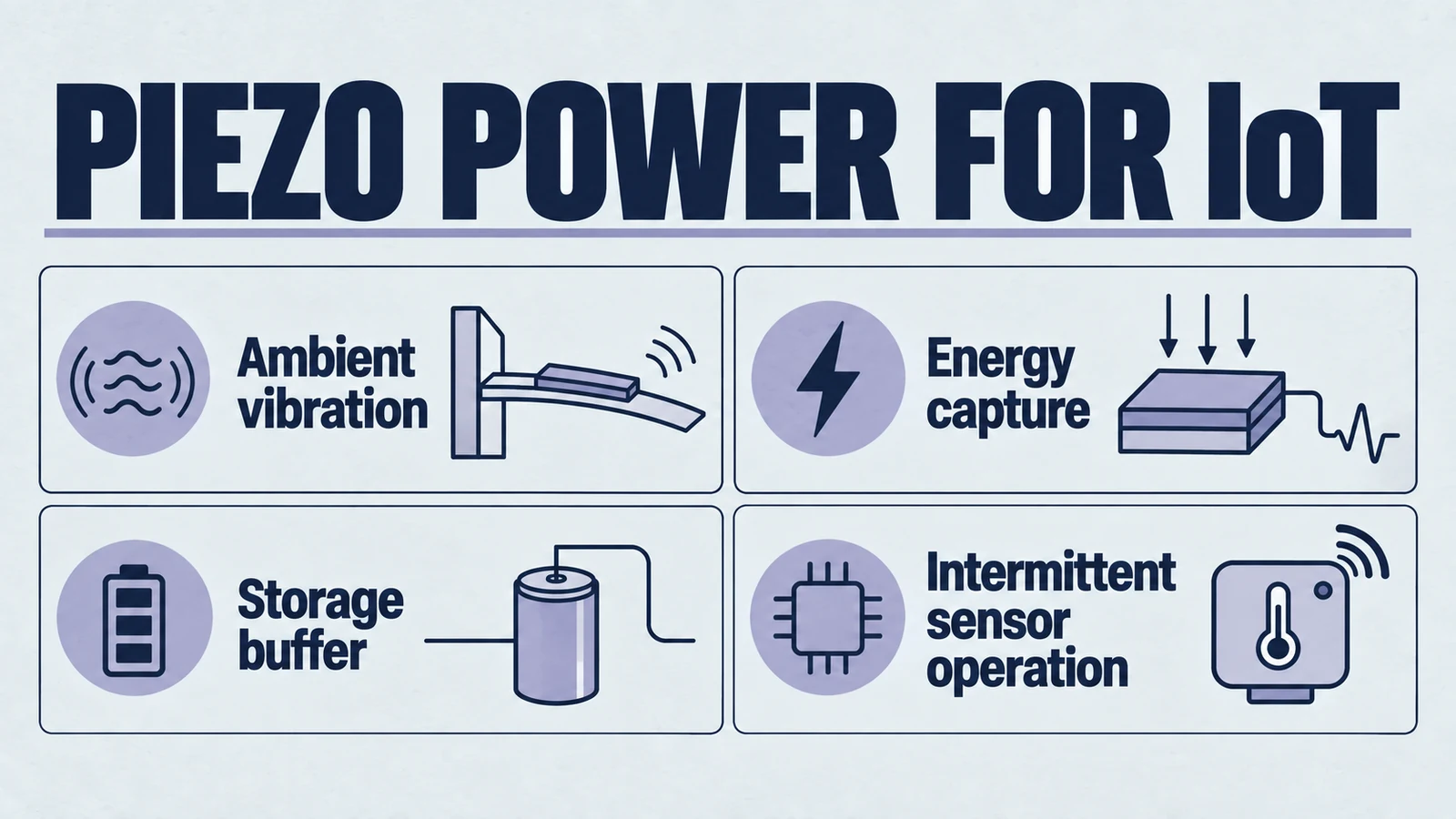
The Internet of Things (IoT) is changing the way devices and sensors interact across homes, factories, and infrastructure. A critical challenge facing IoT expansion is the power supply for distributed devices. Piezoelectric energy harvesting, leveraging piezoelectric materials' ability to convert mechanical vibrations into electrical energy, can support suitable low-power IoT devices when the available vibration energy is sufficient.
Understanding Piezoelectric Energy Harvesting
Piezoelectric energy harvesting captures ambient mechanical energy—such as vibrations, pressure, or motion—and transforms it into usable electrical power. Piezoelectric materials, typically ceramics like lead zirconate titanate (PZT) or flexible polymers such as polyvinylidene fluoride (PVDF), generate electric charges when mechanically deformed, creating renewable energy sources ideal for low-power IoT devices.
Product path for this search intent
Match the article topic to the right YJ Piezo product page
Use this article when sensor performance depends on target distance, beam angle, housing material, liquid behavior, or false echo control. For "Piezoelectric Energy Harvesting: Powering the IoT Revolution", the practical value is in turning the topic into a measurable selection or sourcing decision.
- Ultrasonic Sensors
Distance, level, and detection sensor portfolio
- Flow Measurement Transducers
Bubble and flow-related ultrasonic sensing paths
- Air Acoustic Transducers
Air-coupled transducers for range and presence detection
How Piezoelectric Harvesting Powers IoT
Self-Powered Sensors
Piezoelectric energy harvesting significantly benefits remote, inaccessible, or hostile environments where changing batteries regularly is impractical. Devices like environmental sensors, structural health monitoring systems, and industrial IoT devices become more reliable and autonomous through energy harvesting.
Wireless and Battery-Free Operation
The integration of piezoelectric materials eliminates or significantly reduces dependency on traditional battery systems, reducing maintenance costs and environmental impacts. For example, piezoelectric energy harvesting can power wireless sensors embedded in infrastructure, enabling long-term monitoring without external power sources.
Practical Applications and Case Studies
Smart Infrastructure
Piezoelectric sensors integrated into bridges, roads, and buildings can convert structural vibrations caused by traffic or environmental factors into electrical power, driving sensor arrays and data transmission modules without external energy sources.
Wearable Technology
Flexible piezoelectric polymers like PVDF are ideal for wearable IoT applications. Embedded within textiles, these materials harvest energy from human movements, powering biometric monitoring devices and smart clothing without bulky batteries.
Industrial Automation
Factories and manufacturing facilities utilize piezoelectric energy harvesters to power sensor networks that monitor machinery health, reducing downtime through predictive maintenance.
Advantages and Challenges
Advantages
- Sustainability: Piezoelectric harvesting offers a renewable energy source, decreasing reliance on batteries and grid power.
- Maintenance Reduction: Lower operational costs through minimized battery replacements.
- Scalability: Suitable for mass deployment in diverse IoT environments.
Challenges
- Energy Storage and Management: Efficient energy storage systems must complement piezoelectric harvesters for stable power delivery.
- Material Durability: Ensuring long-term reliability in various environmental conditions requires ongoing materials research and innovation.
The Future of Piezoelectric Harvesting in IoT
Advances in material science, particularly nanostructured and lead-free piezoelectric ceramics, are poised to expand the efficiency and applicability of piezoelectric harvesting technologies. Combined with developments in ultra-low power electronics and energy management systems, piezoelectric energy harvesting will increasingly power sophisticated, autonomous IoT networks.
Conclusion
Piezoelectric energy harvesting represents a pivotal technology in the IoT revolution, enabling self-sustaining, reliable sensor networks critical for smart infrastructures and industries. As research continues to advance, piezoelectric technologies promise unprecedented efficiency and sustainability in powering tomorrow's interconnected world.
Interested in integrating piezoelectric energy harvesting solutions into your IoT applications? Contact us today to discuss tailored energy harvesting solutions.
Engineering decision notes
Ultrasonic sensing and detection
Use this article when sensor performance depends on target distance, beam angle, housing material, liquid behavior, or false echo control. For "Piezoelectric Energy Harvesting: Powering the IoT Revolution", the practical value is in turning the topic into a measurable selection or sourcing decision.
YJ Piezo treats ultrasonic sensing as an acoustic interface problem: transducer frequency, beam shape, housing, drive electronics, and target environment are reviewed together.
Selection checks
- Define target range, dead zone, beam angle, and mounting geometry before choosing the sensor family.
- Check the medium, target surface, temperature swing, foam, vapor, and side-wall risk.
- Separate detection repeatability from ideal lab accuracy when the sensor will operate in a tank, tube, or moving line.
Failure risks
- A sensor can pass bench distance tests and still fail in tanks with foam, agitation, vapor, or narrow geometry.
- Changing only frequency without reviewing beam angle and mounting can increase false echoes.
- Ignoring housing material or sealing requirements can shorten lifetime in washdown or chemical environments.
RFQ details
- What is the minimum and maximum detection distance?
- Is the target liquid, solid, sheet material, air flow, or a moving object?
- What temperature, humidity, IP rating, and output signal does the system require?
Relevant YJ Piezo pages
- Ultrasonic Sensors
Distance, level, and detection sensor portfolio
- Flow Measurement Transducers
Bubble and flow-related ultrasonic sensing paths
- Air Acoustic Transducers
Air-coupled transducers for range and presence detection
Application FAQ
- What makes an ultrasonic sensor page useful for procurement?
- It should connect range, beam angle, output signal, housing, mounting, and environmental limits to a concrete use case. A model name alone is not enough for reliable supplier comparison.
- Which information speeds up an ultrasonic sensor RFQ?
- Send the target material, distance range, installation geometry, output interface, temperature range, IP rating, and whether the application involves foam, vapor, liquid, or moving objects.