
Understanding PZT Powder: The Foundation of High-Performance Piezo Ceramics
Introduction
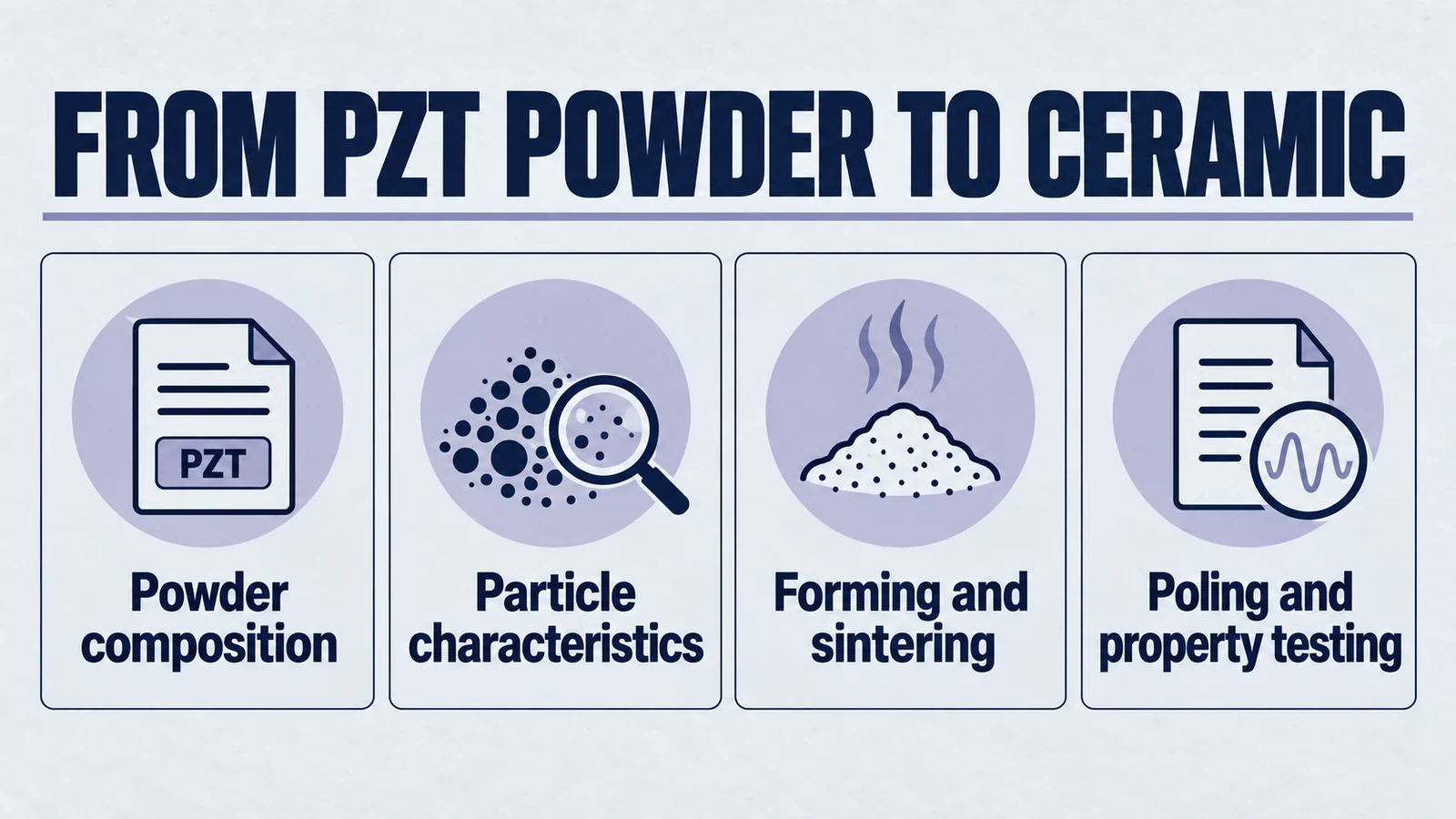
PZT powder, or lead zirconate titanate powder, is the core raw material enabling high-performance piezoelectric ceramics and transducers across modern industries. As demands for precision sensing, efficient actuation, and reliable transduction increase in sectors such as medical imaging, ultrasonic processing, and precision manufacturing, it is essential for engineers, R&D teams, and procurement managers to gain a deeper understanding of PZT powder's characteristics and production processes to maximize their applications' performance.
This extended guide explores the definition, crystal structure, advanced production methods, key material properties, testing standards, and real-world application impacts of PZT powder to equip your team with practical knowledge for sourcing and applying high-quality piezoelectric powder effectively.
If you are evaluating supply rather than only researching the material, use the dedicated PZT powder supplier and China export inquiry page. It separates the commercial review—requested material, parameters, possible quantity, destination, and shipment planning—from the technical background covered here.
Product path for this search intent
Match the article topic to the right YJ Piezo product page
Use this article when the choice is not just a shape, but a material tradeoff between sensitivity, loss, coupling, stability, and operating field. For "Understanding PZT Powder: The Foundation of High-Performance Piezo Ceramics", the practical value is in turning the topic into a measurable selection or sourcing decision.
- PZT Material Hub
Material grades and application tradeoffs
- Piezoelectric Ceramics
Shapes and ceramic manufacturing options
- PZT Material Supplier Hub
Material control, grade selection, and sourcing support
Case note: from trial kilograms to a tonne-scale powder program
An EMEA-based piezoceramic producer, buying through a regional distribution partner, qualified our powders exactly this way: trial quantities of three grades (P-51, P-44, P-33) with separate recommended sintering regimes for each, before committing to volume. Production batches of P-81 then scaled from several hundred kilograms per shipment to a single order above one tonne, moving by air freight with the safe-transport certification the route required.
Two details tell the story. The customer reported a recent multi-hundred-kilogram batch measurably better than the one before it and asked us to hold that standard — batch consistency became the working baseline. And production for the latest order started on confirmation, ahead of payment clearing: an arrangement only repeat programs earn.
There is also a supply-chain dimension that datasheets never mention. Because raw piezoelectric powder is a fine particulate, many otherwise capable manufacturers simply decline to export it: couriers demand safety data sheets, customs offices expect a precise commodity classification, and the packaging has to keep the material sealed and dry across a long freight chain. Yujie has handled this export workflow for years, arranging the required paperwork, testing, and compliant powder packaging with freight forwarders as a matter of routine, which is why our powder reaches laboratories and OEM plants in over fifty countries. When you evaluate a powder source, ask about the shipping paperwork as early as you ask about particle size — it is the step where most orders quietly fail.
What is PZT Powder?
PZT powder is an oxide solid solution of lead zirconate and lead titanate, commonly written Pb(ZrxTi1−x)O3, with a perovskite crystal structure. This structure is critical, as it allows the alignment of electric dipoles under an external electric field, exhibiting strong piezoelectric and ferroelectric properties essential for the functioning of piezoelectric ceramics. The Zr/Ti ratio influences phase structure and electromechanical response. Conventional soft/hard behavior is tailored mainly through dopants, defect chemistry, and processing that affect domain-wall mobility.
Additionally, doping elements such as Nb, La, or Fe are often used to fine-tune properties like dielectric constant, mechanical quality factor, and coercive field strength, enabling engineers to customize the powder for application-specific requirements.
Advanced Production Methods of PZT Powder
The production method of piezoelectric powder heavily influences the microstructure and final electromechanical properties of piezo ceramics. Besides the widely used Solid-State Reaction, Sol-Gel Process, and Spray Pyrolysis, advanced methods include:
- Hydrothermal Synthesis: Produces highly uniform, fine PZT powders at relatively low temperatures, enhancing phase purity and energy efficiency.
- Molten Salt Synthesis: Utilizes a molten salt medium for particle growth, providing precise control over morphology and reducing agglomeration.
- Combustion Synthesis: Allows rapid powder formation with reduced energy input while achieving fine, reactive powders ideal for low-temperature sintering.
Each method impacts the powder's homogeneity, phase structure, particle size distribution, and sintering behavior, directly determining the achievable dielectric, piezoelectric, and mechanical properties in the final component.
Critical Properties and Testing of PZT Powder
When evaluating PZT powder for your projects, consider:
- Particle Size Distribution: Consistency in fine particle size enhances green body packing density, promoting uniform sintering.
- Chemical Purity: Impurities can shift Curie temperature and increase dielectric losses, directly affecting device performance.
- Phase Stability: A stable perovskite phase is necessary for optimal piezoelectric properties. XRD testing is commonly used to confirm phase purity.
- Specific Surface Area: Impacts sintering kinetics and grain growth control during ceramic processing.
- Sintering Characteristics: Evaluate density, grain structure, shrinkage, and defects under the proposed forming, debinding, and sintering process. A low firing temperature alone does not establish dense, crack-free ceramics.
- Polarization Behavior: Understanding coercive field and remanent polarization is crucial to evaluate the powder's readiness for device-level poling.
Routine testing methods include particle size analysis (laser diffraction), SEM for morphology, BET for surface area, and electrical property measurements on test discs. Learn more about testing and measuring piezoelectric materials.
Impact on Piezoelectric Ceramic Performance
High-quality PZT powder underpins reliable, high-performance piezo ceramics:
- Enhanced Piezoelectric Coefficients: Vital for sensitive sensors, precise actuators, and high-efficiency transducers.
- Lower Dielectric Loss and Higher Qm: Beneficial for power ultrasonic applications and energy efficiency.
- Stable Performance Across Temperatures: Essential for industrial, aerospace, and automotive environments.
- Mechanical Strength and Long-Term Stability: Reduces risk of depolarization and mechanical failure during high-frequency operations.
By selecting the right PZT powder, manufacturers can reduce yield losses, enhance device consistency, and support innovation in high-precision applications.
Applications of PZT Powder-Based Piezo Ceramics
PZT powder-based ceramics are integral to:
- Medical ultrasound imaging and specialized medical devices
- Ultrasonic cleaning and welding transducers
- Precision actuators for semiconductor and optical equipment
- Vibration energy harvesting modules
- Force, pressure, and acceleration sensors
- Inkjet printer heads for precise droplet control
- Underwater sonar transducers for marine applications
- MEMS-based piezoelectric devices for advanced sensors
These applications highlight the wide-reaching impact of PZT powder quality on technological advancements in healthcare, manufacturing, and energy sectors.
Future Trends and Sustainability
While PZT remains the gold standard for high-performance piezoelectric applications, there is a growing focus on:
- Lead-Free Piezo Materials: Environmental regulations drive interest in alternatives like KNN and BNT-based powders.
- Sustainable Processing: Energy-efficient and waste-minimizing methods are increasingly prioritized by leading manufacturers.
- Advanced Dopant Engineering: Tailoring powders for specific operational conditions, such as high-temperature stability or enhanced mechanical coupling.
Staying informed about these trends can help your team align future R&D with industry shifts while maintaining current high-performance standards.
Conclusion
A thorough understanding of PZT powder, its advanced production methods, critical properties, and its direct impact on ceramic performance is crucial for engineers and buyers aiming to deliver high-reliability, high-precision piezoelectric devices. By prioritizing powder quality and supplier collaboration, your team can maximize yield, performance, and customer satisfaction.
If you have an actual powder requirement, continue to the PZT powder supply review with the parameters and possible quantity available for the project. For component development, review the separate custom piezoelectric component process.
Engineering decision notes
PZT material and ceramic selection
Use this article when the choice is not just a shape, but a material tradeoff between sensitivity, loss, coupling, stability, and operating field. For "Understanding PZT Powder: The Foundation of High-Performance Piezo Ceramics", the practical value is in turning the topic into a measurable selection or sourcing decision.
YJ Piezo coordinates PZT ceramic projects with manufacturing support, so material formulation, sintering, polarization, electrode process, and outgoing inspection can be reviewed against the final application.
Selection checks
- Separate sensing needs from high-power actuation needs before comparing d33 or coupling values.
- Check dielectric loss, Qm, Curie temperature, aging behavior, and operating field against the real duty cycle.
- Confirm whether the application needs standard PZT grades or a custom formulation and geometry.
Failure risks
- Choosing only the highest d33 can create heat, drift, or depolarization risk in power ultrasonics.
- A ceramic that performs well in free measurement can fail once bonded, clamped, or loaded.
- Material substitutions without batch testing can change capacitance, resonance, and system tuning.
RFQ details
- Is the part used for sensing, actuation, atomization, cleaning, welding, or measurement?
- What field strength, temperature, duty cycle, and mechanical load will the ceramic see?
- Which values must be controlled: d33, capacitance, resonance, impedance, Qm, or dimensional tolerance?
Relevant YJ Piezo pages
- PZT Material Hub
Material grades and application tradeoffs
- Piezoelectric Ceramics
Shapes and ceramic manufacturing options
- PZT Material Supplier Hub
Material control, grade selection, and sourcing support
Application FAQ
- Is the highest d33 always the best PZT choice?
- No. High d33 can be useful for sensitivity, but high-power ultrasonic systems often need lower loss, higher Qm, better thermal stability, and safer operation under field and stress.
- What makes PZT material selection different from catalog buying?
- The right PZT choice depends on geometry, load, drive field, duty cycle, temperature, and inspection targets. A catalog value is only useful when it is tied to the final assembly conditions.