
Piezoelectric Actuators and Micro-Motion: How Ceramics Enable Precision Movement
Piezoelectric Actuators and Micro-Motion: How Ceramics Enable Precision Movement
In precision manufacturing, optical alignment, laboratory automation, aerospace instrumentation, and electronics, small controlled movements can determine whether a system meets its design target. Central to many of these motion systems is the piezoelectric actuator, a solid-state device that uses piezoelectric ceramics to create repeatable micro-motion. This guide explains how piezoelectric actuators function, what advantages they can offer, and which design limits engineers should validate before specifying a PZT ceramic element.
Understanding Piezoelectric Actuators
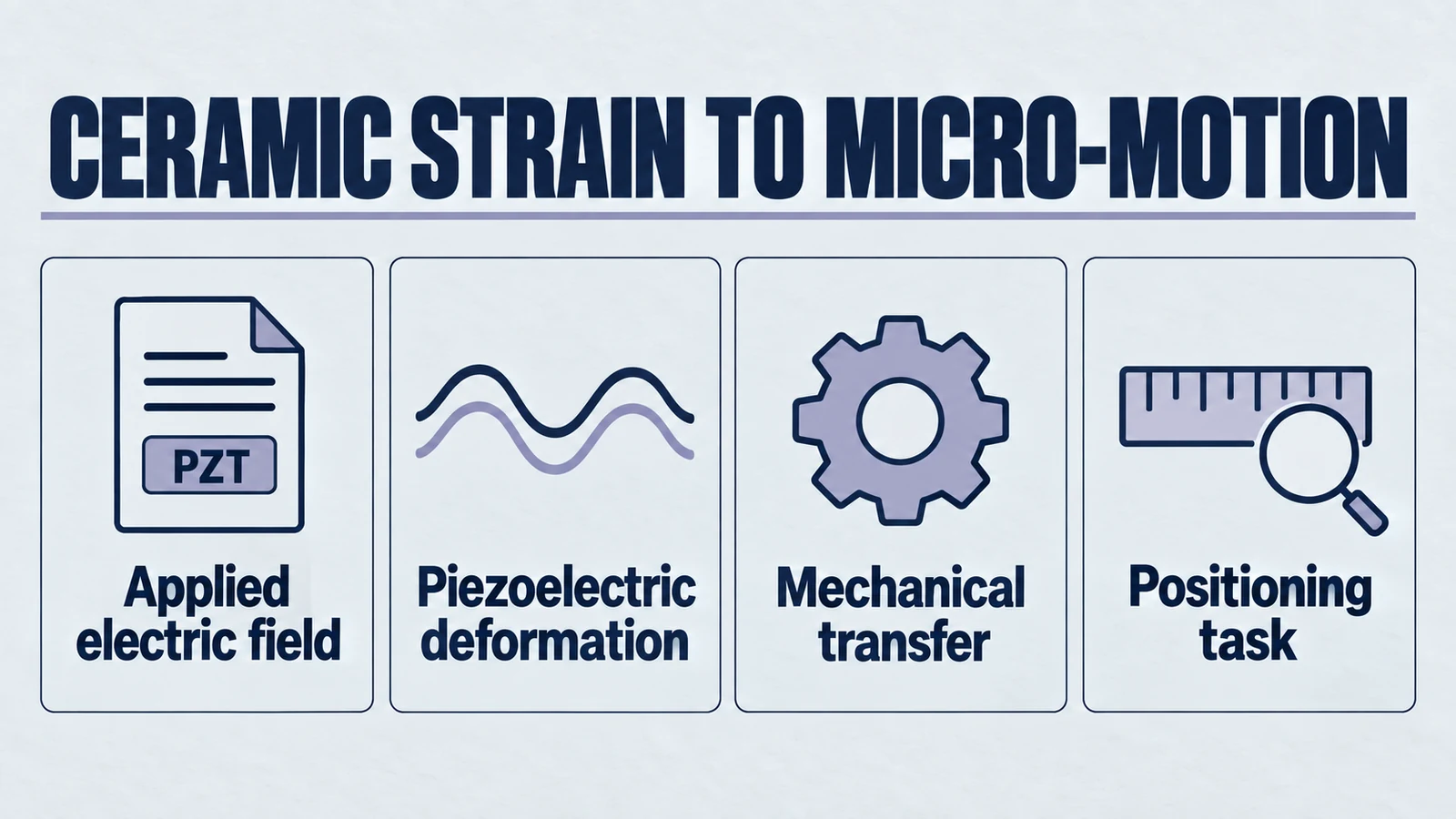
Piezoelectric actuators are specialized devices that convert electrical energy into precise mechanical displacement or force, thanks to the piezoelectric effect inherent in certain ceramic materials. When an electric field is applied to piezoelectric ceramics, typically lead zirconate titanate (PZT), they deform slightly—expanding or contracting—in a highly predictable and controllable manner. This deformation, although extremely minute (often in the nanometer to micrometer range), is reproducible and accurate, making piezoelectric actuators essential for applications requiring fine movement and positioning.
Key Advantages of Piezoelectric Actuators
1. Ultra-High Precision and Accuracy:
Piezoelectric actuators deliver exceptional precision, capable of positioning objects at the nanometer scale. This ultra-fine control is important in semiconductor manufacturing, optical alignment, and high-precision instrumentation.
2. Rapid Response Time:
With response times in the microsecond range, piezoelectric actuators significantly outperform conventional electromechanical actuators. This capability enables real-time adjustments in dynamic environments, critical in fields like vibration control and adaptive optics.
3. Compact Size and High Power Density:
Due to their solid-state nature, piezoelectric actuators avoid sliding mechanical parts inside the ceramic element itself. With the right preload, drive electronics, bonding, and environmental controls, their compact form factor makes them suitable for integration into miniature and micro-electro-mechanical systems (MEMS).
4. Low Power Consumption:
Piezoelectric actuators consume very little power, often operating at milliwatt levels. This efficiency is ideal for battery-operated portable devices and systems where energy consumption is a critical factor.
Applications of Piezoelectric Actuators
1. Semiconductor Industry:
In semiconductor manufacturing, piezoelectric actuators precisely position wafers and optics, significantly enhancing the accuracy of lithographic processes. Their micro-motion capability allows for precise alignment, ensuring higher yield and performance. Our disc series ceramics provide the foundation for these critical positioning systems.
2. Medical and Analytical Device Design:
Piezoelectric actuators can support micro-positioning in laboratory instruments, imaging mechanisms, fluid-control assemblies, and other regulated equipment designs. The finished-device manufacturer still needs to validate motion output, control electronics, material contact paths, and any regulatory submission requirements. PZT ceramic elements provide the motion source, while device-level safety and performance depend on the complete system design.
3. Aerospace and Defense:
Aerospace and defense programs may use piezoelectric actuators in adaptive structures, vibration damping, and precise positioning systems in satellites or aircraft. Material grade, electrode design, bonding, thermal cycling, and qualification testing determine whether a ceramic element is suitable for the target environment. Our rectangular piezo ceramic elements are often evaluated when directional motion and compact packaging are design priorities.
4. Optics and Photonics:
Piezoelectric actuators enable precise alignment and adjustment of optical components in lasers, microscopes, telescopes, and photonic devices. This controlled motion supports imaging, spectroscopy, and communication applications when the actuator, driver, and feedback loop are designed together. PZT material selection affects sensitivity, stroke, stability, and drive limits.
Future Trends and Innovations
The piezoelectric actuator market continues to evolve, driven by technological advancements and increasing demand for miniaturization and high-precision control. Future innovations include integrating advanced materials such as lead-free piezo ceramics and composite materials to enhance performance and sustainability. Additionally, developments in AI and advanced control systems are expected to further refine the capabilities of piezoelectric actuators, broadening their applicability and performance envelope.
Conclusion
Piezoelectric actuators, powered by the properties of piezoelectric ceramics, remain important building blocks for precision micro-motion technology. Their accuracy, fast response, compact size, and efficient electrical drive can support demanding OEM designs when material choice, geometry, and operating limits are validated together.
Related Products and Resources:
- Piezoelectric Ceramics for Custom OEM Components
- PZT Material Selection Guide
- PZT Material Supplier Capabilities
- Disc Series Ceramic Materials
- Ring Series Ceramic Elements
- Rectangular Piezo Ceramic Elements
- Contact Yujie for PZT Ceramic Element Review
- Piezo Actuators: Mechanisms and Applications
- High-Performance Piezo Actuators for Precision Engineering
Product path for this search intent
Match the article topic to the right YJ Piezo product page
Use this article when the choice is not just a shape, but a material tradeoff between sensitivity, loss, coupling, stability, and operating field. For "Piezoelectric Actuators and Micro-Motion: How Ceramics Enable Precision Movement", the practical value is in turning the topic into a measurable selection or sourcing decision.
- PZT Material Hub
Material grades and application tradeoffs
- Piezoelectric Ceramics
Shapes and ceramic manufacturing options
- PZT Material Supplier Hub
Material control, grade selection, and sourcing support
Engineering decision notes
PZT material and ceramic selection
Use this article when the choice is not just a shape, but a material tradeoff between sensitivity, loss, coupling, stability, and operating field. For "Piezoelectric Actuators and Micro-Motion: How Ceramics Enable Precision Movement", the practical value is in turning the topic into a measurable selection or sourcing decision.
YJ Piezo coordinates PZT ceramic projects with manufacturing support, so material formulation, sintering, polarization, electrode process, and outgoing inspection can be reviewed against the final application.
Selection checks
- Separate sensing needs from high-power actuation needs before comparing d33 or coupling values.
- Check dielectric loss, Qm, Curie temperature, aging behavior, and operating field against the real duty cycle.
- Confirm whether the application needs standard PZT grades or a custom formulation and geometry.
Failure risks
- Choosing only the highest d33 can create heat, drift, or depolarization risk in power ultrasonics.
- A ceramic that performs well in free measurement can fail once bonded, clamped, or loaded.
- Material substitutions without batch testing can change capacitance, resonance, and system tuning.
RFQ details
- Is the part used for sensing, actuation, atomization, cleaning, welding, or measurement?
- What field strength, temperature, duty cycle, and mechanical load will the ceramic see?
- Which values must be controlled: d33, capacitance, resonance, impedance, Qm, or dimensional tolerance?
Relevant YJ Piezo pages
- PZT Material Hub
Material grades and application tradeoffs
- Piezoelectric Ceramics
Shapes and ceramic manufacturing options
- PZT Material Supplier Hub
Material control, grade selection, and sourcing support
Application FAQ
- Is the highest d33 always the best PZT choice?
- No. High d33 can be useful for sensitivity, but high-power ultrasonic systems often need lower loss, higher Qm, better thermal stability, and safer operation under field and stress.
- What makes PZT material selection different from catalog buying?
- The right PZT choice depends on geometry, load, drive field, duty cycle, temperature, and inspection targets. A catalog value is only useful when it is tied to the final assembly conditions.