
Ultrasonic Transducer Manufacturers: Technical Benchmarks for Quality and Design
Executive Summary
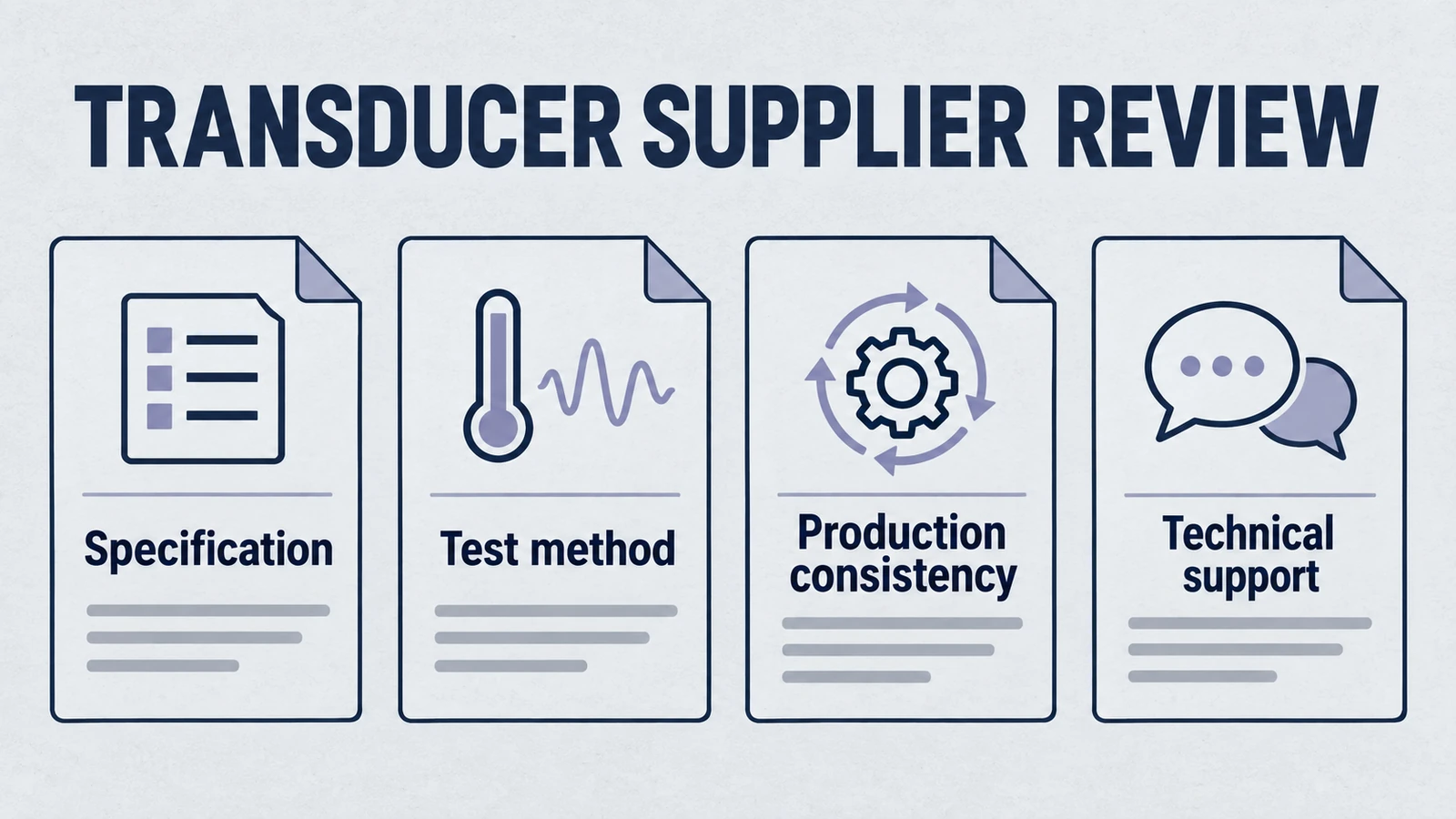
Ultrasonic technology serves a wide range of applications, from medical diagnostic equipment to industrial plastic welding and ultrasonic cleaning. The transducer is the interface between electrical energy and mechanical acoustic waves, so its quality strongly affects efficiency, stability, and service life. For design engineers, supplier quality teams, and OEM technical leaders, the challenge is not simply finding a factory that can ship a transducer. The real task is separating manufacturers that control materials, design, assembly, and validation from those that mainly assemble to price.
This guide provides an in-depth analysis of the technical and operational distinctions that separate leading manufacturers from the broader market. Drawing upon principles of piezoelectric physics, acoustic engineering, and advanced manufacturing methods, we examine factors such as grain structure homogeneity and pre-stress stabilization that determine performance. It also explains how vertically integrated providers, such as Yujie Piezo, use in-house ceramic manufacturing and custom engineering to deliver practical value. If your main question is whether a supplier can act as an OEM co-development partner during NPI, use our innovation partner guide. If you need the step-by-step process for moving a transducer program from DFM and samples into pilot run and scale-up, use our manufacturing workflow guide. This article stays focused on technical manufacturer evaluation.
Product path for this search intent
Match the article topic to the right YJ Piezo product page
Use this article when the risk is supplier selection, engineering support, validation evidence, integration reliability, and whether the manufacturer can scale from sample to production. For "Ultrasonic Transducer Manufacturers: Technical Benchmarks for Quality and Design", the practical value is in turning the topic into a measurable selection or sourcing decision.
- Ultrasonic Transducer Manufacturer & Supplier Hub
Published product families, custom OEM review, RFQ inputs, and project-specific validation planning
- PZT Material Supplier Hub
Material control and grade selection
- Piezoelectric Ceramics
Ceramic manufacturing and custom shapes
1. The Material Foundation: Piezoelectric Ceramics Science
The defining characteristic of any high-performance ultrasonic transducer is the quality of its active element: the piezoelectric ceramic. While generic suppliers often treat the ceramic ring or plate as a standard off-the-shelf component, top-tier manufacturers understand that the ceramic is a complex material system whose properties must be tailored at the molecular level for specific applications.
1.1 The Dichotomy of "Hard" vs. "Soft" PZT Materials
A fundamental differentiator in the capability of an ultrasonic transducer manufacturer is their mastery of Lead Zirconate Titanate (PZT) formulations. The industry broadly categorizes these materials into "hard" and "soft" types, a distinction that is critical for application success but often overlooked in budget manufacturing.
1.1.1 PZT-8: The Gold Standard for High-Power Applications
For applications requiring high power density and continuous duty cycles—such as ultrasonic welding, cutting, and cleaning—the industry standard is PZT-8 (Navy Type III). Top manufacturers like Yujie Piezo utilize true PZT-8 formulations, which are doped with acceptor ions (like Fe3+) to create "hard" domain wall motion.
- Mechanical Quality Factor (Qm): The primary metric for high-power efficiency is Qm. A high Qm (typically >1000 for PZT-8) indicates low internal mechanical damping. This means that as the crystal vibrates thousands of times per second, very little energy is lost to internal friction.
- Thermal Stability: In high-power operations, internal friction generates heat. If a manufacturer substitutes a cheaper, "softer" ceramic (like PZT-4) in a welding transducer, the lower Qm results in rapid self-heating. This heat can lead to depoling or frequency drift, causing the ultrasonic generator to lose lock. Top providers ensure their PZT-8 materials maintain stability even under high dielectric drive fields and mechanical stress.
- Dielectric Loss (tan δ): Leading manufacturers prioritize materials with exceptionally low dielectric loss. High dielectric loss in inferior materials creates dielectric heating independent of mechanical motion, acting as a secondary failure mode during high-voltage operation.
1.1.2 PZT-4: Optimizing for Transmission Output
While PZT-8 is the choice for resonance quality, PZT-4 (Navy Type I) is engineered for high transmission output. It possesses a higher piezoelectric charge constant (d33) compared to PZT-8, allowing for larger displacement amplitudes for a given voltage. A sophisticated ultrasonic transducer manufacturer will recommend PZT-4 for applications like sonar transmitters or underwater acoustic communication, where the goal is maximizing the source level rather than minimizing heat generation in a resonant stack.
1.1.3 PZT-5A/5H: The Sensitivity for Sensing
For non-destructive testing (NDT) and medical diagnostic probes, the requirement flips from power handling to sensitivity. "Soft" piezoceramics like PZT-5A and PZT-5H are characterized by high dielectric constants and high electromechanical coupling factors (kt). Top manufacturers use these materials to maximize the voltage generated from weak returning echoes, improving the signal-to-noise ratio (SNR) of the imaging system. The ability to source or manufacture high-purity soft PZT with consistent grain size is a hallmark of quality sensing providers.
1.2 Vertical Integration: The "Powder-to-Product" Advantage
A critical strategic advantage held by companies like Yujie Piezo is vertical integration. By manufacturing the piezoelectric ceramics in-house rather than purchasing them from third-party vendors, these manufacturers control the entire quality chain.
- Raw Material Purity: The process begins with oxide powders (Lead, Zirconium, Titanium). Impurities at the parts-per-million level can act as pinning sites for domain walls or create conductive pathways that lower breakdown voltage. In-house manufacturing allows for the strict auditing of raw material purity.
- Sintering and Microstructure: The firing (sintering) profile determines the density and grain structure of the ceramic. A top-tier manufacturer optimizes the sintering curve to achieve near-theoretical density (>98%). Low-cost ceramics often contain microscopic pores (voids). These voids have two deleterious effects: they scatter high-frequency acoustic waves, reducing sensitivity, and they act as stress concentrators where mechanical cracks can initiate under high-power vibration.
- Batch Traceability: In high-volume manufacturing, batch-to-batch consistency is paramount. If one batch of ceramic has a resonant frequency 500Hz lower than the next, it wreaks havoc on the tuning of ultrasonic generators. Vertical integration allows manufacturers to implement Statistical Process Control (SPC) on the ceramic powder lots, ensuring that every transducer in a shipment falls within a tight tolerance window.
| Feature | Top-Tier Manufacturer (e.g., Yujie Piezo) | Generic/Budget Supplier |
|---|---|---|
| Ceramic Source | In-house manufacturing or strictly audited proprietary supply | Open market, "spot buy" based on lowest price |
| Material Verification | Agreed d33, Qm, tan δ and frequency checks, with documented sampling or per-piece coverage | Batch sampling or no testing |
| Grade Specificity | True PZT-8 for welding, PZT-5H for NDT | Generic "PZT" often mislabeled |
| Grain Structure | Qualified density, porosity, microstructure and firing-process evidence for the grade | Porous, variable grain size, prone to cracking |
| Traceability | Full traceability to powder lot | None |
2. Advanced Acoustic Design and Simulation
Beyond the material itself, the design of the transducer—the geometry of the metal masses, the thickness of matching layers, and the configuration of the stack—distinguishes a simple assembly from a precision-engineered acoustic tool. Leading ultrasonic transducer manufacturer entities employ advanced computational modeling to predict and optimize performance before physical prototyping begins.
2.1 Finite Element Analysis (FEA) Modeling
The gold standard for modern transducer design is Finite Element Analysis (FEA). Software suites allows engineers to virtually simulate the electromechanical behavior of the device.
- Modal Purity: A transducer is designed to operate in a specific vibration mode (e.g., longitudinal piston mode). However, complex geometries can support parasitic modes (bending, radial, or torsional) that sit dangerously close to the operating frequency. FEA allows designers to adjust the geometry of the back mass or horn to push these parasitic modes away from the main resonance. A "dirty" spectrum with coupled modes leads to energy waste and uneven vibration amplitude.
- Stress Management: In high-power Langevin transducers, the nodal point (the point of zero displacement) experiences maximum mechanical stress. If this stress exceeds the fatigue limit of the bolt or the ceramic, the device will fail severely. FEA allows engineers to visualize stress concentrations and design smooth fillets or radii to distribute the load, significantly extending fatigue life.
- Thermal Simulation: Heat is the enemy of piezoelectric performance. Advanced manufacturers use multi-physics simulation to model heat generation and dissipation. This informs the design of cooling channels (air cooling fins or water jackets) and the selection of thermally conductive backing materials to ensure the PZT stack remains cool.
2.2 Acoustic Matching Layers: The Science of Transmission
For sensing, NDT, and medical applications, getting the sound energy out of the ceramic and into the target medium (water, tissue, plastic) is the primary challenge. This is the domain of the acoustic matching layer.
- Impedance Mismatch: PZT has a high specific acoustic impedance (~30 MRayl), while water or tissue is low (~1.5 MRayl). Without a matching layer, roughly 80% of the energy reflects back into the transducer at the interface.
- Quarter-Wave Engineering: Top manufacturers employ matching layers ground to a precise thickness of λ/4 (one-quarter wavelength) of the target frequency. This layer acts as an acoustic transformer, bridging the impedance gap.
- Advanced Materials: Innovation in this area is a key differentiator. While basic probes use simple epoxy, advanced manufacturers utilize composite materials (such as silver-loaded epoxy or alumina-filled polymers) to tune the impedance to the exact geometric mean of the piezo and the load.
- Gradient Layers: Recent research and high-end implementations involve multiple matching layers or gradient impedance layers (varying density) to broaden the bandwidth. A wider bandwidth allows for shorter pulses, which directly translates to higher axial resolution in imaging and flaw detection. Manufacturers utilizing Flexible Printed Circuit Boards (FPCBs) as matching layers have also demonstrated enhanced transmission performance.
2.3 Backing Material Technology
The material bonded to the rear of the piezoelectric crystal, known as the backing block, plays a dual role in performance and is a closely guarded secret of top manufacturers.
- Damping and Resolution: The backing block absorbs the acoustic energy radiated from the back of the crystal. If the backing is too light (low impedance), the crystal rings for a long time like a bell, resulting in poor resolution. If it is too heavy (high impedance), it damps the vibration too much, reducing sensitivity. Top providers formulate proprietary backing mixtures—often involving tungsten or high-density powders suspended in a polymer matrix—to achieve a specific acoustic impedance (typically 5-10 MRayl) that balances sensitivity with short pulse duration.
- Thermal Dissipation: In high-duty cycle arrays, the backing block also acts as a thermal conduit. Top manufacturers incorporate thermally conductive fillers to pull heat away from the active element, preventing thermal depolarization during prolonged scanning.
3. Precision Manufacturing and Assembly
The theoretical perfection of a design is meaningless without execution. The assembly of an ultrasonic transducer is a high-precision process where tolerances are measured in microns and process variables are controlled to the nth degree.
3.1 The Langevin Stack Assembly: Pre-Stress Engineering
In the realm of high-power ultrasonics (cleaning, welding), the "Langevin" or bolted stack transducer is the dominant design. The assembly of this stack is the most critical process step.
- The Necessity of Pre-Stress: Ceramics are strong in compression but weak in tension. During high-power operation, the vibration cycle puts the ceramic into alternating states of compression and tension. If the tension exceeds the ceramic's tensile strength, it will crack. To prevent this, the stack is bolted together under a massive compressive "bias" force or pre-stress.
- Validated Preload: Compressive preload must keep the ceramic and interfaces within the validated operating stress envelope throughout vibration. Determine target and tolerance for the exact formulation, ring geometry, bolt/end-mass design, contact uniformity, temperature and drive. Verify assembly using a qualified torque–load procedure, force measurement or calibrated charge monitoring, then validate loaded resonance, losses and temperature rise. A PZT-8 label does not establish a universal preload or a supplier’s assembly equipment.
3.2 Surface Metrology and Interface Integrity
The interfaces between the ceramic rings and the metal masses (front driver and back mass) must be flat, clean, and repeatable.
- Flatness and Finish: Specify flatness, parallelism and roughness separately on the drawing, with measurement methods and acceptance limits. Lapping or polishing may obtain repeatable contact and load distribution; requirements depend on geometry, electrodes, interfaces, preload and duty. Review measured surface records rather than an undefined optical-flatness claim. Poor contact can increase local stress or heating, but no generic roughness threshold establishes field failure.
- Cleanliness: Specify assembly cleanliness for the product and application, including cleaning, handling and interface inspection. A cleanroom or local clean zone may be appropriate where contamination sensitivity requires it. Ask which facility/process, air classification, operating condition and monitoring records support any cleanroom claim. Air cleanliness does not replace mating-surface inspection; trapped particles can create local contact or stress risks.
3.3 Metal Component Metallurgy
The metal parts of the transducer are not passive holders; they are acoustic waveguides.
- Material Selection: Top providers use aerospace-grade Titanium (Ti-6Al-4V) or high-strength Aluminum (7075-T6) for the front drivers. Titanium is preferred for its exceptional fatigue strength and acoustic efficiency, despite its high cost and difficulty to machine. Budget manufacturers often substitute lower-grade aluminum or steel, which suffers from internal hysteresis losses (heating) and lower fatigue limits.
- Grain Structure: Just as with ceramics, the grain direction of the metal matters. High-quality metal stock is chosen so that the grain structure aligns with the direction of wave propagation, minimizing scattering losses.
4. The Hidden Processes: Aging and Stabilization
One of the most significant differences between a premium ultrasonic transducer manufacturer and a low-cost provider is the management of time-dependent material properties, known as "aging."
4.1 The Physics of Piezoelectric Aging
After a PZT ceramic is poled (given its piezoelectric properties by a high voltage field), its material constants do not stay static. They drift logarithmically over time as the ferroelectric domains relax into a lower energy state.
- Frequency Drift: The resonant frequency of a freshly poled ceramic can shift significantly over the first few weeks.
- Capacitance Change: The dielectric constant also drops, changing the electrical impedance match.
4.2 Artificial Aging and Stabilization Protocols
A budget manufacturer will assemble a transducer, test it immediately, and ship it. By the time it reaches the customer, the frequency has drifted, and the unit is no longer matched to its generator.
- Heat Treatment: Top manufacturers employ accelerated aging processes. They subject the ceramics (or completed assemblies) to controlled heat cycles (e.g., 80°C to 120°C) to speed up the relaxation process. This "stabilizes" the domains.
- Conditioning and Timing: Ask for the grade’s conditioning history, measurement time since poling and validated storage/release criteria. A hold period may be part of a controlled process, but does not by itself ensure unchanged properties throughout field service.
5. Comprehensive Quality Control and Testing
Marketing claims of "high quality" are verifiable only through rigorous data. Top providers distinguish themselves through the depth and transparency of their testing protocols.
5.1 Impedance Analysis: The Fingerprint of Quality
Every piezoelectric transducer has a unique electrical "fingerprint" visible through an impedance analyzer.
- Admittance Circles: Top manufacturers analyze the admittance loop (G vs. B). A perfect transducer produces a clean, large, single circle. Distortions, smaller inner loops, or "fuzz" on the circle indicate parasitic modes, micro-cracks, or poor bonding.
- Spurious Mode Detection: The impedance plot (Z vs. Frequency) should show a clean resonance and anti-resonance. Spikes or "glitches" between these two points are signs of coupled modes. Top providers set strict automated masks; if a spur exceeds a certain dB level, the unit is rejected. Budget suppliers often lack the sophisticated equipment to detect these subtle flaws.
5.2 High-Power Characterization
Standard impedance analysis is done at low voltage (<1V). However, transducers behave non-linearly at high power.
- Voltage Dependency: As drive voltage increases, the mechanical Qm drops, and the resonant frequency shifts downward. A transducer that looks good at 1V might overheat and fail at 3000W.
- Stress Screening: Request the product-specific screening procedure, drive, load, temperature limits, duration and acceptance criteria. Burn-in can expose some early defects, but a universal 24-hour full-amplitude run is not an established recipe and does not prove absence of latent failures or thermal stability in every installation.
5.3 Environmental Stress Screening (ESS)
- Thermal Cycling: To ensure the bond lines (epoxy or mechanical) can withstand real-world conditions, transducers are cycled between temperature extremes (e.g., -20°C to +60°C). This tests the coefficient of thermal expansion (CTE) matching between the ceramic, metal, and matching layers.
- Submersion Testing: For underwater transducers or cleaning transducers, long-term submersion tests ensure the integrity of waterproof seals (IP68) and cable glands.
6. Application-Specific Engineering: The Yujie Piezo Approach
A distinct advantage of partnering with a specialized ultrasonic transducer manufacturer like Yujie Piezo is the ability to access application-specific engineering. The "one size fits all" approach is rarely optimal in ultrasonics.
6.1 Ultrasonic Welding and Joining
In plastic welding, the transducer must withstand massive reaction forces from the horn contacting the part.
- Rigid Mounting: Yujie designs welding converters with rigid nodal mounting flanges that decouple the vibration from the housing, preventing energy loss into the machine structure.
- Cooling Integration: For high-speed automation lines, air cooling ports are integrated directly into the housing design to maintain PZT-8 stability.
6.2 Ultrasonic Cleaning
Cleaning applications require uniform cavitation distribution to avoid "hot spots" that can damage delicate parts or "cold spots" that leave residue.
- Matched Arrays: Top providers bin and match transducers by frequency and capacitance so that when 50 transducers are driven by a single generator, they all draw equal power.
- Sweep-Ready: Transducers are designed with a bandwidth that supports "sweep frequency" operation, a technique used to eliminate standing waves in the cleaning tank.
6.3 Medical and Sensing
- Pulse Fidelity: For imaging, the goal is a short pulse. Yujie leverages composite materials and heavy backing to achieve high bandwidth (broadband) response, crucial for axial resolution.
- Form Factor Customization: From miniature catheter probes to large phased arrays, the ability to dice, grind, and package ceramics into custom shapes is a key service.
7. Commercial Value: The Total Cost of Ownership
While premium transducers from top manufacturers carry a higher initial unit cost than generic alternatives, the Total Cost of Ownership (TCO) is invariably lower.
7.1 Reliability and Uptime
In an industrial production line, the cost of a transducer failure is often much higher than the component itself. Frequency drift can cause weld defects, scrap, extra troubleshooting, or unplanned downtime. A transducer with documented stability and a predictable service window supports planned maintenance instead of reactive replacement.
7.2 Generator Protection
A failing transducer often takes the generator with it. If the impedance of the transducer changes drastically due to heating or cracking, it can present a short circuit or highly reactive load to the ultrasonic generator, blowing the power transistors. Investing in a high-quality transducer protects the much more expensive generator investment.
7.3 Warranty and Support
Supplier support also matters. Beyond replacement terms, engineering support can help troubleshoot coupling issues, horn design, drive electronics, and application-specific operating limits. This support can reduce iteration time during development and qualification.
8. Conclusion
The selection of an ultrasonic transducer manufacturer is a strategic decision that reverberates through the entire lifecycle of a product. The difference between a top-tier provider and a commodity supplier is rarely visible to the naked eye. It lies in the invisible details: the purity of the ceramic powder, the homogeneity of the grain structure, the precision of the pre-stress, and the rigor of the testing.
Providers like Yujie Piezo distinguish themselves through vertical integration, FEA-informed design, precision manufacturing, and documented quality control. For OEMs and end-users, this supports more stable systems, clearer validation data, and more predictable service behavior.
This article is intentionally technical. If the next decision on your side is about collaboration model, engineering communication, or partner fit during development, continue with our OEM innovation partner guide. If your team now needs the process view for DFM, prototype iteration, validation, pilot run, and scale-up, continue with our manufacturing workflow guide. If procurement needs a vendor-screening framework, use our supplier qualification checklist.
Summary of Key Differentiators
| Criteria | Top-Tier Manufacturer | Generic Supplier |
|---|---|---|
| PZT Formulation | Specialized (PZT-8 vs PZT-4) | Generic / Mixed |
| Design Method | FEA Simulation & Modal Analysis | Copy / Reverse Engineering |
| Assembly | Documented cleanliness, interface inspection and validated preload controls | Unspecified or undocumented assembly controls |
| Aging | Thermal Stabilization Protocols | Ship immediately |
| Testing | Impedance Analysis, High Power | Basic Functionality |
| Support | Custom Engineering & Design | Sales Only |
Engineering decision notes
OEM integration and supplier qualification
Use this article when the risk is supplier selection, engineering support, validation evidence, integration reliability, and whether the manufacturer can scale from sample to production. For "Ultrasonic Transducer Manufacturers: Technical Benchmarks for Quality and Design", the practical value is in turning the topic into a measurable selection or sourcing decision.
YJ Piezo combines direct project coordination with ceramic manufacturing support, so procurement and engineering teams can evaluate material control, application review, sample validation, and production consistency together.
Selection checks
- Ask whether the supplier controls ceramic manufacturing or only assembles purchased elements.
- Review sample policy, inspection records, engineering response quality, and production lead-time stability.
- Compare suppliers and integration paths by validation evidence, not only by unit price and datasheet similarity.
Failure risks
- A low-price sample can pass early tests but fail when batch variation, thermal load, or assembly stress appears.
- A supplier without material control may not explain why impedance, capacitance, or resonance drift occurs.
- Weak RFQ information leads to quotes that are fast but not technically comparable.
RFQ details
- What application, operating environment, and failure cost should the supplier design around?
- Which sample tests and outgoing records are required before pilot production?
- What customization, MOQ, tooling, and delivery constraints must be known before quotation?
Relevant YJ Piezo pages
- Ultrasonic Transducer Manufacturer & Supplier Hub
Published product families, custom OEM review, RFQ inputs, and project-specific validation planning
- PZT Material Supplier Hub
Material control and grade selection
- Piezoelectric Ceramics
Ceramic manufacturing and custom shapes
Application FAQ
- How should an OEM compare piezoelectric suppliers?
- Compare material control, engineering support, test evidence, customization ability, sample policy, and batch consistency. Unit price matters, but only after the technical risk is understood.
- What makes an RFQ technically useful?
- A useful RFQ includes application, dimensions, target frequency, electrical limits, duty cycle, operating medium, environment, expected quantity, required reports, and current failure or replacement context.
Related Products
- Ultrasonic Transducer Manufacturer & Supplier Hub
- Ultrasonic Welding Transducers
- Ultrasonic Cleaning Transducers