
From Component Supplier to Innovation Partner: How OEM Teams Choose a Piezoelectric Transducer Development Partner
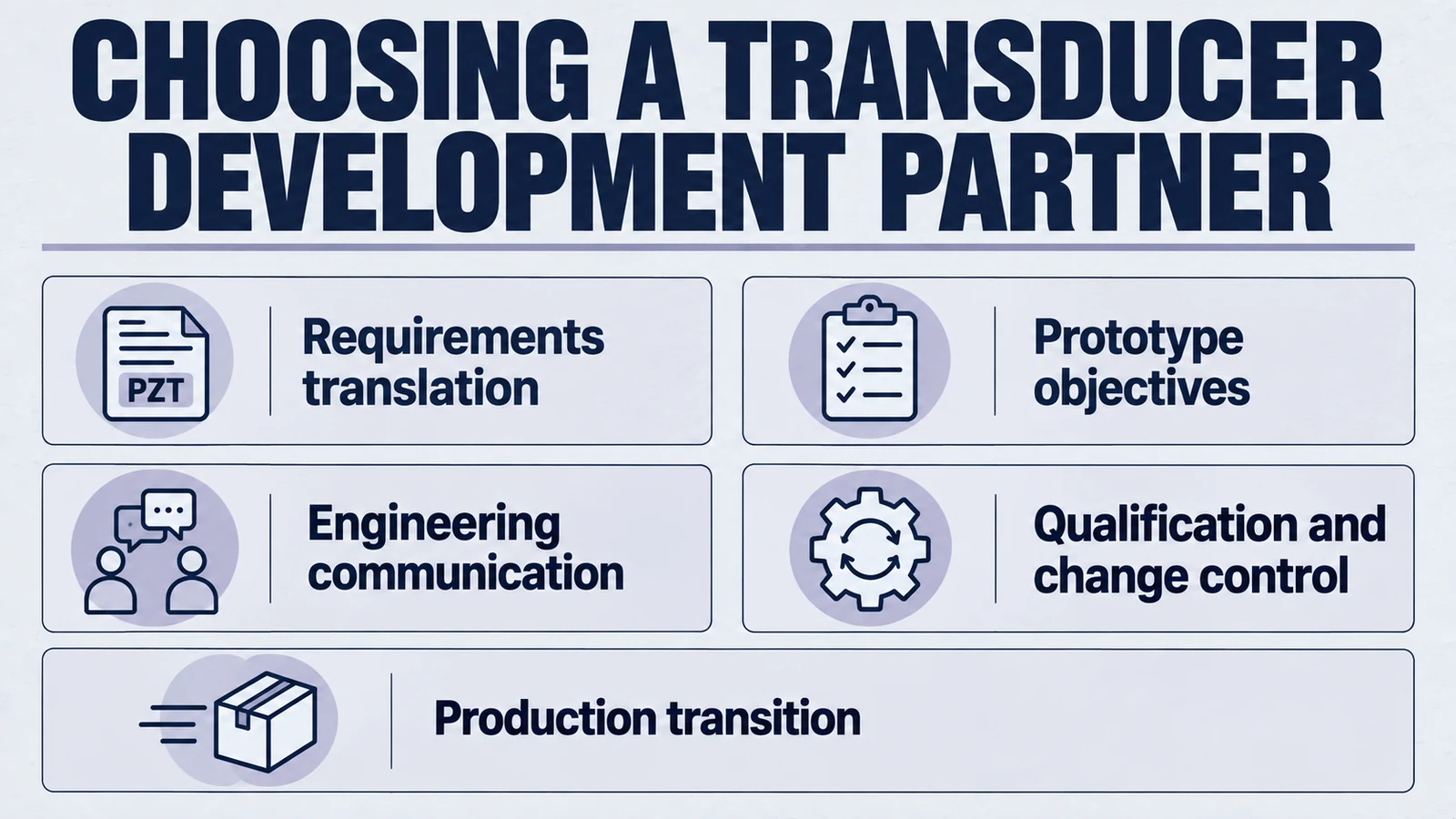
The Decision OEM Teams Actually Need to Make
When an OEM team starts sourcing a new piezoelectric transducer, the conversation often begins in the wrong place. Teams compare unit pricing, ask for a datasheet, request a sample, and assume the rest of the development path will fall into place later. That workflow may be enough for mature, low-variation parts. It is rarely enough for projects that require custom geometry, application-specific tuning, qualification support, or a controlled transition from prototype to production.
That is why the real question is not simply, "Which manufacturer can supply this component?" The more important question is, "Which company can work with our engineers through uncertainty, design iteration, NPI, and scale-up without becoming a bottleneck?" If your immediate need is a technical benchmark of ceramic control, FEA, assembly precision, and test discipline, start with our manufacturer quality and design guide. If procurement is building a sourcing scorecard for certifications, logistics, and vendor qualification, use our supplier qualification checklist. This article is narrower on purpose: it explains how to identify a genuine development partner for OEM work.
The distinction matters because most schedule slips in piezo programs are not caused by a lack of factories. They are caused by unclear requirements, weak engineering communication, late design-for-manufacturing feedback, and uncontrolled change once the program starts moving. A transactional component supplier ships parts against a drawing. An innovation partner helps the OEM define the right drawing, test plan, integration assumptions, and ramp path in the first place. That difference directly affects time-to-qualification, first-pass yield, and how much risk stays on your internal team.
Product path for this search intent
Match the article topic to the right YJ Piezo product page
Use this article when the risk is supplier selection, engineering support, validation evidence, integration reliability, and whether the manufacturer can scale from sample to production. For "From Component Supplier to Innovation Partner: How OEM Teams Choose a Piezoelectric Tra...", the practical value is in turning the topic into a measurable selection or sourcing decision.
- Ultrasonic Transducer Manufacturer & Supplier Hub
Published product families, custom OEM review, RFQ inputs, and project-specific validation planning
- PZT Material Supplier Hub
Material control and grade selection
- Piezoelectric Ceramics
Ceramic manufacturing and custom shapes
1. Start With the Development Workflow, Not Just the Catalog
For custom or semi-custom piezoelectric programs, catalog breadth is only a small part of the decision. A long list of ceramic or transducer options does not tell you whether the supplier can translate system-level requirements into a workable device architecture. OEM teams should evaluate how the supplier handles the first three project conversations: application understanding, feasibility framing, and risk identification.
Translate System Requirements Into Transducer Requirements
A development partner should be able to move from application language to engineering language quickly. That means turning statements like "we need more cleaning uniformity," "our sensor needs better repeatability," or "the stack is overheating during continuous duty" into specific variables: target frequency window, acoustic load, drive voltage range, mounting constraints, thermal limits, environmental exposure, and acceptable spread between units. Without that translation layer, sample iterations become guesswork.
This is especially important when the piezoelectric element interacts with a broader system such as ultrasonic welding, cleaning equipment, or sensing assemblies. In these cases, the transducer is not a standalone part; it is one part of an electromechanical chain. The right partner will ask about the horn, backing, housing, driving electronics, duty cycle, and field environment before pretending the correct part number is obvious.
Expect Feasibility Framing Before Formal Quotation
One of the clearest differences between a component seller and a co-development partner is what happens before the quote. A transactional vendor typically responds with price tiers and lead time. A development-oriented partner usually responds with scoped questions, likely technical risks, and an outline of what needs to be validated first. That behavior is not "slow sales"; it is a sign that the team understands the cost of building the wrong sample.
At this stage, strong partners normally define a first-pass work package such as:
- the target operating window and non-negotiable constraints
- which parameters can remain flexible during early sampling
- what material or geometry assumptions are provisional
- what test fixtures or driver conditions are needed for a meaningful evaluation
- which risks must be retired before pilot production
This early structure is often more valuable than the first piece of hardware itself. It keeps the OEM from treating samples like proof of manufacturability when they are really only proof of concept.
2. What an Innovation Partner Contributes During NPI
The phrase "NPI support" gets used casually, but in a good supplier relationship it has a specific meaning. It means the manufacturer can help the OEM move from an engineering idea to a repeatable, documented, testable process. That involves far more than cutting a custom shape or changing a resonant frequency. It means reducing the number of unknowns that survive into pilot and mass production.
Joint Definition of Prototype Objectives
Prototype rounds should not all be evaluated against the same standard. In the earliest stage, the purpose may be to confirm vibration mode, bandwidth, cavitation behavior, impedance, or packaging feasibility. Later rounds may focus on matching electronics, thermal stability, waterproofing, or tolerance spread. A true development partner helps define what each round is supposed to prove so the OEM can make faster decisions and avoid over-interpreting incomplete data.
This is where direct familiarity with custom piezoelectric design becomes important. If the supplier understands how material choice, geometry, electrode layout, bonding, and assembly interact, they can explain which variables should move together and which should be isolated across sample rounds. That makes the development process more deliberate and much less expensive.
Support for Documentation, Validation, and Transition Gates
By the time an OEM reaches pilot production, the supplier should no longer be operating from informal email history alone. The partnership should produce a working set of program controls: revision references, critical dimensions, performance targets, inspection methods, and validation records. These are the tools that keep a good prototype result from collapsing when the program expands.
A capable innovation partner usually contributes some combination of the following during NPI:
- sample build summaries and revision notes
- agreed incoming-inspection parameters
- application-relevant test recommendations
- clear distinctions between prototype-only assumptions and production-ready settings
- defined criteria for pilot release and controlled scale-up
That support reduces a common OEM failure mode: treating "sample approved" as equivalent to "process understood."
3. Engineering Communication Is a Design Variable
In complex component programs, communication speed is not a soft issue. It is a technical variable that changes cycle time, design quality, and issue containment. Many supplier relationships fail here. Technical questions get routed through sales staff, design changes are summarized informally, and decisions that should take one engineering call stretch into a week of email relay.
Direct Engineer Access Matters More Than Marketing Promises
OEM teams should ask a simple question early: when a technical issue appears, who will we actually speak to? If the answer is "your salesperson will check with engineering," expect lost context, delayed root-cause analysis, and slow iteration. If the answer is a named engineer or technical project owner who can discuss drive conditions, integration constraints, and measurement methods directly, the relationship is far more likely to move efficiently.
Fast access is most valuable when the test result is ambiguous. A frequency shift might be caused by fixture loading, ceramic spread, preload, bond line thickness, or electronics mismatch. Engineers need a conversation partner who can reason through those variables in real time, not a commercial intermediary collecting screenshots.
Look for Structured Feedback, Not Just Fast Replies
Response time alone is not enough. Good partners create engineering memory as a project moves. They record what changed between sample rounds, which variables were held constant, what failure modes were observed, and what the next decision depends on. That turns communication into a real program asset instead of a fragmented inbox.
In practical terms, OEM teams should look for suppliers who can maintain a stable communication rhythm: pre-sample alignment, post-test review, documented action items, and explicit ownership of the next step. That discipline is what makes a partner useful during pressure-heavy launch periods.
4. Qualification and Change Control Separate Partners From Vendors
Many suppliers can produce an acceptable sample. Far fewer can protect that result once the project is qualified and commercialized. For OEM programs with long lifecycles, a development partner must show that they understand what cannot change casually: material batch behavior, process windows, tooling assumptions, inspection criteria, and the conditions used during customer validation.
Qualification Should Be Built Around the OEM's Real Risk
A partner-minded manufacturer does not offer one generic "quality assurance" statement for every customer. Instead, they help the OEM decide which risks deserve formal qualification. In one program, the key risk may be resonance drift under temperature. In another, it may be adhesive durability, unit-to-unit sensitivity spread, or acoustic output after sealing. The partner's role is to align sample evaluation, pilot builds, and production controls around the failure modes that would actually damage the OEM's product.
This is where the collaboration model differs from a pure procurement exercise. A sourcing checklist can verify whether the supplier has certifications and traceability. A development partner goes one step further and helps decide which characteristics must be locked, how they will be monitored, and when a change requires customer review.
Change Notification Is a Strategic Capability
For long-running programs, change control is one of the strongest signals of a reliable partner. OEM teams should look for suppliers who can clearly state what constitutes a meaningful change, who reviews it, how the customer is informed, and what re-validation may be required. That includes material substitutions, process changes, tooling refreshes, inspection updates, and packaging or logistics changes that affect component integrity.
If a supplier treats these topics informally, the OEM eventually absorbs the risk. If a partner treats them systematically, the OEM protects qualification work already completed and avoids surprise performance drift later in the product lifecycle.
5. Commercial Behavior Still Matters, but in a Different Way
Choosing an innovation partner does not mean ignoring price, MOQ, or delivery. It means evaluating those variables in the context of the full program. A development-focused supplier should be able to explain how the commercial model evolves from early samples to pilot and from pilot to repeat production. That includes lead-time assumptions, tooling ownership, documentation obligations, and how the supplier plans for scale without damaging responsiveness.
Healthy Commercial Signals in Long-Term Programs
OEM teams should pay close attention to behaviors such as willingness to discuss forecast visibility, capacity planning, confidentiality, sample prioritization, and how non-recurring engineering work is scoped. Strong partners understand that early-stage projects need flexibility, while later-stage projects need predictability. They can usually explain where that handoff happens and what they need from the customer to support it.
This is also the stage where a good partner connects the commercial discussion back to technical ownership. For example, they may distinguish between open variables still under development and frozen variables that drive production commitments. That alignment prevents commercial pressure from forcing technical decisions prematurely.
6. A Simple Framework for Evaluating Partner Fit
The table below is a practical way to separate a transactional source from a true co-development partner.
| Evaluation Area | Transactional Component Supplier | Innovation Partner for OEM Programs |
|---|---|---|
| Early Project Discussion | Focuses on price, drawing, and lead time. | Clarifies application goals, integration constraints, and technical risk before quoting. |
| Prototype Management | Ships samples without a structured test objective. | Defines what each sample round is meant to validate and documents key changes. |
| Engineering Access | Technical questions move through sales channels. | OEM engineers can work directly with technical staff on design, integration, and troubleshooting. |
| NPI Support | Provides build-to-print execution only. | Supports documentation, validation gates, and prototype-to-pilot transition planning. |
| Change Control | Handles changes informally unless a failure occurs. | Defines what changes matter, how they are reviewed, and when customer re-approval is required. |
| Commercial Alignment | Optimizes around the current PO. | Balances sample flexibility, pilot discipline, and scale-up predictability across the program lifecycle. |
7. Use the Right Guide for the Right Decision
Many teams collapse three different decisions into one supplier conversation, which is exactly how canonical-style content overlap happens in the real world as well. To keep the evaluation clean, separate the questions:
- If you need to benchmark material control, FEA rigor, assembly precision, stabilization, and test methodology, read our technical manufacturer evaluation guide.
- If you need procurement-side screening for certifications, responsiveness, logistics, and supply risk, use our supplier selection checklist.
- If you need a starting point for standard and custom ultrasonic sourcing, visit our ultrasonic transducer supplier hub.
This page should be used when the core decision is narrower and more strategic: can this company help us move through co-development, qualification, and ramp with less engineering friction and less lifecycle risk?
Conclusion
The best OEM programs do not win because they found the cheapest component source. They win because they chose partners who could reduce ambiguity early, shorten iteration loops, support structured NPI, and protect the program once the design was qualified. That is what separates an innovation partner from a component supplier in piezoelectric transducer development.
For teams building products with custom acoustic requirements, long validation cycles, or meaningful integration risk, the supplier decision should be treated as a development-model decision. The right partner helps define the work, not just fulfill it.
If your team is evaluating a new transducer program and needs practical support on co-development, sampling, or qualification planning, contact the Yujie engineering team to discuss the application and the development path.
Engineering decision notes
OEM integration and supplier qualification
Use this article when the risk is supplier selection, engineering support, validation evidence, integration reliability, and whether the manufacturer can scale from sample to production. For "From Component Supplier to Innovation Partner: How OEM Teams Choose a Piezoelectric Tra...", the practical value is in turning the topic into a measurable selection or sourcing decision.
YJ Piezo combines direct project coordination with ceramic manufacturing support, so procurement and engineering teams can evaluate material control, application review, sample validation, and production consistency together.
Selection checks
- Ask whether the supplier controls ceramic manufacturing or only assembles purchased elements.
- Review sample policy, inspection records, engineering response quality, and production lead-time stability.
- Compare suppliers and integration paths by validation evidence, not only by unit price and datasheet similarity.
Failure risks
- A low-price sample can pass early tests but fail when batch variation, thermal load, or assembly stress appears.
- A supplier without material control may not explain why impedance, capacitance, or resonance drift occurs.
- Weak RFQ information leads to quotes that are fast but not technically comparable.
RFQ details
- What application, operating environment, and failure cost should the supplier design around?
- Which sample tests and outgoing records are required before pilot production?
- What customization, MOQ, tooling, and delivery constraints must be known before quotation?
Relevant YJ Piezo pages
- Ultrasonic Transducer Manufacturer & Supplier Hub
Published product families, custom OEM review, RFQ inputs, and project-specific validation planning
- PZT Material Supplier Hub
Material control and grade selection
- Piezoelectric Ceramics
Ceramic manufacturing and custom shapes
Application FAQ
- How should an OEM compare piezoelectric suppliers?
- Compare material control, engineering support, test evidence, customization ability, sample policy, and batch consistency. Unit price matters, but only after the technical risk is understood.
- What makes an RFQ technically useful?
- A useful RFQ includes application, dimensions, target frequency, electrical limits, duty cycle, operating medium, environment, expected quantity, required reports, and current failure or replacement context.
Related Products
- Ultrasonic Transducer Manufacturer & Supplier Hub
- Piezoelectric Ceramic Elements
- Ultrasonic Welding Transducers