
Choosing a Reliable Supplier for Piezoelectric Ceramics and Transducers
In today's precision-driven industries, piezoelectric ceramics and piezo transducers play a crucial role in enabling innovations—from ultrasonic cleaning to medical imaging, from industrial sensing to beauty devices. However, the performance and reliability of these applications hinge on one key factor: choosing the right supplier.
This article provides a procurement-side framework to help engineers, sourcing teams, and R&D leaders evaluate and select a reliable supplier of piezoelectric materials and transducers, ensuring consistency, performance, and supply-chain control.
If your real decision is about choosing a co-development model for OEM sampling, NPI, and direct engineering collaboration, see our innovation partner guide. If you need a technical benchmark for manufacturer quality, design, and validation discipline, use our manufacturer quality guide. This page stays focused on supplier qualification and procurement diligence.
Why Supplier Choice Matters
Product path for this search intent
Match the article topic to the right YJ Piezo product page
Use this article when the risk is supplier selection, engineering support, validation evidence, integration reliability, and whether the manufacturer can scale from sample to production. For "Choosing a Reliable Supplier for Piezoelectric Ceramics and Transducers", the practical value is in turning the topic into a measurable selection or sourcing decision.
- Ultrasonic Transducer Supplier Hub
OEM sourcing and engineering collaboration
- PZT Material Supplier Hub
Material control and grade selection
- Piezoelectric Ceramics
Ceramic manufacturing and custom shapes
Unlike general-purpose components, piezoelectric ceramics and transducers are highly sensitive to material composition, production precision, and application-specific customization. A minor deviation in d33 constant, frequency response, or mechanical Q factor can lead to major functional discrepancies in your end product.
Partnering with the right supplier means:
- Access to application-specific design support
- Consistent electromechanical performance
- Reliable batch-to-batch quality
- Agile prototype customization
- Support for scaling up from samples to mass production
- A supplier that can support your roadmap without creating sourcing bottlenecks
The wrong choice, on the other hand, could mean costly delays, inconsistent results, and missed opportunities in competitive markets.
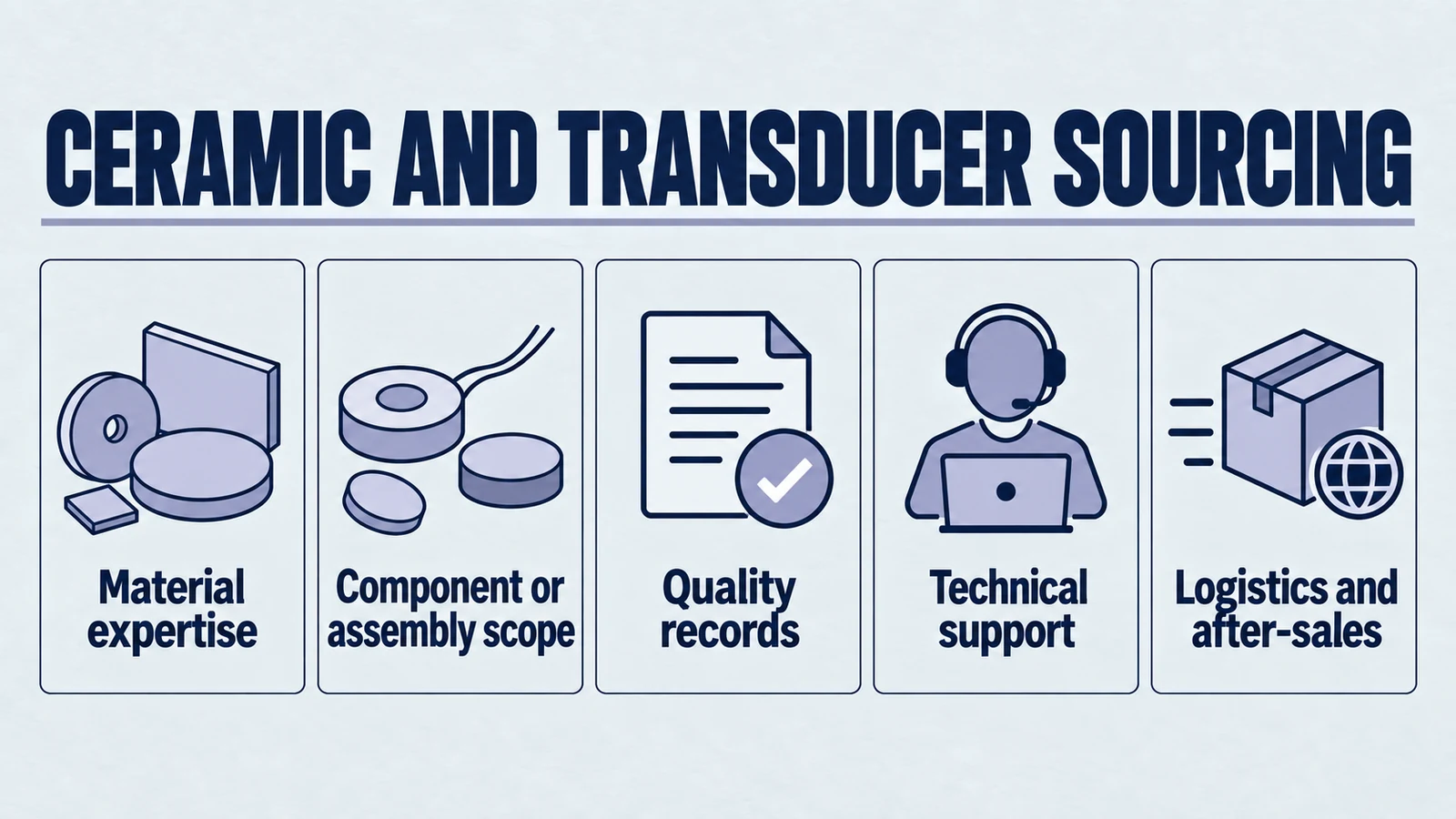
Key Criteria for Selecting a Supplier
1. Material Expertise and Manufacturing Experience
Look for suppliers with deep knowledge of PZT materials, including soft, hard, and semi-hard compositions. An experienced manufacturer should provide:
- A wide range of material formulations (e.g., PZT-4, PZT-5, PZT-8 equivalents)
- In-house R&D capabilities for custom ceramic development
- Consistent performance data across dielectric, piezoelectric, and coupling parameters
- Experience with multilayer co-firing, tape casting, and high-temperature sintering
Tip: Ask for datasheets and long-term test results for specific material grades. Also, inquire about repeatability across different production lots.
A supplier's knowledge of how materials perform under different environmental and electrical loads can be essential for high-reliability applications like aerospace or automotive.
2. Product Range and Customization Capabilities
A reputable supplier should offer a comprehensive portfolio of piezoelectric ceramics and transducers, including:
- Discs, rings, tubes, plates, and spheres in standard and custom dimensions
- Multilayer actuators, stacked elements, and bimorphs
- Ultrasonic transducers (single-element, phased array, immersion, air-coupled types)
- Custom shapes, surface finishes, metallization, and electrode patterns
Advanced applications often require more than standard formats. Look for:
- Finite Element Modeling (FEM) support
- Custom frequency tuning and impedance matching
- Coating, bonding, and encapsulation services
A capable supplier should be able to support design review and iteration, but from a procurement perspective the key question is whether that support is documented, repeatable, and available when the program scales.
3. Quality Control and Certifications
A reliable supplier should adhere to international standards such as:
- ISO 9001 for Quality Management Systems
- Medical-device quality documentation when required by the finished-device program
- RoHS and REACH compliance for environmental safety
- In-house testing for d33, kp, kt, dielectric loss, resonant frequency, and mechanical Q
Advanced testing may include:
- Laser interferometry for displacement
- High-voltage endurance and thermal cycling tests
- Scanning electron microscopy (SEM) for microstructure analysis
Ask about their incoming, in-process, and final inspection procedures. A supplier that provides SPC (Statistical Process Control) charts and batch traceability shows a mature quality mindset.
4. Technical Support as a Procurement Risk Check
Technical support should be evaluated as a sourcing risk-control capability, not as vague partnership language. Procurement teams should verify whether:
- Their engineers understand your application context
- They respond promptly to technical inquiries
- They offer simulation support or design suggestions for integration
- They can advise on thermal management, mounting, and driving circuitry
Effective technical support can prevent costly design errors, reduce the number of prototyping cycles, and improve performance consistency. If you need a deeper framework for evaluating the co-development relationship itself, use our OEM partnership guide.
5. Lead Time, Logistics, and After-Sales Support
In global supply chains, delivery reliability is as important as technical quality. A dependable supplier should provide:
- Transparent lead times (especially for prototypes and urgent batches)
- Real-time order tracking or logistics updates
- Efficient customs documentation and export experience
- Clear communication in case of delays or disruptions
- After-sales support for troubleshooting, replacements, and feedback loops
Don't underestimate the value of a supplier who provides predictable delivery schedules—this helps reduce inventory costs and avoid supply chain disruptions.
Common Pitfalls to Avoid
- Over-relying on price
Low-cost suppliers may cut corners on materials or tolerances, risking your product's reputation. - Ignoring long-term scalability
A supplier who can't scale up quickly may hold back your market expansion. - Neglecting regional compliance
Ensure your supplier's materials are certified for your region's safety and environmental standards. - Choosing a supplier with poor communication
Delayed or unclear communication can stall development and increase the risk of costly errors. - Failing to validate quality claims
Always ask for test reports and consider running an initial qualification project.
Why Yujie Is a Trusted Partner for Global Manufacturers
At Yujie, we bring manufacturing expertise built since 1996 in piezoelectric ceramics and transducers for global OEMs across medical, industrial, consumer electronics, and beauty sectors. Our core advantages:
- Wide material portfolio, including soft, hard, and custom PZT formulations
- Full-spectrum capabilities: From raw material R&D to device assembly
- Strict quality systems, traceable test reports, and detailed inspection records
- Responsive engineering support tailored to specific applications
- OEM-friendly workflows, including sample development, confidential customization, and agile scale-up
- Global shipping experience across Asia-Pacific, Europe, and the Americas
We serve customers in applications ranging from high-power ultrasonic welding to miniaturized medical sensors. Whether you're seeking a trusted supplier for ongoing production or exploring new design possibilities, Yujie offers the expertise and agility to support your goals.
Final Thoughts
Choosing a supplier for piezoelectric ceramics and transducers is not just a procurement decision. It is a sourcing decision with direct consequences for product performance, launch timing, and operational risk. By focusing on technical expertise, quality assurance, customization, and support, you ensure that your innovations are built on solid foundations.
In today's competitive global landscape, qualifying a proven supplier can be the difference between controlled scale-up and recurring supply disruption.
Use the right guide for the right question: this page is for supplier screening and procurement diligence; our manufacturer quality benchmark is for technical auditing; and our innovation partner guide is for OEM co-development fit.
Need help sourcing high-quality piezoelectric components?
📩 Contact Yujie at business@szyujie.com or visit yujiepiezo.com to explore our solutions.
To learn more about our piezoelectric products and how they can be customized for your specific applications, or to discuss your supply chain requirements, please contact our team.
🏭 Explore Our Supplier Solutions
As a leading manufacturer, we provide comprehensive supply chain solutions:
- PZT Material Supplier - Complete PZT grades, custom formulations, global shipping
- Piezoelectric Components Supplier - Discs, rings, plates, custom shapes and assemblies
- Ultrasonic Transducer Supplier - Cleaning, atomizing, NDT, medical applications
Experience reliable supply chain, competitive pricing, and technical excellence with Yujie Technology.
Engineering decision notes
OEM integration and supplier qualification
Use this article when the risk is supplier selection, engineering support, validation evidence, integration reliability, and whether the manufacturer can scale from sample to production. For "Choosing a Reliable Supplier for Piezoelectric Ceramics and Transducers", the practical value is in turning the topic into a measurable selection or sourcing decision.
YJ Piezo combines direct project coordination with ceramic manufacturing support, so procurement and engineering teams can evaluate material control, application review, sample validation, and production consistency together.
Selection checks
- Ask whether the supplier controls ceramic manufacturing or only assembles purchased elements.
- Review sample policy, inspection records, engineering response quality, and production lead-time stability.
- Compare suppliers and integration paths by validation evidence, not only by unit price and datasheet similarity.
Failure risks
- A low-price sample can pass early tests but fail when batch variation, thermal load, or assembly stress appears.
- A supplier without material control may not explain why impedance, capacitance, or resonance drift occurs.
- Weak RFQ information leads to quotes that are fast but not technically comparable.
RFQ details
- What application, operating environment, and failure cost should the supplier design around?
- Which sample tests and outgoing records are required before pilot production?
- What customization, MOQ, tooling, and delivery constraints must be known before quotation?
Relevant YJ Piezo pages
- Ultrasonic Transducer Supplier Hub
OEM sourcing and engineering collaboration
- PZT Material Supplier Hub
Material control and grade selection
- Piezoelectric Ceramics
Ceramic manufacturing and custom shapes
Application FAQ
- How should an OEM compare piezoelectric suppliers?
- Compare material control, engineering support, test evidence, customization ability, sample policy, and batch consistency. Unit price matters, but only after the technical risk is understood.
- What makes an RFQ technically useful?
- A useful RFQ includes application, dimensions, target frequency, electrical limits, duty cycle, operating medium, environment, expected quantity, required reports, and current failure or replacement context.