
7 Critical Questions to Ask Your Piezoelectric Ceramic Manufacturer Before Placing an Order
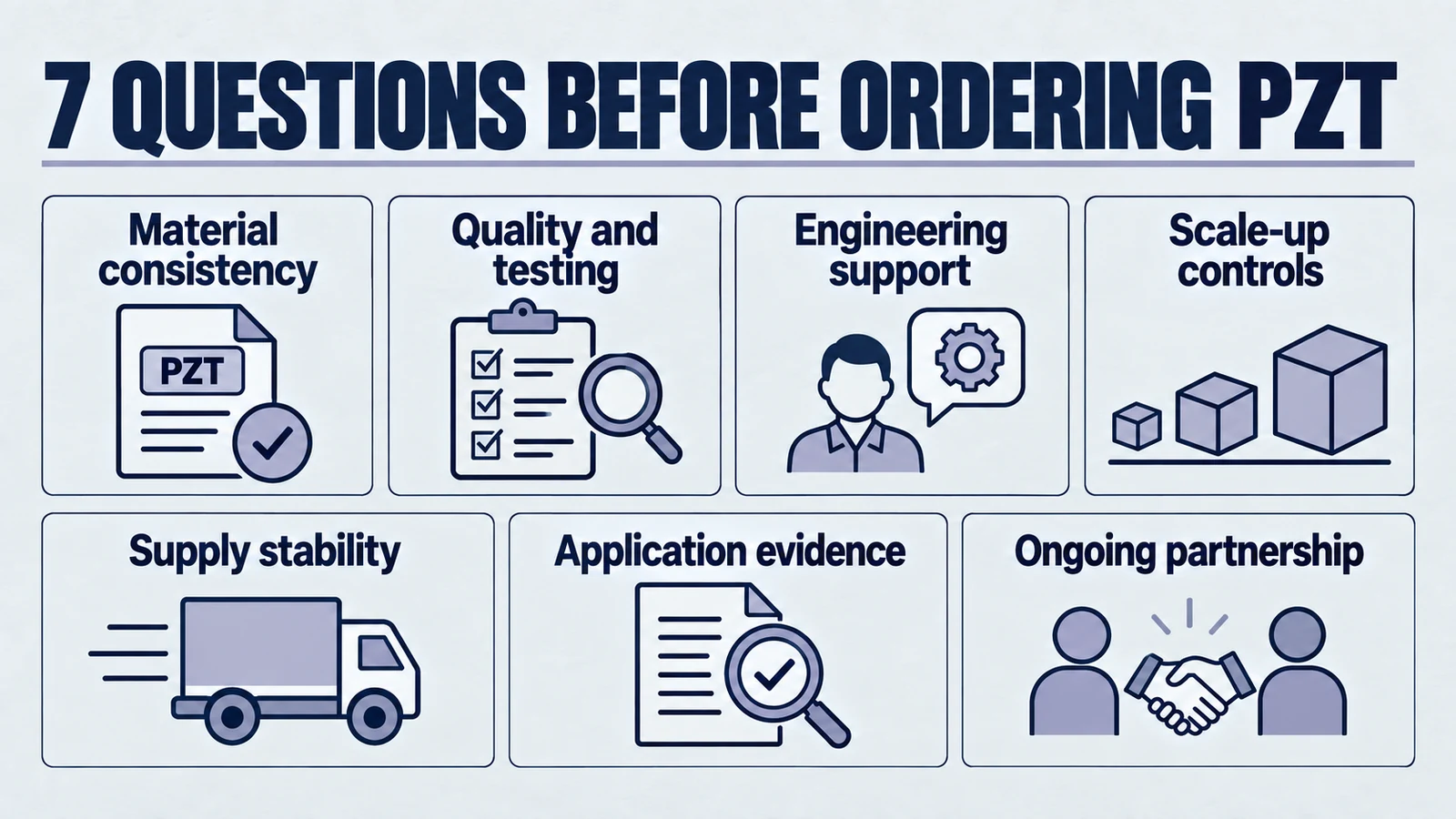
Choosing a piezoelectric ceramic component for your application is not like ordering a standard nut or bolt. This component is the functional heart of your device. Whether it's an ultrasonic transducer for medical imaging, a precision actuator for semiconductor manufacturing, or a sensor for non-destructive testing, the performance, reliability, and consistency of the piezo element are directly transferred to your final product. Choosing a piezoelectric ceramic manufacturer is like choosing an engine supplier for a race car; the wrong choice makes everything else irrelevant.
Too often, the selection process is oversimplified, boiling down to a comparison of generic data sheets and a seemingly attractive per-unit price. This approach can create hidden costs that slow a project: unforeseen development delays, inconsistent product performance, expensive redesigns, and serious field failures that damage your brand's reputation. The true cost of a "cheap" component is rarely cheap.
To navigate this complex landscape and forge a truly valuable partnership, you need a strategic framework. This guide provides seven essential questions that will empower your engineering and procurement teams to look beyond the price tag. Asking these questions will help you accurately assess a piezoelectric ceramic manufacturer's true capabilities, transforming a simple supplier transaction into a strategic advantage that drives innovation and ensures long-term success.
Question 1: How do you control material composition and ensure batch-to-batch consistency?
Product path for this search intent
Match the article topic to the right YJ Piezo product page
Use this article when the risk is supplier selection, engineering support, validation evidence, integration reliability, and whether the manufacturer can scale from sample to production. For "7 Critical Questions to Ask Your Piezoelectric Ceramic Manufacturer Before Placing an O...", the practical value is in turning the topic into a measurable selection or sourcing decision.
- Ultrasonic Transducer Supplier Hub
OEM sourcing and engineering collaboration
- PZT Material Supplier Hub
Material control and grade selection
- Piezoelectric Ceramics
Ceramic manufacturing and custom shapes
This question should be your first and most fundamental inquiry, as it addresses the very foundation of piezoelectric performance. The properties of a piezo ceramic are not intrinsic; they are meticulously engineered through precise chemistry and microstructure control. A component labeled "PZT-5A" from one manufacturer can have vastly different performance characteristics from a "PZT-5A" made by another, all due to minute variations in formulation and processing.
The Science of Consistency: What to Look For
An expert piezoelectric ceramic manufacturer understands that consistency is not an accident; it is the result of rigorous, multi-stage control. Here are the key areas to probe:
- Raw Material Purity and Qualification: The process begins with the elemental building blocks. A manufacturer's control over their supply chain for raw materials like lead, zirconium, and titanium oxides is paramount. They should be able to discuss their qualification process for new suppliers and the purity standards they demand (e.g., 99.9%+). Inconsistent raw material purity is the first domino to fall in a chain reaction that leads to unpredictable final component properties.
- Proprietary Formulations and Doping: Standard industry designations like PZT-4, PZT-5H, or PZT-8 describe families of materials, not exact, universally agreed-upon recipes. A truly knowledgeable manufacturer develops their own proprietary formulations. They use specific doping agents—such as Niobium (Nb), Antimony (Sb), or Bismuth (Bi)—in precise quantities to fine-tune material properties for specific application demands. For example, a formulation for a high-power ultrasonic welding transducer will be doped differently than one for a highly sensitive acoustic sensor to optimize parameters like the mechanical quality factor (Qm) or the piezoelectric charge coefficient (d33).
- Process Control is Everything: The transformation from powder to a functional ceramic involves several critical, thermally and electrically sensitive stages. A capable manufacturer must demonstrate precise, documented control over:
- Calcination and Milling: Ensuring a homogenous chemical reaction and achieving the correct particle size distribution, which affects sintering behavior and final grain structure.
- Sintering: The temperature profiles—including ramp rates, soak times, and atmospheric conditions—during sintering directly determine the ceramic's final density and grain size, which in turn influence its dielectric and mechanical properties.
- Poling: The strength of the electric field, the temperature, and the duration of the poling process are what align the ferroelectric domains and impart the piezoelectric effect. Insufficient control here results in low piezoelectric activity and inconsistent performance.
A top-tier manufacturer will not just provide a "typical values" datasheet. They should be able to provide full material traceability from the raw powder lot to the finished, serialized component. The gold standard is the ability to provide batch-specific data, such as a histogram showing the distribution of d33 values across a lot of 1,000 pieces. This proves their consistency, demonstrating that their process yields a tight, predictable distribution of properties, not just a favorable average.
A hypothetical ±2% resonance spread must be assessed against the actual mode, dimensions, elastic/electrical properties, assembly and acceptance limits. It does not uniquely diagnose sintering or permittivity defects, nor necessarily require hand tuning or cause unusable images. Use measured process and system evidence before assigning a cause or business consequence.
Question 2: Can you provide a detailed overview of your Quality Management System and testing protocols?
Where ISO 9001 is required by the customer or program, verify the certified scope and effective QMS operation. Certification is not product certification or guaranteed 100% conformity, and must be supplemented by agreed evidence for piezoelectric ceramics. The real value lies in understanding how a manufacturer's quality philosophy is embedded into every step of their production and testing process.
The Anatomy of Robust Piezo-Specific Quality Control
A quality-focused piezoelectric ceramic manufacturer builds their QMS around the principle of preventing defects, not just catching them at the end. Their system should feature:
- Multi-Stage Inspection: Quality checks cannot be a final-gate activity. They must be integrated throughout the manufacturing flow. This includes incoming analysis of raw material chemistry, post-sintering checks for density and dimensional accuracy, post-poling verification of piezoelectric properties, and a justified final inspection plan for measurable critical characteristics, including sampling and destructive tests where applicable.
- Inspection extent: Define critical characteristics, measurement capability, test destructiveness, acceptance risks and the program’s requirements. Every-unit screening may be appropriate for some tests; justified sampling may be appropriate for others. Neither alone guarantees absence of all defects.
- Traceability and Reporting: Agree lot/serial identification, report fields, methods and records required for the actual program. A Certificate of Conformance is not necessarily a per-serial raw-measurement report; regulatory and contractual scope determine the evidence.
An expert partner views their QMS not as a bureaucratic burden but as a core competitive advantage. They should be able to clearly articulate their testing methodologies, the specific models of equipment used (e.g., Agilent or Keysight impedance analyzers, APC or Piezotest d33 meters), and the statistical process control (SPC) methods they employ to monitor process stability and drive continuous improvement. They welcome customer audits, seeing them not as an intrusion but as an opportunity to build trust and demonstrate their commitment to quality.
Consider the choice between two potential suppliers. Manufacturer A offers a slightly lower price and performs batch sampling on the d33 coefficient. Manufacturer B is marginally more expensive but provides 100% testing and reporting for d33, resonant frequency, and the planar coupling factor (kp). Manufacturer B's decision to test 100% of these specific parameters indicates a deep, experience-based understanding of applications like precision actuators or advanced sensors, where these exact values are critical for device calibration and predictable performance. They are not just testing for "good" or "bad"; they are testing for tight conformance to a specification because they know their customer's system depends on it. Their testing protocol is application-aware. By choosing Manufacturer B, you are not just buying a component; you are buying insurance. You are effectively outsourcing a critical quality assurance step, which reduces your own incoming inspection burden, accelerates your manufacturing cycle, and massively reduces the risk of downstream failures or costly product recalls. The testing protocol becomes a reliable proxy for the manufacturer's depth of industry expertise and their respect for your application's risk profile.
Question 3: What level of application engineering and co-development support do you offer?
A technical drawing and a Request for Quote (RFQ) should be the beginning of a technical conversation, not the end of one. The answer to this question clearly separates commodity-level vendors from true strategic partners. A simple vendor will quote exactly what is on the drawing. A partner will question the drawing to make it better, more reliable, and more cost-effective to manufacture.
The Spectrum of Engineering Support
The level of engineering engagement a piezoelectric ceramic manufacturer provides can vary dramatically. It is crucial to understand where a potential supplier falls on this spectrum:
- Basic Support (The Vendor): This is a reactive level of support. They can answer questions about their standard material properties and will manufacture precisely to the customer's print, regardless of any potential design flaws or manufacturing challenges. The responsibility for design success rests entirely with the customer.
- Advanced Support (The Partner): This is a proactive, collaborative level of support that creates immense value. It includes:
- Design for Manufacturability (DFM) Feedback: A partner's engineers will proactively review your component design and suggest modifications to improve manufacturing yield, tighten achievable tolerances, reduce internal stresses, or lower costs. This could be as simple as suggesting, "If we change this sharp corner to a slight radius, we can significantly reduce the risk of chipping during lapping and improve the mechanical integrity of the part."
- Finite Element Analysis (FEA) and Simulation: The most advanced partners offer FEA modeling services. They can use software to simulate how a proposed component geometry and material will behave electrically and mechanically within your assembly. This powerful tool can predict resonant frequencies, displacement, stress points, and acoustic output before the first expensive physical prototype is ever made, dramatically reducing the number of design iterations.
- Deep Application-Specific Expertise: A true partner has engineers who possess deep domain knowledge in your specific field, whether it's medical ultrasound, non-destructive testing (NDT), industrial flow meters, or aerospace actuators. They can offer insights that go beyond pure ceramic manufacturing, helping you solve system-level challenges.
An expert partner positions their engineering team as a seamless extension of your own R&D department. Their primary goal is not just to win the purchase order for the component, but to ensure your entire project is a resounding success. They understand that they succeed only when you succeed. They facilitate collaborative design workshops and regular technical meetings to solve complex challenges as a unified team.
This engineering support is not a "freebie" or a simple "value-add"; it is a powerful mechanism for compressing your product development lifecycle and lowering your Total Cost of Ownership (TCO). Imagine you send a design for a novel ultrasonic transducer to two suppliers. The vendor quotes it as-is. The expert partner quotes it but also provides a complimentary FEA report suggesting a minor modification to the component's shape that their simulation shows will increase the acoustic output by 2 dB. This proactive support allows you to skip an entire prototype iteration. This directly saves you the hardware cost of that prototype cycle, but more importantly, it saves your engineering team 4-6 weeks of building, testing, and analysis. This engineering support directly causes an acceleration in your development timeline. In a competitive market, launching your product 4-6 weeks ahead of your rival can be the key to capturing critical first-mover advantage and establishing market leadership. The value of that market share can be worth millions, completely dwarfing the cost of the piezoelectric components. The manufacturer's engineering support has transformed from a technical service into a strategic business weapon for your company. The conversation shifts from "How much does the part cost?" to "How much market value can this partnership create?"
Question 4: How do you manage the transition from prototyping to high-volume production?
One of the most common and dangerous pitfalls in sourcing custom components is the "prototype trap." A manufacturer produces a small batch of beautiful, "golden" samples that meet every specification, winning your business. However, when you place an order for 10,000 units, they fail spectacularly—quality plummets, lead times stretch into oblivion, and performance becomes erratic. This question is designed to help you identify a piezoelectric ceramic manufacturer with a genuinely scalable and repeatable process, averting this costly scenario.
Hallmarks of a Scalable Manufacturing Process
A manufacturer who can truly scale does not simply "turn up the dial" on their lab equipment. They have a formal, validated system for moving from development to mass production. Key indicators include:
- Formal Process Validation: A mature manufacturer will have a structured process for scaling. This is often a Production Part Approval Process (PPAP) or a similar methodology. This involves a rigorous qualification of the mass-production equipment and processes to prove, with data, that they yield parts with the same statistical distribution of properties as the original, approved prototypes.
- Dedicated vs. Shared Production Lines: Inquire about their factory layout and equipment philosophy. Do they have separate, dedicated lines and kilns for small-batch prototyping versus high-volume production? While shared lines can work, it is important to understand how they manage scheduling, prevent cross-contamination, and ensure that a large production run does not get delayed by an urgent R&D project (or vice-versa).
- Transparent Capacity Planning: A scalable partner should be able to speak intelligently and with data about their production capacity. They can tell you their current factory utilization rates, the maximum output of their critical equipment (like sintering furnaces and dicing saws), and their documented plans for expansion. They should be able to provide data-backed assurances that they can meet your volume forecast two or three years from now.
An expert partner treats scalability as a feature that is designed into their manufacturing process from the very beginning, not as an afterthought. They are transparent about their capabilities and limitations and will work with you to develop a phased ramp-up plan, ensuring quality and delivery schedules are maintained at every volume step. For them, the 100,000th part is subject to the exact same rigorous process controls and 100% testing protocols as the 10th part, and they have the traceability and SPC data to prove it.
The importance of this question goes to the heart of your business strategy. Consider a startup company developing an innovative new product. They need 100 parts for their initial pilot launch, but their business plan forecasts a need for 50,000 parts per year within two years if the product is successful. If they choose a small "job shop" manufacturer that excels at hand-crafting beautiful prototypes but has no documented scaling process, they are unknowingly planting a time bomb in their supply chain. When the startup's product becomes a hit and orders surge, they will be forced to find and re-qualify a new, high-volume manufacturer. This re-qualification process—involving new tooling, samples, testing, and validation—can easily take 6-12 months. During that time, production is halted, sales are lost, and competitors have a wide-open window to rush in and seize the market. The initial choice of a non-scalable manufacturer directly causes a future growth bottleneck. The selection of a piezoelectric ceramic manufacturer is therefore not just a technical decision for the current product; it is a strategic business decision that directly impacts your company's future growth trajectory. A procurement manager who selects a partner with proven scalability is not just buying parts; they are building a resilient supply chain that enables and protects their company from its own success.
Question 5: What are your typical lead times, and how do you ensure supply chain stability?
In the wake of recent global events, supply chain resilience has escalated from a logistical concern to a board-level strategic imperative. A fantastic component that arrives a week after your production line has shut down waiting for it is a useless component. Predictability and reliability of supply are now just as important as technical quality and price.
Deconstructing the Supply Chain for Resilience
A robust supply chain is about more than just quoting a lead time. It is about transparency, risk mitigation, and a proactive approach to management.
- Transparent and Realistic Lead Times: A trustworthy partner provides realistic lead times based on current capacity and material availability, not optimistic numbers designed to win an order. They should be able to break down the lead time into its constituent parts (raw material acquisition, powder processing, sintering, machining, testing, shipping) so you understand the critical path. Most importantly, they communicate proactively if any delays are anticipated.
- Strategic Raw Material Sourcing: The supply chain starts long before your order is placed. Ask a potential piezoelectric ceramic manufacturer where they source their critical raw materials, especially the core PZT powders or their oxide precursors. Do they have multiple, fully qualified suppliers for these critical materials to avoid single-source vulnerability? Do they hold a strategic buffer stock of these materials to insulate their production—and therefore your supply—from upstream shocks?
- Collaborative Inventory Management: The most forward-thinking manufacturers move beyond a simple order-by-order transactional relationship. They demonstrate a commitment to partnership by offering collaborative inventory solutions. This could include Kanban systems, Just-in-Time (JIT) delivery agreements, or maintaining a dedicated safety stock of your finished components at their facility, ready for immediate dispatch.
An expert partner views supply chain management as a core competency, not a back-office function. They actively engage in collaborative forecasting with their key customers to plan production schedules and material procurement months in advance. They have a documented risk mitigation plan that addresses potential disruptions, whether they are geopolitical, logistical, or material-based.
The financial leverage of a stable supply chain is often underestimated. If a shipment of critical piezo components is delayed because the manufacturer planned inventory poorly, the customer's downtime cost can exceed the purchase price of the parts. This simple example shows why choosing a supplier based only on a small price difference can be risky. A supplier with buffer stock, qualified material sources, and proactive communication helps the customer evaluate the full cost of line-down risk, not only the price of the component.
Question 6: Can you provide case studies or performance data relevant to my specific application?
A generic claim of "experience built over decades" is a meaningless marketing statement. In contrast, a statement like, "Here is how we developed a custom hard PZT formulation to solve a thermal stability and depoling issue for another client in the downhole oil and gas drilling industry" is a powerful and credible demonstration of relevant expertise. This question is designed to cut through the marketing fluff and test for true depth, not just breadth, of a manufacturer's experience.
The Evidence of True Expertise
When you ask for proof of experience, look for concrete, application-specific evidence:
- Relevant Application Case Studies: A manufacturer should be able to provide non-confidential examples of projects they have completed within your industry. If you are a medical device company, this means showing experience with material-contact documentation needs, packaging near sterilization processes, and traceability expectations defined by the finished-device quality system. If you are an aerospace company, it means showing experience with components designed for high-g survivability, extreme shock and vibration, and performance over wide temperature ranges.
- Performance Data Under Real-World Conditions: Standard datasheets provide material properties measured under ideal, low-power, room-temperature laboratory conditions. An engineer knows that this is not how parts perform in the real world. An expert piezoelectric ceramic manufacturer can provide data on how their materials perform under the stresses of your application: at high drive fields, at elevated temperatures, or after millions of operational cycles (longevity and fatigue testing). This is the data that truly matters for predicting reliability and performance.
- Problem-Solving Narratives: The most compelling case studies are not just simple success stories; they are problem-solving narratives. They should follow a clear structure: "A customer came to us with this specific challenge... here is how our engineering team analyzed the physics of the problem... here is the custom material formulation or component design we developed to solve it... and here is the data showing the improved performance." This demonstrates their intellectual process and problem-solving methodology, not just their basic manufacturing capability.
An expert partner maintains a well-organized library of application notes and case studies that they can readily share. Their engineers and sales staff can "speak your language," demonstrating a clear understanding of the unique physics, regulatory landscape, and business drivers of your specific market. They are not afraid to admit what they do not know, but they have a documented process for finding the answer, which further builds trust and credibility.
The value of this relevant experience is that it serves as the most reliable predictor of future project success and actively de-risks your own R&D investment. Imagine your company is developing a novel ultrasonic atomization device for a nebulizer and is facing challenges with the piezoelectric material depoling at the high drive levels required for efficient aerosol generation. If you partner with a manufacturer who can immediately show you a case study where they developed a specific hard PZT formulation (e.g., a proprietary PZT-8 variant) to solve that exact problem for a different high-power application, you can leverage their pre-existing knowledge. You avoid months of trial-and-error, "reinventing the wheel" by testing standard materials that are destined to fail. The manufacturer's past experience directly accelerates your current R&D cycle. In essence, you are acquiring years of their focused research and development by proxy. This dramatically reduces your technical risk and shortens your path to a viable, reliable product. The manufacturer is no longer just a supplier of ceramic parts; they have become a supplier of proven solutions and applicable intellectual property, which is an infinitely more valuable proposition.
Question 7: How do you define a successful partnership beyond the initial purchase order?
This final, open-ended question is designed to uncover a potential supplier's core business philosophy. It moves beyond the technical and logistical and into the strategic. A transactional vendor, focused on short-term sales, will give an answer centered on fulfilling the basic requirements of the purchase order: "We define success by providing good quality, on-time delivery, and competitive pricing." A true strategic partner, however, will give an answer that is focused on the future and mutual growth.
The Language of a Long-Term Partner
Listen carefully to the language and concepts they use in their response. A manufacturer committed to a long-term partnership will talk about:
- Continuous Improvement and Future Technology: They will discuss their own internal R&D efforts to develop next-generation materials. They might say something like, "We are currently developing a new high-temperature material that could enable your next-generation device to operate in more demanding environments." This shows they are thinking about your future needs, not just their current sales.
- Proactive Communication and Collaboration: They will describe a relationship where their team proactively brings new ideas, technologies, and process improvements to you, rather than simply waiting for your next RFQ to land in their inbox.
- Shared Goals and Aligned Success: Their language will naturally shift from "you" and "us" to "we." They will talk about helping you win in your market, because they fundamentally understand that if you grow, they will grow too. Their definition of success is tied to your success.
- Robust Post-Sale Support: They will have a clear, responsive process for handling any technical inquiries or troubleshooting potential field issues. They see this not as a burdensome warranty claim, but as a continuation of the partnership and an opportunity to learn and improve together.
An expert partner defines their success by your metrics: your market share growth, your successful next-generation product launches, and the establishment of a multi-year collaborative technology roadmap. They seek to be designed-in to your product roadmap for the next five years, not just the bill of materials for the current quarter. The entire relationship is built on a foundation of trust, transparency, and mutual benefit.
The answer to this single question reveals whether the manufacturer operates on a transactional or a relational business model, a distinction that has profound implications for your company's long-term agility and capacity for innovation. When Manufacturer A's answer focuses on fulfilling the specs of the current PO, they are signaling that they are a component provider. When Manufacturer B's answer includes a discussion of their material roadmap and they ask questions about your 3-year product plan, they are signaling their intent to align their own R&D with your future needs. This creates a powerful, symbiotic feedback loop: your future technical challenges drive their innovation, and their material and process innovations enable your next breakthrough product. In a rapidly evolving market, a company's ability to innovate is its primary competitive advantage. By choosing a partner like Manufacturer B, you secure not just a component supplier, but an external innovation engine. This strategic alignment creates a durable competitive moat around your business that a simple, transactional relationship with Manufacturer A could never provide. The final choice is between buying a part and investing in a future.
Vetting Your Piezoelectric Ceramic Manufacturer: Vendor vs. Partner
The table below provides a concise summary of the key differences between a transactional vendor and a strategic partner, mapped to the critical questions discussed. Use it as a quick-reference guide during your evaluation process.
| Critical Question Area | Transactional Vendor Response | Strategic Partner Capability |
|---|---|---|
| 1. Material Consistency | "We use standard PZT-5A. Here is the datasheet." | "We provide full batch traceability, custom formulations for your application, and statistical process control data to support consistency." |
| 2. Quality & Testing | "We are ISO 9001 certified and do batch sampling." | "We agree critical characteristics, test methods, sampling, acceptance criteria and reporting/traceability scope for the actual program." |
| 3. Engineering Support | "Send us your final drawing and we will provide a quote." | "Let's review your design together. Our engineers can run FEA simulations to optimize performance and ensure manufacturability before you commit to tooling." |
| 4. Scalability | "We can make more when you need them." | "We have a documented PPAP process to seamlessly scale from prototype to high-volume production, ensuring the 100,000th part is identical to the 10th." |
| 5. Supply Chain | "Our standard lead time is 12 weeks." | "We offer collaborative forecasting, safety stock programs, and have multiple qualified raw material suppliers to mitigate risk and ensure supply continuity." |
| 6. Proven Expertise | "We have been in business since 1996." | "Here are three case studies from your industry where we solved similar challenges, along with high-drive performance data for the proposed material." |
| 7. Partnership Model | "We offer competitive pricing and on-time delivery." | "Our goal is to be an extension of your R&D team, contributing to your product roadmap and helping you win in your market for years to come." |
Conclusion: Choosing a Partner, Not Just a Part
Selecting the right piezoelectric ceramic manufacturer is one of the most critical technical and business decisions you will make. The evidence is clear: the right partner is not the one with the lowest initial quote, but the one with the most comprehensive and credible answers to these seven questions. A thorough vetting process is not an expense; it is a high-yield investment that pays massive dividends in superior product performance, unwavering reliability, and accelerated speed to market.
At Yujie Piezo, our entire operation was built from the ground up on the principle of being the strategic partner our clients deserve. We don't just welcome these tough questions; we have structured our entire organization—from our fundamental material science and rigorous quality systems to our collaborative application engineering support—to provide the right answers.
Is your project too critical to leave to chance? Schedule a no-obligation technical consultation with our application engineers today. Let's move beyond the datasheet and discuss your specific challenges, and together, we can build a solution that powers your innovation.
Engineering decision notes
OEM integration and supplier qualification
Use this article when the risk is supplier selection, engineering support, validation evidence, integration reliability, and whether the manufacturer can scale from sample to production. For "7 Critical Questions to Ask Your Piezoelectric Ceramic Manufacturer Before Placing an O...", the practical value is in turning the topic into a measurable selection or sourcing decision.
YJ Piezo combines direct project coordination with ceramic manufacturing support, so procurement and engineering teams can evaluate material control, application review, sample validation, and production consistency together.
Selection checks
- Ask whether the supplier controls ceramic manufacturing or only assembles purchased elements.
- Review sample policy, inspection records, engineering response quality, and production lead-time stability.
- Compare suppliers and integration paths by validation evidence, not only by unit price and datasheet similarity.
Failure risks
- A low-price sample can pass early tests but fail when batch variation, thermal load, or assembly stress appears.
- A supplier without material control may not explain why impedance, capacitance, or resonance drift occurs.
- Weak RFQ information leads to quotes that are fast but not technically comparable.
RFQ details
- What application, operating environment, and failure cost should the supplier design around?
- Which sample tests and outgoing records are required before pilot production?
- What customization, MOQ, tooling, and delivery constraints must be known before quotation?
Relevant YJ Piezo pages
- Ultrasonic Transducer Supplier Hub
OEM sourcing and engineering collaboration
- PZT Material Supplier Hub
Material control and grade selection
- Piezoelectric Ceramics
Ceramic manufacturing and custom shapes
Application FAQ
- How should an OEM compare piezoelectric suppliers?
- Compare material control, engineering support, test evidence, customization ability, sample policy, and batch consistency. Unit price matters, but only after the technical risk is understood.
- What makes an RFQ technically useful?
- A useful RFQ includes application, dimensions, target frequency, electrical limits, duty cycle, operating medium, environment, expected quantity, required reports, and current failure or replacement context.