
The Yujie Standard: 5 Critical Factors to Vet Your Next Ultrasonic Transducer PZT Supplier
Introduction: Beyond the Datasheet—The Hidden Risks in PZT Transducer Sourcing
In medical-device, non-destructive testing (NDT), and industrial automation programs, the ultrasonic transducer is a key part of the acoustic system. Image quality, flow measurement stability, and detection repeatability all depend in part on the quality and consistency of the piezoelectric core.
Yet the sourcing process is often oversimplified into a comparison of datasheets and price points.
This common practice creates a real but manageable sourcing risk. A datasheet confirms a material's classification, but it reveals little about suitability for a specific stress profile or performance consistency from one batch to the next. A lower initial component cost can later appear as performance variation, project delay, field troubleshooting, or extra qualification work if the supplier cannot document process control.
Product path for this search intent
Match the article topic to the right YJ Piezo product page
Use this article when the risk is supplier selection, engineering support, validation evidence, integration reliability, and whether the manufacturer can scale from sample to production. For "The Yujie Standard: 5 Critical Factors to Vet Your Next Ultrasonic Transducer PZT Supplier", the practical value is in turning the topic into a measurable selection or sourcing decision.
- Ultrasonic Transducer Supplier Hub
OEM sourcing and engineering collaboration
- PZT Material Supplier Hub
Material control and grade selection
- Piezoelectric Ceramics
Ceramic manufacturing and custom shapes
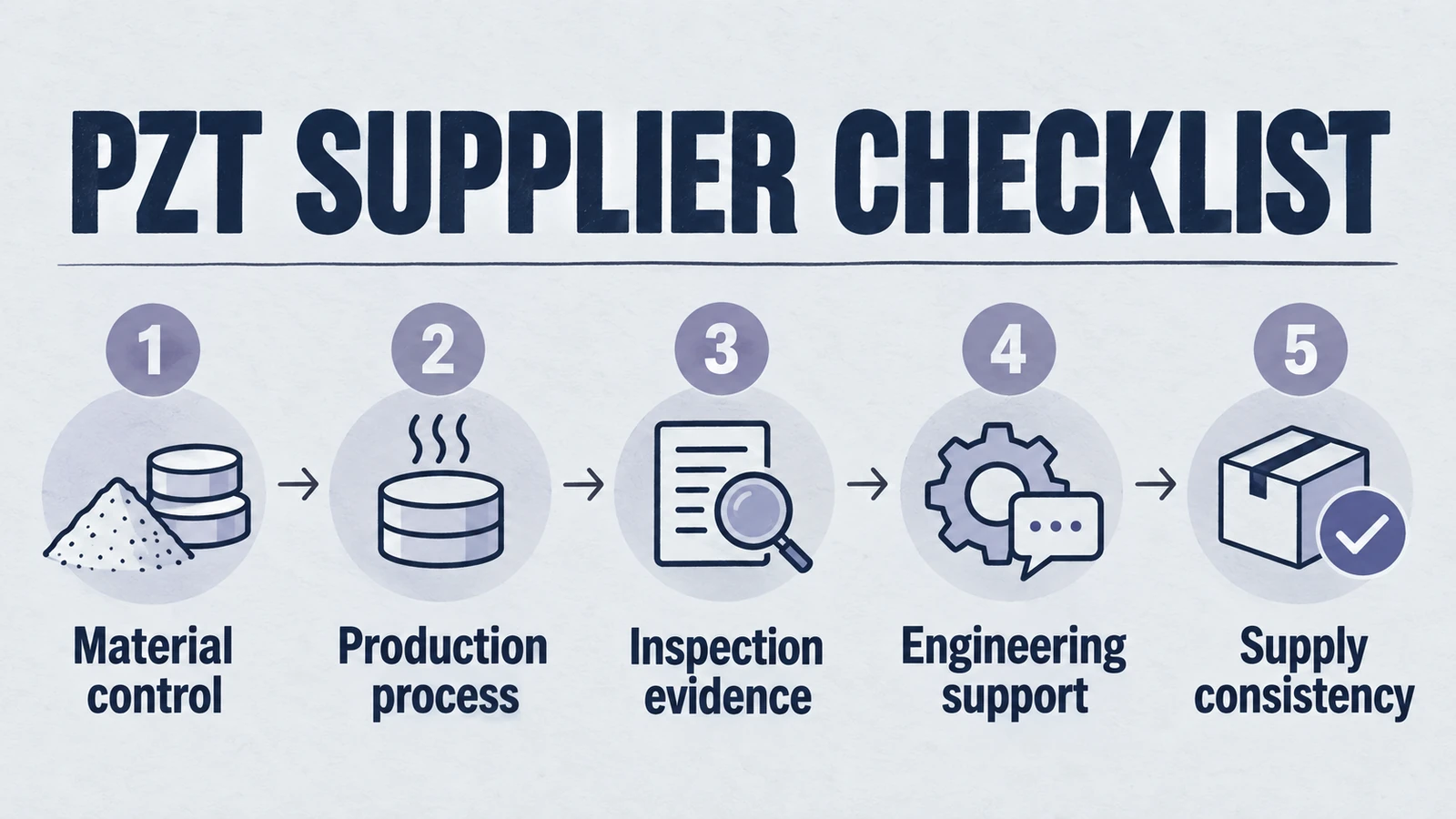
To mitigate this risk, a superior evaluation framework is required—one that moves beyond the datasheet and evolves from a simple commodity comparison to a deep technical consultation. This framework must scrutinize the supplier's entire value chain, from the purity of their raw material science to the depth of their engineering partnership. It requires asking not just "What are your specs?" but "how do you document those specs on the ten-thousandth unit?" This report introduces that framework: The Yujie Standard, a five-factor methodology for vetting an ultrasonic transducer PZT supplier to ensure performance, reliability, and long-term value for high-reliability applications.
Factor 1: From Powder to Performance—Scrutinizing the Manufacturing Chain
The performance of a finished piezoelectric transducer is determined long before it is assembled. Its ultimate electromechanical properties are forged in the crucible of its manufacturing process, where every step is a critical link in a chain of causality. A supplier's control over this chain is a direct and non-negotiable proxy for the consistency and reliability of their final product. Evaluating a supplier must therefore begin with a forensic examination of three foundational manufacturing stages.
Raw Material Purity: The Elemental Foundation
The entire process begins with elemental building blocks—finely milled oxides of lead, zirconium, and titanium. The purity of these precursors is paramount. High-performance lead zirconate titanate (PZT) ceramics demand raw material purity exceeding 99.9%. Even trace impurities, measured in parts per million, can introduce defects into the material's perovskite crystal lattice structure. These imperfections disrupt the uniform alignment of electric dipoles, creating inconsistencies in the piezoelectric effect and leading to unpredictable performance. A supplier who cannot verify and control the purity of their raw material supply chain is building their products on a foundation of uncertainty. The first domino to fall in a chain reaction of poor quality is almost always inconsistent raw material purity.
The Sintering Process: Forging the Ceramic Microstructure
During the high-temperature sintering process, the raw powder is densified and fused into a solid ceramic form. This is far more than simple heating. The precise control of temperature profiles—including ramp rates, soak times at peak temperature, and atmospheric conditions—directly dictates the final ceramic's density and grain structure. These microstructural characteristics, in turn, govern its ultimate mechanical strength, dielectric properties, and electromechanical coupling coefficients. An uncontrolled or inconsistent sintering process can result in ceramics with internal voids, non-uniform grain growth, or micro-cracks, all of which degrade performance and can lead to premature failure under mechanical or electrical stress. A premier supplier does not just fire their ceramics; they engineer the microstructure through meticulous, documented process control.
Poling: The "Activation" of Piezoelectric Properties
In its sintered state, the ceramic component is not yet piezoelectric. The internal crystal domains, each with its own electric dipole, are randomly oriented, resulting in no net piezoelectric effect. The material must be "activated" through poling. This critical process involves heating the ceramic below its Curie temperature while subjecting it to a strong, direct current (DC) electric field. This forces the ferroelectric domains to align in the direction of the field, creating a permanent macroscopic polarization and imparting the powerful piezoelectric properties for which PZT is known. The strength of the electric field, the temperature, and the duration of the process are all critical variables. Insufficient control at this stage results in a weakly-poled, underperforming component with a low piezoelectric charge coefficient (d₃₃) and inconsistent behavior from one unit to the next. A supplier's mastery of the poling process is what transforms a simple ceramic disc or ceramic ring into a high-performance electromechanical engine. When a customer chooses a supplier with rigorous, documented control over these three stages, they are not just buying a component; they are outsourcing their risk management and investing in predictability.
Factor 2: Quality Assurance—The Gap Between Certification and True Reliability
In the pursuit of supplier qualification, certifications like ISO 9001 are often treated as a useful signal of quality. Where this certification is required by the customer or program, it is a common and critical mistake to view it as sufficient. ISO 9001 certification concerns effective operation of the quality management system within its certified scope; it does not, by itself, document the quality of the product that system produces. A supplier can be fully certified yet still ship components with wide performance variations if their internal standards are lax or their testing methodologies are inadequate for the demands of high-performance applications. A truly reliable partner is defined not by their certificate, but by their philosophy of quality and the rigor of their testing protocol. This reveals a fundamental gap between two distinct approaches to quality assurance.
The Commodity Approach: Statistical Batch Sampling
The most common practice in high-volume manufacturing is statistical batch sampling. A small number of components are randomly selected from a large production lot and tested. If this sample meets the minimum specifications, the entire batch is approved and shipped. While this approach is cost-effective and sufficient for many consumer goods, high-reliability applications often require tighter documentation and more direct verification. For a medical-device assembly or an NDT system, component variation needs to be evaluated as part of the finished system's risk controls.
Agree the Inspection Plan and Evidence Scope
A top-tier supplier, operating as a true partner, uses documented testing for the parameters that matter most to the application. This can include moving beyond statistical sampling toward broader testing of critical electrical and mechanical parameters. Impedance analyzers are used to measure the frequency response spectrum, identifying resonant and anti-resonant frequencies and checking for abnormal behavior. Concurrently, d₃₃ meters are used for direct measurement of the piezoelectric charge coefficient, the primary metric of a material's ability to convert mechanical stress into electrical charge. This dual-pronged approach helps document batch-to-batch consistency for high-reliability systems and gives the device team better data for its own validation work.
The following table summarizes the fundamental differences between these two supplier philosophies, providing a clear evaluation matrix for discerning engineers and procurement managers.
| Evaluation Criterion | Commodity Supplier Approach | The Yujie Partnership Standard |
|---|---|---|
| Raw Material Sourcing | Market Grade; Limited Traceability | Verified 99.9%+ Purity; Rigorous Supply Chain Control |
| Manufacturing Control | Standardized, Broad-Tolerance Profiles | Documented Statistical Process Control (SPC) at Every Node |
| Quality Testing | Statistical Batch Sampling (Acceptable Failure Rate) | Agreed measurable characteristics, test methods, sampling and acceptance criteria |
| Engineering Support | Reactive Sales Support; Catalog-Based | Proactive Engineering Consultation; Direct Access to Experience Built Since 1996 |
| Customization | Limited to Standard Geometries | Full OEM/ODM Solutions; Custom Material Formulations |
| Business Model | Transactional Component Vendor | Integrated Engineering Partner |
Factor 3: Partnership Model—Moving from Component Vendor to Engineering Ally
Achieving peak performance in a sophisticated ultrasonic system is rarely accomplished with an off-the-shelf component. It is the result of a synergistic relationship between the component's inherent properties and its integration into the larger system. This reality underscores the immense value of choosing a supplier who operates not as a transactional vendor, but as a collaborative engineering partner. A passive supplier who simply ships a part number places the entire burden of design, optimization, and integration risk squarely on the customer's engineering team. A true manufacturing partner operates as a proactive extension of that team, leveraging deep expertise to accelerate development and de-risk the entire project.
This partnership model is built on three pillars of support. First is the availability of deep engineering consultation. A supplier with experienced engineers, such as Yujie's team with practical piezoelectric experience built since 1996, can provide useful guidance. They can help select a suitable PZT material—such as a "hard" PZT-4 type for high-power ultrasonic cleaning or a "soft," high-sensitivity PZT-5H for medical imaging components—and optimize the transducer's design for a specific application's operational demands.
Second is the capability for full OEM and ODM solutions. high-reliability applications often have unique requirements for form factor, frequency, power handling, or environmental resilience that cannot be met by a standard catalog part. A partner-supplier has the infrastructure and expertise to develop completely custom transducers, from formulating a unique PZT material to designing the housing and matching layers, ensuring the final component is perfectly tailored to the system's needs.
Third is the provision of agile prototyping and lifecycle support. The journey from concept to production is iterative. A true partner facilitates this process by offering rapid prototyping and small-batch sampling. This allows the customer's R&D team to quickly test, validate, and refine their designs, significantly reducing the development cycle and mitigating the risk of costly redesigns late in the process. This collaborative approach is a strategic investment. The supplier's expertise becomes a direct asset to the customer's project, reducing internal R&D overhead and accelerating time-to-market. The true return on investment is not measured in the cost per component, but in the speed and success of the customer's innovation.
Factor 4: Portfolio Breadth and Application-Specific Expertise
A supplier's product portfolio is more than a sales catalog; it is a tangible record of their accumulated knowledge and a direct reflection of their engineering capabilities. A narrow portfolio may indicate deep expertise in a single niche, but a broad and diverse portfolio demonstrates a versatile mastery of piezoelectric technology across a wide spectrum of demanding applications. This cross-domain experience creates a powerful, synergistic innovation loop, where lessons learned in one challenging field can be applied to solve novel problems in another. When evaluating a supplier, their portfolio breadth serves as evidence of their ability to tackle complex, multi-faceted engineering challenges.
Yujie's diverse product range exemplifies this principle, showcasing proven success across distinct application categories:
- High-Sensitivity & Precision Applications: The development of transducers for medical ultrasound imaging, nebulizer devices, and precision ultrasonic flow meters demonstrates a deep understanding of applications where signal fidelity, high coupling coefficients, and measurement accuracy are paramount. This requires mastery of high-sensitivity materials like PZT-5H and designs that minimize signal noise and maximize electromechanical conversion.
- High-Power & Durability Applications: Conversely, a portfolio that includes ultrasonic welding and cleaning transducers, as well as robust underwater acoustic transducers, proves expertise in high-power systems. These applications demand "hard" PZT formulations that can handle high electrical drive, resist depoling under stress, and deliver significant mechanical energy reliably and efficiently in harsh industrial or subsea environments.
- Material Science Foundation: Crucially, a top-tier supplier's expertise is not confined to transducer assembly. The ability to supply raw piezoelectric ceramic components including discs, rings, rectangular plates, and tubes—and to develop custom material formulations—proves that their application knowledge is built upon a fundamental mastery of the underlying material science.
This breadth is a significant advantage for the customer. Consider an engineer developing a novel downhole sensor for the oil and gas industry, an application requiring both extreme durability and high sensitivity. A supplier specializing only in industrial cleaning might understand power handling but not signal fidelity. A supplier focused only on medical devices might understand sensitivity but not long-term reliability in high-pressure environments. A supplier with proven expertise in both domains is uniquely positioned to understand the complex trade-offs and engineer an optimal, reliable solution. The breadth of a supplier's portfolio is therefore a key indicator of their ability to serve as a versatile and innovative engineering partner.
Factor 5: Scalability with documented consistency
A successful prototype is a milestone, but a successful product is one that can be manufactured in high volumes with production conformance demonstrated against agreed limits. Individual parts need not be literally identical. The transition from prototype to full-scale production is one of the most critical and risk-laden phases of product development. It is here that a supplier's true capabilities are revealed. A supplier who can provide a handful of perfect "golden samples" but cannot replicate that performance at scale is not a viable partner for a serious commercial enterprise. Therefore, the final and most crucial factor in vetting a supplier is their demonstrated ability to ensure performance consistency as production scales from single units to thousands or millions.
This capability, which can be termed scalability with documented consistency, is not a standalone feature but the culmination of all the preceding factors.
- It is the supplier's rigorous control over the manufacturing chain—from raw material purity to sintering and poling—that creates a repeatable, documented process capable of producing consistent results.
- It is their unwavering commitment to 100% component testing that verifies this consistency, checking the agreed measurable characteristics under defined conditions. Screening does not guarantee detection of every latent defect or future failure.
- It is the partnership model that ensures the supplier understands the customer's full-scale production requirements from the very beginning of the design process, allowing them to engineer for manufacturability.
A supplier who has mastered these areas can confidently support the entire product lifecycle, from initial rapid prototyping and small-batch sampling for R&D validation to seamless, high-volume bulk production. This promise is fundamental to de-risking the customer's business model. Inconsistent component supply is a primary cause of production line shutdowns, soaring quality control costs, product recalls, and severe field failures. The "batch-to-batch variability" that plagues suppliers with poor process control is an existential threat to their customers. A supplier who supports consistency at scale is offering more than a quality component; they are offering a form of business continuity insurance. They are ensuring the stability, predictability, and ultimate success of the customer's own manufacturing operations and commercial ambitions.
Conclusion: Choosing Your Partner for Piezoelectric Innovation
The process of selecting an ultrasonic transducer PZT supplier for a high-reliability application must be elevated beyond a simple comparison of specifications and prices. As demonstrated by the five pillars of The Yujie Standard, a comprehensive evaluation must probe the very foundation of a supplier's operations. It requires an assessment of their manufacturing process control, a validation of their quality assurance philosophy, an understanding of their engineering partnership model, an appreciation for their portfolio breadth, and a confirmation of their ability to deliver scalability with documented consistency.
Ultimately, the choice is not between two components, but between two fundamentally different business philosophies: a short-term, transactional approach that prioritizes initial cost at the expense of hidden risks, versus a long-term, strategic partnership that prioritizes reliability, performance, and shared success. The former delivers a part in a box; the latter delivers a competitive advantage.
Your next breakthrough product deserves more than an off-the-shelf component. It requires a dedicated engineering partner. Don't just source a transducer; secure a competitive advantage. Contact Yujie's engineering team today to schedule a technical consultation for your project. Let us show you how The Yujie Standard can de-risk your design and accelerate your path to innovation.
Companion Guides for Supplier Selection and Custom Engineering
Engineering decision notes
OEM integration and supplier qualification
Use this article when the risk is supplier selection, engineering support, validation evidence, integration reliability, and whether the manufacturer can scale from sample to production. For "The Yujie Standard: 5 Critical Factors to Vet Your Next Ultrasonic Transducer PZT Supplier", the practical value is in turning the topic into a measurable selection or sourcing decision.
YJ Piezo combines direct project coordination with ceramic manufacturing support, so procurement and engineering teams can evaluate material control, application review, sample validation, and production consistency together.
Selection checks
- Ask whether the supplier controls ceramic manufacturing or only assembles purchased elements.
- Review sample policy, inspection records, engineering response quality, and production lead-time stability.
- Compare suppliers and integration paths by validation evidence, not only by unit price and datasheet similarity.
Failure risks
- A low-price sample can pass early tests but fail when batch variation, thermal load, or assembly stress appears.
- A supplier without material control may not explain why impedance, capacitance, or resonance drift occurs.
- Weak RFQ information leads to quotes that are fast but not technically comparable.
RFQ details
- What application, operating environment, and failure cost should the supplier design around?
- Which sample tests and outgoing records are required before pilot production?
- What customization, MOQ, tooling, and delivery constraints must be known before quotation?
Relevant YJ Piezo pages
- Ultrasonic Transducer Supplier Hub
OEM sourcing and engineering collaboration
- PZT Material Supplier Hub
Material control and grade selection
- Piezoelectric Ceramics
Ceramic manufacturing and custom shapes
Application FAQ
- How should an OEM compare piezoelectric suppliers?
- Compare material control, engineering support, test evidence, customization ability, sample policy, and batch consistency. Unit price matters, but only after the technical risk is understood.
- What makes an RFQ technically useful?
- A useful RFQ includes application, dimensions, target frequency, electrical limits, duty cycle, operating medium, environment, expected quantity, required reports, and current failure or replacement context.