
Why Shape Matters: A Deep Dive into the Geometry of Piezoelectric Ceramics
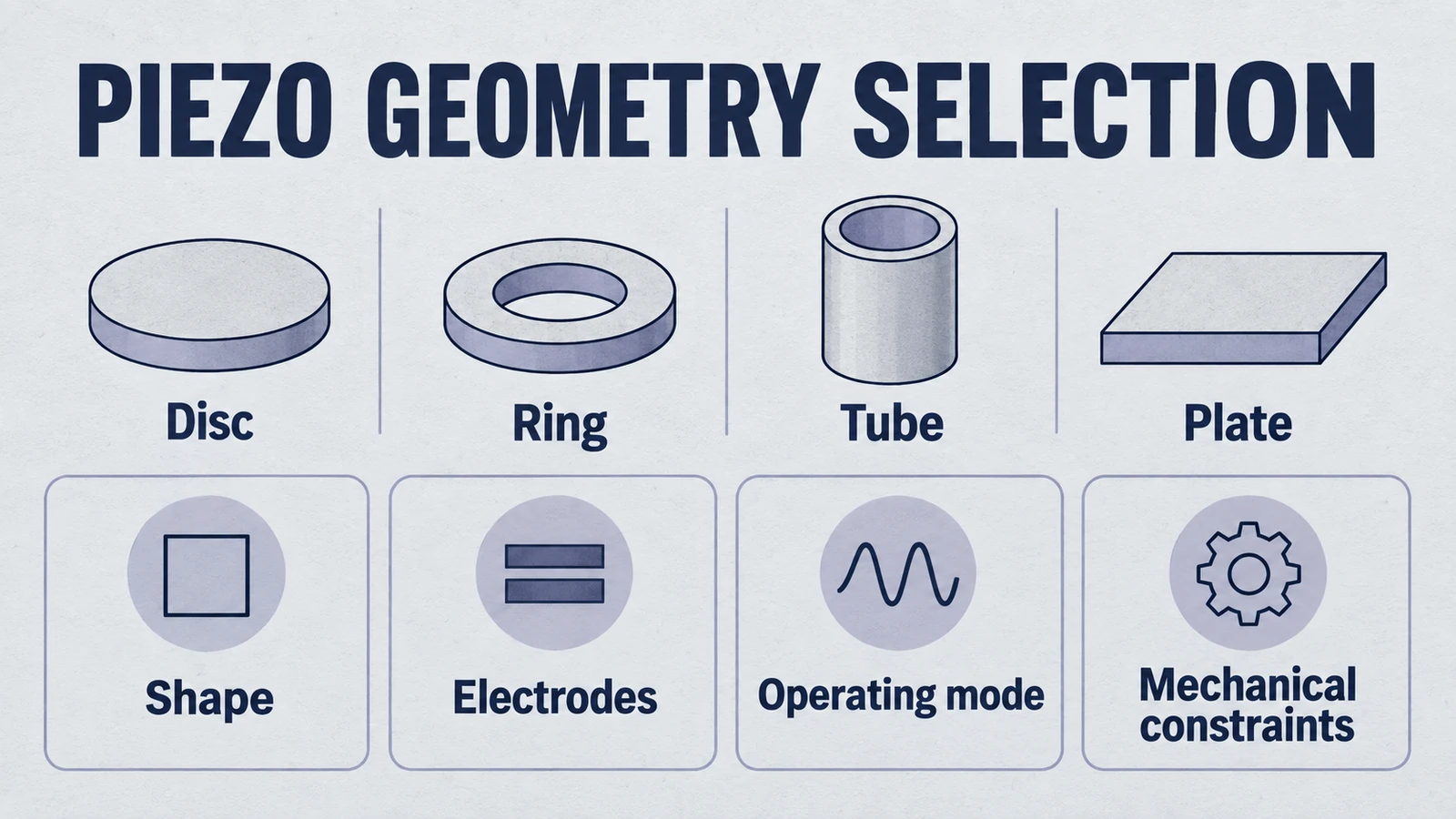
Piezoelectric performance is never set by material alone. Once a PZT ceramic is processed into a plate, disc, ring, tube, hollow sphere, or spherical cap, the geometry itself starts selecting which vibration modes are easy to excite, which resonances become dominant, and where mechanical stress concentrates first.
That is why shape selection should happen early, before a team locks frequency, matching layers, packaging, or transducer architecture. This guide is meant to help engineers choose the right shape family, understand the geometry-to-application mapping, and then move to the specialist article that matches the decision in front of them instead of treating every ceramic form as interchangeable.
Use this page as a practical overview of the main shape families. If you already know you need a detailed answer on rectangular plates, disc-vs-ring-vs-tube trade-offs, focused bowl physics, or radius of curvature, use the selection map below and go directly to that topic.
Product path for this search intent
Match the article topic to the right YJ Piezo product page
Use this article when the choice is not just a shape, but a material tradeoff between sensitivity, loss, coupling, stability, and operating field. For "Why Shape Matters: A Deep Dive into the Geometry of Piezoelectric Ceramics", the practical value is in turning the topic into a measurable selection or sourcing decision.
- PZT Material Hub
Material grades and application tradeoffs
- Piezoelectric Ceramics
Shapes and ceramic manufacturing options
- PZT Material Supplier Hub
Material control, grade selection, and sourcing support
Geometry Selection Map: Choose by Shape or Constraint
Use the selection map below to move directly to the question your team is trying to answer. Each link drills into one shape decision or design constraint.
Disc vs Ring vs Tube
Use this when the shortlist is already round and the real question is power handling, resonance behavior, or packaging logic.
Open the disc vs ring vs tube guideRectangular Plates
Use this when the system needs directional actuation, cantilever behavior, tiled arrays, or a custom non-round footprint.
Open the rectangular plate guideFocused Bowl Geometry
Use this when the team wants to understand how a bowl-shaped ceramic actually creates a focal region.
Open the bowl-shaped focusing guideRadius of Curvature
Use this when the part is already curved and the decision shifts toward working distance, beam width, and tolerance stack-up.
Open the ROC selection guideCurved Ceramic vs Acoustic Lens
Use this when the debate is broader transducer architecture: should focusing come from ceramic geometry or from a downstream acoustic lens?
Open the focused architecture comparisonAlready know the geometry family is a ring?
That is a different stage of the decision. Use one of the ring-specific companion pages below instead of forcing this overview page to do the narrower job:
- Custom ring engineering for OEM programs: use this when the ring geometry is already chosen and the next task is application-specific design, prototype logic, and validated co-development.
- Ring procurement and QA guide: use this when the design direction is already ring-based and procurement now needs supplier diligence, MOQ, lead-time, and incoming inspection controls.
Start with the dominant constraint, not the shape name
The fastest way to create geometry confusion is to ask “which shape is best?” before defining best for what. In practice, shape selection should be driven by the dominant system constraint:
- Need high force and high stiffness? Start from stack or block logic and look at rectangular architectures.
- Need large displacement or beam-like bending? Plates and tubes usually enter the shortlist early.
- Need high-power continuous ultrasonics? Rings often become important because pre-stress becomes possible.
- Need omnidirectional response or hydrostatic robustness? Hollow spheres and curved shells deserve serious attention.
- Need a controlled focal region? The decision shifts toward focused bowls, radius of curvature, and lens-vs-curved architecture rather than generic “piezo shape” talk.
This is why the same ceramic family can appear in a precision actuator, an underwater sensor, and a high-power ultrasonic radiator while behaving like three very different engineering systems. The constitutive equations do not change, but the boundary conditions do.
Geometry-to-application mapping
Rectangular plates and stacks: directional motion, arrays, and custom packaging
Rectangular piezo plates make sense when the design benefits from directional actuation, beam bending, tiled apertures, or a custom footprint that would be awkward with radial symmetry. Their value is not simply that they are “not round.” It is that length, width, and thickness can be assigned different jobs.
If your problem is fundamentally about anisotropic motion, array packing, or a controlled rectangular footprint, go deeper in the rectangular plate guide instead of forcing a disc to behave like a beam.
Discs, rings, and tubes: similar materials, very different envelopes
A disc, ring, and tube can share material families while behaving very differently in resonance control, pre-stress strategy, cooling, hydrostatic sensitivity, and packaging. Grouping them together is convenient for catalogs, but it can be misleading for design.
Use the disc vs ring vs tube guide when the real decision is not “round part or not,” but which round geometry best matches your power level, mode purity, and mechanical risk.
If that comparison already points you toward rings, move next to either the custom ring engineering guide or the ring procurement guide, depending on whether the next decision is engineering or sourcing.
Engineering Risk: The “Default Disc” Assumption
Warning: Discs are often treated as the default answer because they are common and easy to source. But awkward diameter-to-thickness ratios, radial harmonics, and packaging demands can make them the wrong answer. If power, pre-stress, or hydrostatic loading matters, compare against ring and tube architectures early.
Curved and focused geometries: when shape controls where energy goes
Once you move into bowls, spherical caps, and other curved parts, the question is no longer only which mode gets excited. It becomes a question of field shaping: where energy converges, how wide the focal zone is, and how sensitive the design becomes to curvature error, bond-line thickness, and medium variation.
That branch is best handled as a set of narrower decisions:
- How bowl-shaped piezo ceramics focus ultrasound explains the focusing mechanism.
- How to choose radius of curvature covers working distance, beam width, and tolerance sensitivity.
- Curved ceramic vs acoustic lens architecture helps teams choose the broader stack strategy.
Spheres and shells: when omnidirectionality or hydrostatic survival dominates
Hollow spheres and similar shell structures matter when directional beam control is not the goal. They are useful when omnidirectional response, external pressure resistance, or hydrostatic sensing behavior matters more than a narrow beam or compact flat package.
This is a good reminder that “best geometry” depends on what the application is trying to preserve: force, displacement, focus, omnidirectionality, or survivability.
A practical comparison table: what each geometry is best at
| Geometry Family | What It Usually Does Well | What It Commonly Struggles With | Best Next Read |
|---|---|---|---|
| Rectangular Plate / Stack | Directional motion, beam bending, tiled apertures, compact custom packaging | Replacing a round radiator when symmetry or radial behavior is actually required | Rectangular plate guide |
| Disc | Compact emitters, common thickness or radial-mode packages, familiar integration | Mode coupling in awkward aspect-ratio windows, high-power continuous duty | Disc vs ring vs tube |
| Ring | High-power stacks, pre-stressed assemblies, power ultrasonics | Treating it like a disc with a hole instead of a different mechanical system | Disc vs ring vs tube |
| Tube | Scanning, fluidic actuation, hydrostatic sensing, segmented-electrode motion | Fragility, hoop-stress limits, cross-axis coupling | Disc vs ring vs tube |
| Focused Bowl / Spherical Cap | Geometric focusing, compact focal architectures, high local intensity | Curvature tolerance, bond-line control, overly simplistic focus assumptions | Bowl focusing guide |
| Sphere / Shell | Omnidirectional response, hydrostatic robustness, underwater work | Trying to repurpose it for directional beam tasks it was never meant to solve | Hollow sphere product family |
Common geometry selection mistakes
- Making the overview page compete with the specialist pages. Overview pages should map the decision space. Specialist pages should answer the narrow question in depth.
- Choosing by catalog familiarity. Teams often default to discs because they are common, not because they are the best mechanical fit.
- Confusing geometry with material. Soft vs hard PZT matters, but it does not rescue the wrong shape.
- Ignoring packaging effects. Pre-stress, bond lines, curvature tolerances, and matching layers can matter more than a clean theoretical mode chart.
- Treating focused designs as one decision. Focusing mechanism, radius of curvature, and lens-vs-curved architecture are related, but they are not the same question.
Material choice still matters, but only after geometry narrows the problem
Once the shape family is narrowed, material selection becomes more useful. Hard PZT formulations usually enter high-power emission, high Qm, and pre-stressed architectures. Softer formulations are usually favored when sensitivity, displacement, or receive performance is the dominant goal. But material choice cannot compensate for a geometry that is wrong for the application envelope.
A practical sequence is:
- Choose the dominant mechanical or acoustic constraint.
- Choose the best geometry family.
- Open the specialist geometry branch page.
- Then lock material, dimensions, and stack details.
How to use this geometry guide
If you are in early concept work, read this page once to place your project in the right geometry family. If you are already in detailed design, use this article as the overview of piezoelectric ceramic geometries and jump straight to the most relevant follow-up guide for the narrow engineering question.
- Use this page to place the project in the right shape family.
- Use the linked sub-guides to answer the narrow question in depth.
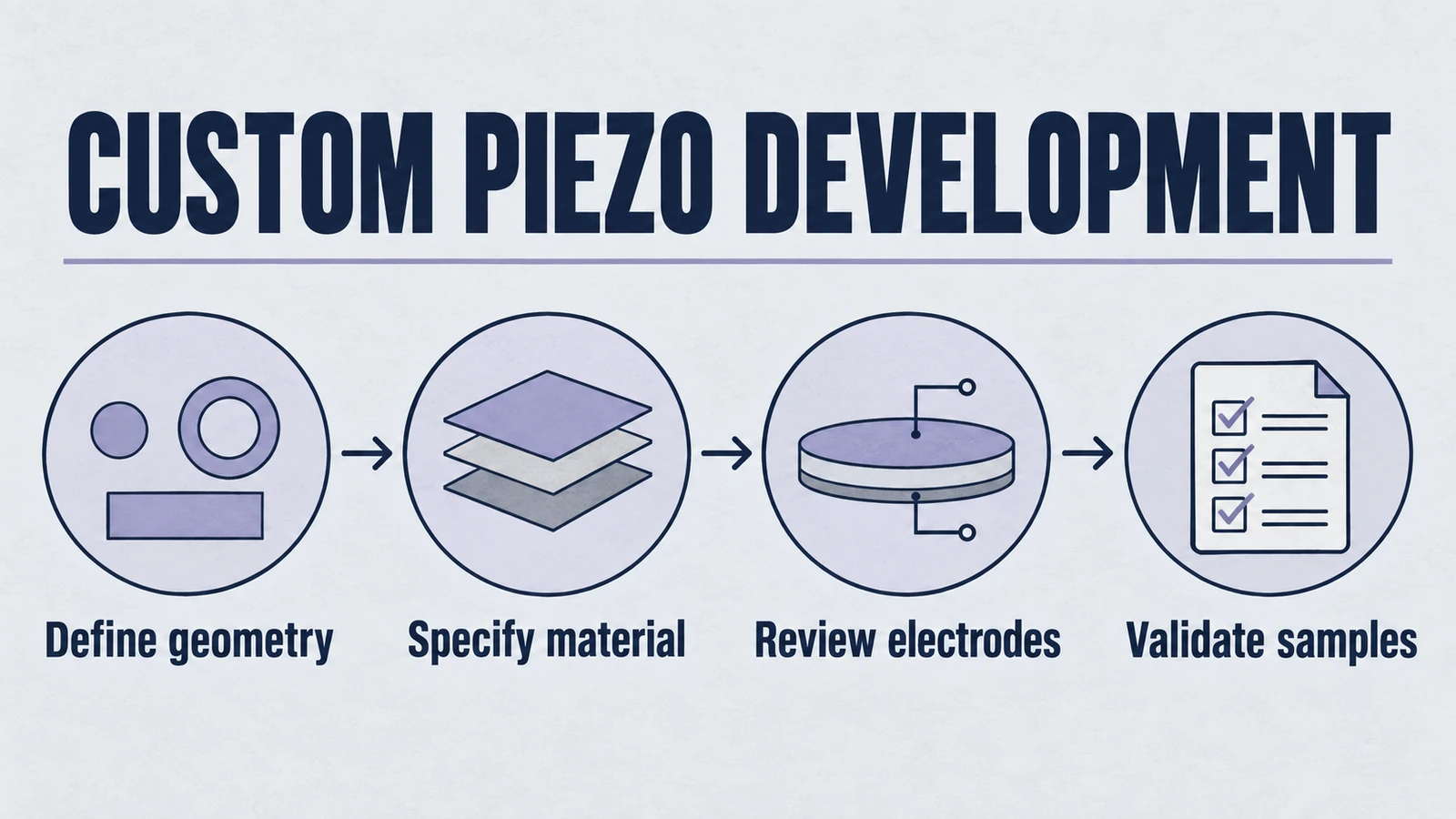
- Then move into product-family selection, material choice, and prototype validation.
Related Product Families
Engineering decision notes
PZT material and ceramic selection
Use this article when the choice is not just a shape, but a material tradeoff between sensitivity, loss, coupling, stability, and operating field. For "Why Shape Matters: A Deep Dive into the Geometry of Piezoelectric Ceramics", the practical value is in turning the topic into a measurable selection or sourcing decision.
YJ Piezo coordinates PZT ceramic projects with manufacturing support, so material formulation, sintering, polarization, electrode process, and outgoing inspection can be reviewed against the final application.
Selection checks
- Separate sensing needs from high-power actuation needs before comparing d33 or coupling values.
- Check dielectric loss, Qm, Curie temperature, aging behavior, and operating field against the real duty cycle.
- Confirm whether the application needs standard PZT grades or a custom formulation and geometry.
Failure risks
- Choosing only the highest d33 can create heat, drift, or depolarization risk in power ultrasonics.
- A ceramic that performs well in free measurement can fail once bonded, clamped, or loaded.
- Material substitutions without batch testing can change capacitance, resonance, and system tuning.
RFQ details
- Is the part used for sensing, actuation, atomization, cleaning, welding, or measurement?
- What field strength, temperature, duty cycle, and mechanical load will the ceramic see?
- Which values must be controlled: d33, capacitance, resonance, impedance, Qm, or dimensional tolerance?
Relevant YJ Piezo pages
- PZT Material Hub
Material grades and application tradeoffs
- Piezoelectric Ceramics
Shapes and ceramic manufacturing options
- PZT Material Supplier Hub
Material control, grade selection, and sourcing support
Application FAQ
- Is the highest d33 always the best PZT choice?
- No. High d33 can be useful for sensitivity, but high-power ultrasonic systems often need lower loss, higher Qm, better thermal stability, and safer operation under field and stress.
- What makes PZT material selection different from catalog buying?
- The right PZT choice depends on geometry, load, drive field, duty cycle, temperature, and inspection targets. A catalog value is only useful when it is tied to the final assembly conditions.