
Ultrasonic Transducer Types & Selection Guide for OEM Teams
Introduction
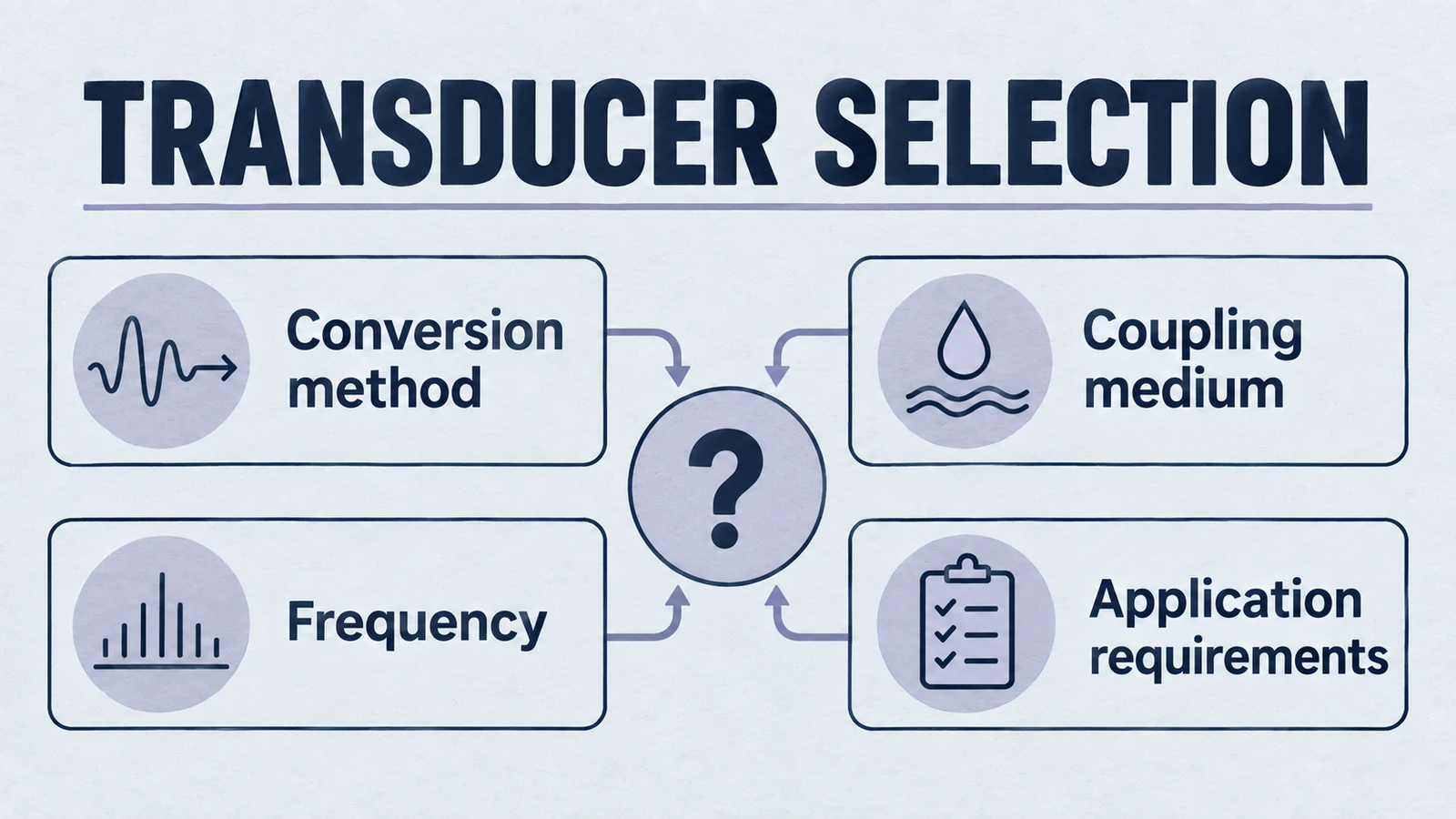
Quick answer: An ultrasonic transducer converts electrical signals into mechanical vibration above 20 kHz and can also receive ultrasonic echoes. Main types include contact, immersion, air-coupled, focused, cleaning, welding, flow, and sensor transducers. Selection depends on frequency, medium, beam shape, power, bandwidth, housing, and PZT material behavior.
This page is the type-and-architecture guide. For use-case examples, read the separate ultrasonic transducer applications guide. For sourcing, review the OEM transducer supplier hub and the ultrasonic sensor range.
For material choice, use PZT fundamentals and PZT ultrasonic transducer selection. For sensor comparisons, see ultrasonic vs infrared sensors.
An ultrasonic transducer is a device that converts electrical energy into mechanical vibrations at frequencies above 20 kHz—beyond the range of human hearing—and can also convert received ultrasonic waves back into electrical signals. This bidirectional energy conversion makes ultrasonic transducers essential across industries ranging from non-destructive testing (NDT) and medical imaging to industrial cleaning, atomization, and underwater sensing.
This pillar guide covers everything engineers need to understand about ultrasonic transducers:
Product path for this search intent
Match the article topic to the right YJ Piezo product page
Use this article when sensor performance depends on target distance, beam angle, housing material, liquid behavior, or false echo control. For "Ultrasonic Transducer Types & Selection Guide for OEM Teams", the practical value is in turning the topic into a measurable selection or sourcing decision.
- Ultrasonic Sensors
Sensing assemblies
- Piezoelectric Ceramic Elements
PZT material and geometry options
- Ultrasonic Cleaning Transducers
Cleaning assemblies
- What ultrasonic transducers are and how they differ from other sensors
- The physics of how they generate and receive ultrasonic waves
- Key transducer types and their application-specific trade-offs
- How to select the right transducer for your application
- What to look for when evaluating suppliers and manufacturers
Working Principle and System Context
An ultrasonic transducer is an electromechanical device that generates or detects ultrasonic waves—sound waves with frequencies typically ranging from 20 kHz to several MHz. Unlike optical or capacitive sensors that rely on light or electric fields, ultrasonic transducers use mechanical wave propagation, allowing them to work through opaque materials, liquids, and harsh environments where other sensing methods fail.
Core Components
Most ultrasonic transducers share these fundamental components:
- Piezoelectric element: The active component (typically PZT ceramic) that converts electrical signals to mechanical vibration and vice versa
- Matching layer: Optimizes acoustic impedance between the piezo element and the transmission medium
- Backing material: Dampens unwanted vibrations and controls bandwidth
- Housing: Provides mechanical protection, electrical connections, and environmental sealing
Comparison with Other Sensor Types
Unlike infrared or laser-based distance sensors, ultrasonic transducers can detect transparent objects, work in dusty environments, and measure through liquid levels. However, they are generally slower than optical methods and may be affected by temperature variations that alter sound velocity.
How Ultrasonic Transducers Work
Piezoelectric Effect in Ultrasonics
The operating principle of most ultrasonic transducers relies on the piezoelectric effect—the ability of certain crystalline materials to generate an electric charge when mechanically stressed, and conversely, to deform when an electric field is applied.
In ultrasonic applications, piezoelectric ceramics like PZT (Lead Zirconate Titanate) are polarized during manufacturing to align their internal dipoles. When an alternating voltage is applied at the material's resonant frequency, it produces mechanical oscillations that radiate as ultrasonic waves. The efficiency of this conversion depends on piezoelectric constants like d33, k, and Qm.
From Electrical Signal to Mechanical Wave
The transduction process works in two modes:
Transmit mode:
- An electrical oscillator generates an AC signal at the desired ultrasonic frequency
- This signal excites the piezoelectric element, causing it to expand and contract
- The mechanical vibrations propagate through the matching layer into the transmission medium (air, water, or solid)
- The ultrasonic wave travels outward until it encounters a boundary or target
Receive mode:
- Returning ultrasonic waves (echoes or transmitted signals) strike the transducer face
- The mechanical pressure deforms the piezoelectric element
- This deformation generates a proportional electrical signal
- The signal is amplified and processed to extract timing, amplitude, or frequency information
For maximum efficiency, the transducer operates at or near its resonant frequency, where mechanical displacement per unit voltage is highest. Impedance matching between the piezo element, matching layers, and transmission medium is critical for minimizing energy loss.
Types of Ultrasonic Transducers
Contact vs Immersion Transducers
Contact transducers are placed directly on the test surface with a coupling gel or couplant to ensure acoustic transmission. They are widely used in:
- Weld inspection and flaw detection
- Thickness gauging of metals and composites
- Portable NDT field applications
Immersion transducers operate with the component submerged in a water bath or with a water column (squirter) providing coupling. Benefits include:
- Consistent coupling without operator variability
- Ability to perform automated C-scan imaging
- Higher precision for aerospace and semiconductor inspection
Single Element vs Array Transducers
Single-element transducers contain one piezoelectric disc or plate. They are:
- Simple and cost-effective
- Suitable for basic pulse-echo or through-transmission measurements
- Limited to fixed beam angles and focal depths
Phased array transducers contain multiple small elements that can be electronically controlled to:
- Steer the ultrasonic beam without mechanical movement
- Focus at variable depths
- Generate real-time cross-sectional images
- Inspect complex geometries like welds and turbine blades
High-Frequency vs Low-Frequency Transducers
Frequency selection involves a fundamental trade-off between resolution and penetration:
| Frequency Range | Characteristics | Typical Applications |
|---|---|---|
| Low (20–100 kHz) | High penetration, lower resolution | Industrial cleaning, sonar, thick material inspection |
| Medium (100 kHz–1 MHz) | Balanced performance | NDT, flow measurement, distance sensing |
| High (1–20 MHz) | High resolution, limited penetration | Medical imaging, thin material inspection, microelectronics |
Special Types: Atomizers, Underwater, NDT
Many conventional free-surface atomizing transducers use MHz excitation; vibrating-mesh and other atomizers can operate at substantially lower ultrasonic frequencies. State the architecture and validated liquid/droplet conditions rather than a universal range to create fine mists through capillary wave disruption. They are used in:
- Medical nebulizers and inhalers
- Humidification systems
- Fuel atomization for combustion
Learn more about ultrasonic atomizing transducers and their design considerations.
Underwater/sonar transducers are designed for aquatic environments with:
- Waterproof housings rated for depth pressure
- Acoustic matching to water's impedance
- Applications in fish finding, depth sounding, and underwater communication
NDT-specific transducers include specialized designs like:
- Angle beam probes: For weld inspection at specific refracted angles
- Delay line transducers: For near-surface resolution
- Dual-element transducers: Separate transmit/receive elements for improved sensitivity
How to Choose an Ultrasonic Transducer
Frequency Selection
Choose frequency based on your resolution vs penetration requirements:
- Thick materials (>100mm steel): 1–5 MHz
- Standard NDT (10–100mm): 2–10 MHz
- Thin materials (<5mm): 10–25 MHz
- Distance sensing in air: 40–200 kHz
- Industrial cleaning: 25–130 kHz
- Atomization: Architecture-dependent; conventional free-surface and vibrating-mesh designs use different frequency ranges
Material Considerations
The choice of piezoelectric material significantly impacts transducer performance. Understanding soft vs hard PZT types is essential:
- Soft PZT (e.g., PZT-5A, PZT-5H): Higher d33 coefficient, better for sensing and receiving applications where sensitivity matters
- Hard PZT (e.g., PZT-4, PZT-8): Higher Qm (mechanical quality factor), better for high-power applications like cleaning and welding where efficiency and heat resistance are critical
For detailed guidance on material constants, see our guide on piezoelectric constants d33, k, and Qm.
Power & Sensitivity Trade-offs
Application requirements determine whether you prioritize power handling or sensitivity:
High-power applications (cleaning, welding, sonochemistry):
- Screen mode-specific mechanical loss and assembled high-drive behavior; Qm >1000 is not a universal qualification threshold
- Require robust thermal management
- Operate at lower frequencies for cavitation or material processing
High-sensitivity applications (medical imaging, precision NDT, sensing):
- Screen mode-specific sensitivity and readout conditions; d33 >400 pC/N is not a universal qualification threshold
- Prioritize signal-to-noise ratio
- May use composite piezo structures for improved bandwidth
Environmental & Mounting Constraints
Consider operating conditions when selecting transducers:
- Temperature range: Standard PZT operates to ~150°C; high-temperature applications may need modified formulations or cooling
- Chemical exposure: Corrosive environments require appropriate housing materials (stainless steel, titanium, PEEK)
- IP rating: Outdoor or washdown environments need IP65 or higher
- Mounting method: Consider bolt-on, clamp-on, or adhesive mounting based on application
- Cable length: Long cables may require impedance matching or signal conditioning
Ultrasonic Transducer Applications
NDT & Inspection
Non-destructive testing is one of the largest application areas for ultrasonic transducers:
- Weld inspection: Detecting cracks, porosity, and lack of fusion
- Thickness gauging: Measuring corrosion in pipelines and pressure vessels
- Flaw detection: Finding internal defects in castings, forgings, and composites
- Aerospace inspection: Composite delamination detection, bond line evaluation
Cleaning & Medical
Ultrasonic cleaning uses cavitation—the formation and collapse of microscopic bubbles—to remove contaminants:
- Precision cleaning of surgical instruments, optical components, and electronics
- Industrial parts cleaning for automotive and aerospace manufacturing
- Jewelry and watch cleaning
Learn how piezoelectric ceramics enhance ultrasonic cleaner efficiency.
Sensing & Automation
Ultrasonic sensors enable contactless measurement in automation:
- Distance/proximity sensing: Object detection, collision avoidance, parking sensors
- Level measurement: Tank level monitoring in water treatment, chemical processing
- Flow measurement: Transit-time and Doppler flowmeters for liquids and gases
For sensing applications, piezo sensor working principles are fundamental to understand.
Atomizing
High-frequency ultrasonic transducers create fine aerosols for:
- Medical nebulizers delivering respiratory medications
- Humidification in HVAC and clean rooms
- Fuel atomization for improved combustion efficiency
- Coating and spray applications
Underwater & Sonar
Underwater transducers enable acoustic sensing in marine environments:
- Depth sounding and bathymetry
- Fish finding and marine biology research
- Underwater acoustic communication
- Sub-bottom profiling for geology and archaeology
Manufacturers and Suppliers
What to Look for in a Supplier
When evaluating ultrasonic transducer suppliers, consider:
- Technical capability: In-house piezo element manufacturing vs assembly only
- Customization: Ability to modify frequency, housing, cable length, and connector types
- Quality certifications: ISO 9001, with medical-device or aerospace quality expectations handled according to the finished-device or program requirements
- Testing and documentation: Frequency response curves, impedance plots, d33 certificates
- Lead time and MOQ: Prototype availability, production scalability
Key Performance Metrics to Request
Ask potential suppliers for these specifications:
- Center frequency and bandwidth: Determines resolution and pulse characteristics
- Impedance at resonance: Critical for driver matching
- d33 value: Indicates piezoelectric sensitivity/output
- Qm value: Describes mechanical loss for the specified mode; not total high-power device efficiency
- Beam profile: For imaging and NDT applications
- Operating temperature range: Verify it matches your environment
OEM/ODM Considerations
For volume production, evaluate:
- Consistency of piezo element properties batch-to-batch
- Automated production capability for repeatability
- Traceability and lot documentation
- Engineering support for integration challenges
- Flexible logistics and regional support
Yujie Technology provides ultrasonic transducer manufacturing and OEM services with piezoelectric expertise built since 1996.
Common FAQs
What frequency is considered ultrasonic?
Ultrasonic frequencies are above 20 kHz—beyond the range of human hearing. Industrial ultrasonic applications typically use 20–100 kHz, while medical imaging uses 1–20 MHz for higher resolution.
Are all ultrasonic transducers piezoelectric?
Most are, but not all. Magnetostrictive transducers use magnetic materials for high-power, low-frequency applications like industrial cleaning. However, piezoelectric transducers dominate due to their efficiency, frequency range, and compact size.
What is the difference between ultrasonic and sonic?
Sonic refers to sound within human hearing range (20 Hz to 20 kHz). Ultrasonic refers to frequencies above 20 kHz. Infrasonic refers to frequencies below 20 Hz.
How do you test an ultrasonic transducer?
Common tests include:
- Impedance analysis: Measures resonant frequency and electrical characteristics
- d33 measurement: Quantifies piezoelectric output using a Berlincourt meter
- Pulse-echo testing: Verifies acoustic output and reception sensitivity
- Bandwidth measurement: Determines frequency response using swept-frequency excitation
What is the typical lifespan of an ultrasonic transducer?
Service life requires product-specific endurance evidence with drive, load, duty, cooling, environment, failure criterion and variation stated. Generic sensing-year or high-power-hour intervals do not establish a particular component’s life.
See also the professional cleaner transducer HJ-5025 and the ultrasonic cleaner transducer HJ-3528B for bench-top and mid-power systems.
Can ultrasonic transducers work in harsh environments?
Yes, with proper design. High-temperature applications require piezo materials with elevated Curie temperatures. Corrosive environments need chemically resistant housings. Underwater applications require pressure-rated, sealed enclosures with appropriate acoustic windows.
Conclusion
Ultrasonic transducers are versatile electromechanical devices that enable a wide range of industrial, medical, and sensing applications through their ability to generate and detect high-frequency sound waves. Selecting the right transducer requires understanding:
- The piezoelectric effect that powers most transducers
- Trade-offs between frequency, resolution, and penetration depth
- Material selection based on key piezoelectric constants
- Environmental and mounting constraints for your application
For engineers designing systems that incorporate ultrasonic transducers, understanding the relationship between piezoelectric and ultrasonic transducer terminology helps clarify component selection. Whether you need standard products or custom designs, partnering with an experienced manufacturer ensures you get transducers optimized for your specific requirements.
Ready to discuss your ultrasonic transducer needs? Contact our engineering team for technical consultation and custom solutions.
Project Planning Notes
Once the terminology is clear, the next step is to connect architecture choices to candidate sensor models and RFQ details.
Application-to-Model Mapping
- Short-range machine positioning: MU18 ultrasonic distance sensor
- General factory distance and level tasks: MU30 ultrasonic sensor
- Long-range silo and crane monitoring: SR80 long-range ultrasonic sensor
RFQ Checklist
- Target range and acceptable blind-zone limit.
- Environment details: dust, foam, vapor, washdown, or chemicals.
- Output interface: PNP/NPN, relay, analog, or RS485 requirements.
- Power and duty profile for continuous or intermittent operation.
- Annual quantity, sample timing, and delivery expectations.
Start model screening at the ultrasonic sensor hub, review supplier capabilities on ultrasonic transducer supplier hub, and send your requirements through engineering RFQ contact.
Engineering decision notes
Ultrasonic sensing and detection
Use this article when sensor performance depends on target distance, beam angle, housing material, liquid behavior, or false echo control. For "Ultrasonic Transducer Types & Selection Guide for OEM Teams", the practical value is in turning the topic into a measurable selection or sourcing decision.
YJ Piezo treats ultrasonic sensing as an acoustic interface problem: transducer frequency, beam shape, housing, drive electronics, and target environment are reviewed together.
Selection checks
- Define target range, dead zone, beam angle, and mounting geometry before choosing the sensor family.
- Check the medium, target surface, temperature swing, foam, vapor, and side-wall risk.
- Separate detection repeatability from ideal lab accuracy when the sensor will operate in a tank, tube, or moving line.
Failure risks
- A sensor can pass bench distance tests and still fail in tanks with foam, agitation, vapor, or narrow geometry.
- Changing only frequency without reviewing beam angle and mounting can increase false echoes.
- Ignoring housing material or sealing requirements can shorten lifetime in washdown or chemical environments.
RFQ details
- What is the minimum and maximum detection distance?
- Is the target liquid, solid, sheet material, air flow, or a moving object?
- What temperature, humidity, IP rating, and output signal does the system require?
Relevant YJ Piezo pages
- Ultrasonic Sensors
Sensing assemblies
- Piezoelectric Ceramic Elements
PZT material and geometry options
- Ultrasonic Cleaning Transducers
Cleaning assemblies
Application FAQ
- What makes an ultrasonic sensor page useful for procurement?
- It should connect range, beam angle, output signal, housing, mounting, and environmental limits to a concrete use case. A model name alone is not enough for reliable supplier comparison.
- Which information speeds up an ultrasonic sensor RFQ?
- Send the target material, distance range, installation geometry, output interface, temperature range, IP rating, and whether the application involves foam, vapor, liquid, or moving objects.