
Selecting Piezo Ceramics for Continuous Duty Applications
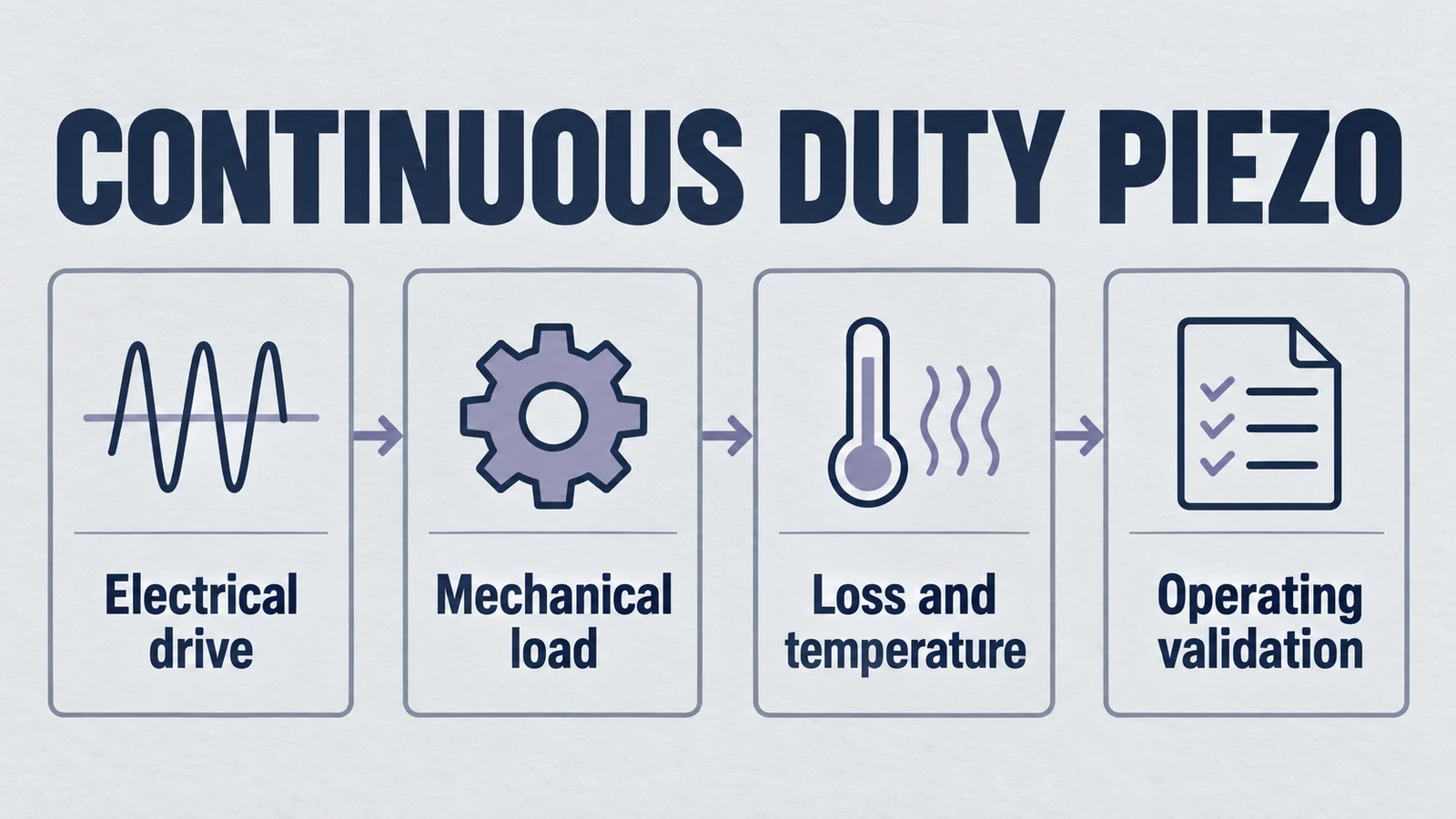
By Yujie Piezo Engineering Team
Reliability-focused guidance for engineers designing long-term, continuous piezoelectric operation
Continuous duty is where piezo ceramics stop behaving like “components” and start behaving like “materials under a life test.” A design that looks stable over a short bench run can drift, heat-soak, depole, crack, or quietly lose output after weeks or months of uninterrupted cycling.
This article is a reliability-oriented reference for selecting piezo ceramics when the system will operate continuously, not just occasionally. The emphasis is not on peak performance for a demo. It is on staying inside appropriate electrical, thermal, and mechanical margins for thousands to billions of cycles.
1. What “continuous duty” really changes
Product path for this search intent
Match the article topic to the right YJ Piezo product page
Use this article when the choice is not just a shape, but a material tradeoff between sensitivity, loss, coupling, stability, and operating field. For "Selecting Piezo Ceramics for Continuous Duty Applications", the practical value is in turning the topic into a measurable selection or sourcing decision.
- PZT Material Hub
Material grades and application tradeoffs
- Piezoelectric Ceramics
Shapes and ceramic manufacturing options
- PZT Material Supplier Hub
Material control, grade selection, and sourcing support
Intermittent use gives a piezo element something it desperately needs. Recovery time.
- Thermal recovery (the part cools).
- Electrical recovery (leakage and dielectric absorption relax).
- Mechanical recovery (stress relaxes, microcracks stop seeing peak cyclic driving).
Continuous operation allows loss power to create sustained heating. Temperature can accelerate property evolution and degradation. Damage, depoling, dielectric breakdown or adverse interface changes may increase losses and create positive thermal feedback. Normal ferroelectric aging does not invariably increase loss: hard-PZT aging can raise mechanical Q. Investigate the measured loss and temperature behavior of the actual assembly.
If you only remember one rule, remember this.
In continuous duty, your limiting factor is rarely peak output. It is self-heating and long-term stability.
Two practical consequences follow.
- A ceramic that looks “fine” for 10 minutes can still be a bad choice if it creeps upward in temperature for 2 hours.
- A material choice cannot be separated from the drive method and packaging. The same ceramic can be stable in one stack-up and unstable in another.
2. Heat accumulation. Where the temperature rise actually comes from
A piezo in steady operation is an energy converter. Some energy goes into useful vibration, and some becomes heat. Under continuous drive, even a few percent loss is enough to push the element to an elevated steady-state temperature.
2.1 The three dominant heating paths
- Dielectric loss (electrical loss)
In an AC electric field, the ceramic behaves like a capacitor with a lossy dielectric. The loss is commonly represented by the loss tangent (). Higher means more energy dissipated per cycle. - Mechanical loss (internal friction)
Mechanical damping inside the ceramic and in bonded interfaces converts strain energy to heat. This is linked to mechanical quality factor . Lower generally means higher mechanical damping and more heat generation in high-power vibration. - Load and interface loss (what the ceramic is coupled to)
Adhesive layers, backing blocks, acoustic windows, housings, gaskets, and preload fixtures all dissipate energy. A ceramic that runs cool in free vibration can run hot once integrated.
A reliability mistake is to treat the ceramic as the only loss source. In many continuous-duty assemblies, interface loss is the dominant heater.
2.2 Why frequency matters more than people think
In continuous duty, frequency multiplies loss power. The number of electrical and mechanical cycles per second is literally the clock driving dissipation.
- Higher frequency often increases dielectric-loss contribution because the reactive current increases.
- Near resonance, vibration amplitude rises, and mechanical loss plus interface loss can dominate.
So “same voltage” does not mean “same heating” across different frequencies, mounting stiffnesses, or boundary conditions.
2.3 A simple way to estimate dielectric heating risk
If your operating mode is off-resonance actuation or sensing, dielectric loss is often the first heating term to check. A common approximation for dielectric loss power is:
- is angular frequency.
- is capacitance under operating bias and temperature.
- is the RMS drive voltage.
This is not a perfect predictor. It is a good sanity check. It tells you why “a little more voltage” can become “a lot more heat” under continuous drive.
2.4 The steady-state reality
For long runs, temperature rise tends to settle at a steady value where:
- generated heat = removed heat (conduction, convection, radiation)
If that steady-state temperature is close to a risky region (electrode degradation, adhesive softening, depoling margin shrinkage, plastic creep in housings), the part will fail early even if it survives a short burn-in.
A critical detail. The limiting temperature is often not the ceramic’s Curie temperature. It can be the adhesive glass transition, a potting compound softening point, or a sealing material that changes stiffness and shifts resonance.
3. Material aging under cyclic stress. What changes over time
Piezo ceramics are ferroelectric. Their performance depends on domain alignment. Under electric field, stress, and temperature, that domain structure evolves.
3.1 What “aging” looks like in practice
Over time you may observe:
- Resonant frequency drift
- Capacitance drift
- Reduced displacement at constant drive
- Increased current draw at constant voltage
- Lower coupling (, ) and lower output for the same input
- Increased hysteresis or phase changes in impedance under load
Some of this is normal ferroelectric aging. The reliability concern is when aging is accelerated by self-heating and high field.
A practical reliability signal is the direction of change.
- Output down plus current up is usually bad news.
- Frequency drift that forces the driver to chase resonance can increase current, which increases heat.
3.2 Fatigue mechanisms that matter in continuous duty
Continuous duty amplifies three fatigue drivers:
- High cycle count (obvious, but usually underestimated)
- High electric field (especially under drive waveforms with high peak voltage)
- Sustained elevated temperature (the accelerator for almost everything)
When these combine, degradation can shift from “slow drift” to “runaway loss increase.”
3.3 Depoling margin is a thermal and electrical design problem
Depoling risk rises when the ceramic experiences a combination of:
- Elevated temperature that reduces coercive field margin.
- High alternating electric field.
- Field extrema relative to the poling direction: reverse peaks and excessive forward field can limit operation. A correctly rated forward DC bias can reduce reverse-field excursions; DC bias or waveform asymmetry alone is not a depoling diagnosis. Check insulation and lifetime constraints as well.
- Mechanical stress that biases domain switching.
This is why two systems using the same ceramic can have very different lifetimes. One may run cooler and with lower field ripple. The other may be hot and driven harder during start-up or resonance tracking.
4. Qm and loss tangent. The two parameters that decide whether the part cooks itself
Engineers often treat material selection as “pick a or coupling factor.” For continuous duty, that approach is backward.
4.1 Qm. Why it matters
(mechanical quality factor) is a measure of mechanical loss. In simplified terms:
- High . lower mechanical damping. generally better suited for high-power, continuous resonance operation.
- Low . more damping. more mechanical heat generation under large vibration.
In continuous resonance applications (ultrasonic cleaning, welding, high-power sonics), high-Qm “hard” piezo ceramics are commonly favored because they hold efficiency and stability under sustained drive.
The hidden reliability benefit of higher is that it can reduce internal heating at a given vibration amplitude. That can prevent the system from entering the loss. heat feedback loop.
4.2 tanδ (loss tangent). Why it matters
reflects dielectric loss. In simplified terms:
- Lower . less dielectric heating at a given electric field and frequency.
- Higher . more current for the same voltage, more heat, higher risk of thermal drift.
Also watch how changes with temperature. Some materials look acceptable at room temperature, then become dramatically lossier once warmed.
4.3 The trap. Looking at Qm without tanδ
A high-Qm material can still run hot if dielectric losses dominate in your drive condition. Similarly, a low ceramic can still run hot if mechanical and interface losses dominate because you are exciting large strain at resonance.
Continuous duty selection is about the combined loss budget under your true operating mode.
4.4 Quick mapping. What usually dominates
| Operating mode | Common dominant loss | What to prioritize first |
|---|---|---|
| Off-resonance actuator | Dielectric loss | Low , stable capacitance vs temperature |
| Resonant power ultrasonic | Mechanical plus interface loss | High , stable resonance under load |
| Harsh environment sensor | Insulation and contamination driven loss | Low leakage, robust electrodes, sealing strategy |
Treat this table as a starting hypothesis. Validate with a thermal and impedance test on the full assembly.
5. Continuous duty failure modes. What actually fails in real systems
Think in two phases.
- Early-life failures. manufacturing and integration defects that show up quickly.
- Wear-out failures. damage accumulation and aging mechanisms that take time.
5.1 Early-life failures. What shows up in burn-in
Common patterns:
- Electrode and termination defects
Poor electrode adhesion, micro-voids, or weak termination can localize current and heating. Local hotspots are often invisible until a long steady-state run. - Bondline failures
Adhesive voids, incorrect cure, or CTE mismatch can cause debonding. Debonding changes boundary conditions, shifts resonance, and often increases heating. A small debond can be enough to trigger a resonance shift that the driver tries to compensate for by delivering more power. - Edge chipping and handling microcracks
Ceramics can carry invisible damage. Continuous vibration grows these defects. Edge chips and sharp corners are common crack initiators. - Electrical overstress events
A single transient (startup overshoot, impedance mismatch, cable inductance, ESD, relay switching) can initiate partial depoling or microcracking.
If continuous duty matters, burn-in should not just be “run it for an hour.” Burn-in should be run under worst-case thermal conditions long enough to approach steady temperature. Often that means hours, not minutes.
5.2 Wear-out failures. The slow killers
- Depoling and loss of coupling
As temperature rises and electric field cycles, domain alignment degrades. Output falls and losses rise. - Microcrack growth and brittle fracture
Piezo ceramics are brittle. Repeated strain and stress concentration at edges, holes, sharp fillets, and bonded constraints can grow microcracks until severe fracture. - Electrode migration and insulation breakdown
Elevated temperature and field accelerate insulation degradation, especially in humid, contaminated, or chemically exposed environments. Leakage current is both a symptom and a heater. - Packaging-driven drift
Creep in plastics. relaxation in clamps. adhesive aging. All can change stiffness and shift resonance. The ceramic may be fine while the stack-up becomes unstable. - Thermal runaway
The most dangerous mode. Loss increases temperature. Temperature increases loss. Eventually the system crosses a point where it cannot stabilize.
6. A reliability-first selection workflow
This is a practical approach that matches how continuous-duty failures actually happen.
Step 1. Define your real duty cycle and thermal environment
Continuous duty is not just “always on.” Capture:
- Continuous time at full drive
- Ambient temperature range and airflow assumptions
- Cooling constraints (conduction path, convection, heat sink availability)
- Whether the element is enclosed (heat trapped) or exposed
- Allowed steady-state temperature at the ceramic and at the bondline
If you cannot state the worst-case steady temperature target, you do not have a continuous-duty design yet.
Step 2. Determine whether you are operating near resonance
- Off-resonance actuation (smaller displacement). dielectric loss often dominates.
- Resonant operation (large vibration). mechanical loss and load/interface losses can dominate.
Your material priorities change depending on which regime you are in. Also confirm whether your driver uses resonance tracking (PLL, phase-locked control). Tracking can keep you at peak vibration, but it can also drive you into higher current if the assembly drifts.
Step 3. Prioritize loss parameters over headline sensitivity
For continuous duty, screen materials by:
- (dielectric loss)
- (mechanical loss)
- Curie temperature and recommended max operating temperature margin
- Coercive field margin at operating temperature (risk of depoling)
- Stability of properties under temperature and field
Only after that do you optimize coupling and piezo constants.
Step 4. Verify with impedance plus thermal testing. not just functional output
At minimum, validate on the full assembly:
- Impedance spectrum cold and hot. including frequency shift and phase.
- Current draw and phase under real load over time.
- Temperature rise to steady state. include the bondline and the hottest spot.
An unexplained or continuing current rise after expected warm-up, with drive and load controlled, warrants investigation. Separate reactive current from real power using phase or direct power measurement, and correlate current with capacitance, impedance, temperature and output. A rise in total AC current alone does not establish approaching failure.
Measurement tips that reduce false confidence:
- Use a thermocouple or RTD at a consistent location. IR cameras can be misleading on shiny electrodes.
- Run long enough to reach thermal steady state. If temperature is still rising after 30 minutes, you are not done.
- Repeat at worst-case ambient. A design that is appropriate at 25°C can fail at 50°C with the same drive.
Step 5. Build in margin
Common margin ideas:
- Reduce electric field (voltage) if possible.
- Avoid operating exactly at the peak of resonance for long durations if not required.
- Improve thermal paths (clamping conduction, heat sinking, airflow, reducing thermal resistance to housing).
- Control moisture and contamination. sealing is often a reliability feature, not just an environmental feature.
- Prefer geometries (such as rings, discs, or tubes) and edge procedures that reduce stress concentration (fillets, chamfers, controlled electrode edges).
7. Practical rules of thumb. Use them skeptically
These are not universal laws. They are risk flags.
- If your application is high-power resonance and continuous. treat high as a near-requirement.
- If your application is high frequency / high voltage continuous. treat low as a near-requirement.
- If your ceramic runs “a bit warm” in a short test. expect it to run meaningfully hotter in a sealed housing over a long run.
- If resonance drifts with temperature. your driver may chase resonance. that can increase current and heat.
- If you rely on adhesive bonding. assume bondline properties will change with temperature and time. design so that small stiffness changes do not push you into an unstable resonance condition.
A blunt reality. If your system has no thermal margin, “better material” will not save it. It will only delay the failure.
8. What to send your supplier. So the material recommendation is actually credible
If you ask for “a continuous duty piezo material,” you will get a generic answer. Provide these instead:
- Operating frequency and whether you are at resonance
- Voltage waveform, RMS and peak, plus any DC bias
- Expected vibration amplitude, force target, or acoustic output requirement
- Mechanical constraints (bonded, clamped, prestressed) and stack-up drawings if available
- Ambient temperature and cooling method
- Expected lifetime target (hours) and acceptable drift
- Environment (humidity, chemicals, washdown, contamination risks)
With that information, a supplier can recommend a material class and an integration strategy. without it, material selection is guesswork.
A good supplier response should include tradeoffs. For example, higher may reduce heating but can change bandwidth and control behavior. Lower may reduce dielectric heating but may come with different coupling and capacitance.
9. Closing perspective
Continuous duty reliability is less about choosing a “stronger” ceramic and more about managing losses. Heat and cyclic stress are the two levers that dominate long-term performance.
Pick the material with the right loss profile for your operating mode. Validate steady-state temperature and current stability under the real load. Then design thermal and electrical margin as if the system will be left running in the worst possible conditions. because eventually it will.
If you want one practical success criterion for continuous duty, use this.
- The assembly reaches a stable temperature.
- The current and phase stabilize.
- The resonance behavior remains predictable hot versus cold.
If any of those trends drift continuously upward or outward, treat it as a reliability defect even if the system still “works today.”
About the authors
Yujie Piezo Engineering Team supports engineers designing piezoelectric ceramics and ultrasonic components for sensing and power ultrasonics. We focus on materials behavior, failure patterns, and practical integration constraints.
Our typical support work includes interpreting impedance behavior under load, reviewing thermal margins, and identifying likely failure mechanisms from operating conditions.
If you’re evaluating continuous-duty operation and want a reliability-oriented material recommendation, prepare the operating details listed in Section 8. That is the fastest way to get an answer that survives real life.
Engineering decision notes
PZT material and ceramic selection
Use this article when the choice is not just a shape, but a material tradeoff between sensitivity, loss, coupling, stability, and operating field. For "Selecting Piezo Ceramics for Continuous Duty Applications", the practical value is in turning the topic into a measurable selection or sourcing decision.
YJ Piezo coordinates PZT ceramic projects with manufacturing support, so material formulation, sintering, polarization, electrode process, and outgoing inspection can be reviewed against the final application.
Selection checks
- Separate sensing needs from high-power actuation needs before comparing d33 or coupling values.
- Check dielectric loss, Qm, Curie temperature, aging behavior, and operating field against the real duty cycle.
- Confirm whether the application needs standard PZT grades or a custom formulation and geometry.
Failure risks
- Choosing only the highest d33 can create heat, drift, or depolarization risk in power ultrasonics.
- A ceramic that performs well in free measurement can fail once bonded, clamped, or loaded.
- Material substitutions without batch testing can change capacitance, resonance, and system tuning.
RFQ details
- Is the part used for sensing, actuation, atomization, cleaning, welding, or measurement?
- What field strength, temperature, duty cycle, and mechanical load will the ceramic see?
- Which values must be controlled: d33, capacitance, resonance, impedance, Qm, or dimensional tolerance?
Relevant YJ Piezo pages
- PZT Material Hub
Material grades and application tradeoffs
- Piezoelectric Ceramics
Shapes and ceramic manufacturing options
- PZT Material Supplier Hub
Material control, grade selection, and sourcing support
Application FAQ
- Is the highest d33 always the best PZT choice?
- No. High d33 can be useful for sensitivity, but high-power ultrasonic systems often need lower loss, higher Qm, better thermal stability, and safer operation under field and stress.
- What makes PZT material selection different from catalog buying?
- The right PZT choice depends on geometry, load, drive field, duty cycle, temperature, and inspection targets. A catalog value is only useful when it is tied to the final assembly conditions.