
Choosing the Right Bubble Sensor for Your Application: A Buyer's Guide
Introduction
Whether you're designing a medical infusion pump, a lab analyzer, or a fluid control system, undetected air bubbles can compromise performance and may become part of the system risk analysis. That's why selecting the right bubble sensor is an engineering decision that affects detection logic, accuracy, and overall efficiency.
This buyer's guide walks you through key factors to consider when choosing a bubble sensor for your application and explains how Yujie's ultrasonic bubble sensors support OEM design teams through stable supply, customization options, and engineering support.
1. Why Bubble Detection Matters
Product path for this search intent
Match the article topic to the right YJ Piezo product page
Use this article when sensor performance depends on target distance, beam angle, housing material, liquid behavior, or false echo control. For "Choosing the Right Bubble Sensor for Your Application: A Buyer's Guide", the practical value is in turning the topic into a measurable selection or sourcing decision.
- Ultrasonic Sensors
Distance, level, and detection sensor portfolio
- Flow Measurement Transducers
Bubble and flow-related ultrasonic sensing paths
- Air Acoustic Transducers
Air-coupled transducers for range and presence detection
Air bubbles in fluid lines can lead to a range of complications depending on the application:
- Medical-device risk controls, such as air-in-line monitoring in infusion systems that must be validated by the finished-device manufacturer
- Instrument failure, due to incorrect sample volumes, blocked fluid paths, or inconsistent fluid delivery
- Measurement inaccuracy, especially in analytical systems like HPLC, laboratory chemistry analyzers, or blood processing equipment
- Production delays, in automated fluid dispensing, inkjet printing, or industrial liquid filling lines, causing equipment malfunction or downtime
A reliable bubble sensor enables real-time detection of air bubbles, allowing the finished system to respond according to its validated control logic—stopping a pump, pausing the process, or alerting the user to take corrective action. This can reduce waste, improve productivity, and support quality assurance in critical processes.
2. Ultrasonic vs. Optical: Which Sensing Technology is Better?
The two most common technologies in bubble detection are ultrasonic and optical. Each has unique strengths and is suited for different use cases.
| Feature | Ultrasonic Bubble Sensor | Optical Bubble Sensor |
|---|---|---|
| Principle | Uses sound waves to detect acoustic impedance differences | Uses light reflection/refraction to detect bubbles |
| Contact Method | Non-contact (through tubing) | Often non-contact, but may require transparent fluid path |
| Fluid Compatibility | Works with clear or opaque fluids | Best with clear fluids |
| Durability | More resistant to contamination and wear | May degrade with long-term fluid exposure |
| Cost | Moderate | Moderate to high |
Yujie specializes in ultrasonic bubble sensors because of their non-invasive design, stable construction, and versatile compatibility with different tube materials and fluid types. These sensors can support medical-device and industrial systems that require stable, repeatable component performance over time.
3. Key Considerations When Choosing a Bubble Sensor
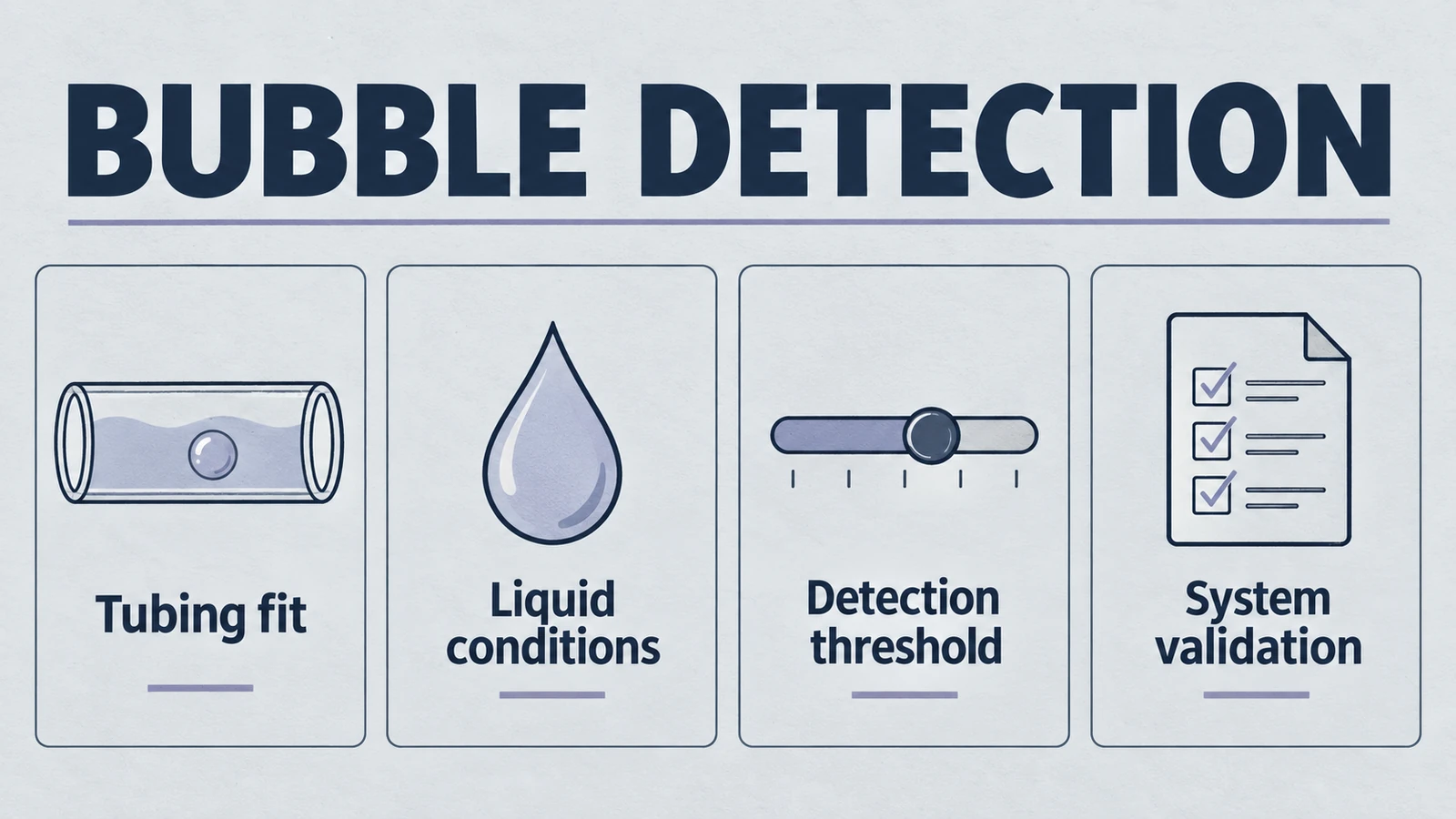
Selecting the right bubble sensor involves evaluating several key factors tailored to your specific application:
✅ Tubing Size and Material
Ensure the sensor is compatible with your tubing diameter, wall thickness, and material type. Soft silicone tubes, rigid plastics, and PVC all have different acoustic properties. Yujie supports multiple tube sizes and materials and can develop custom fixtures or adapters upon request.
✅ Fluid Type
Are you dealing with blood, saline, ink, oil, reagents, or chemical solutions? The sensor's acoustic matching and sensitivity must align with the density, viscosity, and acoustic impedance of your target fluid. Yujie's sensors are optimized for a wide range of medical and industrial fluids.
✅ Sensitivity Requirements
Some applications—such as dialysis machines or in-vitro diagnostic devices—require the detection of bubbles below an application-specific volume threshold (for example, 10 µL). Others, like industrial dosing systems, may only need to detect large air gaps. Clearly define your detection threshold and operating conditions.
✅ Mounting and Integration
Do you need a clip-on external sensor or a built-in, embedded model that integrates into a cartridge or manifold? Yujie offers flexible mounting options and works closely with OEM clients to co-develop enclosure-compatible or space-saving designs.
✅ Certifications & Reliability
If your application is in healthcare or laboratory diagnostics, define the finished-device regulatory and quality requirements early. Component suppliers can provide drawings, test data, and quality documentation, while device-level quality-system and compliance decisions must be handled by the finished-device manufacturer.
4. Why Work with Yujie?
When you choose Yujie as your bubble sensor partner, you gain access to:
- Over 20 Years of Experience in piezoelectric and ultrasonic component manufacturing
- Tailored OEM Solutions that support a wide range of tube sizes, enclosure designs, and sensitivity requirements
- Global Supply Capability, serving clients across Europe, North America, and Asia
- Fast Prototyping Cycles to accelerate product development and reduce time-to-market
- Collaborative Engineering Support, from initial concept through mass production
- Competitive Pricing and Long-Term Supply Stability, suitable for large-volume medical-device OEM and industrial projects
Yujie is more than a supplier—we are a long-term engineering and production partner for your critical fluid management systems.
5. Let's Specify Your Bubble Sensor
If you need a bubble sensor matched to your tubing, your fluid, and your precision requirements, we'd love to hear from you. Whether you're in the concept phase or preparing for mass production, Yujie's team is ready to provide technical support and practical options for validation.
👉 Contact us at business@szyujie.com to discuss your project, request a sample, or start a custom development plan.
Let's build smarter, more controlled, and more reliable fluid systems—together.
Interested in seeing our bubble sensors in action? Check out our Ultrasonic Bubble Detection Sensor product page.
Our piezoelectric technologies support ultrasonic bubble detection systems that require stable sensitivity and repeatable construction. Learn more about our manufacturing capabilities and why OEM teams use Yujie for custom piezoelectric solutions.
For related reading, explore our article on The Science Behind Ultrasonic Transducers to understand the technology that powers our bubble detection systems.
Engineering decision notes
Ultrasonic sensing and detection
Use this article when sensor performance depends on target distance, beam angle, housing material, liquid behavior, or false echo control. For "Choosing the Right Bubble Sensor for Your Application: A Buyer's Guide", the practical value is in turning the topic into a measurable selection or sourcing decision.
YJ Piezo treats ultrasonic sensing as an acoustic interface problem: transducer frequency, beam shape, housing, drive electronics, and target environment are reviewed together.
Selection checks
- Define target range, dead zone, beam angle, and mounting geometry before choosing the sensor family.
- Check the medium, target surface, temperature swing, foam, vapor, and side-wall risk.
- Separate detection repeatability from ideal lab accuracy when the sensor will operate in a tank, tube, or moving line.
Failure risks
- A sensor can pass bench distance tests and still fail in tanks with foam, agitation, vapor, or narrow geometry.
- Changing only frequency without reviewing beam angle and mounting can increase false echoes.
- Ignoring housing material or sealing requirements can shorten lifetime in washdown or chemical environments.
RFQ details
- What is the minimum and maximum detection distance?
- Is the target liquid, solid, sheet material, air flow, or a moving object?
- What temperature, humidity, IP rating, and output signal does the system require?
Relevant YJ Piezo pages
- Ultrasonic Sensors
Distance, level, and detection sensor portfolio
- Flow Measurement Transducers
Bubble and flow-related ultrasonic sensing paths
- Air Acoustic Transducers
Air-coupled transducers for range and presence detection
Application FAQ
- What makes an ultrasonic sensor page useful for procurement?
- It should connect range, beam angle, output signal, housing, mounting, and environmental limits to a concrete use case. A model name alone is not enough for reliable supplier comparison.
- Which information speeds up an ultrasonic sensor RFQ?
- Send the target material, distance range, installation geometry, output interface, temperature range, IP rating, and whether the application involves foam, vapor, liquid, or moving objects.