
Piezo Sensor vs Piezoelectric Sensor: Engineering Terminology, Selection, and Misuse
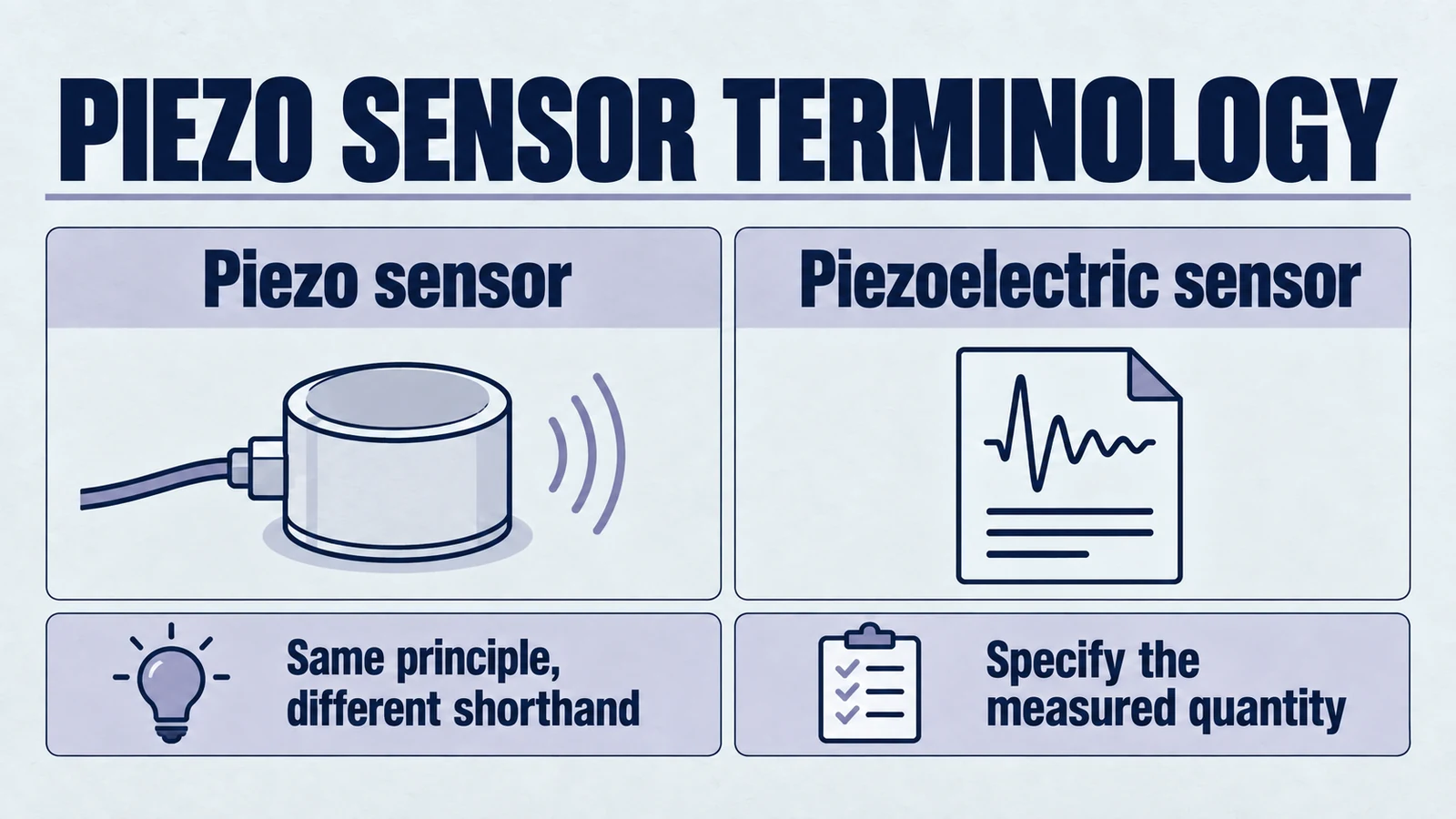
Piezoelectric sensors—or piezo sensors for short—are widely used in modern technology because they can turn physical pressure into electrical signals. Whether in industrial machines, medical tools, or consumer devices, these sensors are valued for their accuracy, speed, and reliability. As industries become more automated and connected, the need for precise sensing technologies grows—and piezo sensors are often the solution.
With their increasing role in modern smart systems, piezo sensors have become essential components in countless applications. This article will walk you through the basic working principles behind piezoelectric sensors, introduce the main types of piezo sensors available today, and show you how they're used across a wide range of fields. Whether you're an engineering student, product designer, or just curious about sensor technology, this guide will give you a solid understanding of how piezo sensors fit into the world of electronics and smart systems.
Terminology and Working Principle Alignment
Piezo sensors rely on something called the piezoelectric effect. This effect happens when certain materials—like quartz or PZT (lead zirconate titanate)—produce an electric charge when they're squeezed, pressed, or vibrated. Inside the material, the atoms shift slightly, and that movement creates a tiny voltage. This is due to the internal structure of the crystal becoming polarized under mechanical stress, generating a voltage difference across the material.
Product path for this search intent
Match the article topic to the right YJ Piezo product page
Use this article when the choice is not just a shape, but a material tradeoff between sensitivity, loss, coupling, stability, and operating field. For "Piezo Sensor vs Piezoelectric Sensor: Engineering Terminology, Selection, and Misuse", the practical value is in turning the topic into a measurable selection or sourcing decision.
- PZT Material Hub
Material grades and application tradeoffs
- Piezoelectric Ceramics
Shapes and ceramic manufacturing options
- PZT Material Supplier Hub
Material control, grade selection, and sourcing support
Learn more about what PZT is and how it works in our comprehensive guide. Understanding the fundamental science behind piezoelectricity helps explain why these materials are so effective for sensor applications.
This voltage can then be captured and interpreted by electronic circuits, allowing the physical event—such as pressure, impact, or vibration—to be measured accurately in real time. Because the sensors respond instantly and don't have moving parts, they are ideal for many high-performance, low-maintenance applications.
Why they're useful:
- React quickly to changes
- Can detect very small forces
- Work across a wide range of conditions (including extreme heat or cold)
- Small, durable, and simple—no moving parts to wear out
- Low power consumption in passive configurations
Types of Piezo Sensors and Their Functions
Piezo sensors come in different forms, depending on what they measure and how they are built. Below are the main categories:
1. Piezoelectric Pressure Sensors
These detect pressure changes in gases or liquids. You'll find them in engines, hydraulic systems, and manufacturing plants, where they help ensure systems stay within appropriate operating limits. Our ultrasonic bubble detection sensors are perfect examples of pressure-sensitive piezoelectric applications.
2. Piezoelectric Accelerometers
Ordinary piezoelectric accelerometers measure dynamic vibration and shock and are useful in structural and machinery monitoring. Their charge leakage prevents a sustained DC response to static gravity, so they are not the usual explanation for smartphone tilt or screen orientation. DC-capable capacitive or other suitable accelerometers serve that role.
3. Piezoelectric Force Sensors
These measure compressive or tensile force and are frequently used in robotics, automation systems, and sports science. For example, they can help a robotic arm apply just the right amount of pressure when gripping an object.
4. Piezoelectric Microphones and Acoustic Sensors
These convert sound waves into electrical signals and are widely used in consumer electronics, voice recognition systems, and even musical instruments. Piezo microphones are especially valued for their durability and resistance to environmental conditions. Our high-frequency acoustic transducers demonstrate this technology.
5. Piezoelectric Ultrasonic Transducers
Often considered a specialized type, these sensors convert electrical signals into high-frequency sound waves (and vice versa), and are widely used in medical imaging and cleaning equipment. Learn more about ultrasonic transducers and their types.
Key Applications of Piezo Sensors in Industry, Healthcare, and More
You'll find piezo sensors in a wide range of products and systems, from everyday gadgets to high-tech medical and industrial tools:
Industrial Equipment Monitoring
In industrial environments, piezo sensors help monitor machinery conditions by measuring vibrations and shocks. This enables predictive maintenance, which prevents costly downtime and extends equipment lifespan. Our ultrasonic welding transducers are prime examples of industrial piezoelectric applications.
For joining applications, see the metal welder transducer HJ-1364 and the precision welder transducer HJ-5020D.
Medical Devices
Piezoelectric components are essential in ultrasound machines, which use sound waves to create internal images of the body. They're also found in surgical devices, dental tools, and specialized medical equipment, where precision and responsiveness are crucial. Our medical ultrasonic transducers showcase the precision possible with piezoelectric technology.
Consumer Electronics
Many smartphones, tablets, and game controllers use piezo sensors to detect taps, pressure, or gestures. They're also used in wearable devices to track motion or body posture. Explore how piezoelectric ceramics enhance beauty devices.
Automotive Systems
In the automotive industry, piezo sensors help detect engine knock, monitor airbag deployment, measure tire pressure, and even support autonomous driving features through vibration and distance sensing.
Environmental Monitoring
Scientists use piezo sensors to detect seismic activity, monitor ocean currents, or collect atmospheric data. Their precision and stability over time make them ideal for long-term measurements. Our submersible transducers are designed for harsh underwater environments.
R&D and Testing
In laboratories, piezo sensors are often integrated into testing equipment to measure tiny forces or movements with extremely high resolution. Check out our complete range of disc series and ring series sensors for research applications.
Comparing Piezo Sensors with Traditional Sensors
Understanding the advantages of piezoelectric sensors over traditional sensing technologies is crucial for making informed design decisions. Read our detailed comparison in Piezoelectric vs Traditional Sensors to learn more about when to choose each technology.
Choosing the Right Piezo Sensor for Your Application
Selecting the appropriate piezoelectric sensor depends on various factors including sensitivity requirements, operating conditions, and specific application needs. Our guide on how to choose the right piezoelectric ceramic provides detailed selection criteria.
For specialized applications, consider our various product series:
- Tube series for cylindrical sensing applications
- Rectangular series for flat surface monitoring
- Flow measurement transducers for fluid dynamics
Frequently Asked Questions (FAQ)
What are piezo sensors made of?
Most are made from quartz, PZT (lead zirconate titanate), or other piezoelectric ceramics that can generate electric charge when mechanically stressed. Learn about different types of PZT materials and their properties.
How are piezo sensors different from other sensors?
Unlike resistive or capacitive sensors, piezo sensors generate their own signal without requiring an external power source in passive mode and respond very rapidly to changes. Our comparison guide on piezoelectric vs traditional sensors explains these differences in detail.
Can piezo sensors be used for long-term monitoring?
Yes. Their durability and stability make them suitable for continuous use, especially in harsh or remote environments. Our industrial cleaning transducers demonstrate long-term reliability in demanding conditions.
Future Trends in Piezoelectric Sensor Technology
The future of piezoelectric sensors looks promising, especially with emerging trends in energy harvesting for IoT applications. As we move toward more connected and intelligent systems, piezoelectric sensors will play an increasingly important role.
Conclusion
Piezo sensors are a smart, efficient solution for converting physical motion or force into actionable electrical data. Thanks to their compact design, fast response time, and sensitivity, they're increasingly found in a wide variety of applications. From monitoring machines in factories to enabling safety-related medical procedures, piezo sensors are at the core of countless modern innovations.
As technology evolves, we can expect to see even more creative uses for piezoelectric sensors—especially as they are combined with AI, wireless systems, and energy-harvesting technologies. For students and professionals alike, understanding the science behind piezo sensors opens the door to designing smarter and more responsive products.
Explore our full range of piezoelectric sensor products or contact us for custom solutions tailored to your application. Learn more about Yujie Technology and our commitment to piezoelectric innovation.
For procurement professionals, don't miss our piezoelectric ceramic procurement checklist to ensure you're asking the right questions when sourcing sensors.
Project Selection Notes
When teams move from principle to a real sensor project, they usually need consistent terminology, a quick model screen, and an RFQ checklist that keeps sourcing aligned with the application.
Application-to-Model Mapping
- Short blind-zone positioning: MU18 sensor
- General conveyor and bin sensing: MU30 sensor
- Tank and silo monitoring: SR55 sensor
RFQ Checklist
- Target range and acceptable blind-zone limit.
- Environment details: dust, foam, vapor, washdown, or chemicals.
- Output interface: PNP/NPN, relay, analog, or RS485 requirements.
- Power and duty profile for continuous or intermittent operation.
- Annual quantity, sample timing, and delivery expectations.
Start model screening at the ultrasonic sensor hub, review supplier capabilities on piezoelectric supplier page, and send your requirements through engineering RFQ contact.
Engineering decision notes
PZT material and ceramic selection
Use this article when the choice is not just a shape, but a material tradeoff between sensitivity, loss, coupling, stability, and operating field. For "Piezo Sensor vs Piezoelectric Sensor: Engineering Terminology, Selection, and Misuse", the practical value is in turning the topic into a measurable selection or sourcing decision.
YJ Piezo coordinates PZT ceramic projects with manufacturing support, so material formulation, sintering, polarization, electrode process, and outgoing inspection can be reviewed against the final application.
Selection checks
- Separate sensing needs from high-power actuation needs before comparing d33 or coupling values.
- Check dielectric loss, Qm, Curie temperature, aging behavior, and operating field against the real duty cycle.
- Confirm whether the application needs standard PZT grades or a custom formulation and geometry.
Failure risks
- Choosing only the highest d33 can create heat, drift, or depolarization risk in power ultrasonics.
- A ceramic that performs well in free measurement can fail once bonded, clamped, or loaded.
- Material substitutions without batch testing can change capacitance, resonance, and system tuning.
RFQ details
- Is the part used for sensing, actuation, atomization, cleaning, welding, or measurement?
- What field strength, temperature, duty cycle, and mechanical load will the ceramic see?
- Which values must be controlled: d33, capacitance, resonance, impedance, Qm, or dimensional tolerance?
Relevant YJ Piezo pages
- PZT Material Hub
Material grades and application tradeoffs
- Piezoelectric Ceramics
Shapes and ceramic manufacturing options
- PZT Material Supplier Hub
Material control, grade selection, and sourcing support
Application FAQ
- Is the highest d33 always the best PZT choice?
- No. High d33 can be useful for sensitivity, but high-power ultrasonic systems often need lower loss, higher Qm, better thermal stability, and safer operation under field and stress.
- What makes PZT material selection different from catalog buying?
- The right PZT choice depends on geometry, load, drive field, duty cycle, temperature, and inspection targets. A catalog value is only useful when it is tied to the final assembly conditions.