
Powering IoT Sensors with Vibration: Piezoelectric Energy Harvesting Explained
Powering IoT Sensors with Vibration: Piezoelectric Energy Harvesting Explained
As the Internet of Things (IoT) expands rapidly across industries, powering these billions of connected devices sustainably has become a critical challenge. Traditional batteries are often impractical, especially in remote or hard-to-reach locations. Enter piezoelectric energy harvesting—a game-changing solution that leverages ambient vibration to generate electricity and power IoT sensors without batteries. This blog explores how this technology works, its applications, and why it's gaining attention in the R&D and innovation space.
What Is Piezoelectric Energy Harvesting?
Piezoelectric energy harvesting is the process of converting mechanical strain—typically from vibration, pressure, or motion—into electrical energy using piezoelectric materials. These materials, often ceramics like PZT (lead zirconate titanate), produce an electric charge when mechanically stressed. This property makes them ideal for capturing ambient energy and converting it into usable power.
Product path for this search intent
Match the article topic to the right YJ Piezo product page
Use this article when sensor performance depends on target distance, beam angle, housing material, liquid behavior, or false echo control. For "Powering IoT Sensors with Vibration: Piezoelectric Energy Harvesting Explained", the practical value is in turning the topic into a measurable selection or sourcing decision.
- Ultrasonic Sensors
Distance, level, and detection sensor portfolio
- Flow Measurement Transducers
Bubble and flow-related ultrasonic sensing paths
- Air Acoustic Transducers
Air-coupled transducers for range and presence detection
Why Powering IoT Sensors with Vibration Makes Sense
Many IoT sensors are deployed in environments rich in mechanical energy: vibrating machinery, bridges swaying in the wind, or even the rhythmic movements of the human body. In these contexts, a vibration energy harvester based on piezoelectric materials offers several key benefits:
- Battery-free operation: Reduces maintenance costs and eliminates the need for battery replacement.
- Continuous power supply: Converts ambient vibration into a steady trickle of energy.
- Scalability: Suitable for dense sensor networks, especially in industrial and structural health monitoring.
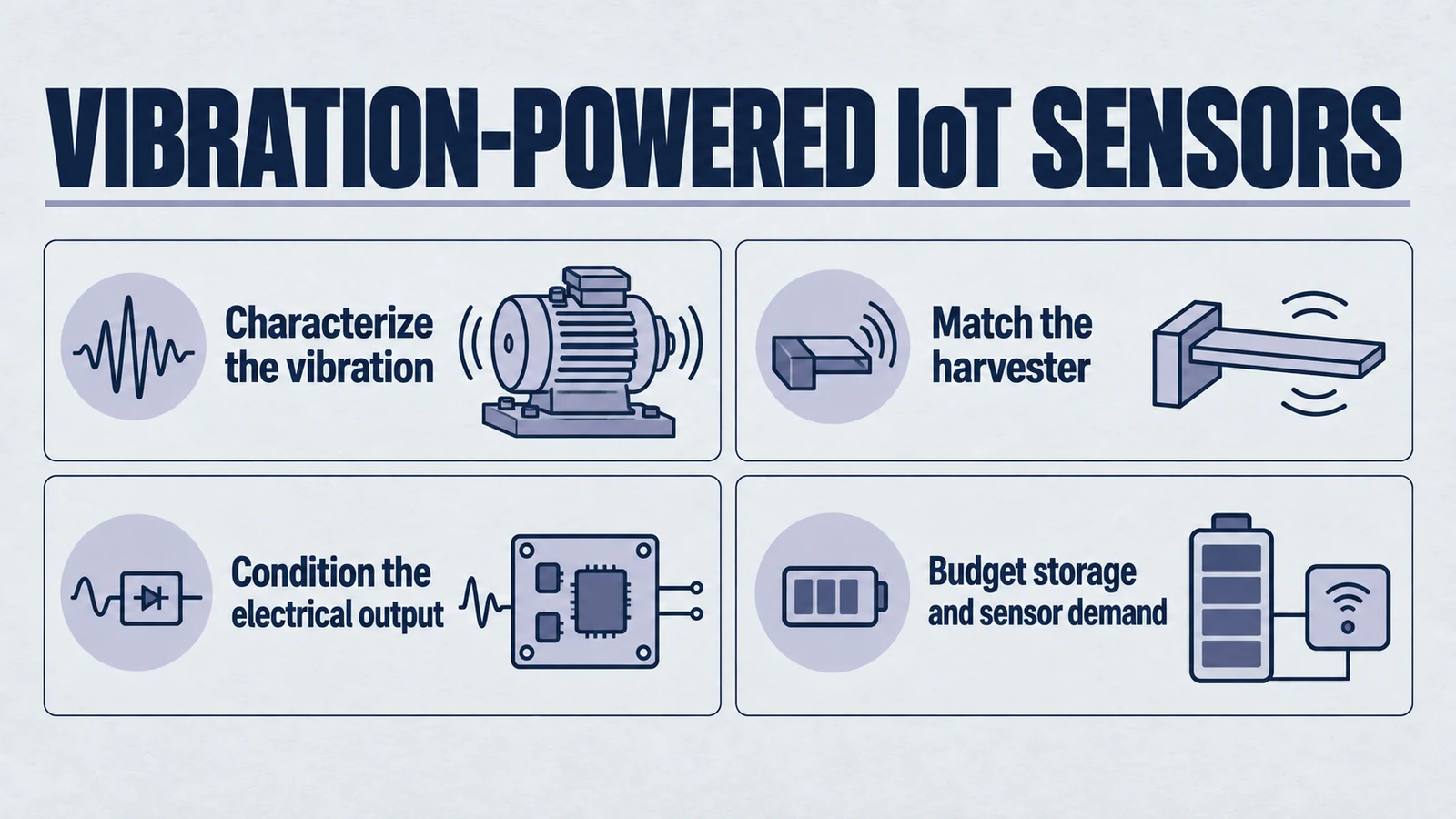
How Piezoelectric Vibration Energy Harvesters Work
- Mechanical Input: Environmental vibrations (e.g., from engines, foot traffic, or airflow) cause deformation in the piezoelectric element.
- Electrical Output: The deformation generates a voltage across the material due to the piezoelectric effect.
- Energy Conditioning: The raw output is conditioned using rectifiers and voltage regulators to provide usable DC power.
- Energy Storage or Use: Energy can be stored in capacitors or supercapacitors, or used immediately to power a low-power circuit or IoT sensor.
Key Components of a Piezoelectric Energy Harvesting System
- Piezoelectric transducer: The core element that converts vibration to voltage.
- Power management circuitry: Manages energy flow and protects downstream electronics.
- Energy storage: Buffers power for intermittent use (e.g., data transmission bursts).
- Load (e.g., sensor): The actual IoT device being powered.
Applications in the Real World
Industrial Condition Monitoring
Machines naturally vibrate during operation. Embedding a piezoelectric harvester in a factory setting enables battery-free IoT sensors to monitor vibration signatures for predictive maintenance.
Structural Health Monitoring
Bridges, buildings, and aircraft are subject to mechanical stress and vibration. Piezoelectric devices can power sensors that track strain, cracks, or deformation over time.
Wearable and Biomedical Devices
Human motion (walking, breathing, heartbeat) creates energy that can be harvested to power health-monitoring sensors or smart textiles. Learn more about piezoelectric sensors in medical devices.
Smart Infrastructure
Smart city solutions—like road traffic counters, rail track monitors, or tunnel safety systems—can utilize piezoelectric energy harvesting where grid power is unavailable.
Advantages Over Other Energy Harvesting Methods
While other techniques like solar, thermoelectric, and RF harvesting have their place, piezoelectric harvesting stands out for:
- Independence from light or heat: Works in dark or thermally stable environments.
- Miniaturization: Piezoelectric elements can be very small yet efficient.
- Immediate responsiveness: Generates power instantly upon mechanical stimulation.
Design Considerations and Challenges
While promising, designing a practical vibration energy harvester for IoT sensors involves several challenges:
- Resonance matching: The harvester must be tuned to match the frequency of ambient vibrations for maximum efficiency.
- Power density: The output is typically low (microwatts to milliwatts), requiring ultra-low-power electronics.
- Durability: Materials must withstand repeated stress over long periods without degradation.
Future Outlook: Innovation Driving Sustainable IoT
As researchers continue to optimize materials, energy conversion efficiency, and microelectronic integration, piezoelectric energy harvesting is becoming increasingly viable for mainstream IoT deployments. With the move toward battery-free IoT sensor power, industries can build smarter, greener, and more resilient systems.
Whether in harsh industrial settings or in wearable biomedical tech, this method is poised to redefine how we think about energy supply in the era of trillions of devices.
Interested in custom piezoelectric solutions? At Yujie, we specialize in high-performance piezo materials and components tailored for energy harvesting applications. Contact us today to explore how we can power your next innovation.
Engineering decision notes
Ultrasonic sensing and detection
Use this article when sensor performance depends on target distance, beam angle, housing material, liquid behavior, or false echo control. For "Powering IoT Sensors with Vibration: Piezoelectric Energy Harvesting Explained", the practical value is in turning the topic into a measurable selection or sourcing decision.
YJ Piezo treats ultrasonic sensing as an acoustic interface problem: transducer frequency, beam shape, housing, drive electronics, and target environment are reviewed together.
Selection checks
- Define target range, dead zone, beam angle, and mounting geometry before choosing the sensor family.
- Check the medium, target surface, temperature swing, foam, vapor, and side-wall risk.
- Separate detection repeatability from ideal lab accuracy when the sensor will operate in a tank, tube, or moving line.
Failure risks
- A sensor can pass bench distance tests and still fail in tanks with foam, agitation, vapor, or narrow geometry.
- Changing only frequency without reviewing beam angle and mounting can increase false echoes.
- Ignoring housing material or sealing requirements can shorten lifetime in washdown or chemical environments.
RFQ details
- What is the minimum and maximum detection distance?
- Is the target liquid, solid, sheet material, air flow, or a moving object?
- What temperature, humidity, IP rating, and output signal does the system require?
Relevant YJ Piezo pages
- Ultrasonic Sensors
Distance, level, and detection sensor portfolio
- Flow Measurement Transducers
Bubble and flow-related ultrasonic sensing paths
- Air Acoustic Transducers
Air-coupled transducers for range and presence detection
Application FAQ
- What makes an ultrasonic sensor page useful for procurement?
- It should connect range, beam angle, output signal, housing, mounting, and environmental limits to a concrete use case. A model name alone is not enough for reliable supplier comparison.
- Which information speeds up an ultrasonic sensor RFQ?
- Send the target material, distance range, installation geometry, output interface, temperature range, IP rating, and whether the application involves foam, vapor, liquid, or moving objects.