
Piezoelectricity Explained for Engineers: Principles and Limits
Introduction
Piezoelectricity represents a fundamental electro-mechanical coupling phenomenon wherein certain materials generate electric charge upon the application of mechanical stress, and conversely, undergo mechanical deformation when subjected to an electric field. Since its initial observation in 1880 by Pierre and Jacques Curie, piezoelectricity has profoundly influenced technological innovation across multiple domains, including medical diagnostics, sensor technology, and advanced electronic systems. A comprehensive understanding of piezoelectric phenomena is imperative for engineers and researchers dedicated to optimizing material performance and exploring novel applications.
Engineering decision focus: Translate core piezoelectric theory into design choices for material type, geometry, thermal margin, and loading conditions before finalizing your sensor or transducer architecture.
What Is Piezoelectricity?
Product path for this search intent
Match the article topic to the right YJ Piezo product page
Use this article when the choice is not just a shape, but a material tradeoff between sensitivity, loss, coupling, stability, and operating field. For "Piezoelectricity Explained for Engineers: Principles and Limits", the practical value is in turning the topic into a measurable selection or sourcing decision.
- PZT Material Hub
Material grades and application tradeoffs
- Piezoelectric Ceramics
Shapes and ceramic manufacturing options
- PZT Material Supplier Hub
Material control, grade selection, and sourcing support
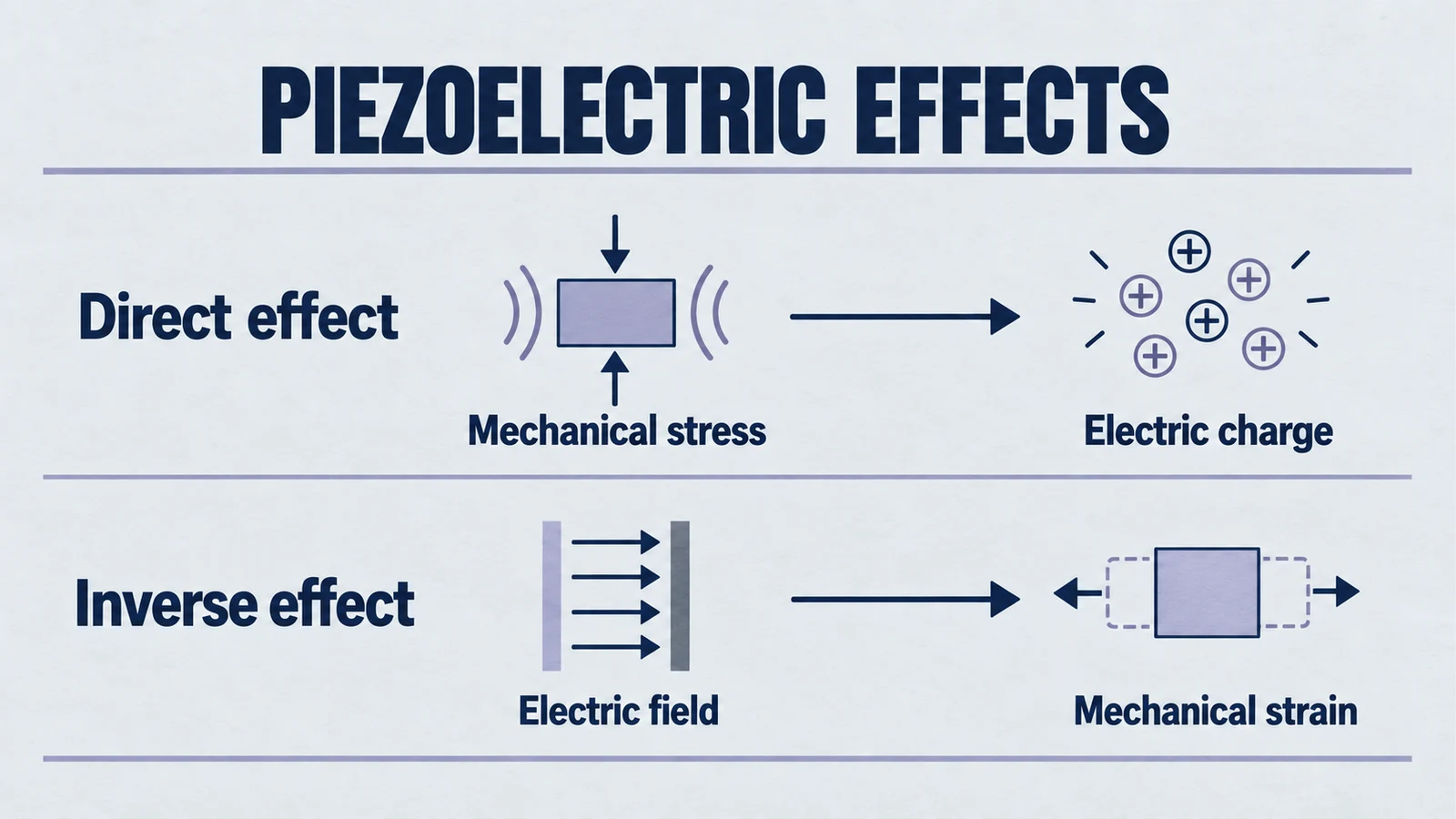
The term "piezoelectricity," derived from the Greek "piezein," meaning "to press," encapsulates the intrinsic property of specific crystalline and polymeric materials to exhibit an electric polarization response when mechanically stressed. This reciprocal behavior—exhibiting both direct (mechanical-to-electrical) and inverse (electrical-to-mechanical) piezoelectric effects—constitutes the foundation for numerous modern technological advancements.
The Physics Underpinning Piezoelectricity
Crystal Lattice Structures and Symmetry Considerations
Conventional linear piezoelectricity requires an appropriate noncentrosymmetric crystal class. Absence of inversion symmetry alone is not sufficient: class 432 is noncentrosymmetric but nonpiezoelectric. Use the material’s symmetry and coefficient tensor rather than treating every such class as piezoelectric.
Atomic-Level Mechanisms: Dipole Alignment and Charge Displacement
At an atomic scale, the application of mechanical stress induces relative displacement of ions within the crystal lattice, altering existing dipole moments or generating new ones. This displacement creates net polarization and an observable electrical potential across the material. The alignment and subsequent realignment of these dipoles under varying mechanical conditions constitute the microscopic origin of piezoelectric phenomena.
Direct and Inverse Piezoelectric Effects
- Direct Piezoelectric Effect: Mechanical stress (T) results in electrical displacement (D).
- Inverse Piezoelectric Effect: Application of electric fields results in mechanical deformation (strain).
This dual relationship is quantitatively described by the tensorial equation: Di = dijk Tjk + εTil El. The first term alone applies when E = 0; εT is permittivity at constant stress
Where:
- Di is the electric displacement vector.
- dijk is the piezoelectric tensor, characteristic of the material.
- Tjk denotes the mechanical stress tensor.
Piezoelectric Materials: Classification, Properties, and Applications
Classification of Piezoelectric Materials
- Natural Crystals: Quartz and Rochelle salt are piezoelectric crystals with distinct coefficient tensors and environmental limits. Do not transfer quartz’s stability to hygroscopic Rochelle salt or rank them by one generic sensitivity label.
- Synthetic Ceramics: Lead zirconate titanate (PZT), Barium titanate (BaTiO3)—offering superior electromechanical coupling coefficients and broad industrial application. Our advanced ceramic materials feature excellent piezoelectric properties.
- Piezoelectric Polymers: Polyvinylidene fluoride (PVDF)—notable for flexibility and suitability in wearable and flexible electronic devices.
Comparative Analysis of Piezoelectric Material Properties
| Material Type | Piezoelectric Coefficient (d33) | Dielectric Constant (εr) | Mechanical Robustness | Thermal Stability |
|---|---|---|---|---|
| Quartz | Zero in the conventional crystallographic d33 component; other tensor components are nonzero | Low | High | Excellent |
| PZT Ceramics | High | High | Moderate | Moderate |
| PVDF Polymers | Moderate | Moderate | High (Flexible) | Limited |
Applications of Piezoelectricity in Industry and Consumer Technologies
Industrial Applications
- Medical Imaging: Piezoelectric-based ultrasonic transducers in diagnostic ultrasound imaging. Our HJ-2806 transducers utilize these principles.
- Non-Destructive Evaluation (NDE): Piezoelectric sensors for detecting structural flaws.
- Energy Harvesting: Generation of electrical energy from ambient mechanical vibrations, powering autonomous IoT systems.
Consumer Applications
- Ignition Systems: Piezoelectric igniters in consumer gas lighters and stove ignitions.
- Audio Systems: Compact piezoelectric speakers and microphones offering miniaturization advantages. Explore our acoustic transducers.
- Wearable Technologies: Incorporation into smart fabrics and flexible electronics for energy harvesting and sensory applications.
Emerging Trends and Innovations in Piezoelectric Research
Development of Lead-Free Piezoelectric Materials
Environmental concerns have catalyzed extensive research into alternative, lead-free piezoelectric compounds, such as potassium sodium niobate (KNN), offering comparable electromechanical properties with reduced ecological impact.
Nano-Scale Piezoelectric Devices
Nanotechnology advancements have facilitated the development of nano-scale piezoelectric devices, enabling enhanced sensitivity, precision, and integration into microelectromechanical systems (MEMS) and nanoelectromechanical systems (NEMS). Our advanced sensor technology incorporates these innovations.
Biomedical and Energy Harvesting Innovations
Emerging biomedical applications, including implantable devices powered by biomechanical energy, leverage piezoelectric mechanisms for self-sustaining energy supply, significantly enhancing device autonomy and end user quality of life.
Role of Artificial Intelligence in Piezoelectric Material Optimization
Integration of artificial intelligence and machine learning methodologies is transforming piezoelectric material discovery and optimization processes, enabling the predictive modeling and synthesis of advanced piezoelectric compositions with tailored properties.
Conclusion and Professional Consultation
The comprehensive understanding of piezoelectricity—from atomic principles to practical applications—remains pivotal for driving technological innovation and developing novel electromechanical systems. Continued exploration and optimization of piezoelectric materials will undoubtedly foster advancements across diverse scientific and industrial landscapes.
Related Engineering Reading
- PZT fundamentals for engineering material decisions
- How to validate d33, k, and Qm in design reviews
- Piezoelectric ceramics options for B2B projects
- Contact engineering to discuss your use case
For detailed expertise and consultation regarding high-performance piezoelectric materials and application-specific solutions, please contact our specialists for professional guidance.
Engineering decision notes
PZT material and ceramic selection
Use this article when the choice is not just a shape, but a material tradeoff between sensitivity, loss, coupling, stability, and operating field. For "Piezoelectricity Explained for Engineers: Principles and Limits", the practical value is in turning the topic into a measurable selection or sourcing decision.
YJ Piezo coordinates PZT ceramic projects with manufacturing support, so material formulation, sintering, polarization, electrode process, and outgoing inspection can be reviewed against the final application.
Selection checks
- Separate sensing needs from high-power actuation needs before comparing d33 or coupling values.
- Check dielectric loss, Qm, Curie temperature, aging behavior, and operating field against the real duty cycle.
- Confirm whether the application needs standard PZT grades or a custom formulation and geometry.
Failure risks
- Choosing only the highest d33 can create heat, drift, or depolarization risk in power ultrasonics.
- A ceramic that performs well in free measurement can fail once bonded, clamped, or loaded.
- Material substitutions without batch testing can change capacitance, resonance, and system tuning.
RFQ details
- Is the part used for sensing, actuation, atomization, cleaning, welding, or measurement?
- What field strength, temperature, duty cycle, and mechanical load will the ceramic see?
- Which values must be controlled: d33, capacitance, resonance, impedance, Qm, or dimensional tolerance?
Relevant YJ Piezo pages
- PZT Material Hub
Material grades and application tradeoffs
- Piezoelectric Ceramics
Shapes and ceramic manufacturing options
- PZT Material Supplier Hub
Material control, grade selection, and sourcing support
Application FAQ
- Is the highest d33 always the best PZT choice?
- No. High d33 can be useful for sensitivity, but high-power ultrasonic systems often need lower loss, higher Qm, better thermal stability, and safer operation under field and stress.
- What makes PZT material selection different from catalog buying?
- The right PZT choice depends on geometry, load, drive field, duty cycle, temperature, and inspection targets. A catalog value is only useful when it is tied to the final assembly conditions.