
Ensuring Quality in Piezoelectric Components: What Engineers Should Look For
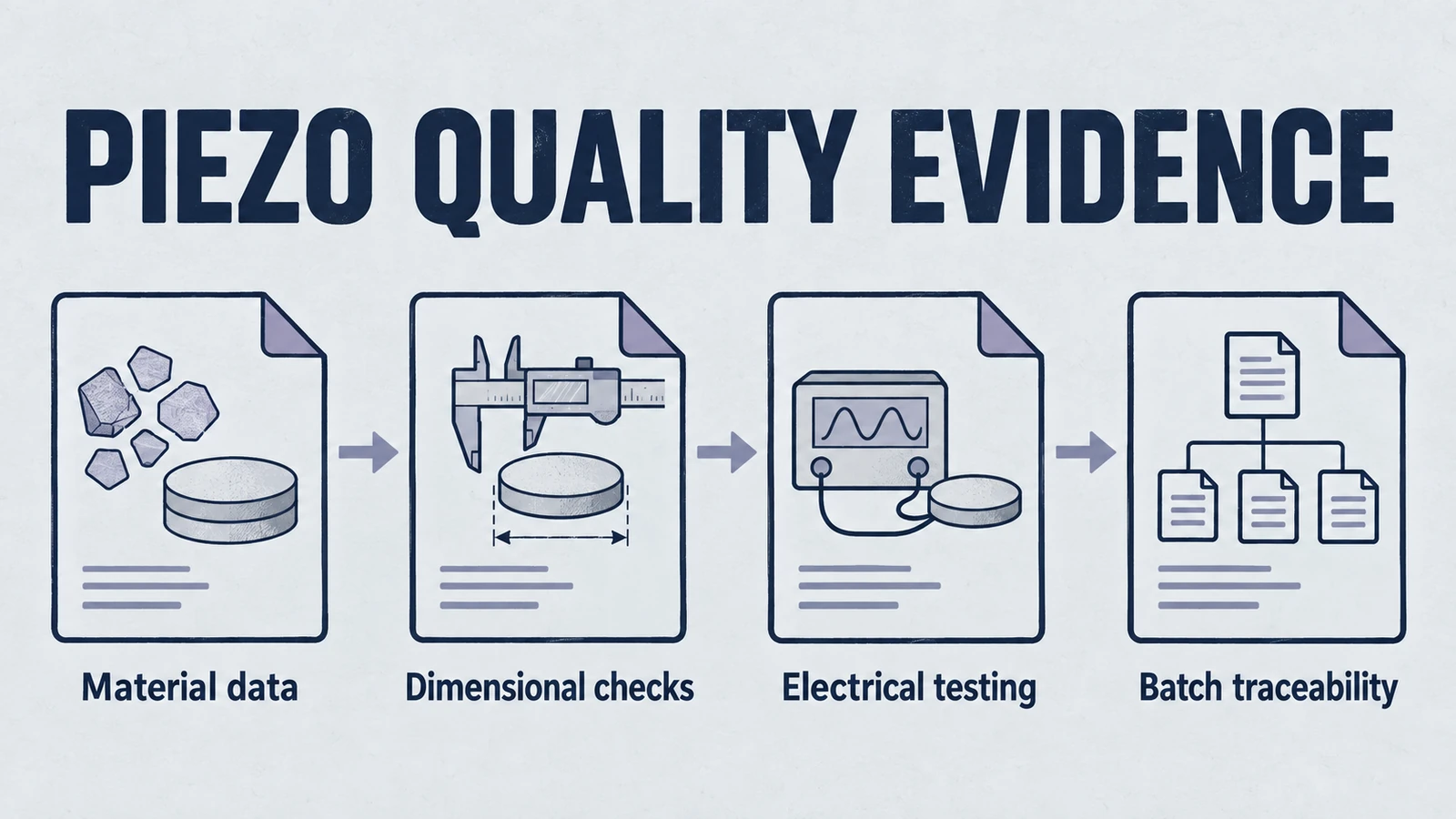
Piezoelectric components are at the heart of countless applications, from ultrasonic sensors and actuators to precise medical devices and industrial machinery. However, the quality of piezoelectric components directly impacts device performance, reliability, and lifetime, making it essential for engineers and procurement teams to understand what to look for when evaluating suppliers and products.
In this guide, we will cover:
Case note: what an unchanged-drawing reorder proves
A European maker of portable ultrasonic instruments sources 1 MHz elements from us — rectangular plates and 10 mm P-33 discs with wrap-around electrodes, in batches of around a hundred pieces. Wrap-around electrodes put both solder points on one face, which simplifies compact assembly but adds a processing step that many catalog suppliers decline at small volumes.
The strongest acceptance signal in component supply is not a test report we write — it is the customer’s second purchase order with the same drawing number. These discs went through the customer’s incoming inspection, assembly, and end-product test, and the reorder came back for another hundred of exactly the same part. Quality assurance, from the buyer’s side, is ultimately measured in unchanged drawings.
- What defines "quality" in piezoelectric components
- Critical quality factors engineers should evaluate
- How to assess a piezoelectric supplier
- Common pitfalls in supplier selection
- Best practices for ensuring consistent quality in your supply chain
Product path for this search intent
Match the article topic to the right YJ Piezo product page
Use this article when the risk is supplier selection, engineering support, validation evidence, integration reliability, and whether the manufacturer can scale from sample to production. For "Ensuring Quality in Piezoelectric Components: What Engineers Should Look For", the practical value is in turning the topic into a measurable selection or sourcing decision.
- Ultrasonic Transducer Supplier Hub
OEM sourcing and engineering collaboration
- PZT Material Supplier Hub
Material control and grade selection
- Piezoelectric Ceramics
Ceramic manufacturing and custom shapes
For a component you have already accepted, the PZT ceramic production batch reorder checklist helps carry the correct part reference, specification and delivery requirements into the next purchase.
What Defines Quality in Piezoelectric Components?
Quality in piezoelectric components is determined by the material consistency, precision of manufacturing, and the supplier's ability to deliver consistent performance across batches. Key aspects include:
- Material Purity and Consistency: High-quality PZT and other piezoelectric ceramics must have controlled grain structure, precise doping, and minimal impurities to ensure stable dielectric and piezoelectric properties.
- Dimensional Precision: Tolerances in dimensions directly affect resonant frequencies, coupling coefficients, and system integration, making it crucial to confirm supplier capabilities in tight-tolerance machining and sintering.
- Electrical Properties: Consistent d33, dielectric constant, and low dielectric loss are critical for performance-sensitive applications.
- Mechanical Strength: Components should withstand handling, assembly, and operational stresses without cracking or depolarization.
- Reliability Over Time: Aging behavior, stability under repeated cycles, and performance under environmental conditions (temperature, humidity) define long-term quality.
Critical Quality Factors Engineers Should Evaluate
When assessing piezoelectric component quality, engineers should:
- Verify Material Certifications: Request material data sheets, batch reports, and, if needed, RoHS and REACH certifications.
- Check Performance Testing: Confirm that the supplier conducts standard tests such as resonance/anti-resonance frequency, coupling factor (k), d33 measurement, and impedance analysis.
- Review Tolerance Capabilities: Evaluate the supplier's precision in outer diameter, thickness, electrode positioning, and alignment.
- Assess Reliability Testing: Ensure the supplier tests for aging, thermal cycling, and humidity resistance.
- Sample Evaluation: Request samples and run in-house testing within your systems to validate real-world performance.
Video: Interpreting Incoming PZT Test Results
This YJ Piezo walkthrough explains how capacitance, d33, and resonance measurements complement one another during incoming inspection. Use it alongside the agreed part specification and recorded test conditions when discussing batch results with your supplier.
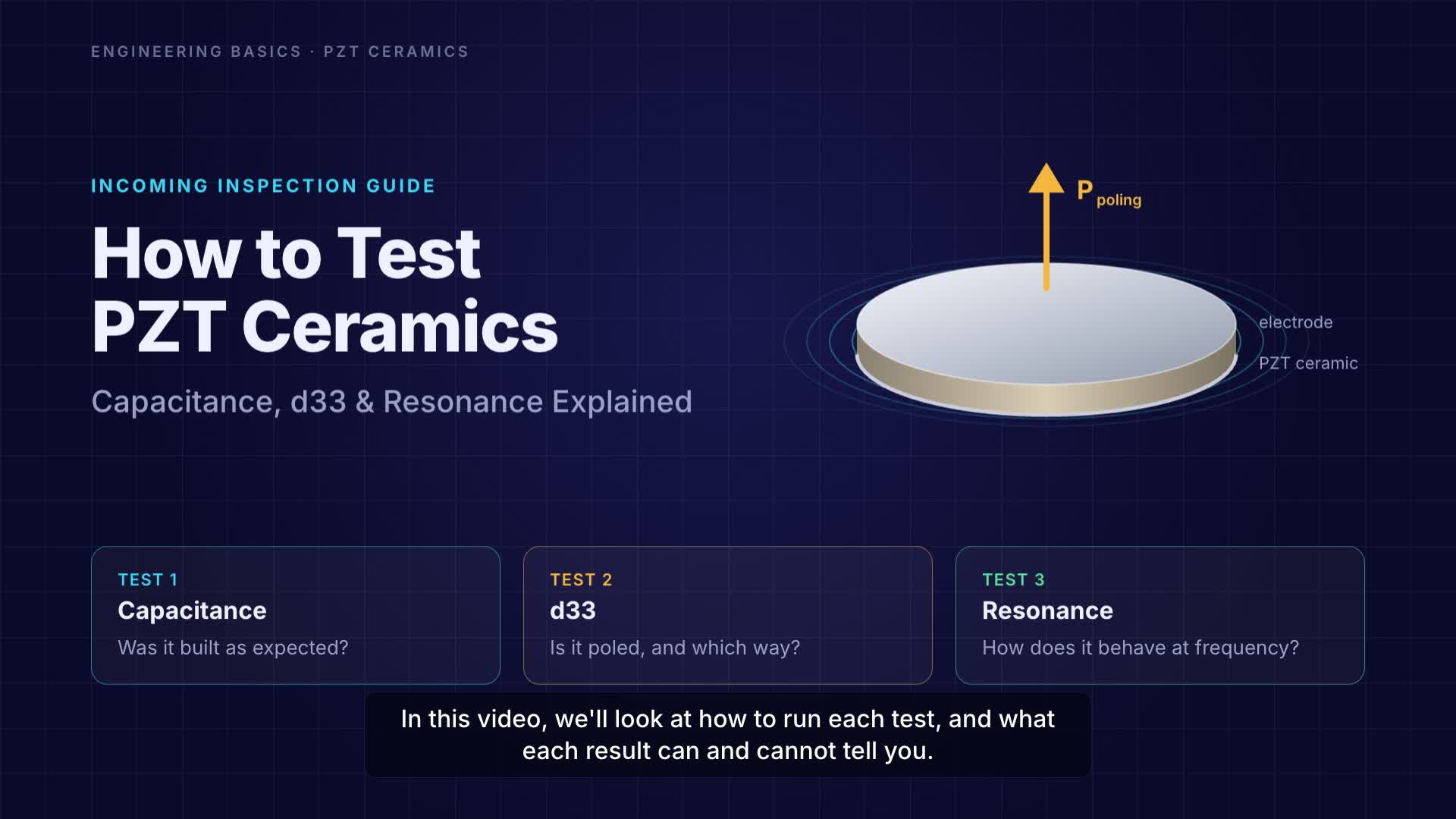
Watch the PZT testing guide on YouTube.
How to Assess a Piezoelectric Supplier
A supplier's ability to consistently deliver high-quality piezoelectric components is often more important than one-off specifications. When performing piezoelectric supplier selection, consider:
- Manufacturing Experience: Years of specialization in piezoelectric materials and transducers indicate process maturity.
- Quality Control Systems: ISO 9001 or equivalent certifications demonstrate process control, but request to review in-house quality inspection procedures.
- Custom Engineering Support: Suppliers who can adjust formulations or geometries to match your application's needs add long-term value.
- Traceability: Ensure the supplier can provide batch traceability for quality assurance and root-cause analysis if issues occur.
- Lead Time and Supply Stability: A high-quality supplier should balance quality with stable delivery timelines.
Quality Considerations by Application Type
Medical and Beauty Devices
For medical ultrasonic transducers and beauty devices, material-contact evaluation and consistent frequency response are critical. Determine intended contact, cleaning/reuse and reprocessing conditions. An internal noncontact ceramic is not evaluated identically to a patient-contact surface; request applicable material and assembly evidence.
Industrial Applications
Industrial cleaning transducers and welding applications require high-power handling and thermal stability. Quality assessment should focus on power density capabilities and thermal cycling performance.
Sensing Applications
For flow sensors and underwater transducers, environmental sealing and long-term stability under varying conditions are paramount.
Common Pitfalls in Supplier Selection
- Chasing Lowest Price: Low-cost suppliers often compromise on powder quality, sintering control, or inspection rigor, leading to inconsistencies and failures in your end products.
- Ignoring Testing Capabilities: Some suppliers may lack in-house impedance analyzers, laser thickness measurement, or d33 meters, affecting component reliability.
- Assuming All PZT Is the Same: Different PZT formulations and production methods lead to different performance profiles; verify compatibility with your application's voltage, frequency, and mechanical requirements.
Best Practices for Ensuring Quality in Your Supply Chain
- Develop Strategic Supplier Partnerships: Treat your supplier as a partner, not just a vendor, encouraging transparency and continuous improvement.
- Implement Incoming Quality Control (IQC): Establish inspection protocols for critical dimensions and electrical properties on incoming batches.
- Request Quality Reports: Ask for testing data, SPC charts, and failure rates with each shipment to monitor trends.
- Audit Supplier Facilities: If possible, perform on-site audits to verify processes, equipment calibration, and material handling.
- Establish Clear Specifications: Provide detailed drawings and specifications to your supplier to avoid misinterpretations.
Working with Yujie Technology: Quality Assurance Standards
At Yujie Technology, we understand that piezoelectric component quality is non-negotiable for your applications. Our quality assurance process includes:
- Full material traceability from raw PZT powder to finished components
- In-house testing facilities with calibrated impedance analyzers and dimensional measurement equipment
- Statistical process control (SPC) monitoring for all critical parameters
- Custom testing protocols tailored to your specific application requirements
Our experience spans from precision disc elements to complex tube geometries, ensuring consistent quality across diverse product categories.
Conclusion
Ensuring piezoelectric component quality requires a structured approach to supplier evaluation and ongoing quality management. Engineers should prioritize suppliers who demonstrate consistency, transparency, and technical expertise, ensuring your systems perform reliably while avoiding costly failures and rework.
Understanding common problems in piezoelectric transducer design and why quality matters in medical and industrial applications can further guide your supplier selection process.
If you are seeking a reliable piezoelectric supplier, Yujie Technology offers precision piezoelectric ceramic and transducer manufacturing experience built since 1996 for global industrial and medical clients. We provide full traceability, quality control reporting, and custom engineering support to ensure your projects meet the highest standards.
Contact us today to discuss your requirements and experience a supplier dedicated to your quality and performance needs.
Engineering decision notes
OEM integration and supplier qualification
Use this article when the risk is supplier selection, engineering support, validation evidence, integration reliability, and whether the manufacturer can scale from sample to production. For "Ensuring Quality in Piezoelectric Components: What Engineers Should Look For", the practical value is in turning the topic into a measurable selection or sourcing decision.
YJ Piezo combines direct project coordination with ceramic manufacturing support, so procurement and engineering teams can evaluate material control, application review, sample validation, and production consistency together.
Selection checks
- Ask whether the supplier controls ceramic manufacturing or only assembles purchased elements.
- Review sample policy, inspection records, engineering response quality, and production lead-time stability.
- Compare suppliers and integration paths by validation evidence, not only by unit price and datasheet similarity.
Failure risks
- A low-price sample can pass early tests but fail when batch variation, thermal load, or assembly stress appears.
- A supplier without material control may not explain why impedance, capacitance, or resonance drift occurs.
- Weak RFQ information leads to quotes that are fast but not technically comparable.
RFQ details
- What application, operating environment, and failure cost should the supplier design around?
- Which sample tests and outgoing records are required before pilot production?
- What customization, MOQ, tooling, and delivery constraints must be known before quotation?
Relevant YJ Piezo pages
- Ultrasonic Transducer Supplier Hub
OEM sourcing and engineering collaboration
- PZT Material Supplier Hub
Material control and grade selection
- Piezoelectric Ceramics
Ceramic manufacturing and custom shapes
Application FAQ
- How should an OEM compare piezoelectric suppliers?
- Compare material control, engineering support, test evidence, customization ability, sample policy, and batch consistency. Unit price matters, but only after the technical risk is understood.
- What makes an RFQ technically useful?
- A useful RFQ includes application, dimensions, target frequency, electrical limits, duty cycle, operating medium, environment, expected quantity, required reports, and current failure or replacement context.