
Reordering PZT Ceramic Parts: A Production Batch Checklist
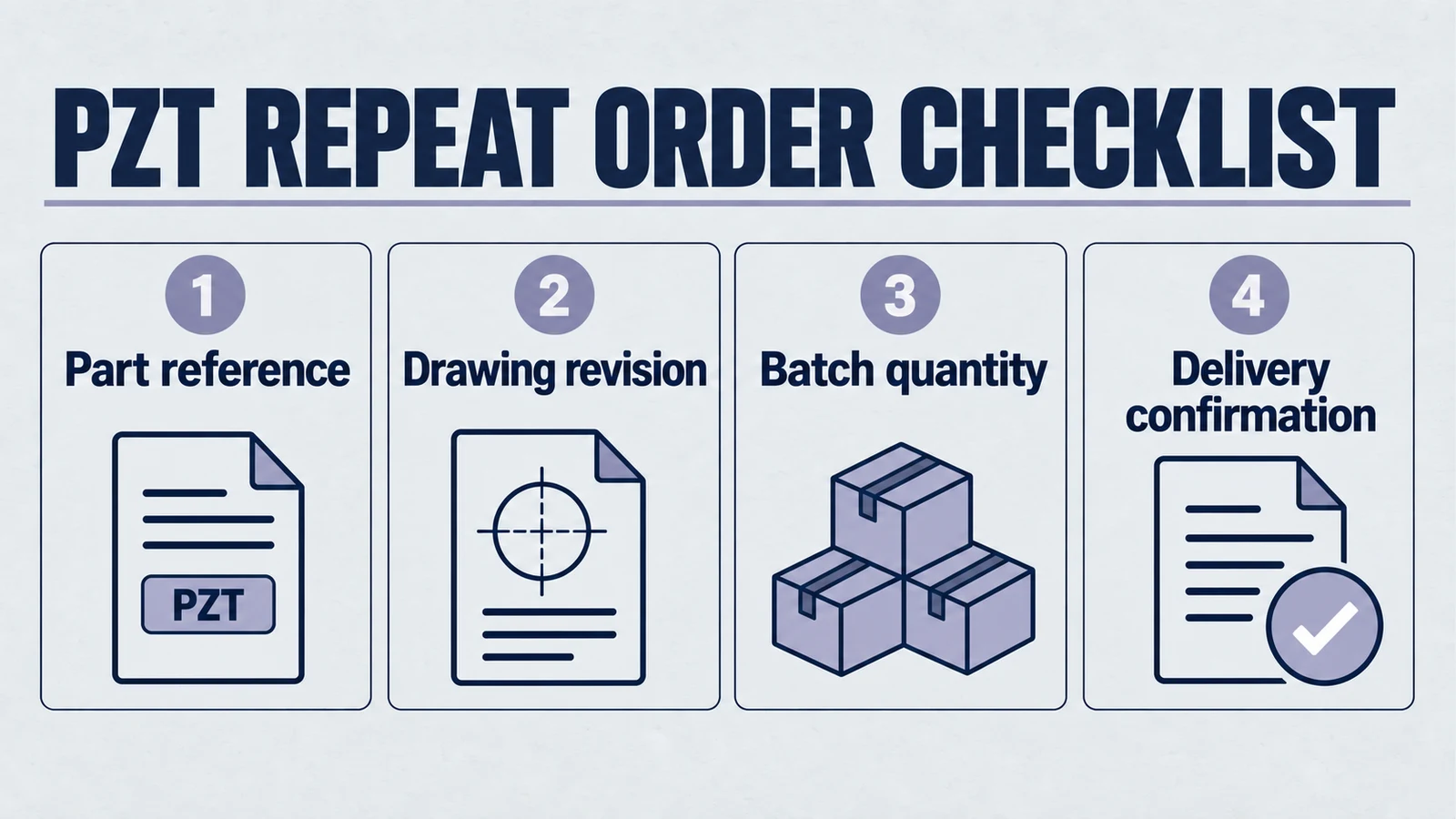
To reorder a PZT ceramic part, provide the supplier's part reference or previous order reference, the agreed specification, the next quantity and the delivery requirements. Include the drawing revision if the part was ordered against a drawing; a formal drawing is not required for every simple ceramic part. State whether the specification is unchanged. This lets the supplier connect the new request with the correct component and confirm the next order.
The checklist applies to ceramic discs, rings, plates and tubes purchased for recurring equipment production. It is also useful when a purchasing colleague takes over a part that another team evaluated. The aim is to make the next purchase clear without repeating the entire initial development discussion.
Start with the approved part reference
“The same as last time” can be ambiguous if the earlier discussion included several geometries, material alternatives or sample versions. Identify the supplier's reference or the previous order and the specification your team accepted. Include your internal part number and drawing revision where applicable. For a part ordered without a formal drawing, refer to the confirmed dimensions, material and electrode arrangement.
A prior purchase order reference can help the supplier locate the history, but the new enquiry should still state the required quantity and specification status. If more than one item was supplied previously, identify which items you want to reorder.
For a part first purchased as a sample, record the specification that your team actually accepted. Where sample approval was conditional on a change, describe that change rather than calling the next request an unchanged repeat order.
Check what has changed since the previous batch
Moving from sample approval to a production order
If you ordered samples first, send us your test feedback and identify the version you accepted. You can then request a production quotation for that specification and the quantity you need. If a change is required, describe it before placing the next order so we can review it with you.
For a ceramic part with an already confirmed specification, you can also place a volume order directly. The sample stage is optional and depends on your purchasing and evaluation needs. Whether the previous purchase was a sample batch or a production batch, confirm the current quantity, price and delivery arrangements for the new order.

A repeat order may use the same ceramic geometry while adding new requirements for electrodes, inspection records, packaging or delivery. Identify these differences at the enquiry stage so the quotation and order acknowledgement can address them.
| Order detail | If unchanged | If changed |
|---|---|---|
| Part and specification | State the existing reference and agreed specification, with drawing revision if used | Identify the changes and attach a revised drawing if applicable |
| Material and electrodes | Refer to the confirmed specification | Request confirmation of the proposed configuration |
| Quantity | Still state the quantity for this order | Ask for the new quantity or quantities to be quoted |
| Inspection or records | Reference the agreed requirements | List any additional requests before ordering |
| Packaging | Confirm the previous arrangement remains suitable | Describe new handling, labelling or packing needs |
| Delivery | Confirm the current destination and timing | Identify new destinations or requested releases |
When a design change is being evaluated alongside an unchanged production part, give the two requests separate references. This helps avoid mixing the evaluation version into an established purchasing line.
Separate repeat batch size from the demand forecast
State the number of parts you intend to purchase now. If your production schedule supports an estimate of future requirements, add it as context. The supplier needs to distinguish a current order from a forecast that may change.
A larger annual estimate does not automatically specify how production or deliveries should be divided. Explain whether you expect occasional replenishment, a regular ordering pattern or several requested delivery releases. Ask for the proposed arrangement to be confirmed before relying on it.
If you are deciding between different batch sizes, request a volume quotation for the confirmed ceramic specification. An earlier sample or production quotation should not be assumed to cover a new quantity, changed requirements or a later purchasing period.
Keep the specification and commercial confirmation together
Compare a repeat batch on the same measurement basis
If a later batch appears different from the original sample, first check that the comparison uses the same part configuration and measurement basis. Record the relevant instrument settings, fixture, environmental conditions and assembly state where those are part of the agreed test method. A loose component and a bonded or clamped component are not the same test object.
PI Ceramic describes frequency, impedance and capacitance characterization in terms of defined testing procedures. APC's technical FAQ also notes that PZT properties can change with aging. These observations do not excuse a nonconforming delivery; they explain why a comparison should preserve its test context before a purchasing conclusion is drawn.
For a reported discrepancy, send the part and batch references, the requirement in question, the observed result and how it was measured. Include relevant photographs or records if available. Ask whether the same characteristic was included in the agreed outgoing checks. A clear record lets the parties distinguish an actual specification difference from a change in test conditions or assembly.
Keep reference samples and records identifiable
If your receiving process retains a comparison sample, label it with the applicable part reference, drawing revision and batch information. Keep it separate from evaluation alternatives. Do not silently replace it with a newer part and continue treating it as the original acceptance reference.
Ask for any needed records during quotation. A catalogue describes a product or material; a batch record documents a defined set of checks for a particular supply. Neither should be described as a complete device qualification unless that work was actually performed and documented.
Before issuing the next purchase order, compare the quotation with the intended part. Check the reference, revision, quantity and any accepted changes. Confirm the applicable commercial terms, requested delivery arrangements and documentation scope.
A repeat-order email may be short, but it should leave a clear record of what is being purchased. If a supplier proposes a different material or another modification, treat it as a change requiring a decision. Do not let it become an assumed continuation of an earlier approval.
Where your organization needs specific inspection reports or labels, include those requirements in the enquiry. Availability and the applicable scope should be confirmed for the order. A repeat purchase does not automatically add reports that were never included in the previous supply.
Check receiving information before dispatch
Verify the delivery contact, destination and any shipping instructions for the current batch. This is especially useful when purchasing, engineering and receiving are handled by different teams, or when a previous sample went to a different site.
Give each item a clear reference so the receiving team can match it to the purchase order. If the new order includes both an unchanged part and an evaluation alternative, request identification that keeps them distinct. Agree packaging and handling requirements appropriate to the actual component.
For multiple destinations or split deliveries, ask how the proposed arrangement will be documented. Requested dates should be distinguished from dates the supplier has confirmed. Production and delivery plans should be based on the current order acknowledgement.
A repeat PZT ceramic order email you can copy
Subject: Repeat order enquiry — PZT ceramic [part reference]
Hello YJ Piezo,
Please quote the next batch of the following ceramic component:
Supplier part or previous order reference: [reference]
Agreed specification or drawing revision, if applicable: [reference]
Specification status: [unchanged / changes listed below]
Quantity required for this order: [quantity]
Other batch quantities to compare, if useful: [quantities]
Requested delivery timing and destination: [details]
Packaging, labelling and documentation requirements: [details]
Estimated future requirement, if known: [forecast]Please confirm the part specification, supply scope and proposed delivery arrangements for this order.
For several part numbers, repeat the part-and-quantity lines for each item. Keep a separate reference for any changed specification. If you are moving the part to an additional supplier, use the second-source ceramic enquiry guide instead of assuming the previous supplier's approval transfers automatically.
Frequently asked questions about repeat ceramic supply
Can I reorder by sending only the previous invoice?
A previous invoice or purchase order can help identify the history, but also state the current part reference, required quantity and whether the specification has changed. Include the current destination and requested timing.
Does successful sample testing establish a production order?
Sample acceptance and a production purchase are separate steps. Confirm the accepted specification, request the production quantity and agree the supply arrangements before placing the order.
Can I request the same part with a different electrode arrangement?
You can enquire about the change, but identify it as a different requirement. An electrode change should be reviewed and confirmed rather than treated as an unchanged reorder. Include the original reference so the difference is clear.
Will the supplier hold stock based on an annual forecast?
A forecast alone does not establish a stock arrangement. If reserved stock or scheduled releases are needed, request those terms explicitly and confirm what is agreed for the part and order.
Prepare your next ceramic purchase
Send YJ Piezo your part reference and next order quantity. The catalogue includes discs, rings, plates and tubes as examples of common ceramic shapes. For a new part, the PZT RFQ template shows how to start with dimensions and quantity.
About this guide and its evidence
Published by YJ Piezo to explain its ceramic enquiry and ordering workflow. The checklist and sample-to-production example describe how to prepare an order; they do not report a customer result or a measured success rate.
The cover and record diagram summarize the references needed for a repeat order. Where no drawing was used, refer to the agreed part specification. Both images are explanatory, not customer documents or shipment records.
External References
- PI Ceramic — testing procedures: context for comparing component characteristics.
- APC International — technical FAQ: composition-dependent aging of PZT properties.