
PZT Ceramic RFQ Template: Dimensions, Material, Electrodes and Quantity
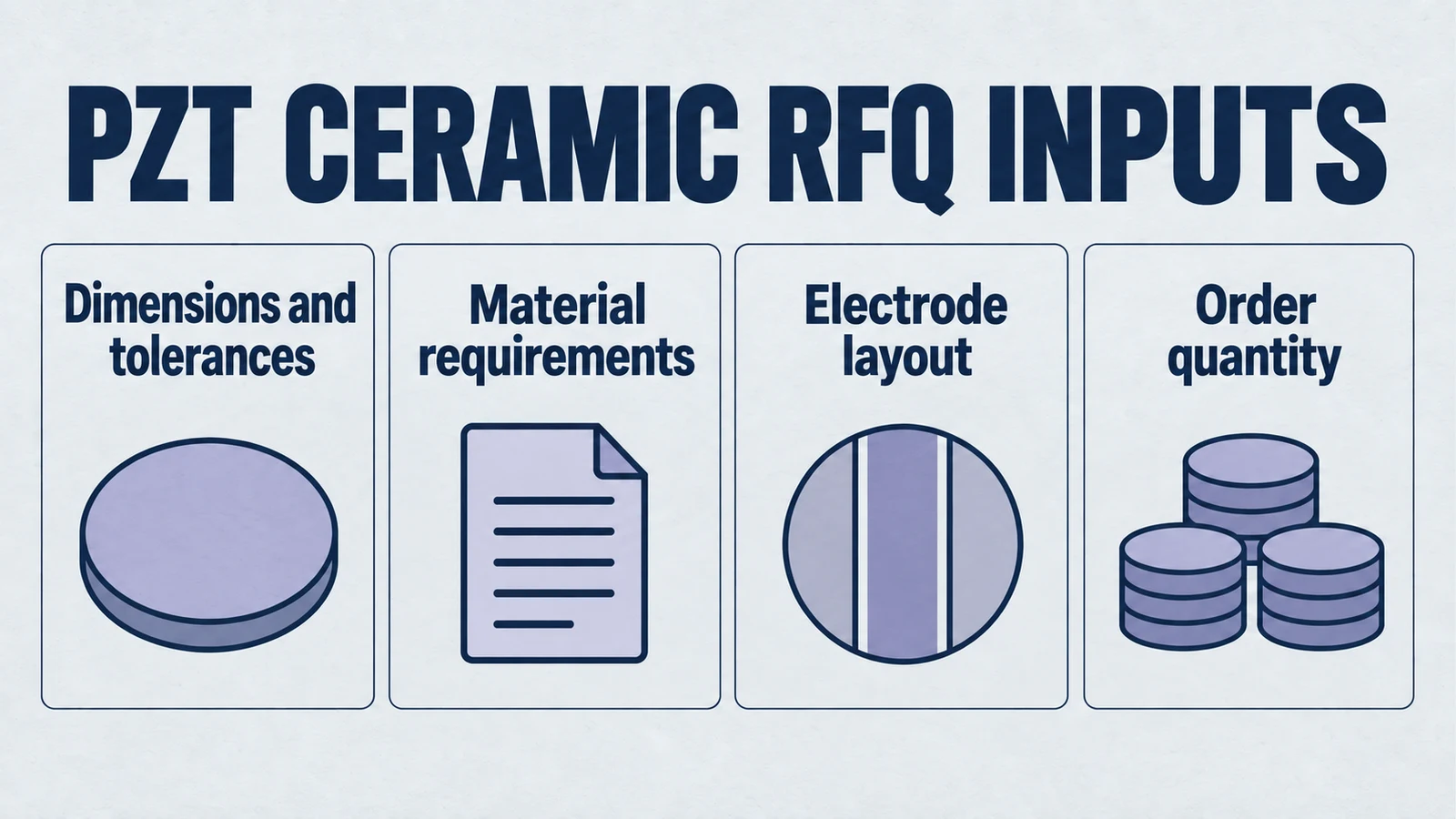
A useful PZT ceramic RFQ starts with the shape, dimensions and quantity you need. Add the material, electrode arrangement and drawing if they are available. For simple discs, rings, plates and tubes, you can begin an enquiry without a complete engineering document package. After we review manufacturability and confirm the specification and order terms, you can order samples to test or proceed directly with a production quantity.
RFQ means request for quotation. This template is for purchasing ceramic elements as parts: it helps a supplier understand what to manufacture and quote. If you need a complete transducer, include that explicitly or use the dedicated cleaning transducer purchasing guide.
Start with the dimensions that define the shape
State the units beside the dimensions. A label such as “small ring” or a photograph alone does not identify the size. For a group of different parts, give each item a separate reference and its own quantity.
| Shape | Dimensions to include | Useful additional detail |
|---|---|---|
| Disc | Diameter and thickness | Any notch, flat or area without electrode |
| Ring | Outer diameter, inner diameter and thickness | Required fit around the central opening |
| Rectangular plate or bar | Length, width and thickness | Which faces carry electrodes |
| Tube | Outer diameter, inner diameter and length | Inner, outer or end-face electrode requirements |
For example, write “ring: outer diameter [value], inner diameter [value], thickness [value], all in [unit].” The bracketed values are your dimensions, not a catalogue limitation. Describe features that cannot be expressed with those basic dimensions in a drawing or a marked sketch.
Turn an outline into an unambiguous part description
For a ring, outer diameter, inner diameter and thickness are independent dimensions. For a tube, state whether the wall is defined by outer and inner diameters or by a diameter and wall thickness; do not provide conflicting sets of values. A rectangular part needs a clear orientation for length, width and thickness, especially when its electrodes are on faces other than the largest pair.
Use a labelled sketch if the words could describe more than one part. Mark which faces are electrodes, where a connection is required and which direction is the polarization axis if that is already defined. A material grade does not supply these missing geometry or connection details.

Nominal size, tolerance, flatness and surface finish answer different questions
“Thickness [value]” gives a nominal dimension. A tolerance states the allowed variation in that dimension. Flatness describes departure from a plane, while surface roughness describes smaller-scale surface texture; a smooth face is not automatically flat. APC's technical FAQ explains this distinction.
For an RFQ, identify whichever requirements your existing assembly needs. If they have not been established, leave them open for discussion rather than inserting an unrelated supplier's default. The APC tolerance page is useful evidence that electrical and dimensional tolerances are specified separately; it is not a YJ manufacturing specification.
Include material and electrode requirements where known
If you already purchase the part, copy the material designation from its specification and identify the supplier's designation as such. A general PZT family and a manufacturer-specific grade are different levels of description. The PZT material reference page can help you read the available material information.
Electrode coverage describes where the conductive surfaces are located. Tell the supplier whether you require electrodes on opposite faces, a specified connection area or another arrangement. If lead wires or an assembled component are required, state that separately. A bare ceramic quotation should not be assumed to include wiring or assembly.
Add the polarization direction when it is defined by your specification. If it is unknown, mark it as unknown rather than selecting a direction from an unrelated example. The supplier can clarify what is needed for a quotation without treating an unconfirmed detail as a finished requirement.
Separate essential inputs from optional supporting information
The first email should make the purchasing request clear. A known material grade, an existing drawing or an application description can improve the response, but not every buyer has all of these ready.
- Start with: shape, dimensions, units and the quantity needed.
- Add if known: material, electrodes, polarization and dimensional tolerances.
- Attach if available: drawing, part specification, relevant photos or current part reference.
- Describe the purchase: sample evaluation, a production order, replenishment or an alternative supplier enquiry.
- Include if applicable: required inspection records, packaging, destination and requested timing.
If a dimension controls the fit in your assembly, identify its required tolerance. Avoid copying a tight tolerance onto every dimension simply because it appears on another part's drawing. Requirements should describe the component you need and remain open to clarification where they are not yet fixed.
Video: How to Specify a Custom PZT Ring: 7 Details Your Supplier Needs
For a ring-specific example, this YJ Piezo video shows how dimensions, mounting, material priorities, electrodes and poling, operating conditions, quantities, and acceptance criteria fit into one enquiry. Start with the dimensions and quantity you know, then identify open points for discussion. The illustrated request is a teaching example, not a released part specification.
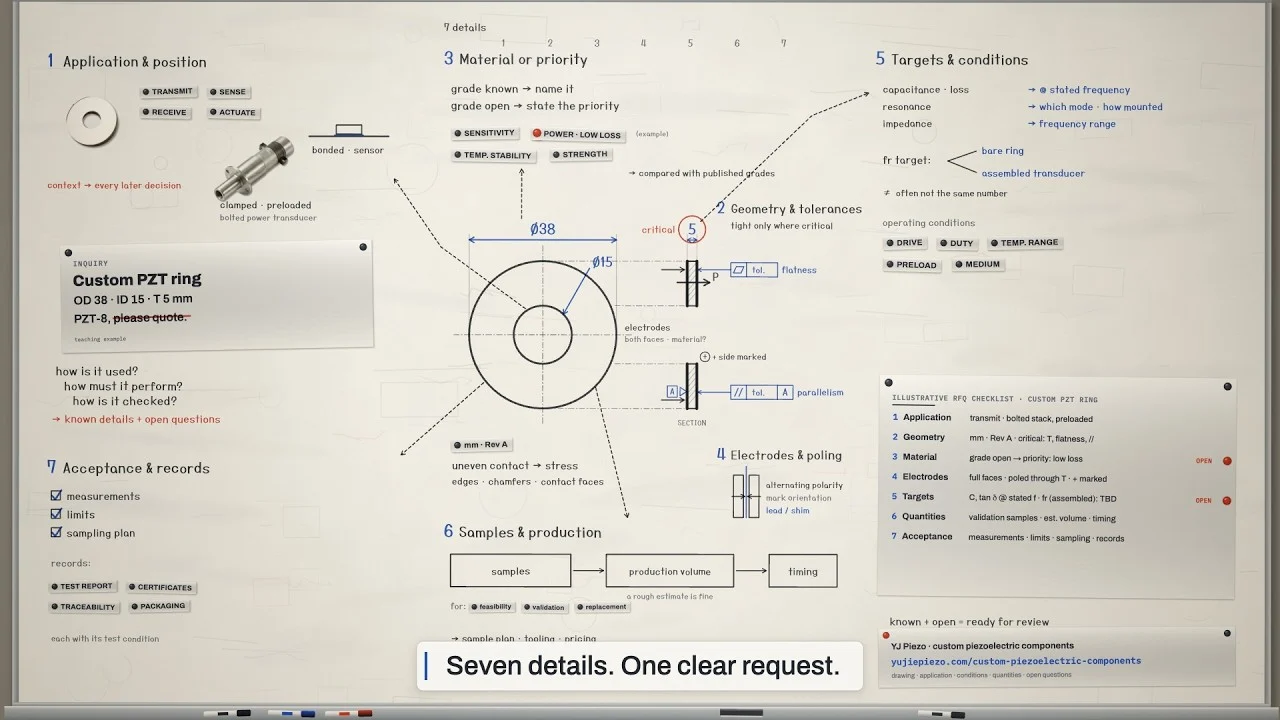
Watch the custom PZT ring specification guide on YouTube.
Copy this ceramic quotation email
Subject: PZT ceramic quotation — [shape and part reference]
Hello YJ Piezo,
We would like a quotation for the following ceramic part:
Shape: [disc / ring / rectangular plate / tube]
Dimensions and units: [details]
Quantity required: [this order]
Material or current grade, if known: [details / unknown]
Electrode and polarization requirements, if known: [details / unknown]
Drawing or part reference, if available: [reference and revision]
Purchase purpose: [evaluation / production / repeat order / alternative supplier]
Delivery destination and requested timing: [details]
Other requirements: [if applicable]Please let us know which details need clarification and confirm the proposed specification and supply scope in your quotation.
You can add a line for other quantities you want compared. Keep anticipated annual demand separate from the quantity in the current request. The volume quotation guide explains how to organize that comparison without changing the part specification.
Sending drawings, photos or an existing part reference
Example: two descriptions that would lead to different parts
“A plate with electrodes on both sides” may sound complete, but a supplier still needs to know which two faces. A thin plate with electrodes on its broad faces is a different connection arrangement from a plate that needs access to both terminals on one side. An electrode wrap or additional connection feature should be shown explicitly, not inferred from the phrase “both sides.” This is a drawing-clarity example, not confirmation that every electrode arrangement is available.
Similarly, “frequency [target]” should say whether it is a specified resonance of the loose ceramic or a requirement of an assembled device. Add the mode or measurement basis if it is known. If the target belongs to the finished instrument, tell the supplier that context rather than presenting it as a verified loose-part characteristic.
Before sending: check that each line item has one part reference, one set of dimensions with units and its own quantity. If the email, sketch and older attachment disagree, identify which document governs. Resolving that ambiguity is often more useful than adding another page of generic material properties.
A drawing should show its revision and the units used. If an older drawing remains in the email thread, identify which revision applies to this enquiry. For several related parts, put the part references in the email as well as the attachment names so that the requested quantities are easy to match.
A photograph can show the shape and electrode layout, but it should accompany dimensions rather than replace them. If you only have an existing supplier's part number, include any available specification. A part number by itself does not establish that another supplier can identify or reproduce the part.
Where the request involves a second source for an existing PZT ceramic, describe the requirements that must stay unchanged. Any proposed alternative should be identified in the response before you decide whether to order evaluation parts.
Frequently asked questions about PZT ceramic RFQs
Do I need a drawing for a standard disc or ring?
You can start with dimensions and quantity. Include the material and electrode details you know. A drawing becomes more useful when the part has additional features, critical tolerances or a specific electrode pattern.
Can I enquire about a size that is not listed online?
Yes. The catalogue provides examples. Send the dimensions of the common ceramic shape you need through the custom piezoelectric components page; the actual manufacturing and supply requirements will be confirmed for that part.
What if my annual requirement is not decided?
State the quantity you currently need and mark annual demand as unknown. A forecast can be added later. It is not necessary to invent an annual quantity to ask for a quotation.
Can one enquiry contain several shapes?
Yes. List each shape as a separate item with its own dimensions, material information and quantity. This allows the response to identify which specification and commercial terms apply to each part.
Send your ceramic part requirements
Send the completed RFQ to YJ Piezo, or begin with the dimensions and quantity you already know. For repeat purchases of a confirmed part, use the shorter production batch reorder checklist.
About this guide and its evidence
Published by YJ Piezo for buyers preparing ceramic component enquiries. The shape checklist follows our published product families; the sketch and wording examples are explanatory, not released manufacturing drawings. Any dimensions, electrode arrangement or required inspection must be confirmed for the actual part before an order is finalized.
The cover summarizes dimensions, material, electrodes and quantity for a ceramic enquiry. The dimension graphic is a schematic, not a released manufacturing drawing or a measured sample.
External References
- APC International — ceramic element tolerances: distinction between dimensional and electrical requirements.
- APC International — technical FAQ: distinction between surface roughness and flatness.