
Buying Ultrasonic Cleaning Transducers in Bulk: An OEM RFQ Guide
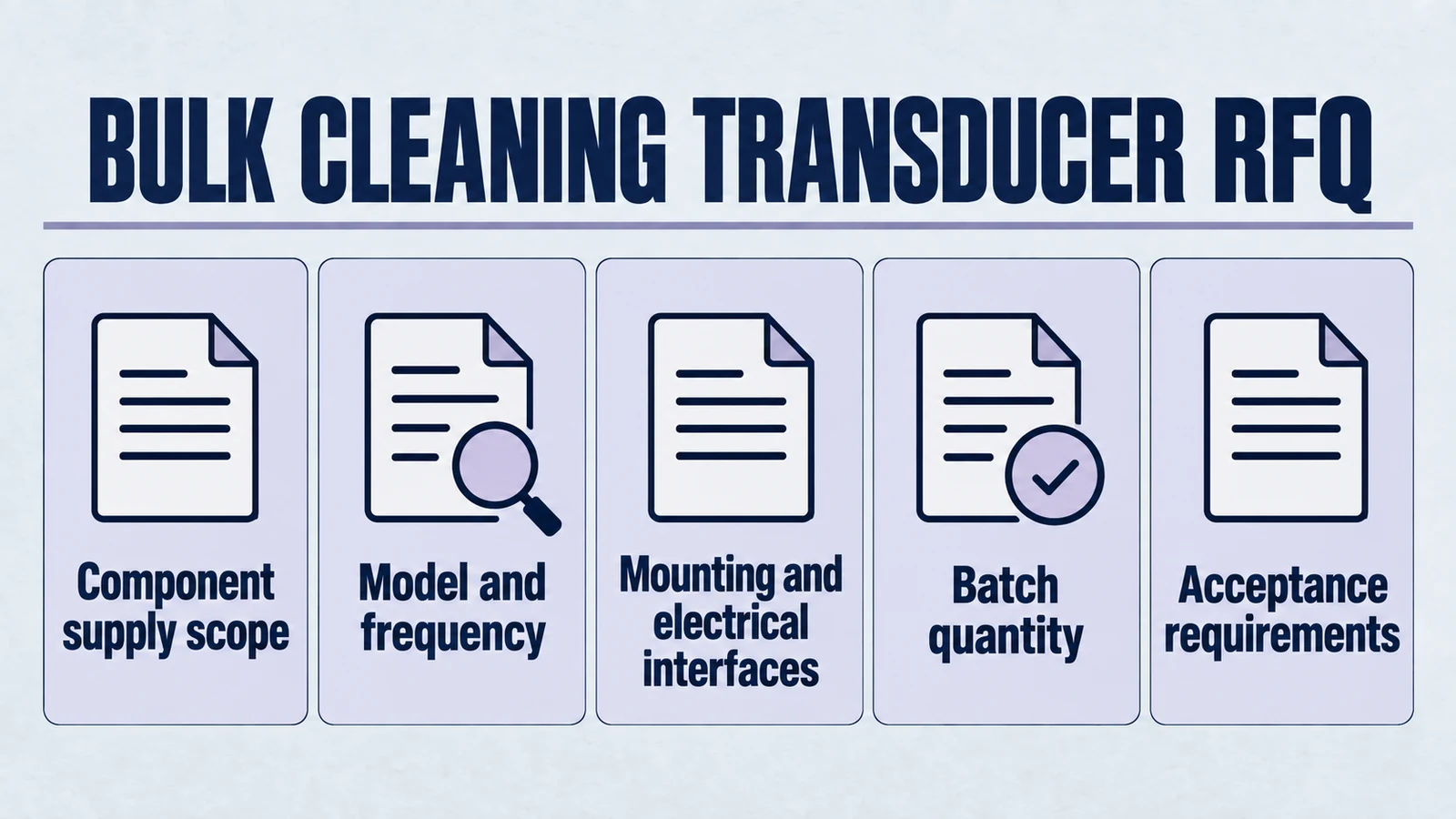
For a bulk ultrasonic cleaning transducer enquiry, identify the component you need, its frequency and mounting arrangement, and the quantities you want quoted. If the transducer is already used in an equipment model, include the current part reference or drawing. This gives the supplier a purchasing requirement tied to a real assembly.
This guide is for cleaning equipment manufacturers, assemblers and professional component suppliers. It focuses on procuring transducers for production and replenishment. The YJ Piezo cleaning transducer series provides catalogue examples to support an enquiry.
Choose a standard model or discuss a custom transducer
Standard products: you can purchase an existing YJ Piezo model directly after confirming the model, quantity and supply terms. Send the catalogue model and any accessories you need. If you want to evaluate it first, ask for a sample quantity; a custom development stage is not required for every standard-product order.
Custom transducers: we usually need drawings and a physical reference sample to review the requested component. Share the drawing and tell us whether a reference sample is available so we can agree the next steps before you send it. A model number or photograph can start a discussion, but does not replace those inputs for a custom manufacturing review.
After confirming manufacturability, the specification and the sample order, we produce samples for you to test in your own equipment. If the results meet your requirements, you can place a volume order against the accepted specification and confirmed production terms. If changes are needed, we review them with you before arranging further work. The sample price and timing are confirmed for the project.
Define exactly what the quotation should include
The phrase “ultrasonic cleaning element” can describe different supply levels. A ceramic ring, an assembled transducer, a generator-and-transducer set and a complete cleaning tank are different items. Specify the component you intend to purchase so the supplier does not quote a different scope.
| Item requested | Information to provide | What to clarify |
|---|---|---|
| Bare ceramic element | Shape, dimensions, material and electrodes | Whether your team will build the transducer assembly |
| Assembled cleaning transducer | Model or drawing, frequency, mechanical interface and quantity | Which mounting parts or electrical connections are included |
| Transducer with additional components | List of requested components and available specifications | Whether those components are available within the quotation scope |
| Component for an existing tank assembly | Current transducer details and relevant mounting information | Who will confirm compatibility in the finished equipment |
This table describes purchasing scopes; it is not a promise that every combination is supplied as a standard package. If you manufacture your own transducer stacks, use the piezoelectric ceramic ring series and the ceramic RFQ template for the ceramic portion of the purchase.
Use frequency and model details together
Buyers often start with a nominal cleaning frequency such as 28 kHz or 40 kHz. Frequency helps identify a product family, but it does not describe the transducer's dimensions, mounting interface, electrical characteristics or compatibility with the generator and tank.
For example, the published HJ-3528B and HJ-3840 pages provide model-specific starting points. Refer to the individual product specification rather than assigning a category-wide rating to every model. Sending a catalogue reference does not replace confirming the requirements of your equipment.
If the application is already established, send its existing requirements. If the cleaning process is still being selected, describe what is known and which requirements remain open. The cleaning transducer selection guide provides technical background; the quotation should identify the actual component proposed.
Make mounting and electrical interfaces visible
Catalogue example: shared ratings do not make two models interchangeable
The HJ-3825 and HJ-3828 entries make this visible. Both published specifications list the same power, static capacitance and mounting thread, while their listed resonance frequencies and body dimensions differ:
| Catalogue field | HJ-3825 | HJ-3828 |
|---|---|---|
| Resonance frequency | 24.8 ± 0.3 kHz | 27.8 ± 0.3 kHz |
| Overall dimensions | Ø65 × 74 mm | Ø59 × 67 mm |
| Static capacitance | 4000 pF | 4000 pF |
| Listed power | 60 W | 60 W |
| Mounting thread | M10 × 1.0 | M10 × 1.0 |
A purchasing line reading only “60 W, M10” would therefore leave a material part of the selection unresolved. Include the model and the actual electrical and mechanical requirements. This example reproduces catalogue data for preliminary comparison; it is not a test of either model in your tank and does not authorize a substitution.

Include a drawing or dimensions of the mounting arrangement where available. Relevant details may include the attachment method, threaded connection, available space and the interface to the tank. A photo can help orient the supplier, but it should accompany the measurements that define fit.
State the known generator information and any required electrical characteristics. When referring to a power rating, identify the source of the rating and whether it describes one transducer or a complete system. Dividing the tank's stated power by a component count is not sufficient to establish a suitable transducer specification.
Installation and operation in the tank affect the complete assembly. Agree who will carry out the required equipment checks. An enquiry for replacement supply should not imply that matching the nominal frequency alone guarantees interchangeability.
Separate component acceptance from the cleaning process
A supplier's component check and your cleaning-process check serve different purposes. Receiving can compare the supplied model, mechanical features and agreed component records with the purchase specification. The equipment builder then evaluates the transducer in its intended tank, generator and installation arrangement. Keep those responsibilities visible when ordering evaluation and production parts.
A cleaning result also depends on the load and process. PI Ceramic's ultrasound application overview provides background on component use in ultrasonic systems. For purchasing, record your intended configuration and the acceptance conditions your own equipment programme requires. A single catalogue wattage does not certify cleaning performance on every part or contaminant.
For a first delivery, use a short order review: does the acknowledgement identify the agreed model, do the interfaces match the drawing, are the required accessories listed, and does each requested quantity refer to that same configuration? If a production batch and spare stock require different packaging or release dates, separate them in the request rather than hiding the difference in an annual total.
Quote the purchasing quantities your factory actually uses
Separate the number of transducers per machine from the number you want to purchase. Add the expected machine build quantity if it helps explain the order, but state the component quantity explicitly. Treat service stock or spare parts as a separate line if they require a different delivery schedule.
You can ask for an evaluation quantity and several production quantities in the same enquiry. Label each one so the response can distinguish sample supply from recurring purchasing. Include normal reorder quantities and an estimated annual requirement only where they are useful and known.
For split deliveries, explain the requested release pattern and destination. Ask the supplier to confirm the proposed supply arrangement in the quotation; do not assume that an annual forecast includes reserved stock, fixed pricing or a particular replenishment schedule.
Bulk cleaning transducer RFQ template
Subject: OEM cleaning transducer quotation — [model / equipment reference]
Hello YJ Piezo,
We are sourcing transducers for [cleaning equipment model or application].
Required supply: [assembled transducer / ceramic element / other specified scope]
Purchase route: [standard YJ model / custom transducer]
Current or requested transducer reference: [model / drawing and revision]
For custom transducers, drawings and physical reference sample: [available / details to discuss]
Frequency and known electrical requirements: [details]
Mounting arrangement and available dimensions: [details]
Generator reference, if available: [details]
Evaluation quantity, if needed: [quantity]
Component quantities to quote: [quantities]
Repeat demand or delivery releases, if known: [details]
Destination and requested timing: [details]Please confirm the proposed component, included accessories and any points requiring clarification.
Frequently asked questions from cleaning equipment buyers
Are cleaning transducers with the same frequency interchangeable?
Frequency alone does not establish interchangeability. Compare the mechanical and electrical requirements and confirm the proposed component in the intended equipment. Include the current part drawing or specification when requesting an alternative.
Can I purchase ceramic rings instead of complete transducers?
You can enquire about ceramic rings separately. Provide their dimensions, material information, electrode requirements and quantities. Make clear that your purchase is for the ceramic component so the quote does not assume a complete transducer assembly.
Can I ask for different production quantities in one RFQ?
Yes. List the quantities against the same transducer specification. Identify evaluation quantities and any requested split deliveries separately so you can compare the resulting quotations on a consistent basis.
Do I need to specify every parameter before contacting YJ Piezo?
No. For a standard product, send the YJ model and quantity first. For a custom transducer, share the drawings, known requirements and whether a physical reference sample is available. We usually need both drawings and a reference sample for the custom review; tell us what is missing so we can discuss whether and how to proceed.
Request cleaning transducers for your next equipment batch
Review the cleaning transducer catalogue, then send your standard model and quantity, or your custom drawings and reference-sample availability, to YJ Piezo. If your factory also purchases welding components, see the welding transducer sourcing guide for its different mechanical and supply interfaces.
About this guide and its evidence
Published by YJ Piezo. The model comparison cites the linked HJ-3825 and HJ-3828 catalogue entries. Catalogue information supports enquiry and preliminary selection; the actual supply specification and equipment acceptance remain specific to the purchase.
The cover summarizes the inputs for a cleaning-transducer enquiry. The comparison graphic reports only the labelled catalogue fields; neither image is a cleaning-performance test or a customer installation record.
External References
- PI Ceramic — generating ultrasound with piezo components: general application background, not verification of the YJ models.