
Sourcing Ultrasonic Welding Transducers for Existing Equipment Models
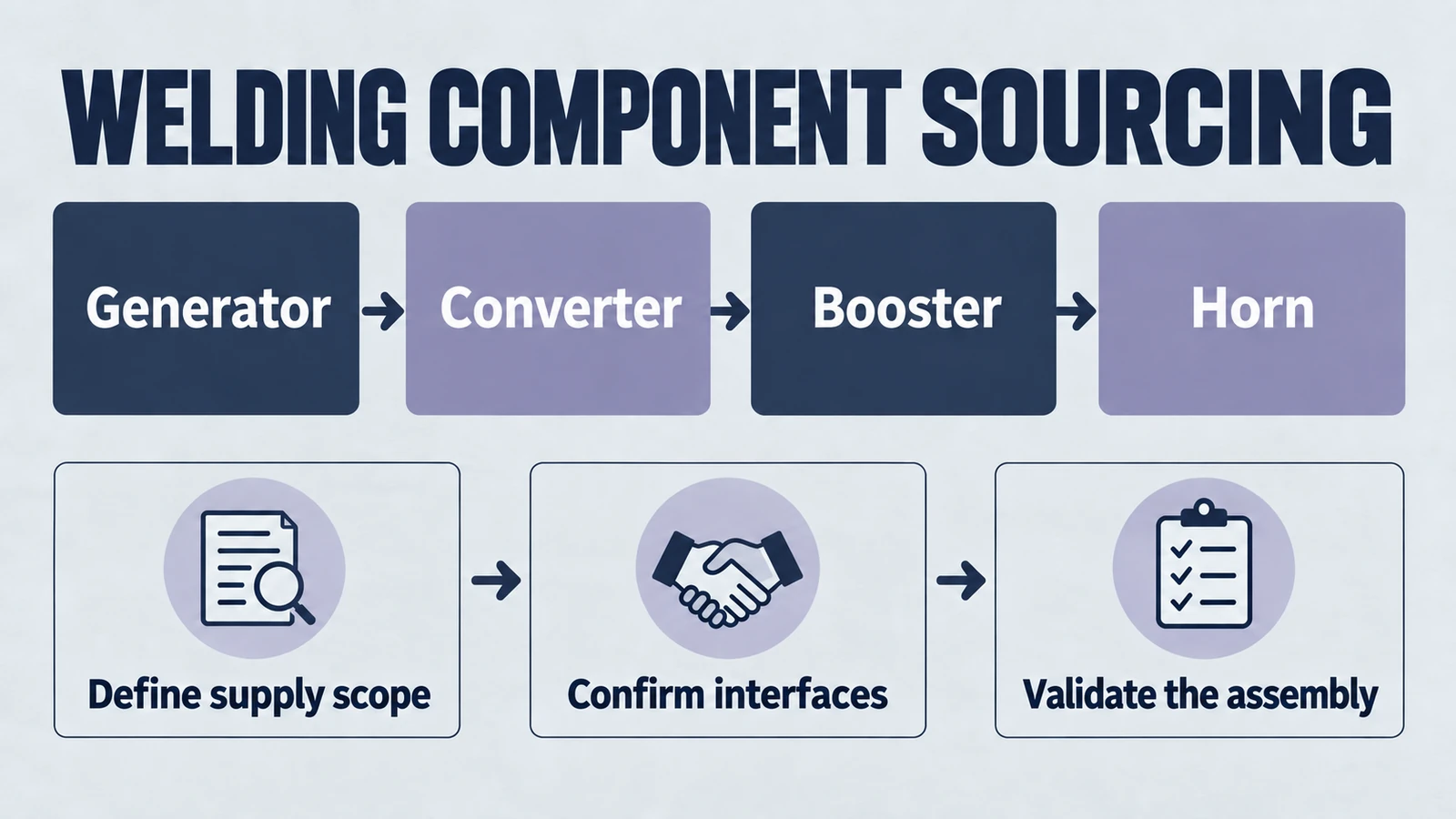
When sourcing ultrasonic welding transducers for an existing equipment model, begin with the current component specification and the quantities your purchasing team needs. Include the frequency, mechanical interfaces, available electrical information and exact supply scope. These details allow a supplier to propose a component for the intended machine.
The same approach applies to an equipment manufacturer ordering production parts and a professional supplier building a repeat parts programme. It also helps when evaluating an alternative source. A nominal frequency or a machine photograph alone leaves too much of the purchased component undefined.
Standard products and custom transducers follow different order paths
Buying a standard model: select an existing YJ Piezo transducer and confirm its specification, quantity and supply terms. You can place an order directly, or request a sample quantity first if you need to evaluate it in your equipment.
Requesting a custom transducer: we usually need drawings and a physical reference sample. Send the drawing and let us know whether the sample is available; we will discuss the review and shipping arrangements with you. An equipment brand, model number or photo helps explain the enquiry but does not establish that we can reproduce the component or guarantee a replacement.
Once manufacturability, the specification and the sample order are confirmed, we produce samples for your team to test in the intended machine. After you accept the samples, you can place a volume order with the agreed specification and production terms. Any changes or further sample work are discussed separately. Sample pricing and timing are confirmed for the actual request.
Specify the transducer and the other parts of the welding stack separately
Ultrasonic welding equipment combines components with different functions. The transducer, sometimes called a converter in equipment documentation, converts electrical input into mechanical vibration. A booster or horn is a separate mechanical component, and the generator supplies the electrical drive.
State which components you need. A quotation for the transducer should not be assumed to include a booster, horn, generator, housing or mounting hardware unless they are identified in the supply scope.
| Purchasing request | Useful reference | Point to confirm |
|---|---|---|
| Transducer or converter | Current model, drawing and electrical specification | The exact assembly and connections included |
| Transducer with a booster or horn | Separate references for the requested components | Availability, interfaces and the scope of the proposed set |
| Ceramic rings for in-house assembly | Ring dimensions, material, electrodes and quantity | Supply of the ceramic parts rather than a complete stack |
| Alternative source for an existing machine | Machine model plus the current component specification | Differences from the existing component and the required fit checks |
Use the welding transducer catalogue for assembled transducer examples. If your company assembles its own stacks, start with the piezo ceramic ring series and provide a ceramic specification. The table describes possible purchasing requests, not a standard package covering every item.
Identify the mechanical interfaces that must remain unchanged
Why a shared thread is only one part of the comparison
The public HJ-5020B and HJ-5020D listings both include an M12 × 1.75 interface, but list different envelopes. The example below reproduces selected catalogue entries; it is not a measurement report or a compatibility declaration.
| Catalogue field | HJ-5020B | HJ-5020D |
|---|---|---|
| Threaded interface | M12 × 1.75 | M12 × 1.75 |
| Listed maximum diameter | Ø50 mm | Ø64 mm |
| Listed height | 103 mm | 116 mm |
The same thread identifies only one mechanical interface. Confirm the resonance frequency, tolerance and measurement conditions for the exact configuration being offered before ordering. This comparison covers the listed mechanical fields only; it does not establish electrical compatibility.
For an existing machine, the component has to fit within an established assembly. Include the overall dimensions, mating interfaces, relevant threaded connections and mounting arrangement where available. A drawing can identify which surfaces or features are critical to installation.
Do not rely on the frequency to identify a mechanical replacement. Transducers used at the same nominal frequency may have different body dimensions, coupling interfaces or connections. An apparently similar exterior also does not establish the internal specification.
If a change is acceptable, identify it as an option. Ask the supplier to list proposed differences so your engineering team can review them before purchasing. This avoids treating a supplier's alternative as an exact replacement without checking the machine requirements.
Provide electrical requirements in their original context
Attach the existing component specification or the relevant generator information if you have it. Useful inputs can include the intended operating frequency, electrical limits, connection arrangement and known duty requirements. Preserve the original units and the conditions associated with any quoted values.
Be clear whether a stated power refers to the generator, the transducer or the complete machine. A machine's headline power rating is not enough to define the ceramic or converter you need to purchase.
For a catalogue enquiry, name the model. For example, the HJ-5020B welding transducer page provides a specific product reference for preliminary comparison. Check that model's information against the machine requirement rather than transferring a rating from another product.
Distinguish replacement supply from a new machine development request
Read the stack as separate purchased components
In Branson's 2000X t power-supply manual, section 2.4.3, the converter, booster and horn have distinct functions within the ultrasonic stack. The booster sits between the converter and horn and can change the vibration amplitude. This is useful terminology for specifying an order; it does not mean a YJ component is approved for that manufacturer's system.

A useful equipment-purchasing checklist has three lines: what is supplied, what it connects to, and who confirms the assembled equipment. If the order is for a converter alone, identify the existing booster or mating assembly. If a complete stack is requested, list each component and the scope the supplier has actually agreed to provide. Keep installation and process validation responsibilities explicit without turning every component purchase into a new machine-design project.
Request differences, not an unsupported “same as” statement
When another model is proposed, ask for a short deviation list: which dimensions, connections, electrical entries or supplied accessories differ from the current part? Your team can then decide which differences are acceptable and what checks are required. A response that clearly identifies an alternative is more useful than one that uses the existing part number while leaving the actual configuration unspecified.
Do not transfer tightening instructions, operating limits or maintenance procedures from one manufacturer's manual to another transducer. Use the instructions applicable to the equipment and component actually supplied. The purpose of the reference here is to clarify component roles and procurement scope, not to prescribe installation settings.
An established component drawing lets the supplier review a defined purchasing requirement. If your team is still deciding the welding architecture or redesigning the stack, mark those points as open. A component quotation does not by itself cover the development or validation of a complete welding machine.
For an alternative component, decide which checks your team needs to complete in the intended assembly. The suitability of the transducer and the outcome of the welding process depend on more than the loose component alone. Confirm the proposed part and the responsibilities for equipment evaluation before treating it as approved for production.
A brand name or familiar model description can help explain the context, but it is not evidence of compatibility. Provide the current component's specification and ask what is being proposed. Avoid assuming direct interchangeability from an unverified cross-reference.
Prepare production quantities and spare requirements clearly
Give the number of transducers you want quoted, even when you have also provided the number of machines you plan to build. If several machine variants use different transducers, list each part and quantity separately.
Identify evaluation parts, normal production quantities and service stock as separate needs. Where you want to compare quantity options, use the same component specification for each option. Include an estimated annual requirement if known, but label it as a forecast rather than a placed order.
If supply continuity is the reason for the enquiry, explain the requested ordering pattern. Discuss split deliveries or stock arrangements explicitly; they should be confirmed in the quotation rather than inferred from an annual quantity.
Welding transducer OEM quotation template
Subject: Welding transducer quotation — [equipment / component reference]
Hello YJ Piezo,
We are sourcing components for an existing welding equipment model.
Equipment model and current transducer reference: [details]
Supply required: [transducer only / separately listed components]
Purchase route: [standard YJ model / custom transducer]
For custom transducers, drawing and revision: [reference / details to discuss]
Physical reference sample for custom review: [available / details to discuss]
Frequency and known electrical requirements: [details]
Mechanical dimensions and mating interfaces: [details]
Generator or current component specification: [if available]
Quantities to quote by part reference: [details]
Evaluation or spare quantities, if applicable: [details]
Destination and requested delivery timing: [details]Please identify the proposed model, what is included and any differences from our stated requirements.
Frequently asked questions about welding transducer sourcing
Does matching the operating frequency establish compatibility?
No. Mechanical interfaces, electrical characteristics and behavior in the intended assembly also need to be considered. Use the existing component specification and the machine's relevant requirements when reviewing an alternative.
Can I purchase only the ceramic rings?
You can request ceramic rings as a separate supply item. Include their dimensions, material and electrode information where known. The PZT ceramic RFQ template helps prepare this request without confusing it with a complete transducer order.
Can I start with the existing model number and photos?
Yes, they can help us understand the initial enquiry. To buy a standard YJ product, identify the YJ model and quantity. For a custom transducer, we usually need drawings and a physical reference sample before confirming a sample-production proposal. Tell us which inputs you have so we can discuss the next step.
How should I enquire about parts for several machine models?
Use a separate line for each transducer reference, specification and quantity. Identify shared parts where you know they are the same. Do not combine similar-looking components into one order line without confirming that they have the same requirements.
Request a quotation for your welding equipment components
Browse the YJ Piezo welding transducers, then send the standard YJ model and quantity, or your custom drawings and reference-sample availability. For ceramic supply changes, see the second-source PZT guide; for cleaning equipment, use the cleaning transducer bulk RFQ guide.
About this guide and its evidence
Published by YJ Piezo. The model example compares selected mechanical fields from the linked public listings. Confirm the exact offered model, configuration and electrical specification before ordering. No named-brand compatibility or independent performance certification is claimed.
The cover and functional diagram distinguish the generator, converter, booster and horn. They explain supply scope, not a complete package supplied as standard. Your team evaluates the proposed component in its intended equipment; the diagrams do not report a validated stack or depict a specific product's internal construction.
External References
- Emerson / Branson — 2000X t power-supply manual, section 2.4.3: converter, booster and horn functions. Brand-specific instructions apply to the equipment covered by that manual.