
Second-Source PZT Ceramics: Buying from an Alternative Supplier
A second source for PZT ceramics is an additional supplier for a part you already use or have specified. A useful enquiry starts with that existing component: its dimensions, material information, electrodes, required performance and purchase quantity. This gives the alternative supplier something concrete to quote.
You may be comparing supply options because of purchasing terms, availability, a changing order schedule or a wish to reduce dependence on one source. Whatever the reason, identify the requirements that must remain unchanged before asking whether another ceramic can meet them.
Describe the current part before describing the sourcing problem
Begin with the shape and dimensions, including units. For a disc, give the diameter and thickness; for a ring, add the inner diameter. A plate needs length, width and thickness, while a tube needs its outer diameter, inner diameter and length. Attach an existing drawing or specification if available.
Copy the material designation and identify its source. Include the electrode pattern, polarization direction and any electrical requirements already defined in your purchasing specification. A photo can help explain connection areas or physical features, but it cannot establish every dimension or material property.
If some details are unknown, say so. You can start an enquiry with the information you have and clarify the remaining requirements before an order is finalized. The ceramic RFQ template provides a concise format for common shapes.
Distinguish a matching requirement from a proposed alternative
The alternative supplier's response should identify what it proposes to supply. A matching shape, a similar material family name or the same nominal frequency does not by itself prove that the component will behave identically in your assembly.
| Comparison | What to check | Purchasing action |
|---|---|---|
| Mechanical fit | Dimensions, tolerances and any locating features | Identify requirements that must remain unchanged. |
| Material designation | Current material information and proposed grade | Request a clear identification of the proposed material. |
| Electrical requirements | Specified limits and measurement conditions, where defined | Compare values measured on an appropriate basis. |
| Connection arrangement | Electrode coverage, polarization and any leads | Confirm the interface required by your assembly. |
| Supply scope | Bare ceramic, wired part or assembled component | Keep the purchased item consistent across quotations. |
| Purchase quantities | Evaluation quantity, current order and usual batch | Quote each intended purchasing stage explicitly. |
Material reference tables help explain grade characteristics, but the finished part's geometry and defined test conditions also matter. Use the PZT material information as supporting information, then agree the specification for the component you intend to buy.
Keep supplier comparison tied to the existing application
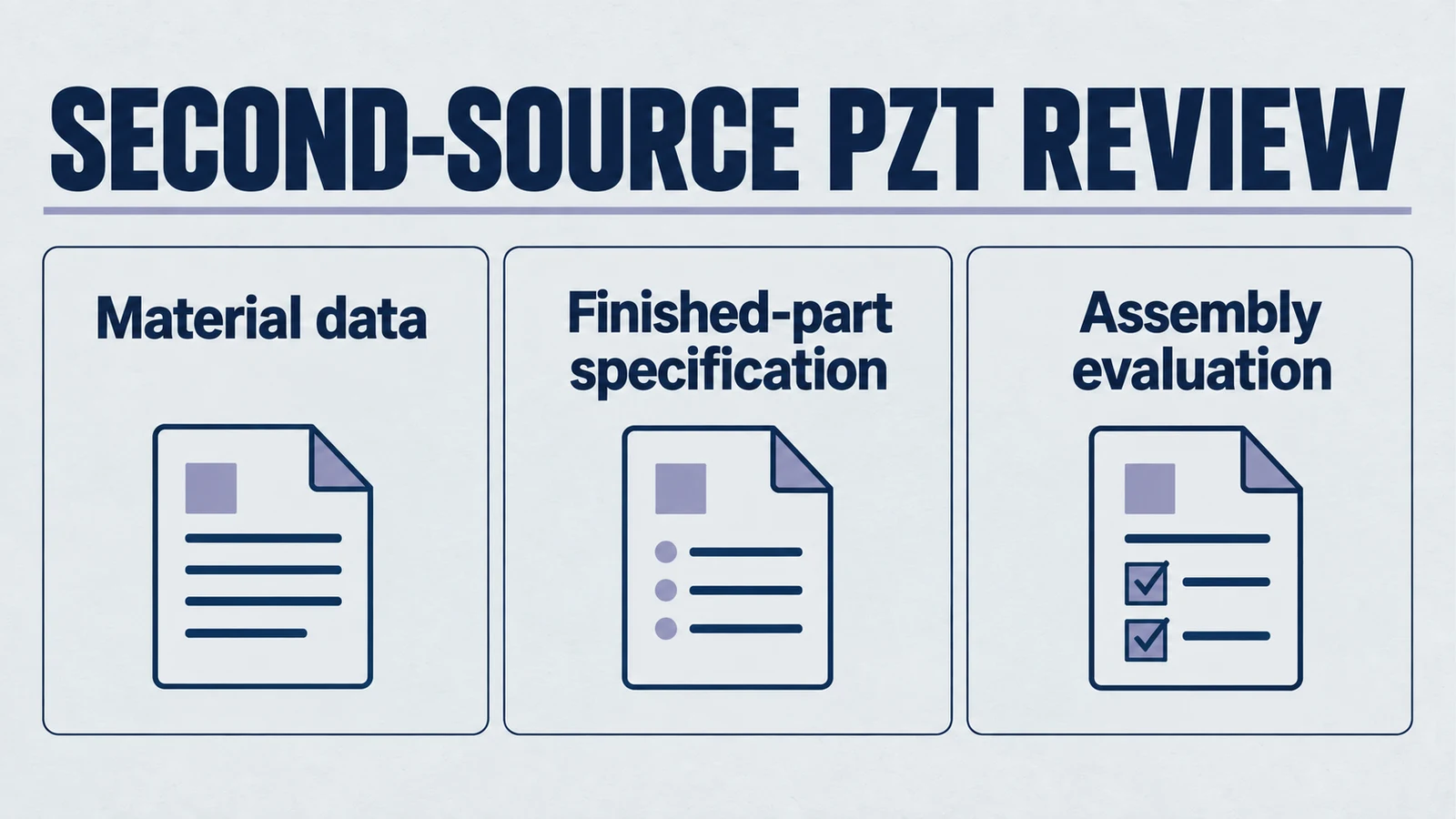
A material table, a part specification and an assembly result are different evidence
A material table describes the supplier's material characterization. A drawing or part specification defines the component being purchased. An assembly test examines how that component behaves in a particular device. Keeping these three records separate prevents a plausible material comparison from becoming an unsupported compatibility claim.
PI Ceramic's testing overview distinguishes typical material data from finished-component characteristics and identifies geometry and measurement conditions as relevant factors. That distinction is directly useful when a new supplier proposes an alternative grade.

A concrete example from YJ's material reference
Our published PZT material table lists the following entries. These are catalogue material values, not measurements of a customer's finished part:
| YJ material | Listed d33 (pC/N) | Listed Curie temperature (°C) | Listed Qm |
|---|---|---|---|
| P-51 | 450 | 260 | 70 |
| P-52 | 575 | 180 | 65 |
The purchasing implication is specific: the term “soft PZT” does not select one of these entries, and the larger d33 value does not establish a better replacement. d33 is a piezoelectric coefficient, not an overall quality score; APC's constant definitions provide the technical background. Curie temperature should not be read as the permitted operating temperature of the device. Keep the current material information and the proposed grade explicit, then compare the part requirements that matter to your assembly.
A second-source enquiry is easier to assess when you separate fixed requirements from preferences. For example, a mounting dimension may be fixed by the housing, while packaging may be open to a supplier's proposal. Make that distinction in the enquiry rather than asking for a completely new design.
If the supplier suggests a material or electrode change, ask for it to be listed separately. This keeps a proposed alternative from becoming an unnoticed change to the current specification. Your team can decide whether the alternative is acceptable and what checks are needed.
Physical samples can sometimes support the discussion, but agree the purpose and arrangements before sending them. An existing sample does not automatically define its material, manufacturing process or all of its acceptance requirements. Where a drawing is available, include it alongside the sample reference.
Use evaluation parts to answer a defined purchasing question
Write a short comparison record before buying evaluation parts. Give each required characteristic a source: the existing drawing, a device requirement, or an agreed measurement method. A line labelled “capacitance” should identify the relevant test conditions where they are defined; a resonance result should identify whether it was measured on a loose component or an assembled stack. When those conditions differ, request clarification rather than declaring the supplier's result out of specification.
Decide what the outcome will authorize. Approval of an evaluation part might permit a pilot order under a named specification; it does not automatically approve every material, dimension or process variation from that supplier. Record accepted deviations and make the approved configuration identifiable in the later purchase order. This is a purchasing decision record, not a request for an open-ended development programme.
For a new supply source, your team may need to check fit, electrical behavior and performance in the actual assembly. Establish the relevant checks using your product requirements. Loose ceramic measurements and a finished device test answer different questions, so decide which party will complete each check.
Ask the supplier to identify the specification associated with the evaluation parts. Record any deviations you accept. A useful result is a clear decision about that proposed part: approved for the intended use, subject to a named change, or unsuitable.
Ordering samples does not commit you to a future production quantity. Equally, a successful sample evaluation does not establish production pricing, delivery arrangements or an unrestricted compatibility claim. Confirm those matters against the proposed production order.
Alternative-supplier enquiry template
Subject: Alternative supply enquiry — existing PZT ceramic [part reference]
Hello YJ Piezo,
We are looking for an additional supplier for an existing ceramic component.
Shape and dimensions, with units: [details]
Current material designation and available specification: [details]
Electrode and polarization requirements: [details / unknown]
Drawing or current part reference: [reference and revision]
Requirements that must remain unchanged: [details]
Evaluation quantity, if needed: [quantity]
Order quantities to quote: [quantities]
Expected repeat requirement, if known: [details]
Delivery destination and requested timing: [details]Please identify the part you propose to supply and list any differences from our stated requirements.
For more than one purchase quantity, use the same specification across the volume quotation comparison. Keep a potential annual forecast separate from an order you are ready to place.
Frequently asked questions about second-source piezo ceramics
Can an alternative PZT grade be treated as a direct equivalent?
A similar grade name is a starting point for comparison, not proof of direct interchangeability. Identify the proposed material and compare the finished component against the requirements of your application before approving a supplier change.
Can I start without the original supplier's drawing?
Yes. Send the dimensions, available material information, photos and quantity. Mark the missing details clearly. The information needed to finalize a quotation depends on the actual part; sending incomplete information does not imply a commitment to reverse engineering.
Do I have to replace the current supplier completely?
No. You can enquire about an additional source while continuing to purchase from your existing supplier. Describe whether you need evaluation parts, a production order or an option for future purchases so that the response addresses the right stage.
What should be recorded after a part is approved?
Keep the supplier's part reference, agreed specification and drawing revision with your approval record. Use those references in the next enquiry, and identify changes explicitly. The PZT ceramic reorder guide covers that handoff.
Discuss an existing ceramic part with YJ Piezo
YJ Piezo accepts enquiries for common discs, rings, plates and tubes, including dimensions outside the listed catalogue examples. Send your current part information and purchase quantities to discuss the proposed supply.
About this guide and its evidence
Published by YJ Piezo. The material comparison is drawn from the linked YJ table; the evaluation record is an explanatory purchasing method, not a reported customer qualification or a certificate of equivalence. The proposed material and finished-part acceptance requirements must be confirmed for the actual order.
The cover and evidence diagram distinguish material data, finished-part specifications and customer assembly evaluation. They are explanatory illustrations, not test results or a certificate of equivalence.
External References
- PI Ceramic — testing procedures and material-data measurement: basis for distinguishing typical material data from an individual component.
- APC International — piezoelectric constants: definitions used when comparing material properties.