
Custom PZT Ceramic Pricing: How to Request Volume Quotes
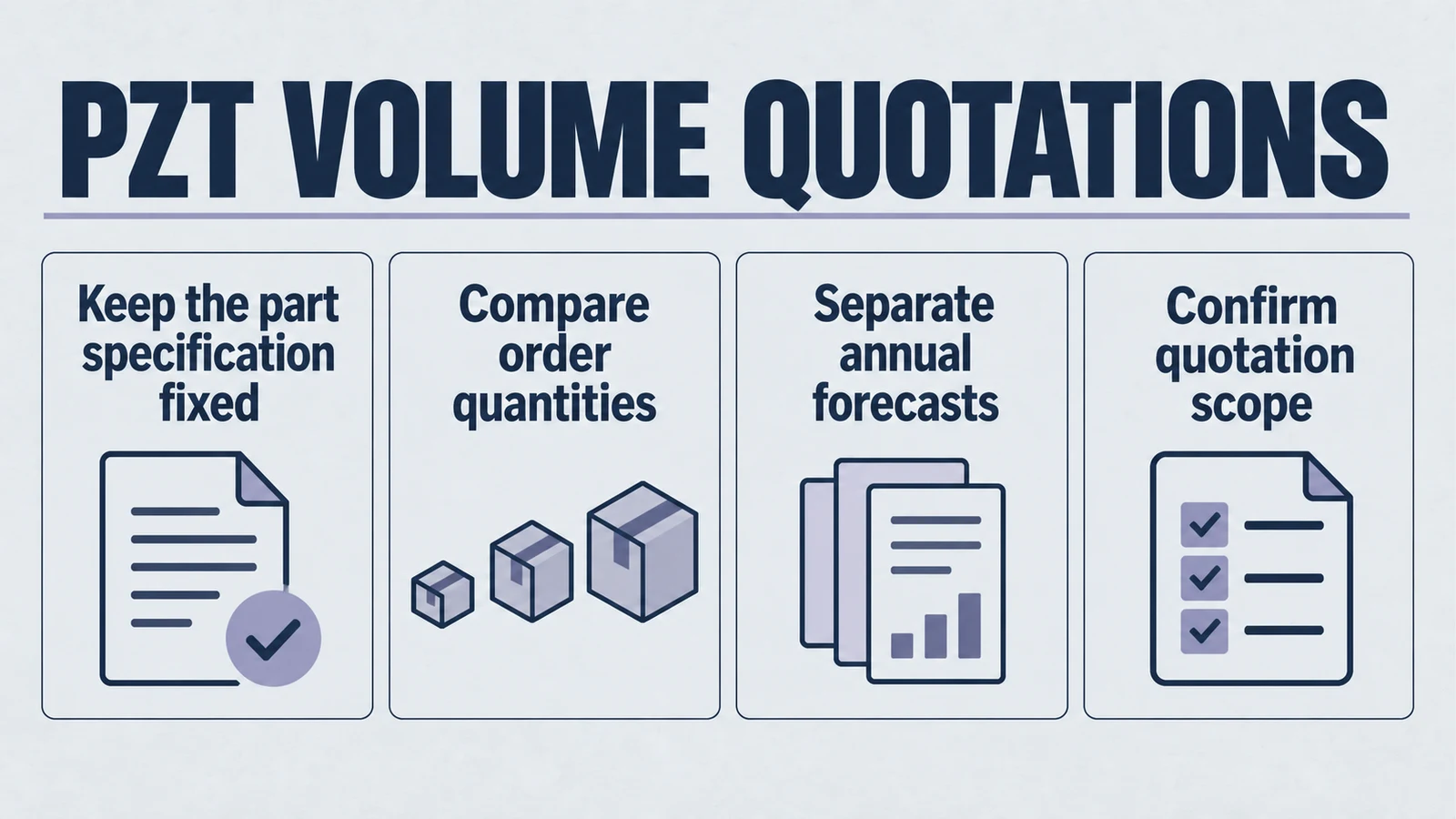
Custom PZT ceramic pricing depends on the part specification, the quantity made in each batch and the scope of supply. To compare bulk quotations, send the same dimensions, material requirement and electrode arrangement with each quantity you want quoted. An estimated annual requirement is useful, but it should be listed separately from the order you are ready to place.
This guide is for buyers sourcing ceramic discs, rings, plates and tubes for equipment production or regular replenishment. It explains the information behind a useful quotation. Individual prices, minimum order quantities and delivery arrangements are confirmed for the actual part and order.
What affects the price of a custom PZT ceramic part?
A description such as “PZT ring” leaves several manufacturing decisions open. Two rings can look similar while requiring different material, machining, electrodes or inspection. Before comparing suppliers, establish what each quotation includes.
| Quotation input | What to specify | Why it matters |
|---|---|---|
| Material | Requested grade or the material currently used | A common family name does not fully define every supplier's material. |
| Shape and dimensions | All relevant dimensions and units | Material use and processing depend on the actual geometry. |
| Tolerances | Required limits, especially at assembly interfaces | Additional precision can change machining and inspection requirements. |
| Electrodes and polarization | Coverage, connection arrangement and known requirements | Different arrangements can require different processing steps. |
| Inspection and records | The checks or documents your purchase requires | Special requirements should be included in the quotation scope. |
| Quantity and delivery | Order quantities and any requested split shipments | Production batches and delivery releases are separate planning inputs. |
For a simple shape, dimensions and quantity are enough to start an enquiry. Add the remaining requirements as far as they are known. A formal drawing is helpful when it exists, but a missing drawing should not prevent an initial discussion. Once the specification and supply terms are confirmed, you can order samples for your own testing or place a volume order directly. A sample order is not required for every ceramic purchase. The PZT ceramic RFQ template shows how to describe each common shape.
Check the manufacturing finish behind the same nominal size
A ceramic outline describes the finished shape, but it does not describe every operation needed to produce it. PI Ceramic's pressing and machining overview explains that a pressed blank can include allowance for later machining. APC also distinguishes as-fired parts from parts with machining tolerances. These are useful distinctions when reading a supplier's offer; neither manufacturer's published tolerances should be assumed to be YJ Piezo's tolerances.
In a purchasing comparison, identify the finished surfaces and dimensions that matter to your assembly. For a ring clamped between metal faces, the thickness and mating faces deserve explicit attention. For a plate located inside a housing, a particular edge or overall envelope may control fit. Ask for the requirement that serves the assembly, rather than adding the tightest possible tolerance to every surface. The supplier can then price a defined part without silently changing the finish or inspection scope.
A scope comparison that does not need a public price list
The following is an illustrative enquiry comparison, not a customer quotation or a statement of stock availability. Imagine that your drawing already defines a ring's material, dimensions and electrodes:
| Request | Keep fixed | Ask the supplier to identify |
|---|---|---|
| Different order quantities | The same agreed specification and inspection requirements | The quotation applicable to each quantity |
| Additional lead attachment | The ceramic drawing, with the new connection requirement listed separately | Whether lead attachment is included, available and separately specified |
| Additional inspection records | The part itself | Which checks, sampling and records are included in that offer |
This keeps a scope change visible. A bare part and a part with extra preparation or documentation can both be valid offers, but they answer different purchasing requests. Send alternatives on separate lines instead of allowing the supplier to choose one without identifying it.

Video: Why Custom Piezo Ceramic Samples Cost More
This YJ Piezo video explains how setup, manual processing, trial and selection, and tooling can affect sample pricing. Which costs carry over to production depends on the part and process. Request separate sample and production quotations, with any tooling or one-time charges identified separately.
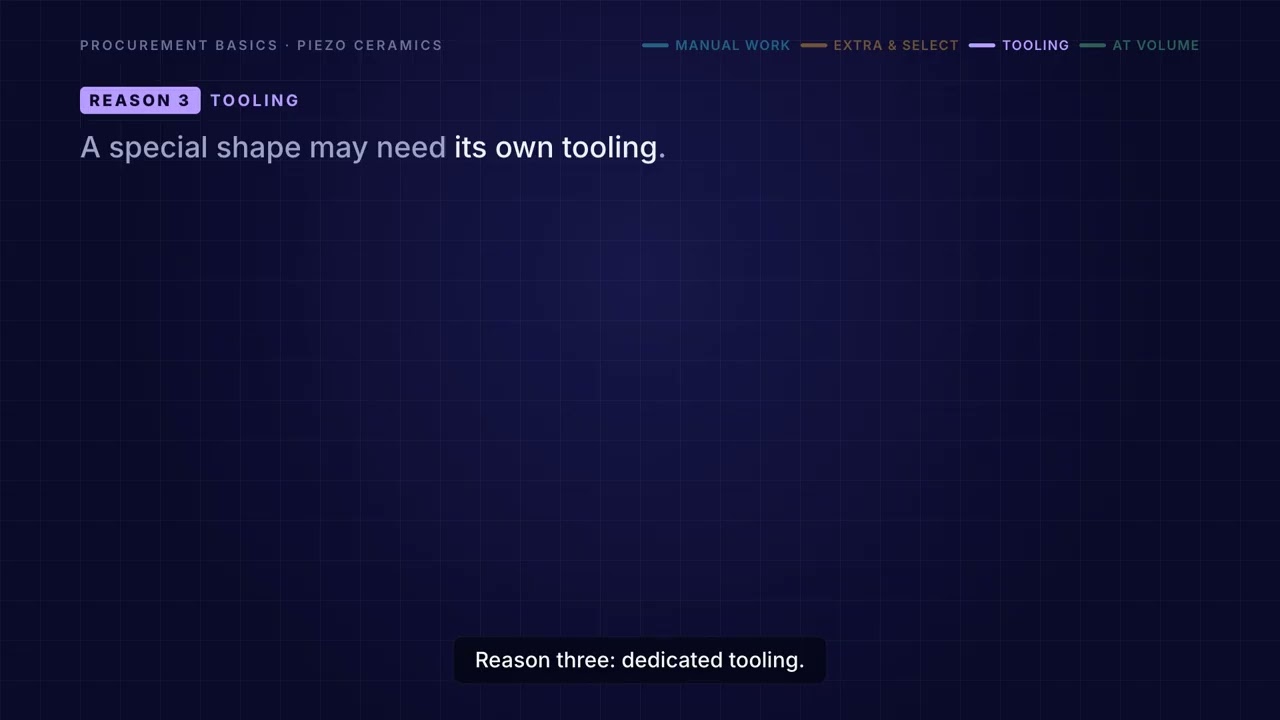
Watch the sample pricing guide on YouTube.
Keep the part fixed when requesting quantity breaks
A quantity break is a quotation for a different order quantity of the same specified part. Requesting several quantities helps purchasing teams compare the practical options for a first order, a normal production batch and a larger replenishment order.
Use one part reference and one agreed specification across the comparison, including the drawing revision if a drawing is used. If you also want to compare two materials or electrode layouts, ask for separate alternatives. Otherwise, a change in specification can be mistaken for a change caused by quantity.
Manufacturing setup and processing can make batch size relevant to the quotation. The relationship is specific to the part: a larger requested quantity does not establish a universal discount or a guaranteed price reduction. Ask the supplier to quote the quantities that reflect your purchasing options.
Separate this order from expected annual demand
The quantity needed now, the usual order size and the expected annual requirement answer different questions. A supplier needs to know whether the enquiry concerns one confirmed purchase, several planned releases or an early forecast for a product that is still being evaluated.
- This order: the quantity you currently want to purchase or compare.
- Normal batch: the quantity you expect to reorder at a time, if known.
- Annual requirement: an estimate of total demand, clearly labelled as an estimate.
- Delivery plan: whether you need one shipment or would like to discuss separate releases.
A forecast helps explain the opportunity; it is not automatically a purchase commitment or a basis for reserved stock. If quantities are uncertain, give the known order requirement and mark the rest “to be determined.” Samples for an existing product and normal dimensional customization remain valid starting points.
Compare the complete quotation scope
When quotations arrive, check the part reference before comparing the commercial terms. Confirm the currency, quoted quantity, unit price, any applicable one-time charges, packaging, transport scope, payment terms and quotation validity. Ask whether requested inspection records are included or need to be listed separately.
A price for a bare ceramic element cannot be compared directly with a price for a wired element or an assembled transducer. Likewise, an order delivered in one shipment has a different supply scope from a request for multiple deliveries. Write these differences into your comparison rather than assuming all quotations cover the same work.
If a quotation includes an alternative to your original specification, ask for the alternative to be identified explicitly. Procurement and engineering can then decide whether to accept it before the order is released.
A volume quotation request you can copy
Replace the bracketed fields with your own requirements. No target selling price or budget is needed to use this template.
Subject: Volume quotation request — PZT ceramic [shape / part reference]
Hello YJ Piezo,
Please quote the following ceramic component:
Shape and dimensions, with units: [details]
Material or current grade: [known requirement / unknown]
Electrode and polarization requirements: [details / unknown]
Drawing reference and revision, if available: [reference]
Quantities to compare: [quantity A / quantity B / quantity C]
Expected repeat batch and annual requirement, if known: [details]
Requested delivery destination and timing: [details]
Additional inspection, packaging or documentation requirements: [if applicable]Please identify any proposed specification changes and confirm the scope included in your quotation.
Frequently asked questions about bulk PZT ceramic pricing
Can I request a quote for a size outside the catalogue?
Yes. YJ Piezo's catalogue models are examples. Common ceramic shapes can be reviewed in the dimensions you need. Send the dimensions and quantity, with material and electrode requirements where known, through the custom piezoelectric components enquiry page.
Is there one minimum order quantity for all piezo ceramics?
No single quantity should be assumed across different ceramic parts. Ask for the applicable minimum and quotation against your actual shape, dimensions and specification. A sample quantity and a repeat production quantity can be discussed separately.
Can a sample quotation be used as the production price?
Request a separate production quotation. The quantity, confirmed specification and supply requirements may differ from the sample order. Include the sample or drawing reference so that both quotations refer to the intended component.
What if I only know the dimensions and quantity?
Send those first. Add a part photo, current material label or application description if available. Mark missing information as unknown so it can be clarified without delaying the first enquiry.
Request a quotation for your ceramic component
Browse the PZT disc, ceramic ring, rectangular plate and piezo tube series, or send your own dimensions. Contact YJ Piezo with the part details and quantities you want quoted.
If you are changing suppliers, use the second-source PZT ceramics guide. For an existing approved part, the repeat-order checklist helps prepare the next purchase.
About this guide and its evidence
This purchasing guide is published by YJ Piezo, which coordinates international component enquiries with manufacturing operations in Wuxi. The examples explain how to describe the item being purchased; they do not establish a universal price, tolerance or inspection package. Our component supply page and material reference provide the first-party product context.
The cover summarizes the inputs for comparing volume quotations. The quotation diagram is explanatory; neither image represents a customer quotation, a price commitment or a production record.
External References
- PI Ceramic — pressing and subsequent machining: manufacturing context for specifying a finished component.
- APC International — ceramic element tolerances: an example of why machining scope must be identified. Its values are APC's, not YJ's.