
Why Quality Matters in Piezoelectric Components for Medical and Industrial Use
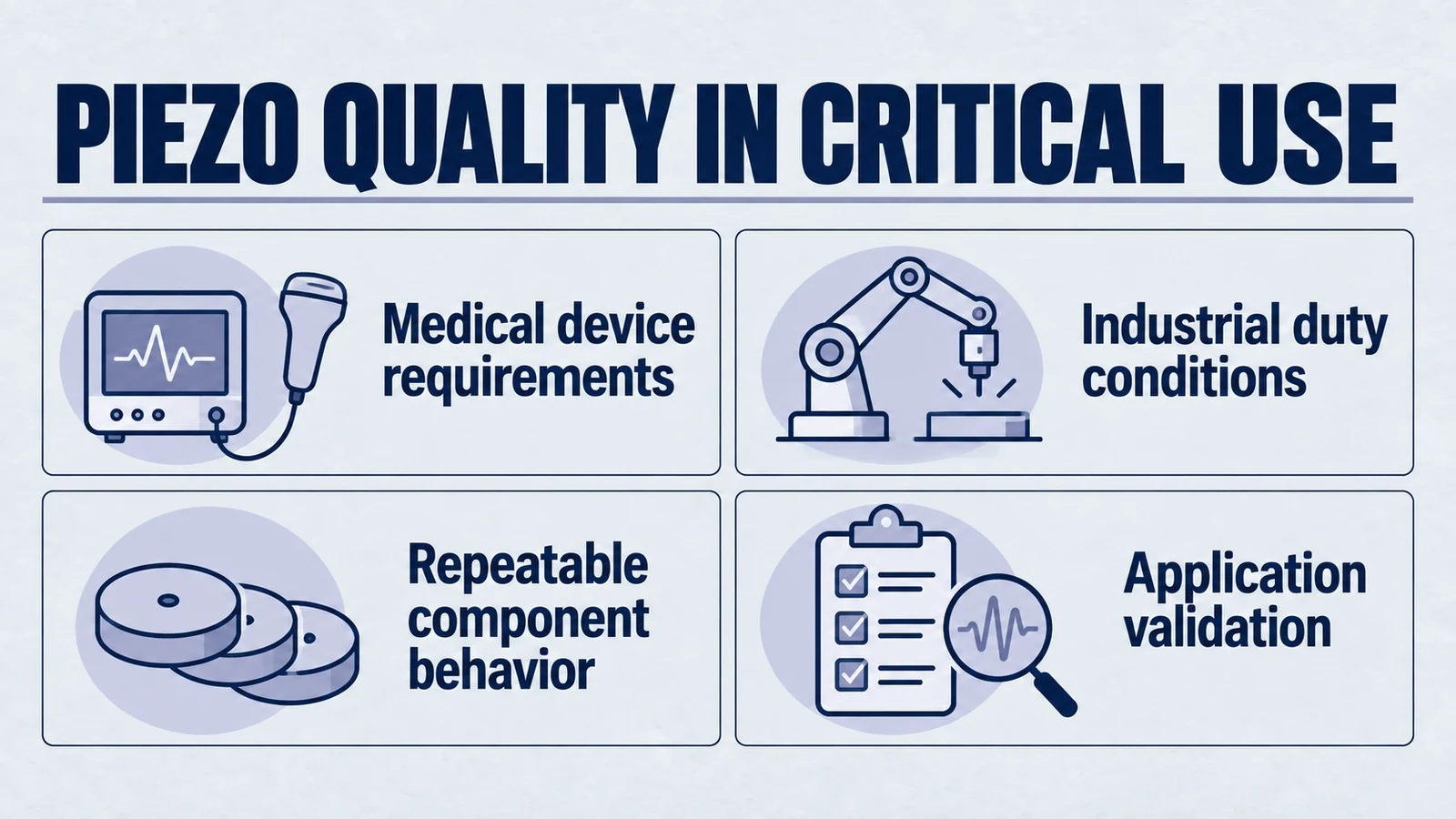
Piezoelectric components are important elements in both medical and industrial systems, where precision, reliability, and durability matter. From ultrasound imaging devices to factory automation sensors, the consistency of these components can influence the overall performance of the end application. In demanding environments, weak component control can contribute to drift, field failures, downtime, or difficult validation work. This article explains why quality in piezoelectric components deserves early engineering attention.
Understanding Piezoelectric Components
Piezoelectric components operate on the principle of converting mechanical energy into electrical energy and vice versa. These components typically include piezoelectric ceramics, transducers, actuators, and sensors. Their function and application depend on the precise mechanical and electrical characteristics of the materials used, including piezoelectric constants, dielectric loss, coupling coefficients, and mechanical strength.
The foundation of all piezoelectric components lies in understanding the science behind piezoelectricity and selecting appropriate PZT materials for specific applications.
Product path for this search intent
Match the article topic to the right YJ Piezo product page
Use this article when the risk is supplier selection, engineering support, validation evidence, integration reliability, and whether the manufacturer can scale from sample to production. For "Why Quality Matters in Piezoelectric Components for Medical and Industrial Use", the practical value is in turning the topic into a measurable selection or sourcing decision.
- Ultrasonic Transducer Supplier Hub
OEM sourcing and engineering collaboration
- PZT Material Supplier Hub
Material control and grade selection
- Piezoelectric Ceramics
Ceramic manufacturing and custom shapes
The Stakes in Medical Applications
In medical devices such as ultrasound imaging systems, surgical tools, and diagnostic sensors, quality is paramount. For example:
- Imaging Consistency: High-performance piezoelectric transducers can support stable acoustic output and receive sensitivity when they are integrated into a validated imaging system. Learn more about advantages of piezoelectric sensors in medical devices.
- Device Risk Control: Material selection, encapsulation, sealing, and electrical isolation should be evaluated within the finished product design. Our piezoelectric ceramic components support those engineering evaluations.
- Regulatory Documentation: Finished medical devices must meet applicable quality and regulatory requirements. Component-level test data, traceability, and process control can support that evidence package, but do not replace finished-device validation.
The importance of quality in adjacent healthcare and beauty-device applications is further emphasized in our analysis of piezoelectric materials in the beauty industry, where precision, sealing, and repeatable output are important design concerns.
Industrial Demands: Reliability and Efficiency
In industrial environments, piezoelectric components power applications such as:
- Precision Manufacturing: Actuators and sensors are used in micro-positioning and vibration control, where submicron accuracy is essential. Explore our custom piezo actuator solutions.
- Condition Monitoring: Piezoelectric sensors detect vibrations, pressure, or strain, enabling predictive maintenance and minimizing unplanned downtime. Understanding factors affecting sensor sensitivity is crucial for these applications.
- Harsh Environments: Components must withstand high temperatures, corrosive conditions, or mechanical stress. Low-quality components degrade quickly and fail to perform. Our underwater transducers exemplify durability in challenging conditions.
The versatility of piezoelectric components across industries is detailed in our comprehensive guide to applications of piezoelectric transducers across industries.
What Constitutes a "High-Quality" Piezoelectric Component?
Several factors define the quality of a piezoelectric component:
- Material Purity: High-grade ceramics (e.g., PZT formulations) require defined composition, microstructure and application-specific performance verification. Learn about PZT powder analysis for material selection.
- Manufacturing Precision: Tolerance control, uniform polarization, and surface finishing significantly impact performance and longevity. Our OEM manufacturing guide explains these critical processes.
- Testing and Validation: Rigorous testing (impedance analysis, aging tests, high-frequency response) supports qualification within the tested operating conditions; it does not guarantee every service outcome.
- Customization Capability: The ability to tailor dimensions, frequencies, and coatings ensures better integration into end-user systems. Explore our range of disc series, ring series, and tube series options.
Risks of Using Low-Quality Components
Cost-cutting by using low-grade piezoelectric components can result in:
- Device Failure: Malfunctions in critical applications such as medical diagnostics or automation lines
- Inconsistent Performance: Fluctuations in signal strength, sensitivity, or resonance frequency that affect piezoelectric sensor performance
- Higher Long-Term Costs: Increased need for replacements, recalibration, and system downtime
- Brand Reputation Damage: Device failures linked to component quality can severely impact OEM credibility
How to Source High-Quality Piezoelectric Components
For companies seeking to integrate piezoelectric components into their products, the following sourcing strategies are recommended:
- Evaluate Supplier Experience: Prefer suppliers with a proven track record in medical and industrial applications. Learn about strategic advantages of OEM partnerships.
- Request Performance Data: Ensure availability of detailed datasheets and test reports. Our procurement checklist provides essential questions to ask suppliers.
- Ask for Samples: Testing in real application settings before large-scale purchasing is crucial
- Check Certifications: ISO 9001 concerns the supplier’s quality management system; verify current certificate scope and issuer. It is not product certification or clinical authorization. Application-specific documentation is separate. For medical-device programs, confirm which quality-system or regulatory records must be supplied at the finished-device level. Understand the importance of choosing a reliable supplier.
Consider the specific requirements for different applications, such as ultrasonic cleaning systems, welding applications, or flow measurement devices.
Quality in Specialized Applications
Different applications demand specific quality considerations for piezoelectric components:
- Ultrasonic Cleaning: Components must deliver consistent power and frequency for effective cleaning. Learn how piezoelectric ceramics enhance cleaning efficiency.
- Welding Systems: High-power applications require components that can handle thermal stress and maintain precision over time
- Sensor Applications: Bubble detection sensors and other precision instruments need exceptional sensitivity and stability
- Energy Harvesting: Components for IoT energy harvesting must optimize power conversion efficiency
Future Trends in Component Quality
The future of piezoelectric components is being shaped by emerging technologies and quality standards:
- Advanced Materials: New ceramic formulations and emerging trends in piezoelectric technology are pushing quality boundaries
- Smart Manufacturing: AI-assisted production controls require demonstrated process capability and validated inspection; they do not guarantee identical quality in all piezoelectric components
- Enhanced Testing: Advanced characterization techniques provide deeper insights into component performance and reliability
Design Considerations for Quality
When designing with piezoelectric components, consider these quality-related factors:
- System Integration: Follow design tips for ultrasonic transducer projects to ensure optimal performance
- Material Selection: Understand how to choose the right piezoelectric ceramics for your specific application
- Environmental Factors: Consider operating conditions and their impact on component longevity
Conclusion
In both medical and industrial domains, the quality of piezoelectric components directly affects performance, reliability, and cost of ownership. As innovation drives demand for more sophisticated applications, selecting well-controlled piezoelectric components is a strategic engineering decision. Investing in quality up front can reduce drift, rework, and qualification delays.
Understanding the science behind ultrasonic transducers and staying informed about future developments in piezoelectric ceramics will help you make informed decisions about component quality.
For guidance on selecting piezoelectric components for medical or industrial device programs, contact us at business@szyujie.com or visit yujiepiezo.com.
Explore our comprehensive range of premium piezoelectric materials and discover how quality piezoelectric components can enhance your product's performance and reliability.
Engineering decision notes
OEM integration and supplier qualification
Use this article when the risk is supplier selection, engineering support, validation evidence, integration reliability, and whether the manufacturer can scale from sample to production. For "Why Quality Matters in Piezoelectric Components for Medical and Industrial Use", the practical value is in turning the topic into a measurable selection or sourcing decision.
YJ Piezo combines direct project coordination with ceramic manufacturing support, so procurement and engineering teams can evaluate material control, application review, sample validation, and production consistency together.
Selection checks
- Ask whether the supplier controls ceramic manufacturing or only assembles purchased elements.
- Review sample policy, inspection records, engineering response quality, and production lead-time stability.
- Compare suppliers and integration paths by validation evidence, not only by unit price and datasheet similarity.
Failure risks
- A low-price sample can pass early tests but fail when batch variation, thermal load, or assembly stress appears.
- A supplier without material control may not explain why impedance, capacitance, or resonance drift occurs.
- Weak RFQ information leads to quotes that are fast but not technically comparable.
RFQ details
- What application, operating environment, and failure cost should the supplier design around?
- Which sample tests and outgoing records are required before pilot production?
- What customization, MOQ, tooling, and delivery constraints must be known before quotation?
Relevant YJ Piezo pages
- Ultrasonic Transducer Supplier Hub
OEM sourcing and engineering collaboration
- PZT Material Supplier Hub
Material control and grade selection
- Piezoelectric Ceramics
Ceramic manufacturing and custom shapes
Application FAQ
- How should an OEM compare piezoelectric suppliers?
- Compare material control, engineering support, test evidence, customization ability, sample policy, and batch consistency. Unit price matters, but only after the technical risk is understood.
- What makes an RFQ technically useful?
- A useful RFQ includes application, dimensions, target frequency, electrical limits, duty cycle, operating medium, environment, expected quantity, required reports, and current failure or replacement context.