
When to Choose a Custom Ultrasonic Transducer Solution
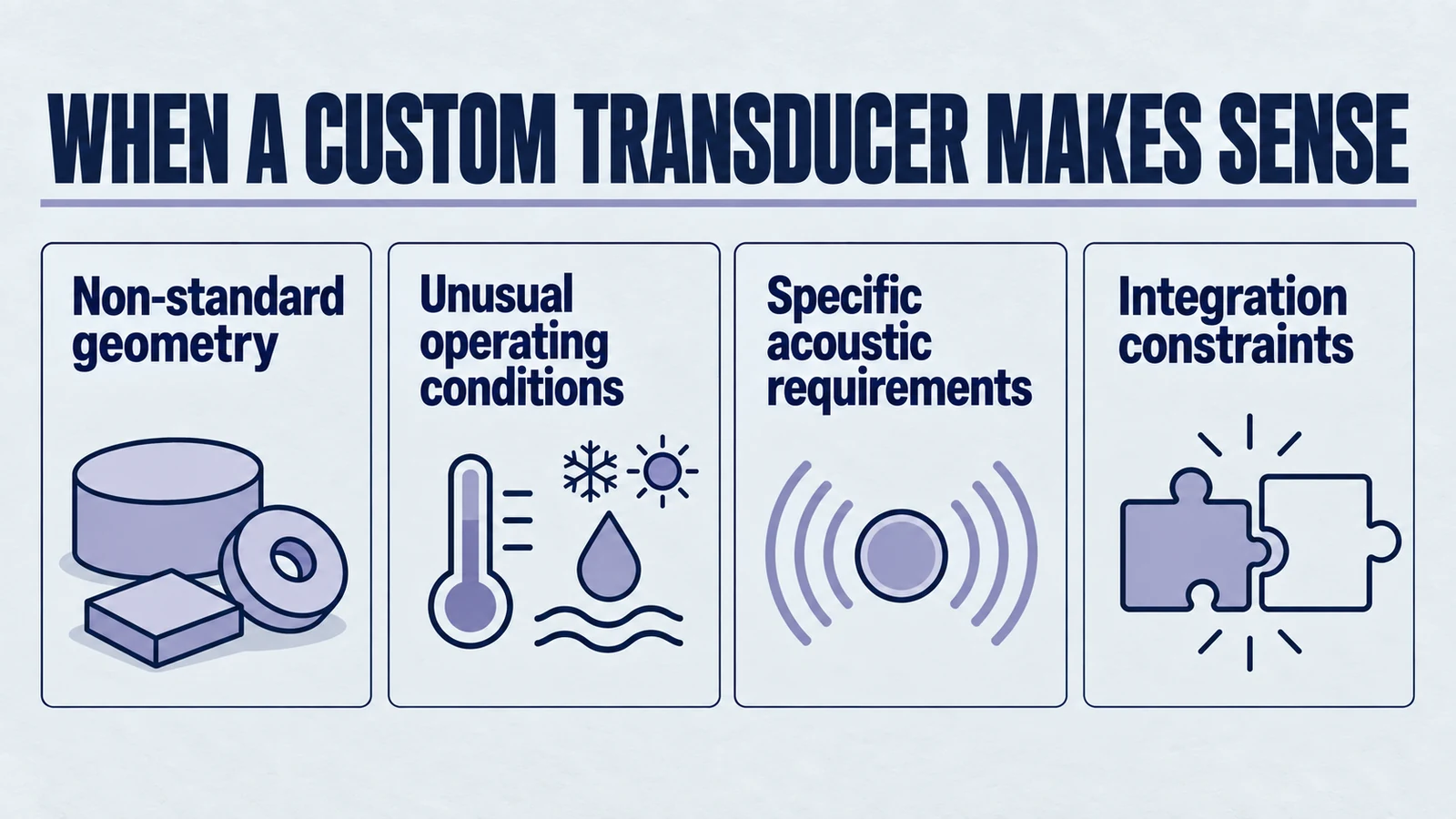
Ultrasonic transducers are essential components in many advanced technological applications. However, not all ultrasonic transducers are created equal, and often, off-the-shelf solutions don't meet specific project needs. This is where custom ultrasonic transducers come into play. But how do you know when it's the right time to choose a custom solution?
Understanding Custom Ultrasonic Transducers
Custom ultrasonic transducers are specifically engineered to meet precise operational parameters and performance requirements. Unlike standard, mass-produced transducers, custom solutions allow businesses to achieve optimal functionality, greater efficiency, and superior reliability tailored to their unique application.
Key Advantages of Custom Piezoelectric Components
Product path for this search intent
Match the article topic to the right YJ Piezo product page
Use this article when the risk is supplier selection, engineering support, validation evidence, integration reliability, and whether the manufacturer can scale from sample to production. For "When to Choose a Custom Ultrasonic Transducer Solution", the practical value is in turning the topic into a measurable selection or sourcing decision.
- Ultrasonic Transducer Supplier Hub
OEM sourcing and engineering collaboration
- PZT Material Supplier Hub
Material control and grade selection
- Piezoelectric Ceramics
Ceramic manufacturing and custom shapes
1. Precision Performance
Off-the-shelf transducers are designed to satisfy general industry requirements and might not cater to niche or highly specialized applications. Custom ultrasonic transducers, on the other hand, ensure precise acoustic properties, resonant frequencies, and power handling capabilities tailored specifically for your project.
2. Enhanced Integration
Standard products often require additional modifications to integrate effectively into existing systems. Custom piezoelectric components can be designed for seamless integration, minimizing adjustments and reducing system complexity.
3. Reliability and Durability
Custom ultrasonic transducers undergo rigorous testing and quality assurance tailored to specific operational conditions, ensuring higher durability, better lifespan, and reduced maintenance needs.
4. Scalability and Flexibility
A tailored design ensures flexibility, enabling easy scalability or adaptability to evolving technology trends or market demands, ensuring long-term investment viability.
When Should You Opt for a Custom Ultrasonic Transducer?
1. Highly Specialized Applications
If your project involves unique or non-standard operating conditions, such as extreme temperatures, pressures, or specific fluid dynamics, a custom ultrasonic transducer is essential. Applications like aerospace, automotive engine monitoring, and specialized medical imaging systems commonly require bespoke components.
2. Exact Frequency and Sensitivity Requirements
When precise control over ultrasonic frequencies and sensitivities is crucial, standard solutions often fall short. Custom solutions can finely tune these parameters to match exact operational needs, enhancing performance and reliability. For applications requiring specific frequencies, consider our high-frequency acoustic transducers or precision flow measurement transducers.
3. Space and Design Constraints
Projects facing tight spatial constraints or requiring specific form factors greatly benefit from custom-designed ultrasonic transducers. Customized geometry and dimensions enable efficient integration without compromising performance. Our compact beauty device transducers demonstrate how space-efficient designs can deliver powerful performance.
4. Compliance and Certification
Industries such as medical, aerospace, and automotive often face stringent regulatory requirements. Custom transducers are designed to comply with specific standards and certifications, helping streamline the approval process and ensuring compliance from day one.
5. High-Performance Demands
In applications demanding high power handling, exceptional durability, or extraordinary acoustic precision, standard products rarely suffice. Customized ultrasonic transducers meet these demands by precisely aligning material properties and structural design with performance objectives. Our industrial welding transducers and high-power cleaning transducers exemplify this capability.
Choosing the Right Partner for Custom Ultrasonic Solutions
Selecting the right partner for custom ultrasonic transducer development is crucial. Consider the following factors:
- Expertise and Experience: Ensure your chosen supplier has substantial experience designing and manufacturing piezoelectric components tailored to complex industry needs.
- Engineering Support: A reputable supplier provides robust engineering support, including design consultation, prototyping, testing, and iterative refinement.
- Quality Assurance: Look for suppliers with rigorous quality management systems and a proven track record of reliability and compliance.
- Lead Times and Scalability: Choose a partner that can deliver solutions within reasonable lead times and scale production quickly to meet your project's evolving needs.
Whether you need specialized solutions for bubble detection, underwater applications, or beauty device applications, the right custom approach can transform your application's performance.
Conclusion
Custom ultrasonic transducers are essential when standard solutions can't meet unique demands or specialized performance criteria. By understanding when and why a custom approach is advantageous, companies can leverage tailored piezoelectric components to achieve enhanced functionality, reliability, and competitive advantage in their respective fields. Always collaborate with experienced, reputable suppliers who can deliver precisely engineered solutions to propel your technology forward.
Companion Guides for Supplier Evaluation and Custom Design
Engineering decision notes
OEM integration and supplier qualification
Use this article when the risk is supplier selection, engineering support, validation evidence, integration reliability, and whether the manufacturer can scale from sample to production. For "When to Choose a Custom Ultrasonic Transducer Solution", the practical value is in turning the topic into a measurable selection or sourcing decision.
YJ Piezo combines direct project coordination with ceramic manufacturing support, so procurement and engineering teams can evaluate material control, application review, sample validation, and production consistency together.
Selection checks
- Ask whether the supplier controls ceramic manufacturing or only assembles purchased elements.
- Review sample policy, inspection records, engineering response quality, and production lead-time stability.
- Compare suppliers and integration paths by validation evidence, not only by unit price and datasheet similarity.
Failure risks
- A low-price sample can pass early tests but fail when batch variation, thermal load, or assembly stress appears.
- A supplier without material control may not explain why impedance, capacitance, or resonance drift occurs.
- Weak RFQ information leads to quotes that are fast but not technically comparable.
RFQ details
- What application, operating environment, and failure cost should the supplier design around?
- Which sample tests and outgoing records are required before pilot production?
- What customization, MOQ, tooling, and delivery constraints must be known before quotation?
Relevant YJ Piezo pages
- Ultrasonic Transducer Supplier Hub
OEM sourcing and engineering collaboration
- PZT Material Supplier Hub
Material control and grade selection
- Piezoelectric Ceramics
Ceramic manufacturing and custom shapes
Application FAQ
- How should an OEM compare piezoelectric suppliers?
- Compare material control, engineering support, test evidence, customization ability, sample policy, and batch consistency. Unit price matters, but only after the technical risk is understood.
- What makes an RFQ technically useful?
- A useful RFQ includes application, dimensions, target frequency, electrical limits, duty cycle, operating medium, environment, expected quantity, required reports, and current failure or replacement context.