
How Piezoelectric Materials Support the Beauty Industry
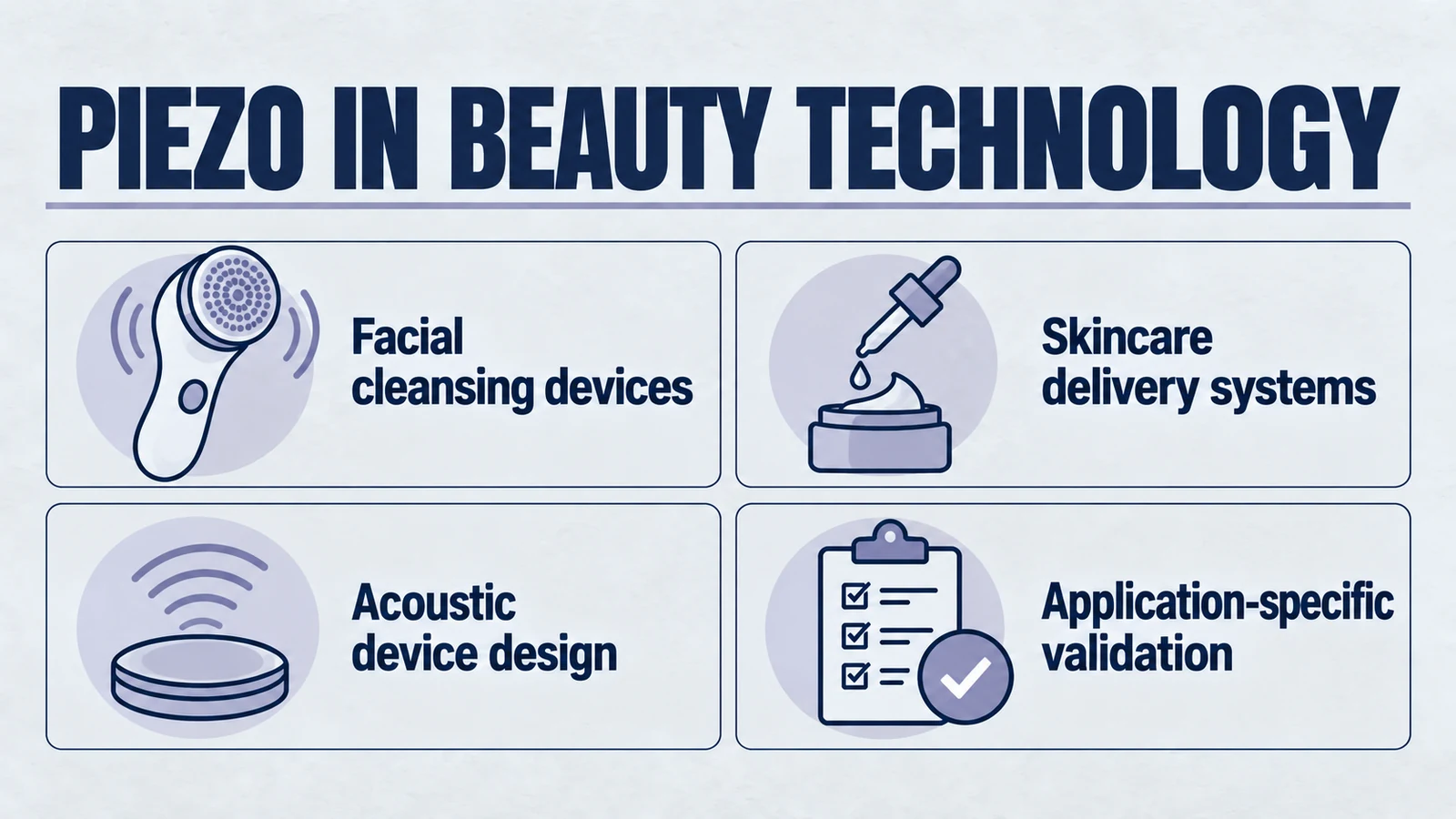
The beauty industry is always changing, using new science and technology to improve skincare tools and procedures. One of the most exciting innovations in recent years is the use of piezoelectric ceramics. These are special materials that were once mainly used in fields like medical imaging and industrial equipment. Now, they are becoming important in beauty devices that help clean, refresh, and treat the skin more effectively.
Whether it's for better face cleansing or more advanced anti-aging tools, piezoelectric materials are helping bridge the gap between electronics and beauty care. As more people look for smart, personalized skincare solutions, the demand for these materials in beauty tech is growing fast.
What Are Piezoelectric Ceramics?
Piezoelectric ceramics are materials that can create electricity when you press or bend them. They can also move or vibrate when you apply an electric current to them. This two-way ability means they can work as sensors (detecting pressure) and as actuators (producing movement).
Product path for this search intent
Match the article topic to the right YJ Piezo product page
Use this article when the choice is not just a shape, but a material tradeoff between sensitivity, loss, coupling, stability, and operating field. For "How Piezoelectric Materials Support the Beauty Industry", the practical value is in turning the topic into a measurable selection or sourcing decision.
- PZT Material Hub
Material grades and application tradeoffs
- Piezoelectric Ceramics
Shapes and ceramic manufacturing options
- PZT Material Supplier Hub
Material control, grade selection, and sourcing support
Most of these ceramics are made from a material called PZT (lead zirconate titanate), but researchers are also working on more eco-friendly versions without lead. These ceramics are small, fast, reliable, and easy to use in compact devices, which makes them perfect for beauty products that need precision.
In skincare tools, this means users can enjoy more controlled, faster, and more targeted procedures—many of which feel like professional spa routines at home.
How Are They Used in Beauty Devices?
Piezoelectric ceramics are being used in many types of skincare and personal care devices. They are not just technical parts—they are what makes the device work. Here are some examples of how they're used:
1. Ultrasonic Facial Cleansing Tools
Distinguish sonic brushes, ultrasonic spatulas and MHz treatment heads. Spatula examples operate in the tens-of-kilohertz range, while other heads may use different frequencies. Giving a frequency for a piezoelectric component does not establish deeper cleaning or efficacy of every finished tool; compare a named device using defined endpoints.
More advanced devices can change the vibration speed and strength to match different skin types, which makes them more comfortable and effective for everyday use.
2. Anti-Aging and Skin-Firming Tools
Piezoelectric ceramics can produce mechanical ultrasound. Microcurrent or iontophoresis, where present, is a separate electrical modality with its own circuit and electrodes. A piezo component alone does not establish collagen production, circulation changes or cell repair; those outcomes require an identified device, protocol and applicable study.
Any wrinkle-reduction or firming claim should identify the finished device, exposure protocol and supporting clinical measurements. Combining ultrasound with light or heat does not automatically establish greater effectiveness.
3. Transdermal Skincare Patches and Devices
Piezoelectric elements can supply vibration for studied ultrasound-mediated delivery mechanisms. Electrical delivery requires a separate electrode/circuit arrangement. Delivery into skin depends on formulation, acoustic exposure and the validated device; it is not guaranteed for arbitrary skincare ingredients.
Ingredient uptake and product consumption are measurable device/formulation outcomes. Do not infer faster action or less waste from vibration alone; future delivery concepts require their own validation.
4. Hair Growth and Scalp Care
Piezoelectric components may support experimental ultrasound systems. Preclinical hair-growth studies do not establish prevention or reversal of hair loss by generic commercial scalp tools. Identify the actual study, device and development status before making an outcome claim.
For combined ultrasound/light systems, evaluate each modality and the finished protocol using directly applicable evidence; combination alone is not proof of a better hair-loss result.
Why Are Piezoelectric Ceramics So Useful in Beauty Tech?
- Precise and Gentle: They can produce very small, accurate vibrations—ideal for use on the face.
- Small and Light: Perfect for portable, handheld devices.
- Low Energy Use: Great for battery-powered tools that need to last long.
- Device-specific comfort: Comfort and adverse effects depend on output, coupling, skin condition and instructions for use. Noninvasiveness does not establish absence of pain or skin damage.
- Durable: They work well for a long time and are stable even with daily use.
The Future of Piezoelectric Beauty Devices
As beauty tech grows, piezoelectric ceramics will likely be part of many next-generation tools. Scientists are working on new versions of these materials that are flexible, stretchable, and even biodegradable. In the near future, we may see:
- Skin patches that move and adjust using built-in piezoelectric sensors
- Smart devices that change their settings based on your skin's needs
- Temporary implants that deliver skincare ingredients slowly over time
Piezoelectric materials might also show up in wellness tools for sleep, stress relief, or even hormone tracking, as the line between beauty and health continues to blur.
In Summary
Piezoelectric ceramics can support controlled motion in beauty-device designs. Finished-device effectiveness, comfort and safe exposure still require appropriate validation and instructions.
For anyone studying engineering, materials science, or product design—and interested in the beauty tech world—this is an exciting area with real growth potential. As more companies invest in these materials, we'll see more creative, high-performance beauty devices hitting the market.
To learn more about our piezoelectric products and how they can be used in beauty applications, or to discuss custom solutions for your beauty tech needs, please contact our team.
Engineering decision notes
PZT material and ceramic selection
Use this article when the choice is not just a shape, but a material tradeoff between sensitivity, loss, coupling, stability, and operating field. For "How Piezoelectric Materials Support the Beauty Industry", the practical value is in turning the topic into a measurable selection or sourcing decision.
YJ Piezo coordinates PZT ceramic projects with manufacturing support, so material formulation, sintering, polarization, electrode process, and outgoing inspection can be reviewed against the final application.
Selection checks
- Separate sensing needs from high-power actuation needs before comparing d33 or coupling values.
- Check dielectric loss, Qm, Curie temperature, aging behavior, and operating field against the real duty cycle.
- Confirm whether the application needs standard PZT grades or a custom formulation and geometry.
Failure risks
- Choosing only the highest d33 can create heat, drift, or depolarization risk in power ultrasonics.
- A ceramic that performs well in free measurement can fail once bonded, clamped, or loaded.
- Material substitutions without batch testing can change capacitance, resonance, and system tuning.
RFQ details
- Is the part used for sensing, actuation, atomization, cleaning, welding, or measurement?
- What field strength, temperature, duty cycle, and mechanical load will the ceramic see?
- Which values must be controlled: d33, capacitance, resonance, impedance, Qm, or dimensional tolerance?
Relevant YJ Piezo pages
- PZT Material Hub
Material grades and application tradeoffs
- Piezoelectric Ceramics
Shapes and ceramic manufacturing options
- PZT Material Supplier Hub
Material control, grade selection, and sourcing support
Application FAQ
- Is the highest d33 always the best PZT choice?
- No. High d33 can be useful for sensitivity, but high-power ultrasonic systems often need lower loss, higher Qm, better thermal stability, and safer operation under field and stress.
- What makes PZT material selection different from catalog buying?
- The right PZT choice depends on geometry, load, drive field, duty cycle, temperature, and inspection targets. A catalog value is only useful when it is tied to the final assembly conditions.