
Beyond the Datasheet: Why Your Choice of Lead Zirconate Titanate Supplier Defines Product Success
Introduction: The Critical Decision Behind Every High-Performance Device
At the heart of countless modern technologies lies an unseen engine: the piezoelectric component. From medical ultrasound imaging to deep-sea sonar arrays, the performance and reliability of the entire system are closely linked to the quality of its core lead zirconate titanate (PZT) ceramic. While often small and internal, this component's impact is significant, converting electrical energy into mechanical force and back again with a precision that drives innovation across industries.
This reality presents a procurement paradox for engineers, product designers, and supply chain managers. On the surface, datasheets from various lead zirconate titanate suppliers can appear nearly identical, listing similar specifications for dielectric constants, piezoelectric coefficients, and coupling factors. This superficial similarity creates a challenging landscape where the true differentiators are obscured, leading many to believe the choice is a simple matter of cost and availability. This assumption, however, represents a critical strategic error.
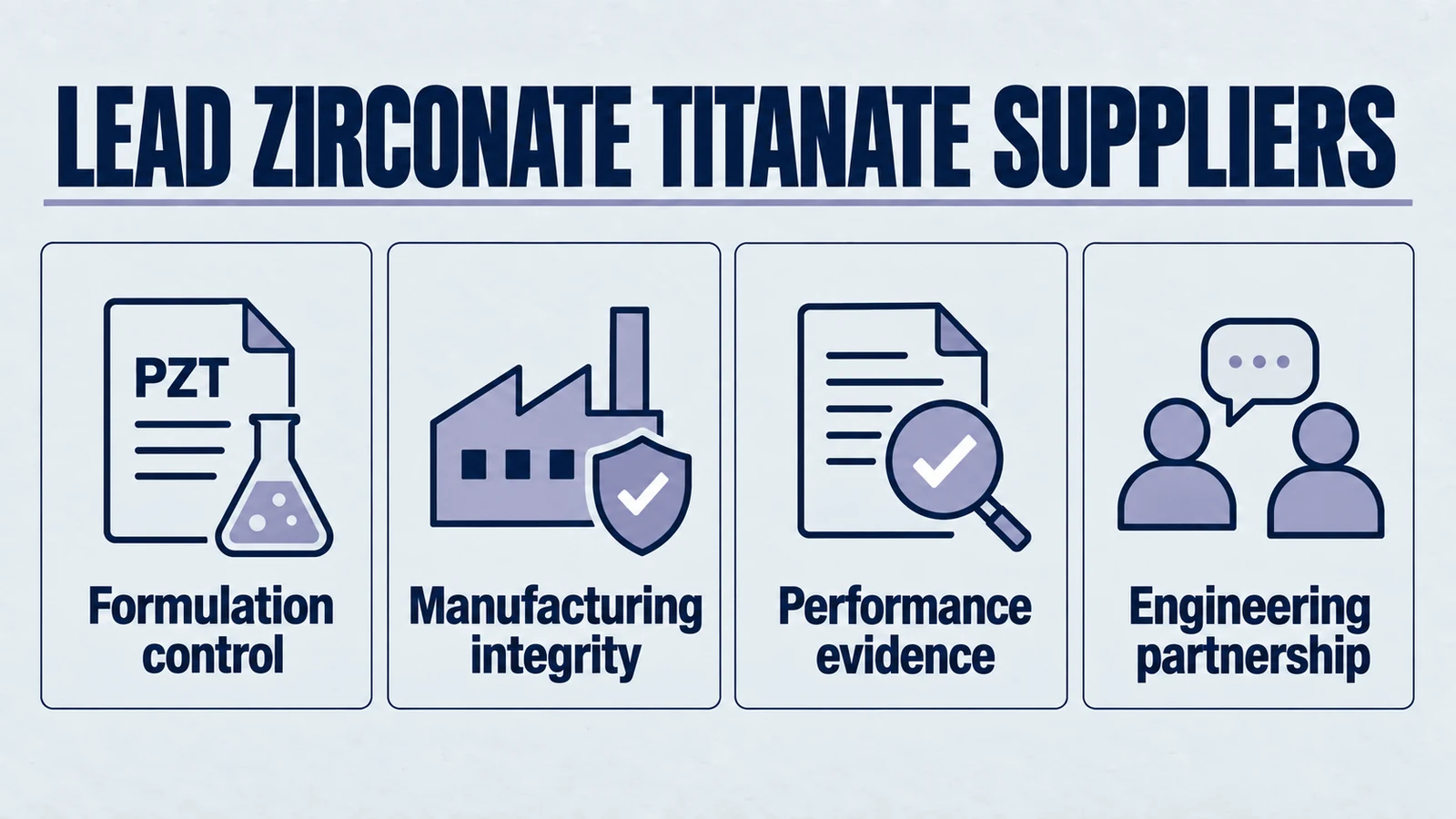
Selecting a lead zirconate titanate supplier is one of the most consequential decisions in the product development lifecycle. A truly rigorous evaluation must look beyond the datasheet to scrutinize the foundational pillars that determine real-world performance and long-term reliability: deep material science expertise, verifiable manufacturing integrity, and a genuine partnership framework. This analysis serves as a guide to that deeper evaluation, using the standards established by Yujie Technology over nearly three decades of dedicated innovation and manufacturing excellence.
Product path for this search intent
Match the article topic to the right YJ Piezo product page
Use this article when the choice is not just a shape, but a material tradeoff between sensitivity, loss, coupling, stability, and operating field. For "Beyond the Datasheet: Why Your Choice of Lead Zirconate Titanate Supplier Defines Produ...", the practical value is in turning the topic into a measurable selection or sourcing decision.
- PZT Material Hub
Material grades and application tradeoffs
- Piezoelectric Ceramics
Shapes and ceramic manufacturing options
- PZT Material Supplier Hub
Material control, grade selection, and sourcing support
1. Material Mastery: The Science Behind Superior PZT Performance
The journey to superior piezoelectric performance begins at the atomic level. A supplier's ability to manipulate and control the fundamental properties of PZT ceramic is the primary determinant of a component's ultimate capability. This requires a level of expertise that transcends standard production and enters the realm of material science.
Deconstructing the Myth of Standardization
Industry designations such as PZT-4, PZT-5A, or PZT-8 do not refer to rigid, universally agreed-upon chemical formulas. Instead, they describe broad "families" of materials, each characterized by a general set of performance traits. For instance, the PZT-4 family is known for "hard" properties like a high mechanical quality factor (Qm) and low dielectric loss, making it suitable for high-power applications. Conversely, the PZT-5 family exhibits "soft" properties like high sensitivity, ideal for piezoelectric sensors. The critical point is that two suppliers offering a "PZT-4" component could be providing materials with vastly different performance profiles under specific, real-world stress conditions. A simple datasheet comparison is therefore insufficient, as it fails to reveal the nuanced engineering that distinguishes a commodity-grade material from a truly optimized solution. For guidance on selecting the right shape for your application, consult our piezoelectric ceramics geometry guide.
The Critical Role of Formulation and Doping
True performance is engineered through meticulous control over the material's composition. This process starts with the elemental building blocks, demanding the use of high-purity (e.g., 99.9%+) lead, zirconium, and titanium oxides to serve as a stable foundation for predictable properties. From this base, expert manufacturers develop proprietary formulations by introducing specific doping agents in precise quantities to "tune" the ceramic's characteristics. Donor dopants like Lanthanum (La) can be used to create "soft" PZT with higher piezoelectric coefficients and sensitivity, while acceptor dopants are used to create "hard" PZT with greater stability under high electric fields. This deliberate chemical engineering is what transforms a generic ceramic into a solution tailored for a specific application, whether it's a high-power ultrasonic welding transducer or a highly sensitive acoustic sensor.
The Yujie Benchmark: Quantifiable Performance
This mastery of material science is not merely theoretical; it manifests in tangible, measurable performance advantages that directly impact device design and reliability. By providing specific, superior metrics, a manufacturer offers more than a component; they offer a higher threshold of performance upon which engineers can build a competitive advantage.
- Ultra-Low Loss for High-Power Applications: For demanding systems like industrial ultrasonic cleaners and naval sonar, energy efficiency and thermal management are paramount. Yujie has engineered PZT materials that achieve a dielectric loss tangent (tanδ) as low as 0.004. A tanδ value requires exact-grade, frequency, field and temperature conditions. It characterizes one loss contribution; loaded high-drive heating, useful-output efficiency and lifetime also depend on mechanical/interface/driver losses and cooling, and require validation.
- High Sensitivity for Precision Sensing: In applications where clarity and precision are important, such as medical imaging equipment and non-destructive testing (NDT), the material's sensitivity is a key performance indicator. Yujie's materials can deliver a shear strain response (d15) reaching up to 950 pC/N. d15 describes shear response; other receive modes require their relevant coefficients. Faint-signal detection, bandwidth and imaging resolution require the properly designed and validated complete system, including its noise budget.
- Case Study: Yujie's P-41 (PZT-4 Class): As a concrete example of this engineered approach, Yujie developed its proprietary P-41 material. While belonging to the PZT-4 family, P-41 is the result of targeted chemical engineering and process optimization designed for endurance. It was formulated to provide resistance to high electric fields and mechanical stability under sustained stress, making it a strong candidate for high-power sonar transducers and industrial ultrasonic drivers where reliability margins must be engineered and tested.
2. Manufacturing Integrity: Forging Consistency from Powder to Polarity
An advanced material formulation is only as good as the manufacturing process that brings it to life. Impeccable process control is the bridge between theoretical performance and real-world reliability. For any organization sourcing components, particularly from overseas, the manufacturing process can feel like a "black box," creating uncertainty around quality and consistency. A premier supplier demystifies this process through transparency, certification, and a long history of refinement.
The Process Defines the Product
The transformation of raw powder into a functional, polarized ceramic involves several thermally and electrically sensitive stages. Expertise at each step is non-negotiable for producing a high-quality component.
- Calcination and Milling: This initial stage involves heating the raw oxides to trigger a homogenous chemical reaction, forming the PZT compound. Subsequent milling achieves a precise particle size distribution, which is critical as it directly affects the ceramic's sintering behavior and final grain structure.
- Sintering: During this high-temperature firing process, the ceramic particles fuse together. The temperature profiles—including ramp rates, soak times, and atmospheric conditions—must be controlled with extreme precision. These parameters determine the ceramic's final density and grain size, which in turn dictate its core mechanical strength and dielectric properties.
- Poling: In its fired state, the ceramic's crystal domains are randomly oriented, resulting in no net piezoelectric effect. The critical poling process involves subjecting the material to a strong DC electric field at an elevated temperature. This aligns the ferroelectric domains, imparting the macroscopic piezoelectric properties to the ceramic. Insufficient control over field strength, temperature, or duration results in underperforming or functionally "dead" components.
The High Cost of Inconsistency
When a supplier lacks rigorous control over these processes, the customer inherits significant business risks. Batch-to-batch performance variations can force costly recalibrations on production lines, leading to delays and inefficiencies. More critically, inconsistent component quality can lead to higher-than-expected failure rates in the field, resulting in warranty claims, product recalls, and brand-quality concerns.
The Yujie Reliability Framework
Yujie counters the risk of inconsistency with a proven, transparent, and scalable manufacturing platform built on decades of experience.
- A Legacy of Refinement: With a history stretching back to 1996, Yujie possesses nearly three decades of institutional knowledge and process optimization. This long track record is a testament to stability and continuous improvement.
- Quality Planning: The drawing, critical parameters, acceptance limits, and available records are reviewed for the selected product.
- Testing and Traceability: Inspection method, sampling level, batch identification, and report fields are confirmed during quotation instead of assumed for every order.
- Scalability: Prototype and production quantities for piezoelectric and ultrasonic components are reviewed against geometry, process, tooling, inspection throughput, and forecast demand.
3. The Partnership Framework: From Component Vendor to Integrated Solutions Provider
In today's complex product development environment, the traditional transactional relationship between a buyer and a component vendor is no longer sufficient. The most successful technology companies seek suppliers who act as strategic partners—collaborators who invest in the customer's success and function as an extension of their own team. This distinction between a vendor and a partner is a crucial factor in evaluating a lead zirconate titanate supplier.
The Strategic Divide: Vendor vs. Partner
A vendor fulfills purchase orders. They provide a datasheet, a quote, and a product that meets a stated specification. A partner, in contrast, engages in a technical dialogue. They seek to understand the application's unique challenges, offer proactive guidance to prevent design errors, and provide comprehensive support throughout the product lifecycle. This deeper level of integration creates immense value, accelerating development timelines and de-risking the entire project. The value of this partnership model is evident in the success stories of companies across diverse global markets, from med-tech startups in Tokyo to major consumer electronics firms in California.
The Pillars of a True Technology Partnership
A genuine partnership is built on a foundation of accessible expertise and a robust service infrastructure. Yujie has structured its entire business model around this principle.
- Deep Application Engineering: Yujie's engineering team, with practical experience built since 1996, is a core asset available to its clients. This team provides technical consultations to help customers select a suitable material formulation and component design for their specific application. This collaborative front-end engineering can reduce design risk, shorten prototyping cycles, and support target performance in the final product.
- Collaborative Co-Development (OEM/ODM): Recognizing that innovation often requires custom solutions, Yujie offers comprehensive OEM and ODM services. This goes far beyond simply manufacturing custom shapes. It is a co-development process that can include rapid prototyping, Finite Element Analysis (FEA) support to simulate performance, and the design of custom assemblies with integrated electrodes, housings, and matching layers. From standard discs, rings, plates, tubes, and hollow spheres to complex geometries, Yujie delivers tailored solutions for all piezoelectric ceramic applications.
- End-to-End Service Infrastructure: A key differentiator is a highly structured support system that covers the entire engagement lifecycle. This system is designed to address the most common pain points in global sourcing: slow communication, lack of transparency, and non-existent post-sale support. Yujie's framework includes:
- Pre-Sale: Most inquiries received on business days are reviewed within 24 hours, followed by technical clarification, available datasheets, sampling discussion, or a qualified facility-visit plan as applicable.
- In-Sale: Real-time production tracking, quality inspection reports, and delivery planning tied to agreed production schedules.
- After-Sale: Lifetime replacement for select components and expert technical support for product integration and troubleshooting.
By integrating with a customer's R&D and operational workflows through this service model, a supplier can become an important part of the value chain. The advantage comes from practical engineering support, documented process control, and a relationship that can adapt as the product matures.
4. The Yujie Standard: A Blueprint for Supplier Excellence
The preceding analysis of material science, manufacturing processes, and partnership models can be synthesized into a practical framework for evaluating any lead zirconate titanate supplier. This evaluation matrix moves beyond surface-level specifications and provides a tool for assessing a supplier's true capability to deliver performance, reliability, and strategic value. The table below contrasts the typical commodity vendor approach with the comprehensive partnership model that defines the Yujie standard.
Table: Evaluating Your Lead Zirconate Titanate Supplier: The Yujie Partnership Standard
| Evaluation Criterion | The Commodity Vendor Approach | The Yujie Partnership Approach (The Yujie Standard) |
|---|---|---|
| Material Formulation | Offers standard "off-the-shelf" materials (e.g., generic PZT-5A). Provides a basic datasheet. | Develops proprietary, application-specific formulations (e.g., P-41 for high power). Provides full performance data, batch traceability, and material science consultation. |
| Manufacturing & Quality | Mentions ISO certification. Relies on batch sampling for quality control. Lead times can be unpredictable. | Provides product-specific inspection requirements, agreed records, and a realistic capacity plan tied to the selected component. |
| Engineering Support | A sales contact who takes specifications and provides a quote. Limited technical depth. | A dedicated engineering team for co-development, FEA simulation support, and deep application-specific guidance. Acts as an extension of the client's R&D team. |
| Service & Supply Chain | Transactional relationship. Support ends after the invoice is paid. Limited visibility into production. | A fully integrated service framework (pre-sale, in-sale, after-sale) with real-time tracking, delivery planning, and long-term technical support. |
This matrix serves as more than a marketing comparison; it is a functional asset for any organization serious about sourcing high-performance components. It provides a clear, actionable checklist for vetting potential suppliers, ensuring that the final decision is based on a comprehensive understanding of a supplier's capabilities and commitment.
Conclusion: Make Your Next Supplier Decision a Strategic Advantage
The selection of a lead zirconate titanate supplier is not a tactical purchase to be delegated to the lowest bidder. It is a strategic investment in a product's performance, a brand's reputation, and a company's long-term success. As demonstrated, a true evaluation must penetrate the surface of the datasheet to assess the deep-seated capabilities in material science, the rigor of the manufacturing process, and the structure of the supplier relationship.
Yujie Technology has built its 28-year legacy on excelling in these three critical areas. The company's commitment to material mastery, manufacturing integrity, and a true partnership framework has made it a trusted global supplier for industries ranging from medical devices and consumer electronics to industrial automation and aerospace.
The most demanding applications require more than a component; they require an engineered solution. Organizations seeking to unlock the peak performance of their next project are encouraged to initiate a technical consultation with Yujie's engineering team. A collaborative discussion about application challenges is the first step toward developing a piezoelectric solution that provides a durable competitive advantage.
Explore our comprehensive PZT material specifications and discover our complete range of ultrasonic transducers and components to experience the Yujie standard firsthand.
Engineering decision notes
PZT material and ceramic selection
Use this article when the choice is not just a shape, but a material tradeoff between sensitivity, loss, coupling, stability, and operating field. For "Beyond the Datasheet: Why Your Choice of Lead Zirconate Titanate Supplier Defines Produ...", the practical value is in turning the topic into a measurable selection or sourcing decision.
YJ Piezo coordinates PZT ceramic projects with manufacturing support, so material formulation, sintering, polarization, electrode process, and outgoing inspection can be reviewed against the final application.
Selection checks
- Separate sensing needs from high-power actuation needs before comparing d33 or coupling values.
- Check dielectric loss, Qm, Curie temperature, aging behavior, and operating field against the real duty cycle.
- Confirm whether the application needs standard PZT grades or a custom formulation and geometry.
Failure risks
- Choosing only the highest d33 can create heat, drift, or depolarization risk in power ultrasonics.
- A ceramic that performs well in free measurement can fail once bonded, clamped, or loaded.
- Material substitutions without batch testing can change capacitance, resonance, and system tuning.
RFQ details
- Is the part used for sensing, actuation, atomization, cleaning, welding, or measurement?
- What field strength, temperature, duty cycle, and mechanical load will the ceramic see?
- Which values must be controlled: d33, capacitance, resonance, impedance, Qm, or dimensional tolerance?
Relevant YJ Piezo pages
- PZT Material Hub
Material grades and application tradeoffs
- Piezoelectric Ceramics
Shapes and ceramic manufacturing options
- PZT Material Supplier Hub
Material control, grade selection, and sourcing support
Application FAQ
- Is the highest d33 always the best PZT choice?
- No. High d33 can be useful for sensitivity, but high-power ultrasonic systems often need lower loss, higher Qm, better thermal stability, and safer operation under field and stress.
- What makes PZT material selection different from catalog buying?
- The right PZT choice depends on geometry, load, drive field, duty cycle, temperature, and inspection targets. A catalog value is only useful when it is tied to the final assembly conditions.