
Custom Piezo Actuator Solutions: Engineering Excellence for Specialized Applications
In high-precision industries, where micrometers matter and performance consistency is non-negotiable, custom piezo actuator solutions stand out as the gold standard. They combine the inherent advantages of piezoelectric materials with tailored engineering to meet the exact requirements of demanding applications. This article explores the fundamentals, advantages, design process, and key application areas for custom piezoelectric actuators, providing engineers and decision-makers with the insights they need to choose the right solution.
Understanding Piezoelectric Actuators
A piezoelectric actuator converts electrical energy into precise mechanical displacement using the piezoelectric effect. When a voltage is applied to a piezoelectric material, it changes shape by a small but highly controllable amount. This movement can be harnessed for:
- Micro-positioning in nanotechnology and optics.
- Precision force control in manufacturing.
- High-frequency motion in medical and ultrasonic applications.
Product path for this search intent
Match the article topic to the right YJ Piezo product page
Use this article when the choice is not just a shape, but a material tradeoff between sensitivity, loss, coupling, stability, and operating field. For "Custom Piezo Actuator Solutions: Engineering Excellence for Specialized Applications", the practical value is in turning the topic into a measurable selection or sourcing decision.
- PZT Material Hub
Material grades and application tradeoffs
- Piezoelectric Ceramics
Shapes and ceramic manufacturing options
- PZT Material Supplier Hub
Material control, grade selection, and sourcing support
While off-the-shelf actuators can serve many purposes, custom-engineered solutions are essential when standard designs fall short of meeting specific performance, form factor, or environmental requirements.
Why Choose a Custom Piezo Actuator?
1. Performance Optimization
Every application has unique parameters — displacement range, load capacity, response time, and operating environment. A custom actuator can be engineered to:
- Deliver maximum displacement without compromising resolution.
- Maintain stability under extreme temperature or vibration.
- Operate efficiently at specific frequencies for resonance tuning.
2. Form Factor and Integration
Custom actuators can be designed to fit into tight spaces, unusual geometries, or seamlessly integrate with existing assemblies, reducing the need for redesigning other system components.
3. Material and Coating Selection
Material choices, such as soft PZT for high sensitivity or hard PZT for high-power applications, can be tailored. Protective coatings or hermetic sealing can be added for harsh environments.
4. Extended Lifespan and Reliability
By matching actuator characteristics to operational loads, stress, and duty cycles, custom solutions ensure longevity and reduce maintenance downtime.
The Engineering Process Behind Custom Solutions
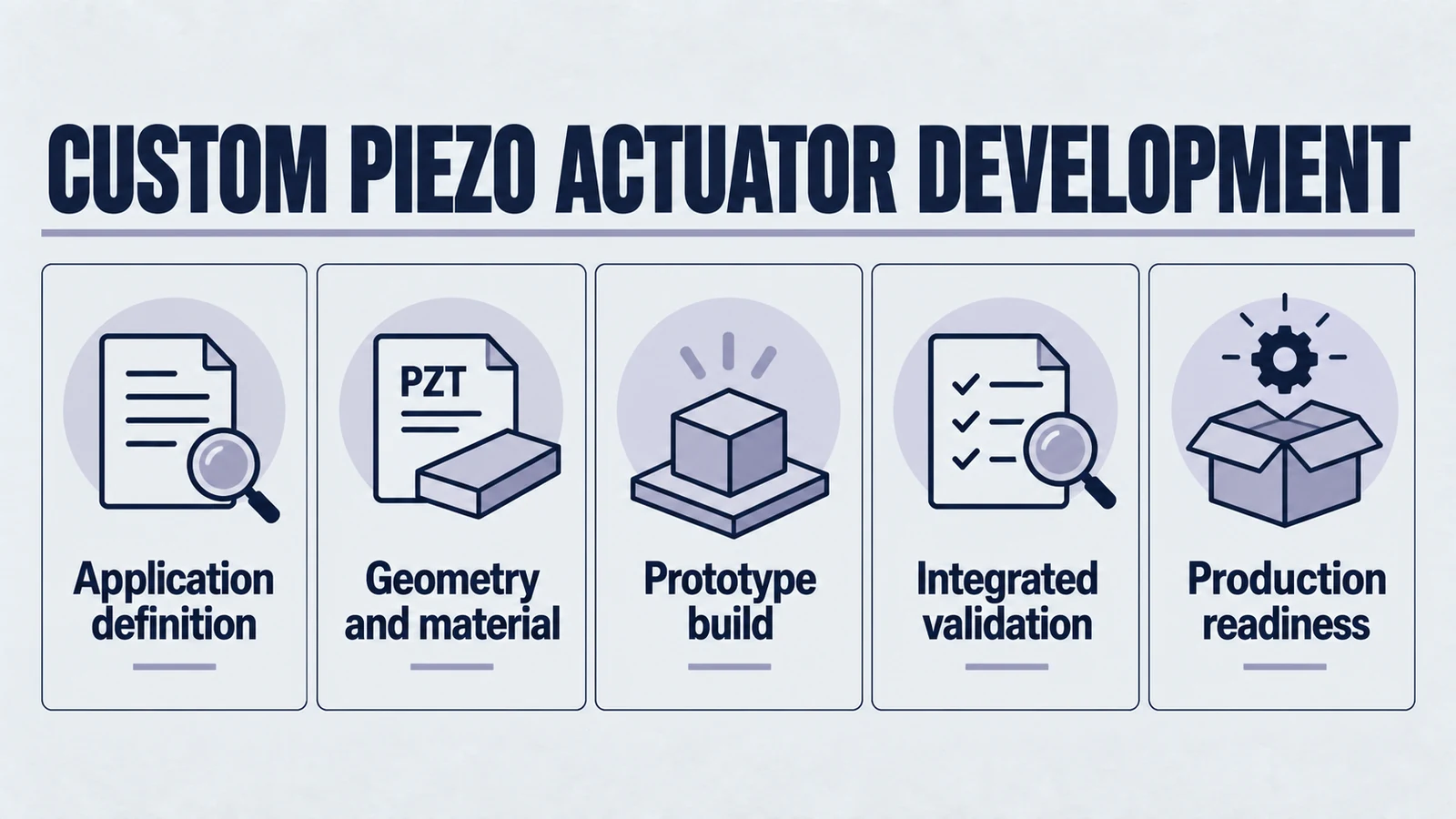
Creating a high-performance custom piezo actuator involves several key steps:
- Requirements Definition
- Application type: medical, industrial, aerospace, or research.
- Desired motion range, resolution, and force output.
- Environmental conditions such as temperature, humidity, or vacuum.
- Material Selection
- Choosing the right piezoelectric ceramic composition (e.g., PZT-5, PZT-8).
- Deciding on electrodes, bonding materials, and encapsulation methods.
- Mechanical and Electrical Design
- CAD modeling for dimensional optimization.
- Electrical circuit design to match drive electronics with actuator characteristics.
- Prototyping and Testing
- Performance validation through load, displacement, and frequency tests.
- Iterative refinement to ensure target specifications are met.
- Production and Quality Control
- Scaling up manufacturing while maintaining strict quality tolerances.
- Implementing endurance testing for long-term reliability.
Application Examples of Custom Piezo Actuators
Medical Imaging and Surgery
Custom actuators are vital in ultrasound transducers, laser surgery equipment, and robotic surgical tools where accuracy, speed, and minimal heat generation are critical.
Aerospace Systems
In spacecraft and satellites, piezo actuators handle fine optical alignment, vibration damping, and fuel control in micro-thrusters.
Semiconductor Manufacturing
Used in wafer alignment, photolithography, and nanofabrication stages, custom actuators deliver the ultra-fine positioning needed for next-gen chips.
Industrial Automation
Custom designs improve quality control systems, automated inspection, and ultrasonic welding processes.
Scientific Research
From atomic force microscopy to high-energy physics experiments, tailored actuators provide the sensitivity and precision researchers demand.
Key Considerations for Choosing a Custom Supplier
When selecting a manufacturer for custom piezo actuator solutions, consider:
- Experience in your industry — understanding specific standards and requirements.
- Material and engineering expertise — ability to recommend optimal PZT types and configurations.
- Prototyping capabilities — speed and flexibility in iteration.
- Quality assurance processes — certifications such as ISO 9001, cleanroom production, and comprehensive testing.
Conclusion
Custom piezo actuator solutions are more than just specialized components — they are precision-engineered enablers of innovation. By aligning material science, mechanical engineering, and application-specific requirements, they ensure optimal performance and reliability.
For applications where accuracy, responsiveness, and durability are paramount, a custom solution is not just an option — it is the competitive advantage.
Learn more about actuator selection criteria and micro-motion applications.
Ready to discuss your custom actuator requirements? Contact our engineering team to discuss your specific needs and solutions.
Related Technical Resources
Use these internal references to compare geometry, material selection, reliability testing, and sourcing decisions.
- Spherical Cap vs Hemispherical Piezo Ceramics
- When Not to Use Focused Piezoelectric Ceramics
- How to Choose Radius of Curvature for Focused Piezo Ceramics
- Key Design Parameters for Curved Piezo Elements
- Focused Piezo Ceramics in Medical Ultrasound: Engineering Constraints
- Mode Coupling Risk in Piezo Ceramic Geometry
- Selecting Piezo Ceramics for Continuous Duty Applications
- Common Mistakes Integrating Ultrasonic Transducers into OEM Systems
Engineering decision notes
PZT material and ceramic selection
Use this article when the choice is not just a shape, but a material tradeoff between sensitivity, loss, coupling, stability, and operating field. For "Custom Piezo Actuator Solutions: Engineering Excellence for Specialized Applications", the practical value is in turning the topic into a measurable selection or sourcing decision.
YJ Piezo coordinates PZT ceramic projects with manufacturing support, so material formulation, sintering, polarization, electrode process, and outgoing inspection can be reviewed against the final application.
Selection checks
- Separate sensing needs from high-power actuation needs before comparing d33 or coupling values.
- Check dielectric loss, Qm, Curie temperature, aging behavior, and operating field against the real duty cycle.
- Confirm whether the application needs standard PZT grades or a custom formulation and geometry.
Failure risks
- Choosing only the highest d33 can create heat, drift, or depolarization risk in power ultrasonics.
- A ceramic that performs well in free measurement can fail once bonded, clamped, or loaded.
- Material substitutions without batch testing can change capacitance, resonance, and system tuning.
RFQ details
- Is the part used for sensing, actuation, atomization, cleaning, welding, or measurement?
- What field strength, temperature, duty cycle, and mechanical load will the ceramic see?
- Which values must be controlled: d33, capacitance, resonance, impedance, Qm, or dimensional tolerance?
Relevant YJ Piezo pages
- PZT Material Hub
Material grades and application tradeoffs
- Piezoelectric Ceramics
Shapes and ceramic manufacturing options
- PZT Material Supplier Hub
Material control, grade selection, and sourcing support
Application FAQ
- Is the highest d33 always the best PZT choice?
- No. High d33 can be useful for sensitivity, but high-power ultrasonic systems often need lower loss, higher Qm, better thermal stability, and safer operation under field and stress.
- What makes PZT material selection different from catalog buying?
- The right PZT choice depends on geometry, load, drive field, duty cycle, temperature, and inspection targets. A catalog value is only useful when it is tied to the final assembly conditions.