
Applications of Piezoelectric Transducers Across Industries
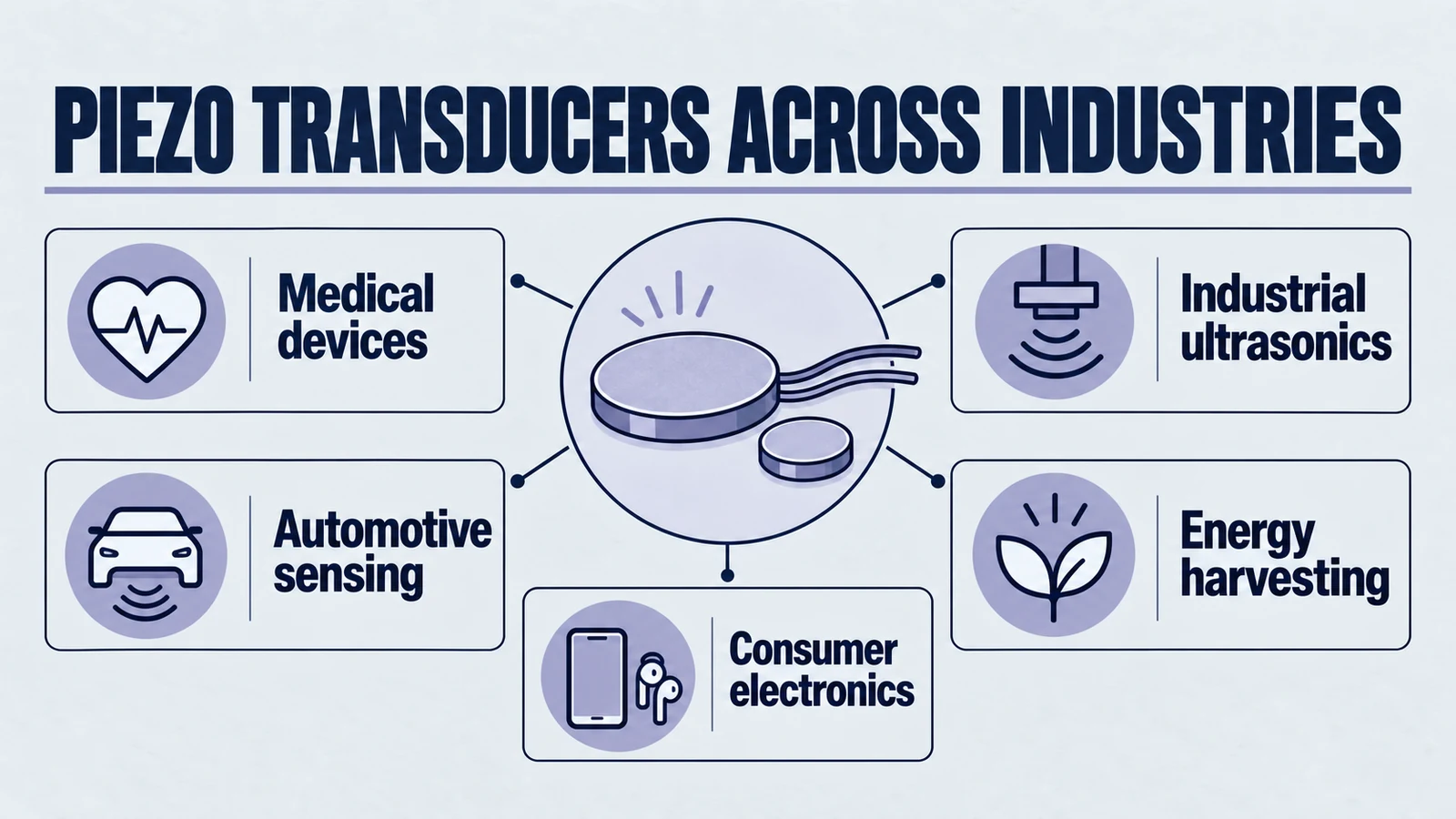
Piezoelectric transducers, commonly referred to as piezo transducers, are devices that convert mechanical energy into electrical energy and vice versa. Their unique ability to precisely sense and actuate makes them essential across a wide array of industries. In this blog, we explore the multifaceted applications of piezo transducers and how they are shaping the future of technology.
Medical and Healthcare Applications
In the medical field, piezo transducers are important components in diagnostic and specialized medical equipment. One of the most recognized applications is in ultrasound imaging systems, where piezo transducers generate and receive high-frequency sound waves, producing detailed images of internal organs and tissues. This non-invasive method is crucial for prenatal care, cardiology, and many other specialties.
Additional medical applications include:
Product path for this search intent
Match the article topic to the right YJ Piezo product page
Use this article when sensor performance depends on target distance, beam angle, housing material, liquid behavior, or false echo control. For "Applications of Piezoelectric Transducers Across Industries", the practical value is in turning the topic into a measurable selection or sourcing decision.
- Ultrasonic Sensors
Distance, level, and detection sensor portfolio
- Flow Measurement Transducers
Bubble and flow-related ultrasonic sensing paths
- Air Acoustic Transducers
Air-coupled transducers for range and presence detection
- Ultrasonic surgical tools that enable precision cutting and coagulation
- Nebulizers and inhalers for effective respiratory therapy
- Intravenous (IV) fluid monitoring using miniature piezo sensors
Their high precision and responsiveness ensure that medical procedures are safer and more effective.
Industrial Ultrasonics
In industrial environments, piezo transducers power a variety of ultrasonic technologies. These devices are crucial for:
- Ultrasonic cleaning machines, which use high-frequency sound waves to remove contaminants from delicate components such as jewelry, lenses, and electronic parts
- Welding and cutting systems, providing precise control in the joining of plastics and metals
- Non-destructive testing (NDT) to detect internal flaws in critical structures without causing damage
The reliability and durability of piezo transducers make them a preferred choice for demanding industrial applications. Our HJ-3528B cleaner transducer and HJ-6015 welder transducer are excellent examples of industrial piezoelectric solutions.
Consumer Electronics
Piezo transducers are also deeply integrated into consumer electronics, providing functionality that enhances user experience. Common applications include:
- Buzzers, alarms, and notifications in smartphones and household devices
- Microphones and speakers in compact gadgets
- Haptic feedback systems in gaming controllers and touch-sensitive interfaces
Their compact size and efficient operation enable innovative designs and seamless integration into everyday products.
Automotive Industry
The automotive sector utilizes piezo transducers to improve both safety and performance. Key applications involve:
- Parking assistance sensors that detect obstacles using ultrasonic waves
- Tire-related research: Piezoelectric strain sensing and energy harvesting are distinct from conventional TPMS pressure measurement, which commonly uses capacitive or piezoresistive MEMS. Identify a specific pressure-sensor architecture before calling it piezoelectric.
- Knock sensors that monitor engine vibrations to optimize combustion
Piezo transducers are built to withstand the harsh conditions of automotive environments, ensuring reliable operation under extreme temperatures and vibrations. For specialized automotive applications, our ultrasonic sensors provide exceptional reliability.
Aerospace and Defense
In aerospace and defense, where precision and durability are paramount, piezo transducers play critical roles in:
- Sonar systems for underwater navigation and detection
- Structural health monitoring of aircraft and spacecraft to detect stress fractures and material fatigue
- Active vibration control to improve stability and comfort
The high sensitivity and long-term stability of piezo transducers make them vital for high-reliability systems. Our CS-220KH underwater transducers are used in various marine and defense applications.
Energy Harvesting and Environmental Monitoring
Piezo transducers are emerging as key players in sustainable technologies. Their ability to harvest mechanical vibrations and convert them into usable electrical energy supports:
- Self-powered sensors for remote monitoring
- Wearable devices that generate power from body movements
- Smart infrastructure systems that monitor structural health and environmental conditions
Environmental monitoring applications include:
- Seismic activity sensors
- Pollution detection devices
- Weather stations that rely on precise sensing components
For projects requiring specialized energy harvesting solutions, our PZT materials offer exceptional piezoelectric properties.
Emerging Innovations
As technology advances, the role of piezo transducers continues to expand. Researchers are exploring new materials and designs to enhance sensitivity, bandwidth, and durability. Innovations in flexible piezo transducers are opening doors to next-generation wearables and biomedical devices, while miniaturization is enabling applications in micro-robotics and implantable medical devices.
Learn more about piezoelectric technologies in our article on the science behind ultrasonic transducers and selecting the right piezoelectric ceramics.
Conclusion
Piezo transducers are foundational components in modern technology, offering strong versatility and precision across industries. From healthcare to aerospace, their impact is far-reaching and continually evolving. Companies seeking cutting-edge solutions turn to piezo transducers for their reliability, efficiency, and adaptability.
To discover how our advanced piezo transducer products can meet your specific needs, contact us today for expert consultation and customized solutions.
Engineering decision notes
Ultrasonic sensing and detection
Use this article when sensor performance depends on target distance, beam angle, housing material, liquid behavior, or false echo control. For "Applications of Piezoelectric Transducers Across Industries", the practical value is in turning the topic into a measurable selection or sourcing decision.
YJ Piezo treats ultrasonic sensing as an acoustic interface problem: transducer frequency, beam shape, housing, drive electronics, and target environment are reviewed together.
Selection checks
- Define target range, dead zone, beam angle, and mounting geometry before choosing the sensor family.
- Check the medium, target surface, temperature swing, foam, vapor, and side-wall risk.
- Separate detection repeatability from ideal lab accuracy when the sensor will operate in a tank, tube, or moving line.
Failure risks
- A sensor can pass bench distance tests and still fail in tanks with foam, agitation, vapor, or narrow geometry.
- Changing only frequency without reviewing beam angle and mounting can increase false echoes.
- Ignoring housing material or sealing requirements can shorten lifetime in washdown or chemical environments.
RFQ details
- What is the minimum and maximum detection distance?
- Is the target liquid, solid, sheet material, air flow, or a moving object?
- What temperature, humidity, IP rating, and output signal does the system require?
Relevant YJ Piezo pages
- Ultrasonic Sensors
Distance, level, and detection sensor portfolio
- Flow Measurement Transducers
Bubble and flow-related ultrasonic sensing paths
- Air Acoustic Transducers
Air-coupled transducers for range and presence detection
Application FAQ
- What makes an ultrasonic sensor page useful for procurement?
- It should connect range, beam angle, output signal, housing, mounting, and environmental limits to a concrete use case. A model name alone is not enough for reliable supplier comparison.
- Which information speeds up an ultrasonic sensor RFQ?
- Send the target material, distance range, installation geometry, output interface, temperature range, IP rating, and whether the application involves foam, vapor, liquid, or moving objects.