
Beyond the Datasheet: How Yujie's Piezo Ceramic Disc Quality Elevates Application Performance
The 'Good Enough' Component That Compromises Billion-Dollar Innovations
Your design is flawless. The system is validated. Yet, in field testing, you are getting "unstable, unreliable readings." Or worse, the "maximum drive displacement drops" after only a few cycles. This is the engineer's nightmare: a high-stakes system failure caused by an inexpensive, "commodity" component.
The most innovative systems—from medical ultrasound systems and precision industrial automation systems to critical automotive sensors—are all fundamentally dependent on one of the smallest components in the assembly: the piezo ceramic disc. This small component, made from materials like lead zirconate titanate (PZT), is responsible for the critical conversion of mechanical energy into electrical signals, and vice versa.
Engineers are trained to select these components based on datasheets. But when it comes to PZT, the datasheet only tells half the story. The "problem" is rarely the initial specification; it is the quality and consistency of the material that is supposed to meet that specification. A significant gap exists between the theoretical promise of a piezo ceramic disc and its practical, in-field performance. This gap is the primary source of engineer frustration, and it is created by manufacturers who cut corners on material purity, sintering, and poling.
Product path for this search intent
Match the article topic to the right YJ Piezo product page
Use this article when the choice is not just a shape, but a material tradeoff between sensitivity, loss, coupling, stability, and operating field. For "Beyond the Datasheet: How Yujie's Piezo Ceramic Disc Quality Elevates Application Perfo...", the practical value is in turning the topic into a measurable selection or sourcing decision.
- PZT Material Hub
Material grades and application tradeoffs
- Piezoelectric Ceramics
Shapes and ceramic manufacturing options
- PZT Material Supplier Hub
Material control, grade selection, and sourcing support
This is not just a theoretical problem; it is a manufacturing challenge. And it is a challenge that Yujie Technology has spent decades solving. This article will explore the common, hidden failure modes of standard piezo ceramic discs and demonstrate why and how a vertically integrated manufacturing partner with decades of specialized expertise is a strong path for reliability.
The Hidden Failure Modes: Why Your Piezo Ceramic Disc is Underperforming
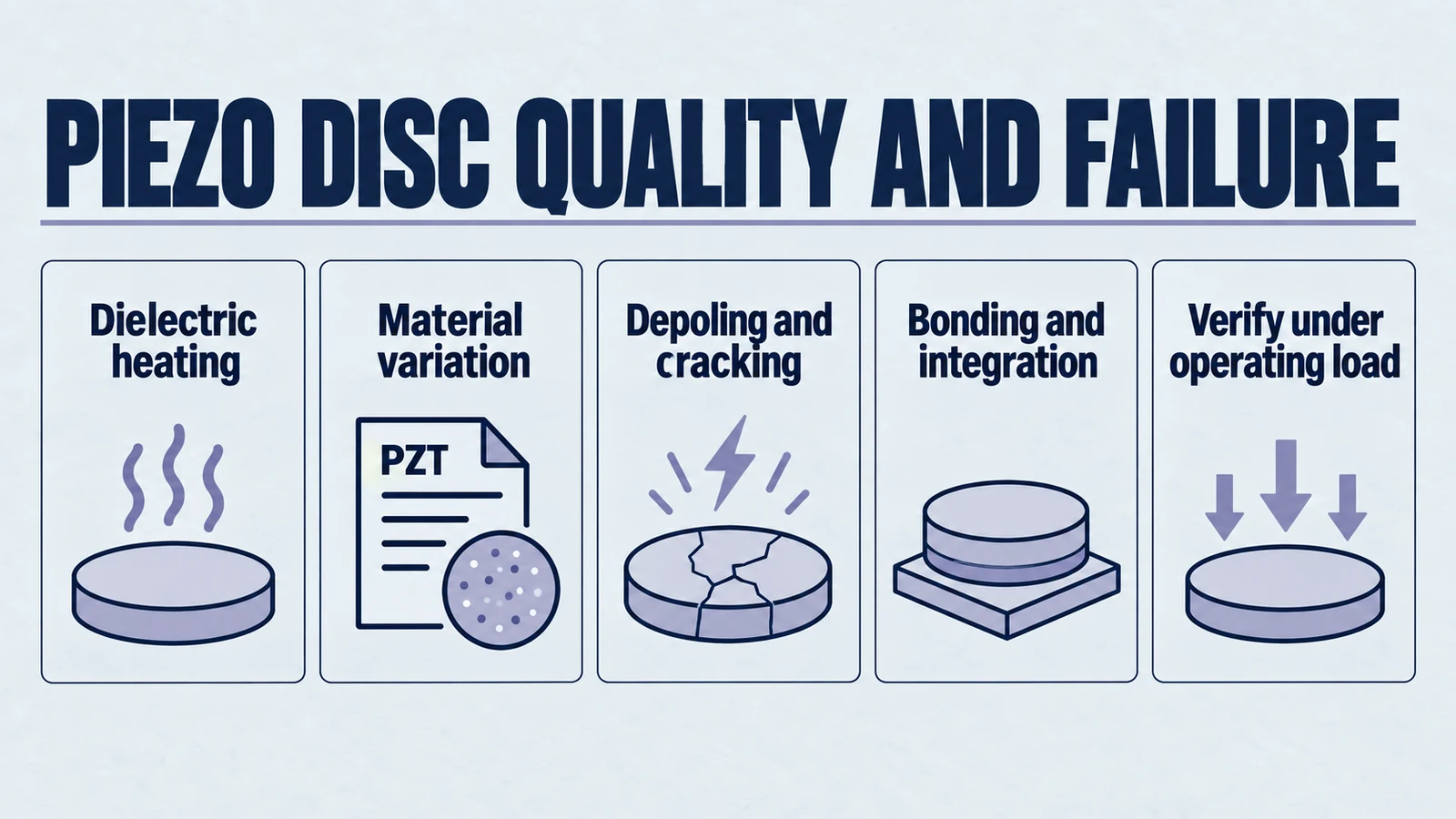
To build reliable systems, one must first understand the hidden causes of failure. In our experience, component-level issues can be traced back to three primary areas.
The Silent Killer: High Dielectric Loss (tanδ) and Thermal Runaway
Many high-power applications—such as ultrasonic cleaning, plastic welding, and high-intensity surgical instruments—drive the piezo ceramic disc at high frequency and high voltage. The most common and serious failure mode in this scenario is heat buildup.
This is caused by high dielectric loss (high tanδ), a material property that dictates how much energy is wasted as heat. In an improperly formulated component, the disc essentially generates more heat than it can dissipate. This leads directly to a cascade of failures: the component overheats, its properties drift, and it can "overheat until it cracks or the metal coating melts." This is not just a component failure; it is a critical system failure that results in equipment downtime, costly repairs, and a reputation for unreliability.
The "Ghost in the Machine": Material Inconsistency and Micro-Defects
For sensing applications—like medical diagnostics, non-destructive testing (NDT), or industrial flow sensors—the primary complaint is different. Here, engineers are plagued by "unstable, unreliable readings" or a gradual "drop in... displacement." The signal is noisy, or it drifts over time.
Noise and drift are not unique diagnoses of ceramic micro-defects. Check electronics, readout noise, cables, grounding, temperature, mounting and ceramic/assembly behavior against controlled measurements before assigning root cause.
The Integration Nightmare: Depoling, Cracking, and Bond Failure
An engineer's job is not done when they buy the disc; they must integrate it. This is where a new set of failures occurs. We see engineers constantly asking: "How do I solder to a piezoelectric ceramic without depoling it?" or "What are the best epoxies to bond" the disc?
A perfectly good piezo ceramic disc can be destroyed during assembly. A simple detached wire can render an entire sub-assembly useless. A component with the wrong geometry or substrate can cause the resonant frequency to shift, throwing off the entire system. This leads to high rejection rates in production, project delays, and frustrating finger-pointing between the engineering team and the component supplier. A supplier who only sells raw discs is leaving their customer to navigate this "integration nightmare" alone.
The Yujie Difference: Engineering Performance at the Material Level
We have diagnosed the problems. Now, we present the solution. The failures described above are not inevitable; they are a symptom of commodity-grade manufacturing. At Yujie Technology, we engineer reliability at the material level.
A Foundation of Expertise (Since 1996)
YUJIE TECHNOLOGY supports OEM projects through piezoelectric manufacturing experience and direct coordination with our Wuxi operations. Our approach is built on four pillars:
- History: Established in 1996, we are pioneers with proven history in PZT technology.
- Expertise: We are backed by engineers with practical experience in piezoelectric R&D and manufacturing built since 1996.
- Quality: Inspection requirements and available records are confirmed against the selected product and order.
- Scale: Prototype and production quantities are planned after reviewing geometry, process, tooling, and forecast demand.
Our core belief is that reliability improves when material, ceramic processing, component design, and agreed inspection are reviewed as one connected process. The finished assembly still needs validation under the customer's actual drive and operating conditions.
Solving Thermal Failure: Yujie's Ultra-Low Loss (tanδ) Materials
PZT-4 is a valid hard power material. Investigate drive, load, tuning, interfaces, cooling and grade-specific loss before attributing overheating to the family designation.
Yujie's proprietary piezoelectric materials achieve tanδ (dielectric loss) as low as 0.004. This "ultra-low loss performance" is not just a minor improvement; it is a fundamental shift in component capability. For you, this translates directly to:
- Loss Characterization: Low tanδ characterizes one dielectric-loss contribution at stated test conditions; measure useful output and total loaded-system losses separately.
- Higher Power Handling: Establish the exact grade/assembly field, stress, duty and thermal operating envelope; low dielectric loss does not prevent thermal runaway or cracking.
- Longer Lifespan: Lifetime and cost claims require defined application/endurance evidence; no primary failure mechanism has been universally eliminated.
This makes Yujie's high-performance discs the perfect choice for demanding applications like ultrasonic cleaning, welding, atomizing, and medical surgical tools.
Solving Signal Failure: Yujie's Superior Sensitivity (d₁₅) Materials
To solve the problem of "unstable readings" in sensing and actuation, the clarity of the signal is everything.
Our materials deliver superior sensitivity & response, with d₁₅ (shear strain coefficient) reaching up to 950 pC/N. This "outstanding shear strain response" provides tangible benefits:
- High Precision: A shear coefficient alone does not establish nanometer precision; stiffness, geometry, hysteresis, electronics and feedback matter.
- Clearer, Stronger Signals: Select the coefficient appropriate to the actual mode and evaluate the complete signal/noise chain. A high d15 does not universally establish higher SNR, imaging resolution or finer flow measurement.
- Consistency Evidence: Review actual process capability, inspection and batch records. Process control can reduce defects and variation but does not establish complete elimination of micro-defects or all signal drift.
This advantage is summarized in the table below, which contrasts common component failures with Yujie's specific, engineered solutions.
The Yujie Advantage: From Common Failures to Documented Performance
| Common Failure Mode | Root Cause (Standard Components) | The Yujie Technology Solution | Yujie's Specific Metric |
|---|---|---|---|
| Overheating, Cracking, Depoling (in High-Power Applications) | High Dielectric Loss (tanδ) | Ultra-Low Loss Materials | tanδ as low as 0.004 |
| Unstable Readings, Signal Drift, Low Output (in Sensing) | Low Sensitivity; Material Inconsistency | Superior Sensitivity Materials | d₁₅ reaching up to 950 pC/N |
| Batch-to-Batch Inconsistency, Performance Drops | Micro-Defects, Impure Powder | Vertically Integrated Manufacturing | "Exceptional batch-to-batch consistency" |
| Component Failure During Assembly (Soldering, Bonding) | Lack of Integration Support | Custom OEM & Transducer Solutions | "Experience built since 1996" |
Beyond the Disc: A Partnership in Customization & Scale
A truly innovative product requires more than just a good component; it requires a reliable partner. Yujie Technology is structured to be that partner, from R&D through to global-scale production.
From Component Supplier to OEM Partner
We are a professional manufacturer of piezoelectric ultrasonic transducers. We provide "Custom OEM Solutions" to reduce the "integration nightmare." Instead of shipping you a raw piezo ceramic disc and a datasheet, our engineering team can work with you to design and deliver an integrated, tested transducer or sub-assembly. We can support soldering, bonding, and housing decisions, helping reduce production risk and align the component with its final application.
Global Scale, Proven Reliability
An innovative material is useless if it cannot be supplied at scale. Yujie is built for volume and reliability.
- Capacity: Available production quantities for piezoelectric ceramic components and ultrasonic transducers are reviewed by product family, process, and forecast.
- International Support: We coordinate documentation, packing, and shipment requirements according to the product, destination, and agreed delivery terms.
Yujie brings experience since 1996, direct project coordination, and manufacturing operations in Wuxi. Customers should qualify the selected part, inspection plan, production schedule, and logistics requirements rather than rely on a site-wide slogan.
Stop Compromising. Start Engineering with Yujie.
The performance, reliability, and lifespan of your end-product are not defined by your design alone. They are defined by the quality of the core components you choose.
A generic piezo ceramic disc is a liability. It introduces risks of thermal failure, signal instability, and batch-to-batch variation that can compromise your entire system.
Yujie Technology mitigates this risk. We offer a partnership built on company history since 1996, practical engineering expertise, and a portfolio of materials with documented performance data. We deliver not just a component, but "Reliability & Consistency."
Your application is too important to leave to chance. Do not let a standard component compromise your innovation.
Contact the Yujie Technology engineering team today. Discuss your custom piezo ceramic disc requirements and discover how our materials and custom solutions can support your application's performance targets.
Engineering decision notes
PZT material and ceramic selection
Use this article when the choice is not just a shape, but a material tradeoff between sensitivity, loss, coupling, stability, and operating field. For "Beyond the Datasheet: How Yujie's Piezo Ceramic Disc Quality Elevates Application Perfo...", the practical value is in turning the topic into a measurable selection or sourcing decision.
YJ Piezo coordinates PZT ceramic projects with manufacturing support, so material formulation, sintering, polarization, electrode process, and outgoing inspection can be reviewed against the final application.
Selection checks
- Separate sensing needs from high-power actuation needs before comparing d33 or coupling values.
- Check dielectric loss, Qm, Curie temperature, aging behavior, and operating field against the real duty cycle.
- Confirm whether the application needs standard PZT grades or a custom formulation and geometry.
Failure risks
- Choosing only the highest d33 can create heat, drift, or depolarization risk in power ultrasonics.
- A ceramic that performs well in free measurement can fail once bonded, clamped, or loaded.
- Material substitutions without batch testing can change capacitance, resonance, and system tuning.
RFQ details
- Is the part used for sensing, actuation, atomization, cleaning, welding, or measurement?
- What field strength, temperature, duty cycle, and mechanical load will the ceramic see?
- Which values must be controlled: d33, capacitance, resonance, impedance, Qm, or dimensional tolerance?
Relevant YJ Piezo pages
- PZT Material Hub
Material grades and application tradeoffs
- Piezoelectric Ceramics
Shapes and ceramic manufacturing options
- PZT Material Supplier Hub
Material control, grade selection, and sourcing support
Application FAQ
- Is the highest d33 always the best PZT choice?
- No. High d33 can be useful for sensitivity, but high-power ultrasonic systems often need lower loss, higher Qm, better thermal stability, and safer operation under field and stress.
- What makes PZT material selection different from catalog buying?
- The right PZT choice depends on geometry, load, drive field, duty cycle, temperature, and inspection targets. A catalog value is only useful when it is tied to the final assembly conditions.